Many people, when starting their fitness journey, are drawn to the machines at the gym that only isolate a single muscle at a time. This is really common, and the truth is, we oftentimes don’t really know any better. We think that by going to the gym to better our health we should be using those machines for our fitness training workouts. But that’s not the most effective way to work out.
The truth is, the foundation of your fitness routine should be stability and balance exercises to…
work to eliminate overcompensations that probably have developed over time
And, there are so manyeffective bodyweight exercises you can do to build this foundation without ever even stepping foot into a gym. Hooray for time and money saved, right?
In this article, you will find basic information on stability and balance training, plus 12 core stability exercises for your next workout:
What Is Stability and Balance Training?
This kind of training is performing an exercise in what we call in the fitness industry a proprioceptively enriched environment. To put it in layman’s terms: an unstable environment.
This can be performing an exercise…
while balancing on one leg
standing on a pillow
BOSU ball
or even a rolled-up yoga mat
Stability and balance training demands a lot of core activation and attention (it’s impossible to be on your phone or have a conversation while doing this type of training – so you’ll have to save your selfies until after you’re done) you can take a selfie after). If you want to get a feel for stability and balance training, you can try balancing on one leg while brushing your teeth!
Think like a kid
As a kid, most of us were running, jumping, climbing, landing on one foot, balancing on a balance beam or on the edge of a sandbox…are you getting the mental picture here? We were doing balance and stability exercises without even realizing it. As adults, we’re not climbing all over the place anymore(unfortunately!), balancing and activating our core as we should.
As a result, many of us have a weak core and distressed lower back, and have adopted many movement compensations (favoring one sidewhile walking, standing, sitting, and even while training). Have you adopted any of these bad habits? Not sure?Don’t worry – there are ways to fix it with core stability exercises.
How Often Should You Incorporate This Type of Training?
Aim for one to two workouts per week. This goes for beginners all the way up to advanced athletes. It’s very important that pros improve stability as well.
Start the single-leg deadlift in a standing position. Keep your core engaged. Now slowly move one leg back by keeping it straight. Simultaneously, move your torso forward until it’s parallel to the floor, with your arms straight and at shoulder height, perpendicular to the floor. To come up, pull your back leg forward, and lift your torso until you are back in a standing position. Switch sides and repeat.
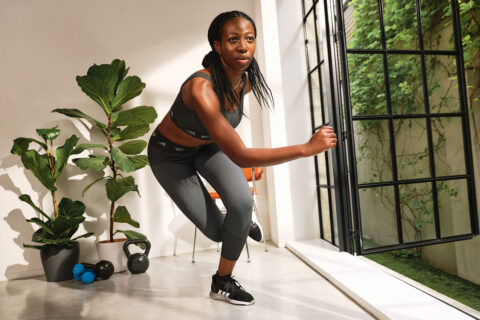
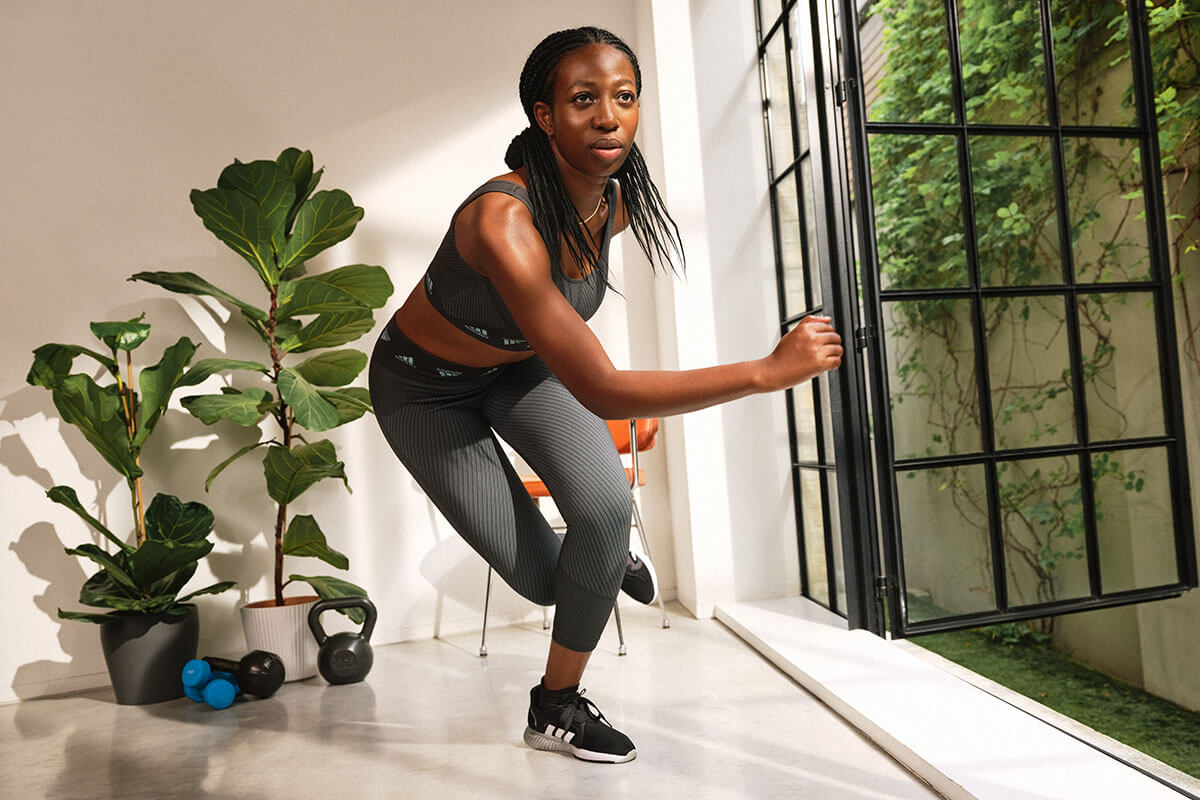
Train your balance and stability with speed skaters! Start in a standing position with your feet hip-width apart. Now shift your weight to your right leg and move your left leg off the floor. Engage your standing leg as you balance with your left leg slightly behind you. Then jump back to the left foot, in the opposite direction. While doing this, your arms are swinging from side to side like a speed skater.
3.Single Leg Squats (SL Squats)
https://www.youtube.com/watch?v=x4aPDZN3wfI<span data-mce-type=”bookmark” style=”display: inline-block; width: 0px; overflow: hidden; line-height: 0;” class=”mce_SELRES_start”> </span> Stand straight on one foot if you want to do single leg squats. Bend the opposite leg by bringing it up in front of you, slightly bent at the knee. Now slowly bend your standing leg into a squat position keeping your knee stable and in line with your ankle. After you’ve completed all reps on one leg, switch sides and repeat.
4.Lunge & Twist
https://www.youtube.com/watch?v=wfd_kWR5Jug<span data-mce-type=”bookmark” style=”display: inline-block; width: 0px; overflow: hidden; line-height: 0;” class=”mce_SELRES_start”> </span> Start in a standing position with your feet together. Keep your core engaged and your chest up. Step your right foot forward into a lunge position. The front knee is perpendicular to the floor, keeping it in line with the ankle and behind the toes. Hold the lunge position, keeping your hips, knees, and legs still while twisting your upper body towards the right from your midsection. Step back into the starting position and repeat the lunge and twist on the opposite side.
Single leg jump squats made easy! Standing on one foot, slightly bend the opposite leg, keeping your foot slightly elevated, lifting at the knee. Keep your core engaged while pushing your bent leg back behind you, slightly squatting with your standing leg. Swing your leg forward, lifting your knee up as you jump off of your standing leg, your arms slightly bent and swinging with the movement. Switch sides and repeat.
Start in a standing position with your core engaged. Step one leg back into a lunge position. Swing the back leg forward in front of you, pushing through the front heel to power a kicking motion. Be sure to engage the glute muscle of your standing leg. Switch sides and repeat the lunge to front kick.
For the side plank oblique crunch, lie on the floor on one side, stacking your elbow directly under your shoulder. Lift your bottom hip up as high as you can while tucking your hips under to stay as straight as possible. Lower your hip back towards the floor, making sure not to touch the ground, and lift back up. Repeat the set on the other side.
Limb raise push-ups can improve your balance and stability. For this exercise, perform a push-up while keeping your hips square to the ground at all times. At the top of the push-up, lift your opposite leg and arm while engaging your core. Your hips and shoulders should move at the same rate, controlling the movement as you raise your arm to shoulder height and lift your leg above hip-level. Be sure to keep your core engaged throughout the entire exercise.
Low plank crunches are another great stability exercise. When performing these crunches, it is important to find a steady pace, not moving too fast. Starting in a plank position, make sure only to elevate your hips slightly, placing your elbows directly under your shoulders. Your core, glutes, and legs are engaged when bringing your opposite knee and elbow together, slightly touching underneath your midsection.
Tip:
You can modify this exercise with a bodyweight exercise that’s called quadruped knee to elbow:
https://www.youtube.com/watch?v=9alFfe4JTJs<span data-mce-type=”bookmark” style=”display: inline-block; width: 0px; overflow: hidden; line-height: 0;” class=”mce_SELRES_start”> </span> The one-legged 4 count burpee is an advanced bodyweight exercise, so make sure to execute it correctly. Your hands should be directly under your shoulders in a plank position, and your core is engaged. Keeping one leg lifted off the ground for the entire movement, bring your grounded foot forward under your midsection and stand up straight, jumping upwards. Bring your body back into a plank position by lowering back to the floor on one leg, kicking one leg behind you, landing in a single-leg plank.
Ever heard about the single leg crab bridge? This intermediate exercise can help you improve your balance and stability. Start by sitting on the floor with your hands slightly behind you, feet on the floor with your knees pointed up at the ceiling. Using one leg, lift your hips off of the floor to shoulder level, lifting your other leg in the air. With your wrists stacked under your shoulders and fingers pointing forward, push through the heel of your supporting leg. Squeeze your glutes at the top of the bridge position, making sure that the ankle is directly under your knee on the supporting leg. Repeat on the other side.
For the squat knee to elbow twist, start in a standing position with your feet slightly wider than shoulder width apart. Lower your hips into a squat, keeping your elbows up, interlocking your hands in front of you at shoulder height. When you come back up to the standing position, twist at your midsection while lifting up one knee to touch your opposite elbow. Follow your hands with your head, looking forward and keeping your back straight. Alternate sides after each squat.
So, did you try out these stability andbalance exercises? If so, you probably noticed that one side is much stronger and more coordinated than the other. That’s normal – just keep practicing to build more strength and balance!
All of these bodyweight exercises can be found in theadidas Training app! Download it today and start improving your balance, stability, and core control!
***
if(!isRussia){
//check Cookie Opt out and User consent
if(!run_getCookie(“tp-opt-out”)){
!function(f,b,e,v,n,t,s){if(f.fbq)return;n=f.fbq=function(){n.callMethod?
n.callMethod.apply(n,arguments):n.queue.push(arguments)};if(!f._fbq)f._fbq=n;
n.push=n;n.loaded=!0;n.version=’2.0′;n.queue=[];t=b.createElement(e);t.async=!0;
t.src=v;s=b.getElementsByTagName(e)[0];s.parentNode.insertBefore(t,s)}(window,
document,’script’,’https://connect.facebook.net/en_US/fbevents.js’);
fbq(‘init’, ‘1594940627485550’); // Insert your pixel ID here.
fbq(‘track’, ‘ViewContent’);
}
}
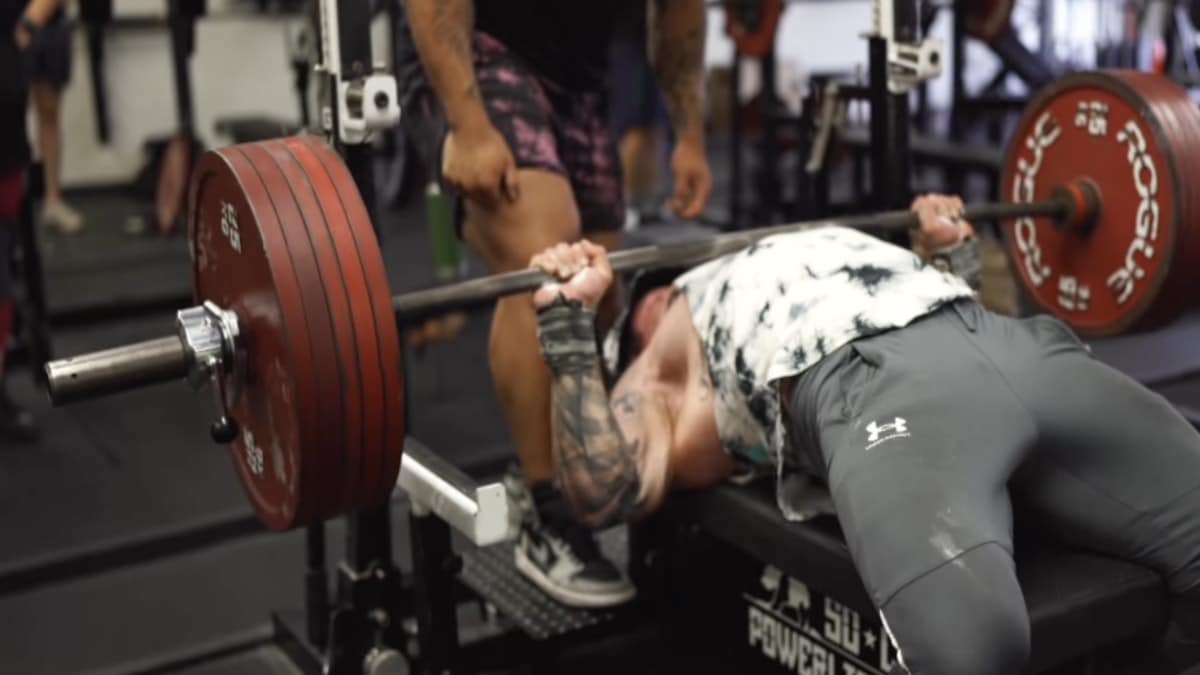
On September 12, 2022, American powerlifter John Haack shared Instagram footage where he captured a raw 275-kilogram (606.3-pound) bench press during a training session. Per the caption of his post, the successful bench press rep is a new personal record (PR) for Haack.
According to Open Powerlifting, Haack’s new bench press mark unofficially exceeds his all-time raw competition best by 7.5 kilograms (16.6 pounds). That figure of 267.4 kilograms (589.7 pounds) from the 2022 World Raw Powerlifting Federation (WRPF) American Pro is the current all-time World Record in the 90-kilogram division.
Haack’s display of strength conveniently comes at a time when he’ll soon have the opportunity to extend his World Record. The powerlifter is preparing for the upcoming United States Powerlifting Association (USPA) Pro Raw. That competition will take place on Sept. 24, 2022, at the Brave Enough CrossFit Gym in North Kansas City, MO.
In addition to his staggering bench press record, Haack also possesses the all-time World Record deadlift and total in the 90-kilogram category. Here’s an overview of the athlete’s top all-time raw competition bests:
John Haack (90KG) | All-Time Raw Competition Bests
Throughout his career, Haack has established a high standard of excellence. Of 25 powerlifting contests to his name, some of which he competed in both the Open and Junior divisions, Haack has won on 21 occasions and qualified for the podium 24 times. When he competes at the USPA Pro, Haack will try to extend his winning streak to four competitions dating back to September 2021.
Here’s a rundown of notable results from Haack’s career:
John Haack | Notable Career Results
2013 USA Powerlifting (USAPL) Badger Open (Open/Raw) — First Place | First career victory
2015-2016 USAPL Raw Nationals (Open/Junior/Raw) — First place
2017 WRPF Boss of Bosses 4 (Open/Raw) — First place
2018-2019 USPA The Tribute (Open/Raw) — First place
2020 USPA Metroflex Powermania (Open/Raw) — First place
2020 WRPF The Showdown (Open/Raw) — First place
2021 WRPF Hybrid Showdown III (Open/Raw) — First place
2021 WRPF Kern US Open (Open/Raw) — Second place
2021 WRPF The Bucked Up Showdown (Open/Raw) — First place
2022 USPA Hybrid Showdown 4 (Open/Raw) — First place
Haack doesn’t have much to prove as a powerlifting superstar with a few World Records under his belt. One of the best things he could do is to continue building a legendary resume by attaining even loftier records.
Kiera Aston is a rare breed of a strength sports athlete. The fitness extraordinaire is simultaneously a competitive powerlifter and an International Federation of Bodybuilding and Fitness (IFBB) Pro League bodybuilder. Aston’s latest training accomplishment exemplifies precisely what the versatile competitor brings to the table.
On September 11, 2022, Aston shared an Instagram post where she completed a raw deadlift of 275 kilograms (606.3 pounds). The pull is a new personal record (PR) for the athlete who wore a lifting belt and lifting straps to help lock out the successful rep. In addition, per the caption of Aston’s post, it is 3.57 times her body weight of 77 kilograms (169.7 pounds) at the time of the lift.
Aston’s deadlift achievement appears to have come after a time when she felt she had to take a step back and recalibrate. After a recent hand injury (date undisclosed), Aston learned she needed surgery that would put a wrench in any potential upcoming competitive plans amid recovery.
She channeled this bit of adversity and turned it into a milestone.
“So apparently, this is what happens when you take a step back and do what you enjoy,” Aston wrote in the caption of her post. “I’ve had zero pressure to exceed in anything since finding out I needed hand surgery. But I don’t do this sport because I have to; I do it because I love it. I haven’t had much structure going into sessions. I just knew I wanted to deadlift, grow my lower body, and get fitter by incorporating some CrossFit sessions. So that’s exactly what I’ve been doing.”
Aston’s new long-term goal is eventually attaining a deadlift of at least 300 kilograms (661.4 pounds) with a body weight of 74.8 kilograms (165 pounds). The mark would also be four times Aston’s body weight. According to Open Powerlifting, no women’s powerlifter has ever deadlifted that much weight in the Raw or Raw With Wraps category. The competitor seems to be well aware of what her potential achievement would mean.
” … The biggest pull in female powerlifting history has my name on it,” Aston wrote. “It’s not ‘if’ … it’s when!”
To date, Aston has competed in just one sanctioned powerlifting meet — the 2019 Global Powerlifting Committee (GPC) Great Britain Bristol Qualifier, where she came in first place. Meanwhile, per NPC News Online, Aston has one bodybuilding result to her name. It came in the form of an 11th-place result in the Figure division at the 2020 Romania Muscle Fest Pro.
Here’s an overview of the athlete’s top stats at her sole powerlifting contest:
Kiera Aston (76KG) | 2019 GPC Great Britain Bristol Qualifier Top Stats
While she isn’t formally competing, Aston has set her sights on a lofty deadlift achievement. At the high level the athlete seems to train, it might only be a matter of time before she makes history.
On September 11, 2022, Canadian strongman Mitchell Hooper shared an Instagram clip where he squatted 315 kilograms (695 pounds), raw, for five reps. According to the caption of the athlete’s post, the feat is a new five-rep personal record (PR) for Hooper, who wore a lifting belt and knee sleeves during the set.
Hooper’s demonstration of leg power is a part of ongoing preparation for his debut at the upcoming 2022 Rogue Invitational. That contest is scheduled to take place on Oct. 28-30, 2022, at the Dell Diamond Stadium in Austin, TX.
In anticipation of the competition, Hooper recently started filming a series on his YouTube channel entitled “Road to the Rogue Invitational.” The first video — shared on Sept. 7, 2022 — features the athlete practicing various traditional events featured in strongman contests. (Note: At the time of this writing, the organizers of the 2022 Rogue Invitational have not announced the events for the contest.)
Hooper ends up lifting Atlas Stones, working through a respective Farmer’s and Sandbag Carry, and even throws in a one-kilometer run on a treadmill for good measure. All in all, Hooper calls his diligent training in the first episode “a good place to start.”
Here’s the current roster of athletes slated to compete in Austin at the end of October:
2022 Rogue Invitational Roster
Notably, while defending champion Martin Licis returns to defend his title, two-time reigning World’s Strongest Man (WSM) Tom Stoltman, 2021 Europe’s Strongest Man (ESM) Luke Stoltman, and four-time WSM champ Brian Shaw each declined their invitations after competing in last year’s edition. Tom Stoltman finished second behind Licis in 2021.
Three such noteworthy absences mean the 2022 Rogue Invitational field could be wide open for an up-and-comer like Hooper. After a 2022 WSM Qualifying Round blitz and three consecutive podium finishes in this year’s Giants Live Strongman Classic, Giants Live World Open, and Shaw Classic — Hooper may very well be in line to capture his first major international strongman victory.
The 2022 Rogue Invitational is set to occur on Oct. 28-30 in Austin, TX.
Some people completely shy away from direct ab exercises, either out of boredom or because they believe the big compound exercises like squats and overhead presses work their abs enough. But plenty of other lifters make ab training a priority, be it to improve performance or their physique.
When it comes to a good-looking set of abs, lower ab development is especially coveted. Exercises that involve leg movement, such as various leg lifts or the simple reverse crunch, are commonly used to target this area. Is it a valid strategy? Maybe, as you’ll soon learn.
Credit: MDV Edwards / Shutterstock
In any case, the reverse crunch is a simple and effective exercise to build and strengthen your abs, improve spine stabilization, and become a fitter, more muscular human being. For many, it’s the first “leg raising” exercise learned, so it’s time you know how to do it properly and reap its benefits.
How to Do the Reverse Crunch
Even though it’s a beginner-friendly exercise, you have to ensure proper form if you want maximal efficiency while avoiding pain. The reverse crunch is slightly more complex than a traditional crunch because it involves leg movement, torso flexion, as well as spinal control. Here’s how to do it right.
Step 1 — Lie Down in Position
Credit: Philip Date / Shutterstock
No need for equipment — except for a gym mat if you need some comfort. Simply lie down on the floor. Keep your upper body completely flat, squeeze your glutes, and tilt your pelvis backwards to push your lower back into the ground. This will prevent your lower back from arching at any point during the lift.
Place your arms on the floor by your side, palms down, and use them for balance. Bend your legs and set your feet flat on the ground.
Form tip: If you have trouble keeping your lower back flat, lift your shoulder blades slightly off the ground. This will help you create more tension in your abs and provide more control over your spine and hips. Having an arched back reduces your ability to contract your abs.
Step 2 — Bring Your Knees Toward Your Head
Credit: Philip Date / Shutterstock
Take a breath into your belly and brace your abs. Tuck your legs towards your face until your hips and lower back lift from the ground. As your legs move, maintain a roughly 90-degree angle at your knees.
No other movement should occur in your body: keep your legs at the same angle, brace as much as you can, and drive your hands into the ground to stabilize yourself. Go slow so that you don’t risk losing posture. In the top position, your hips should be off the ground for maximum ab recruitment.
Form tip: If you want to make the exercise harder, straighten your legs as you begin the movement or after you’ve reached the top position. This creates a longer lever arm and increases the challenge on your core muscles.
Step 3 — Lower Your Legs With Control
Credit: MDV Edwards / Shutterstock
Lower your legs slowly until your feet touch the ground and you’ve returned to the starting position. Moving at a relatively slower speed helps you feel your abs working and eliminates momentum.
To keep tension in your core, don’t allow your lower back to arch as you bring your legs down. Keep your pelvis tilted backwards and your lower back pushed into the ground throughout the entire repetition.
Form tip: If your back begins to arch as your legs move, bend your legs more. Shortening the range of motion can also help. Until you have enough total-core control, only lower your legs until you feel your back starting to arch, and then reverse the movement.
Reverse Crunch Mistakes to Avoid
Ab exercises that incorporate leg movement are prone to bad form because many people lose focus. Even though the reverse crunch is probably the simplest leg raise-type of exercise, mistakes are still frequent.
Arching Your Lower Back
This is a frequent mistake with beginners, because many new lifters lack spinal control and core strength. Arching your lower back will decrease ab involvement and shift more of the workload towards the hip flexors.
Credit: Elnur / Shutterstock
Is it a bad thing? Well, if you want better-looking abs, it won’t be as efficient. More importantly, this can cause stress on the lower back region. If you want to avoid pain and potential injuries, aim to minimize lower back arching and hip flexor involvement. (1)
Avoid it: Make sure your core is always braced and under tension. When you’re not flexing your trunk, make sure your lower back is firmly in contact with the ground. Do the exercise slowly and with control. Slightly elevate your shoulder blades from the floor to further engage your core, if needed.
Using Momentum
It can be tempting to allow momentum to take over because it makes the exercise easier, but it will greatly diminish muscle activation. If you start swinging your legs around, you’ll end up using mostly your hip flexors in lieu of your abs, and you risk arching your lower back during the eccentric (descent).
Credit: antoniodiaz / Shutterstock
If you’re aiming for muscle growth, this is inefficient as it will also reduce time under tension and you’ll have to perform many more repetitions, and spend more time and overall effort, just to have the same stimulus as a strict movement. (2) This can also put more strain on your hip joints and lower back, possibly resulting in pain or injuries.
Avoid it: There is a certain execution speed at which your body will lose muscle tension and optimal bracing. You should never reach that speed but, unfortunately, you only know it once you reach it. If you’re not sure, simply use a slow tempo — two to three seconds on the concentric (lifting) and two to three seconds for the eccentric (lowering).
Benefits of the Reverse Crunch
The simplest exercises are often the most efficient, and the reverse crunch is no exception. Learn how this lift can improve your fitness and provide benefits that other ab exercises lack.
Abdominal Muscle Growth
They say that “abs are made in the kitchen,” but they are actually made in the gym. A balanced diet and a healthy body fat will only reveal them, but if you want to display an impressive set of abs, you have to train them like any other muscle.
A properly executed reverse crunch will offer significant time under tension and provide a different stimulus than what your abs are used to if you’ve only been doing standard crunches or sit-ups. Incorporating the movement for variety will also help build more muscle. (3)
Core Strength
This exercise will improve ab strength and boost your core and bracing abilities. The reverse crunch teaches you how to transfer energy from your your core to other limbs (your legs, specifically). You also learn how to brace properly for maximum efficiency and strength.
Credit: antoniodiaz / Shutterstock
The general principle is similar to squatting, where your core helps you transfer the energy from your legs through your core and into the barbell. The reverse crunch can help you get better at compound exercises which require core stability, making you a stronger and more complete lifter.
Spinal Control
The hard part of the exercise is actually to exert proper ab tension while bracing enough to prevent your lower back from arching. Maintaining this strong position will teach you how to stabilize your spine and efficiently brace your core. Improved spinal stability and control can reduce your risk of lower back pain and injuries, and improve your total-body strength. (4)(5)
Muscles Worked by the Reverse Crunch
The reverse crunch is a trunk flexion exercise, which means that it will mainly target the rectus abdominis, but most of the core will actually contribute. Ab exercises which incorporate leg movement are said to emphasize lower-ab development. Let’s see if that’s true and what muscles it trains.
Rectus Abdominis
This is the famous “six pack.” It’s the most visible ab muscle and goes from the pelvis to the sternum. The main function of the rectus abdominis is to flex the trunk by bringing the ribs and the pelvis closer together.
Credit: Chad Zuber / Shutterstock
Now, here’s the tricky part: It is often claimed that you can “target” the upper or lower sections of the muscle. Typically, ab exercises which bring the ribs closer to the pelvis are considered “upper ab exercises.” Movements which bring the pelvis closer to the ribs, like the reverse crunch, are thought to be “lower ab exercises.”
However, the rectus abdominis is still one single muscle (with multiple tendons running across it) so it is always fully contracted. Is it really possible to emphasize the lower separate from the upper? Let’s look at the research.
One study didn’t find a significant difference between exercises in terms of upper or lower ab recruitment. (6) But the exercises were performed with the lifters’ hands under their lower back, which might have caused less lower abs involvement by increasing the back arch.
Comparatively, some studies have found a difference in activation. (7) If the hips are flexed towards the ribs while the upper body remains stationary, the lower abs have been shown to do more work.
So it seems that recruiting the lower abs is highly related to exercise selection. You cannot “isolate” the upper or the lower abs — the rectus abdominis will always work as a whole — but some movements can stress either section slightly more. Properly performed exercises that contract the abdominals by rotating your pelvis closer to your (stationary) ribcage may emphasize the lower abs more than the upper. (8)
Obliques
The internal and external obliques are the “side abs” going from your hip bones up towards your ribs. They are significantly recruited when twisting from the waist or bending sideways.
The obliques are also slightly involved in flexing the trunk, and they work heavily to prevent the body from bending or twisting. They are recruited, particularly in the top portion of the reverse crunch, to stabilize your lower body as it raises slightly into the air.
Hip Flexors
The hip flexors are a series of muscles responsible for bringing the leg up towards the body. These relatively small but powerful muscles are involved in the reverse crunch because of the leg movement. They are particularly activated as your legs are lowered to the ground and raised from it.
If you fail to lift your pelvis towards your torso in the top part of each repetition, the hip flexors (and not the abdominals) will be the primary muscles worked during the reverse crunch.
Who Should Do the Reverse Crunch
Ab exercises can be useful to virtually anyone, so you should likely include some direct ab exercises in your training. Here’s when the reverse crunch, specifically, is most beneficial.
People Who Want to Look Good
If you want to sport an aesthetic physique, then you need to do some direct ab work. One psychology study even revealed that well-developed abdominals are the most desirable body part for men, and in the top three for women. (9)
If you want your upper body to be pleasing to the eye, then including reverse crunches as part of your training will go a long way, especially when paired with a specific fat loss diet and an overall well-muscled physique.
Strength Athletes
Many strength lifts such as squats, deadlifts, or presses require a strong core to support moving the heaviest weights possible. The reverse crunch can help by developing the muscles responsible for increasing intra-abdominal pressure, improving spinal control and stability, and increasing bracing abilities. A stronger core is shown to help make you stronger as a whole. (10)
Sports Athletes
In the same fashion, core strength will help you develop more speed and power if you’re a general sports athlete. (11) We rarely think of it, but running, jumping, and throwing all require core strength and total-body coordination. Moreover, the reverse crunch strengthens the hip flexors, which will are heavily involved in running, jumping, and agility.
People with Back Issues
If you’ve experienced back pain, or want to prevent it, strengthening your abs is just as important as strengthening your lower back. The body needs balance in order to perform optimally. Unfortunately, modern life often leads to muscular imbalances, poor posture, and a lack of general physical condition. The reverse crunch can help you combat these potential lower back issues by improving core strength. (12)
How to Program the Reverse Crunch
As a basic bodyweight exercise, the reverse crunch is quite straightforward to program. You can also add some resistance to spice things up a bit. Adopt these repetition schemes if you want maximal benefit, instead of doing countless low-effort reps.
Unweighted, Moderate to High Reps
This is a common range for ab exercises. Three to four sets of 10 to 20 repetitions with 30 to 60 seconds of rest will do the trick, provided you use perfect form. If you can bang out an ultra-high number of reps, it’s an indicator that you’re using improper form or you’re a beast that needs to add some resistance.
Weighted, Moderate Reps
You can either secure a small weight plate on your ankles and shins or hold a dumbbell or medicine ball between your feet. A load that’s difficult for three to four sets of six to 12 repetitions will provide an increased challenge to build strength or stimulate new growth. It’s essential to keep your form the same or it will defeat the purpose of the exercise.
Reverse Crunch Variations
Perhaps you’ve had enough of lying on the ground or you want to stimulate your abs and hip flexors in a new fashion. Here are some kickass variations that will share the same benefits as the reverse crunch and focus on your lower abs.
Hanging Leg Raise
Hang from a pull-up bar, hanging knee raise station, or Roman chair. To really recruit your abs and not focus on your hip flexors, be sure to curl your pelvis up toward your chest at the top of the movement.
This is an efficient movement because it can easily be scaled down, by bending the legs, or scaled up by aiming to touch your feet to the bar over your head. Moreover, the hanging version will also “decompress” your spine, providing comfortable relief after an intense pulling workout or leg day.
V-Up
This is a relatively advanced bodyweight exercise, but if you’ve mastered the reverse crunch, this can be a progression instead of adding resistance. The v-up is one of the most powerful movements to improve core bracing because it requires a high level of abdominal tension combined with leg and arm movement.
The exercise will teach you to transfer energy efficiently between your limbs, as well as provide a serious workout for the abs, hip flexors, and even the serratus — a key muscle for shoulder stability and performance.
Lying Leg Raise
This is the reverse crunch’s almost-identical twin brother. It appears similar, but subtle differences offer unique benefits. The lying leg raise only involves leg movement without raising the pelvis or hips, so it will focus more on recruiting the hip flexors.
However, as long as you prevent any lower back arching, your abs will get a serious workout as well. The overall technique is less complicated, making it is relatively simpler than the reverse crunch.
Reverse Crunch Alternatives
What if you want to train your abs while emphasizing the upper part? Don’t worry, you’re covered with these alternatives.
Crunch
The direct opposite of the reverse crunch. The good ol’ crunch is often butchered because the range of motion is so short, but when done correctly, it can be a fantastic ab exercise.
Because it only involves upper trunk flexion, this exercise will torch your upper abs. The basic crunch is possibly one of the most simple and effective ways to train the abs.
Cable Crunch
This exercise is favored for its simplicity and for how convenient it is to add potentially heavy resistance. The cable crunch is the bread and butter for any lifter who wants to build a powerful core.
The cable crunch is one of the best ways to develop stronger, bigger abs through progressive overload. A properly done cable crunch will result in superior upper abs recruitment with little to no hip flexor involvement.
Sit-up
The sit-up is the quintessential ab exercise found in many professional and athletic physical fitness tests. It’s highly efficient for building, and assessing, total core strength and development.
Like all crunch variations, you can easily add external resistance with a weight plate or weighted vest, but many lifters find the properly performed sit-up to be relatively challenging due to the long range of motion.
FAQs
Should I do the reverse crunch at the start or at the end of a workout?
Both can be valid tactics. Training abs at the end of a workout is the traditional way to go, and for good reason. By finishing with ab work, your core won’t be as fatigued during the session when you want to be fresh for heavier exercises, like squats.
But if you’re someone that loathes training abs, doing them first will ensure that you don’t skip them because you’re “too tired” after an exhausting workout. You probably won’t be as strong during the first few sessions, but you’ll likely adapt and benefit in the long-run.
Will the reverse crunch shred my abs?
Unfortunately, no. This exercise will strengthen your abs and stimulate muscle growth, so they can look better, but you have to be able to see them first. The only thing that will reveal your abs is to achieve a low enough body fat percentage.
For that, you need to check your energy expenditure and be in a caloric deficit long enough so that you melt your belly and reveal your six-pack. You can consume less calories, and/or burn more calories through physical activities or cardio.
Reverse Engineer Your Way to a Great Set of Abs
Incorporating the reverse crunch in your training regimen doesn’t just deliver a better looking six-pack. It’s an overlooked way to build a stronger and healthier core. It’s time to stop avoiding ab work, get on the floor, and get those knees up.
References
Avrahami, D., & Potvin, J. R. (2014). The clinical and biomechanical effects of fascial-muscular lengthening therapy on tight hip flexor patients with and without low back pain. The Journal of the Canadian Chiropractic Association, 58(4), 444–455.
Burd NA, Andrews RJ, West DW, Little JP, Cochran AJ, Hector AJ, Cashaback JG, Gibala MJ, Potvin JR, Baker SK, Phillips SM. Muscle time under tension during resistance exercise stimulates differential muscle protein sub-fractional synthetic responses in men. J Physiol. 2012 Jan 15;590(2):351-62. doi: 10.1113/jphysiol.2011.221200. Epub 2011 Nov 21. PMID: 22106173; PMCID: PMC3285070.
Baz-Valle E, Schoenfeld BJ, Torres-Unda J, Santos-Concejero J, Balsalobre-Fernández C. The effects of exercise variation in muscle thickness, maximal strength and motivation in resistance trained men. PLoS One. 2019 Dec 27;14(12):e0226989. doi: 10.1371/journal.pone.0226989. PMID: 31881066; PMCID: PMC6934277.
Huxel Bliven KC, Anderson BE. Core stability training for injury prevention. Sports Health. 2013 Nov;5(6):514-22. doi: 10.1177/1941738113481200. PMID: 24427426; PMCID: PMC3806175.
Stokes IA, Gardner-Morse MG, Henry SM. Abdominal muscle activation increases lumbar spinal stability: analysis of contributions of different muscle groups. Clin Biomech (Bristol, Avon). 2011 Oct;26(8):797-803. doi: 10.1016/j.clinbiomech.2011.04.006. Epub 2011 May 14. PMID: 21571410; PMCID: PMC3157598.
Lehman GJ, McGill SM. Quantification of the differences in electromyographic activity magnitude between the upper and lower portions of the rectus abdominis muscle during selected trunk exercises. Phys Ther. 2001 May;81(5):1096-101. PMID: 11319934.
Sarti MA, Monfort M, Fuster MA, Villaplana LA. Muscle activity in upper and lower rectus abdominus during abdominal exercises. Arch Phys Med Rehabil. 1996 Dec;77(12):1293-7. doi: 10.1016/s0003-9993(96)90195-1. PMID: 8976314.
Duncan M. (2009). Muscle activity of the upper and lower rectus abdominis during exercises performed on and off a Swiss ball. Journal of bodywork and movement therapies, 13(4), 364–367. https://doi.org/10.1016/j.jbmt.2008.11.008
Durkee PK, Polo P, Muñoz-Reyes JA, et al. Men’s Bodily Attractiveness: Muscles as Fitness Indicators. Evolutionary Psychology. April 2019. doi:10.1177/1474704919852918
Kocahan T, Akınoğlu B. Determination of the relationship between core endurance and isokinetic muscle strength of elite athletes. J Exerc Rehabil. 2018 Jun 30;14(3):413-418. doi: 10.12965/jer.1836148.074. PMID: 30018927; PMCID: PMC6028208.
Shinkle J, Nesser TW, Demchak TJ, McMannus DM. Effect of core strength on the measure of power in the extremities. J Strength Cond Res. 2012 Feb;26(2):373-80. doi: 10.1519/JSC.0b013e31822600e5. PMID: 22228111.
Kumar T, Kumar S, Nezamuddin M, Sharma VP. Efficacy of core muscle strengthening exercise in chronic low back pain patients. J Back Musculoskelet Rehabil. 2015;28(4):699-707. doi: 10.3233/BMR-140572. PMID: 25467999.

Whether you’re hitting a workout wall or looking to mix it up, it’s time to MOVE with Love Sweat Fitness.
Yupp, I just relaunched my app with a new design and TONS of new features, all created to motivate you daily and help you feel your absolute best!
Ready to MOVE?
Here are a few of my personal faves that have been true game-changers for my own daily workouts.
500+ days of workouts –Barre, HIIT, yoga, stretching, strength… our fitness library has everything for every goal! Looking for a quick 10 minute booty blast? A 45 minute total body burner? Just tell me a little more about your fitness level and I’ll provide you with a great weekly program!
Chromecast functionality – After receiving so much feedback, I’m proud to say that you can finally tune into each and every LSF workout on your own TV to crush those big goals on a bigger screen!
Track your progress photos – Stay motivated and measure your transformation journey visually in the app with the ability to update new photos and even share them out on social with #TeamLSF.
LSF OG?
If you already have a subscription, you don’t need to make any changes and you’ll see it has everything you loved about the original, just better!
Look for the MOVE icon on your dashboard if you have auto app updates or head to your App Store to manually updated LSF the App to MOVE.
New to Love Sweat Fitness?
There are sooooo many other app enhancements to help you reach your fitness goals, so what are you waiting for?! Come sweat with me and start your 7 DAY FREE TRIAL to see for yourself! Download the MOVE app here and get ready to fall into a new season of fitness.
Well-designed gym machines enhance the effectiveness of your strength and hypertrophy training. They can minimize instability, allowing you to target and overload specific muscles. They can apply variable resistance and resistance to patterns of motion that free weights simply cannot. Good machines can also enhance safety when working with heavy loads or training to failure.
Credit: Prostock-studio / Shutterstock
The problem is that not all machines in the gym are good, useful, or worthwhile. To preface, this review isn’t the biased opinion of a fragile physio or some two-bit trainer who labels random machines as “injurious” or “non-functional.”
This is an objective, biomechanics-based, physiologically-informed discussion from a strength coach and physical therapist who uses certain machines just as often as free weights. With that said, not all machines are created equal. Here are five machines to avoid and five machine problems to avoid.
The Five Worst Exercise Machines
The Five Worst Machine Problems
The Five Worst Exercise Machines
Some machines should be avoided because they “take” more stress and effort than they “give” results. If you’re focused on training efficiently and effectively, double-check your training program to see if any of this avoidable equipment is in your plan.
Squat Machines That Bottom-Out Before You Do
Many lifters may struggle with achieving full depth in a free weight squat. This may occur for a number of reasons — poor coordination, limited ankle flexibility, or a lack of confidence in their ability to stand up after hitting depth.
Hack squats, leg presses, and other lower-body machines that enhance a lifter’s ability to achieve full range of motion in the “squat” movement pattern are worth their weight in gold (or, more specifically, iron).
For lifters with stiff ankles, placing your feet higher or further forward on the platform decreases the amount of ankle dorsiflexion (raising your toes towards your shin) required to hit depth. The upper-body support and guidance afforded by the machine assists lifters deficient in trunk control.
Built-in safety features may empower even the most apprehensive lifters to achieve significant depth. But these built-in safety “stops” can backfire if they end the squat movement too early.
Why Avoid Them
Maybe you’ve experienced this scenario: You hop on a shiny new hack squat or leg press. Everything feels great until midway through the rep…clunk… you’ve hit the machine’s safety stop before reaching the coveted “ass-to-grass” position of full hip and knee flexion.
The machine may have been working smoothly otherwise, but its design may be shorting more than your depth. It’s likely robbing you of potential gains.
Full range of motion squatting has been associated with superior strength and power outcomes compared to partial depth squatting. (1) Although other research showed no difference in strength improvement between those squatting to full depth and those training with partials, it did report significantly greater thigh hypertrophyin the full depth group. (2)
Altogether, it seems that most lifters would benefit from squatting deep. Squat machines should facilitate, not limit, full range of motion training. If the squat machine in your gym hits bottom before you do, it’s probably not worth your time.
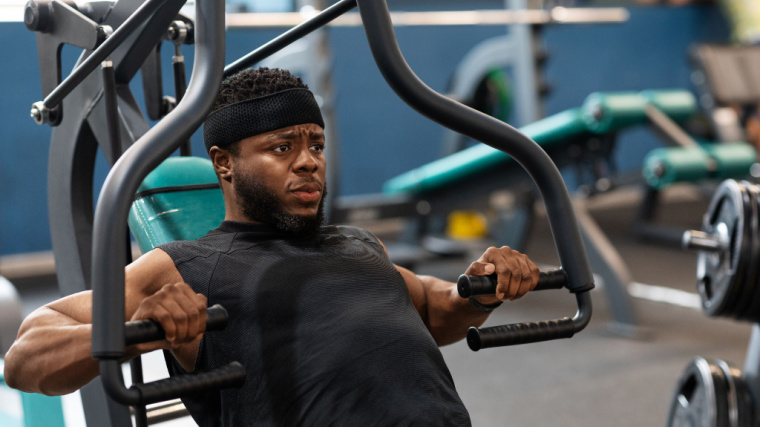
The “High Five” Pec-Deck
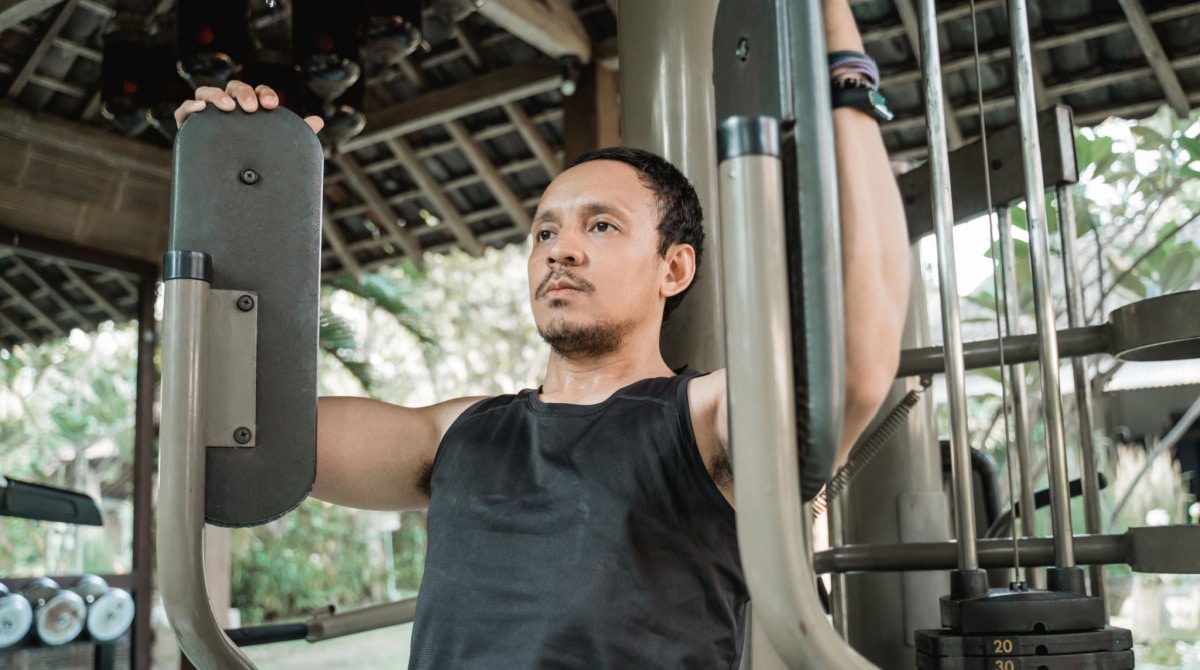
Quite a while ago, many pec-deck or chest flye machines seemed to share a common ill-conceived design — the “high five” arm position. The machine requires users to sit and reach their arms slightly behind their body at shoulder-height, and then externally rotate their shoulders to place their forearms in contact with vertical pads.
To perform the exercise, the user pulls the pads toward each other in front of their chest. These machines train the pectoralis major, anterior deltoid, subscapularis, and few helper muscles. (3) They can still be found in commercial and home gyms.
Why Avoid Them
To be clear, there is nothing inherently “wrong” with this machine. It undeniably hits the pecs. (3) In fact, the total contribution of pectoralis major is likely underestimated because the muscle is put under substantial passive tension during full shoulder external rotation.
The issue with the “high five” pec-deck is not it’s lack of effectiveness, but that it’s unlikely to be universally tolerated by lifters who have existing shoulder issues. For example, when a team of physicians examined 20 weightlifters with painful shoulders, every single weightlifter reported reproduction of shoulder pain in the “high five” position. (4)
Interestingly, half of these weightlifters improved and ultimately avoided surgery with rehab and avoidance of the “high five” position. Heavy strength training in the “high five” shoulder position is thought to be associated with anterior instability. (5)(6) It undoubtedly stresses the front of the shoulder joint, including the rotator cuff.
Altogether, if you have known shoulder problems, including but not limited to stiffness, rotator cuff pathology, biceps tendon issues, or a labrum injury (e.g. SLAP tear), steer clear of the “high five” pec-deck. But don’t despair. There are more forgiving options.
Improved pec-deck designs have multiple handle options. These machines allow the user to select a comfortable position for direct chest training. As a bonus, the improved machines often allow the lifter to spin around and train rear deltoids at the same station, enabling an efficient superset.
Crunch Machines
Abdominal machines will get you off the gym floor, but that’s pretty much the only good thing about most of them. Plate-loaded and stack-loaded crunch machines are generally designed to be used either seated or lying down.
While their designs tend to reduce a multi-joint spinal movement pattern to a single pivot point, this isn’t their main problem. Their range of motion is suboptimal for building a stronger, better looking set of abs.
Why Avoid Them
When you use a crunch machine, whether it’s a seated or supine (lying down) model, you only train through a small portion of your available trunk flexion range of motion. By the time you meet the resistance of the machine, many of your spinal joints are already flexed and the abdominals are only trained in their shortened length.
For the purpose of building muscle, mounting evidence suggests the superiority of training at long muscle lengths rather than short. (7)(8) So if you’re a healthy lifter who wants to build a more pronounced six-pack, a better option is to train through a full range of spinal flexion.
Start your crunch with an extended (arched) back. To accomplish this, you can perform crunches on top of a Swiss ball or lock into a glute-ham developer (GHD) machine for controlled, full range of motion sit-ups.
Standing Calf Raise Machines
Standing calf raise machines eliminate the need to hold heavy weights when performing calf raises. They also provide a stable environment to help the lifter focus on building big, strong gastrocnemius muscles — the superficial calf muscle trained during any straight-knee calf raise exercise. (9)
These machines typically load the calves through pads that rest atop the upper traps. Therefore, the standing calf raise is an axially-loaded exercise, which means the weight is supported through the trunk and spine like squats and deadlifts.
Why Avoid Them
Calf training is accessory work, which is typically programmed toward the end of the workout. By that time, most lifters have already performed at least one heavy axially-loaded lower body exercise. If they’ve trained with high effort and intensity, their core is likely exhausted. But unless their dress code always calls for pants or knee-high socks, calf training probably shouldn’t be skipped.
By avoiding standing machines in favor of machines that apply more direct loading to the target muscles, you can reduce the likelihood that trunk fatigue interferes with building the getaway sticks you’ve always wanted.
While standing calf raise machines have been around for decades, Golden Era bodybuilders had alternatives. They used donkey calf machines, which required the lifter to bend forward to load the calves from atop the pelvis instead of the spine.
There’s photographic evidence of Arnold performing this exercise without the machine, instead recruiting a training partner or the occasional beautiful woman (or two) to sit atop his hips while he performed calf raises.
Can’t find an old-school donkey calf machine? Asking others to climb onto your hips too risqué for your globo gym? There are plenty of alternatives to standing calf raise machines.
Purpose-built 45- or 60-degree calf raise machines load the calves through the hips. They look like mini hack squats. Rotary calf machines allow training to be performed seated with legs straight out in front of the body. If none of these options are available, a basic leg press usually works fine for calf raises while sparing you the axial-loading.
Combo Machines That Botch Both Movements
When limited floor space or budget is a concern, gym owners may be tempted by multi-function machines. Machines like functional trainers and cable columns serve as the gym’s “jack-of-all-trades, master of none.” These machines are mainstays, and there are usually no problems with them. But some multifunction machines are pretty lackluster.
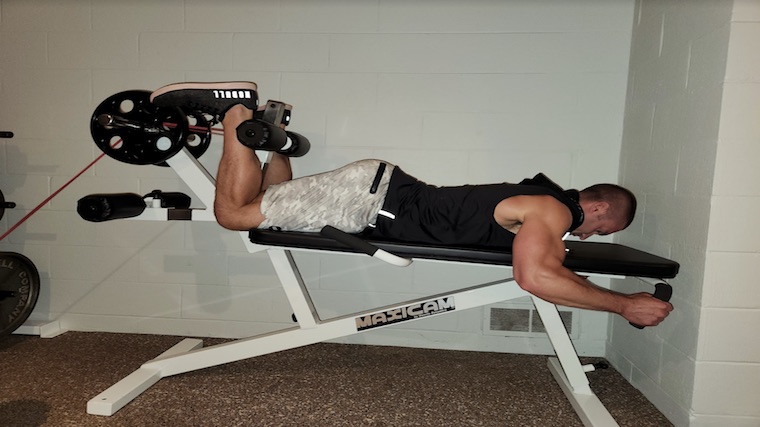
The plate-loaded leg extension/leg curl combo is a multi-function machine that is universally rubbish, regardless of make or manufacturer. These machines combine a seated leg extension with a prone hamstring curl. In theory, these machines are a wonderful, space-efficient station to train two important muscle groups. In reality, you’ll realize after your first set why they are on this list.
Why Avoid Them
The plate-loaded leg extension/leg curl combo only has two jobs — train the quads and train the hamstrings — and it does neither particularly well. For quad training, the resistance peaks near the top position when knees are extended.
However, knee extension torque is highest near the middle of the range of motion, not in full extension. (10) Therefore, the resistance offered by the machine does not match the strength profile of the joint being trained. Many other machines may also fall short of providing ideal resistance through a full range of motion, which is discussed in more detail in the next section.
The prone hamstring curl half of this machine, in particular, is worthless at end-range knee flexion (the contracted position). Past a certain angle of knee flexion, the resistance cuts out because the plates are pulled above the machine’s axis of rotation as you complete the curl.
If you need to use one of these machines because, say, you already have one and aren’t shelling out for two separate machines, you might be able to work around this problem by creatively rigging resistance bands.
Credit: Dr. Merrick Lincoln, DPT, CSCS
Ultimately, there are better machines available for your quad and hamstring training — one dedicated to quads and a separate one for hamstrings.
The Five Worst Machine Problems
Some machines aren’t inherently “bad,” they just suffer from problems that can potentially be addressed with sufficient maintenance, proper setup, or an adjustment to overall program design. Here’s what to watch out for.
Machines Full of Friction
Have you ever felt a mid-rep grinding or jerking sensation when lifting on a machine? Or, maybe you’ve felt that you have to push or pull through lots of “slop” or play in the cables and pulleys of a machine before the weight stack begins to move? If so, you’ve got a friction issue.
Common sources of friction in gym machines can be bent, rusted, or poorly lubricated guide rods; worn or cracked cable sheathing; or worn bearings. Some machines, particularly those with multiple pulleys and long belts or cables have lots of friction when factory-new. By using high-friction machines, you could be sacrificing more than a smooth lifting experience.
Why Avoid Them
The same friction that makes the repetition feel “grindy” during the positive (concentric or lifting) portion of the repetition also robs you of resistance during the negative (eccentric or lowering) portion.
What’s the harm of losing a little resistance during the eccentric phase? It could be limiting the overall effectiveness of the exercise. Our muscles are physiologically stronger during eccentric contraction than concentric contraction. In any given movement, you can lower more weight than you can lift. Therefore, the concentric phase of a typical exercise will always be the limiting factor.
When using high-friction machines, your muscles get short-changed twice-over. First, you’ll need to use less weight than you would otherwise to allow you to overcome the weight and the friction during the concentric part of the lift.
The kicker is that your muscles don’t even get to experience full resistance during the eccentric. The effective resistance during the eccentric is the weight you’ve selected minus the resistance lost to friction.
Avoid the machine “wear” sources of friction by using well-maintained machines. To avoid machines with lots of friction intrinsic in their design, look for plate-loaded machines with high quality bearings.
Machines with Insufficient Support
Well-designed machinesshould help you to lock-in good form and allow you to effectively load the trained movement pattern. Good machines are incredibly effective. For example, research showed that 10 weeks of training on an isolated lumbar extension machine was superior to Romanian deadlift training for improving lumbar extension strength. (11)
However, unlike the highly desirable MedX lumbar extension machine, many other lumbar extension machines lack a seat belt to secure hips during the exercise. These machines can be safely presumed to be only marginally effective.
Speaking of seat belts, if you’ve ever tried a seated dip machine without a belt or pads that lock you in the seat, you’ve experienced this phenomenon: attempt to push down more than a certain percentage of your bodyweight and you rise out of the seat. A lack of support represents a design flaw that somehow made it to market.
Receiving honorable mention in this category are cable hip extension machines and rotary hip extension machines (e.g. 4-way hip). These machines are used standing on one leg while the opposite leg is extended against resistance from a cable or pad.
Although these machines typically offer handles to assist with balance, most users struggle to stabilize their trunk and pelvis. Strong contraction of the working-side glute typically causes anterior tilt of the pelvis along with rotation. These machines ultimately limit the amount of resistance that can be used to train hip extension, and your gluteus maximus is left with minimal gains.
Why Avoid Them
Machines lacking enough support can be less effective because they limit the potential use of higher resistance loads. They can also be downright frustrating. Think about the triceps extension machine with handles above a pad that resembles a preacher curl bench. It’s basically a reverse arm curl machine.
I’ve witnessed lifters try with all their might to lean into this style of seated triceps extension machine only to push themselves away from the machine with heavy loads on the weight stack. A simple fix, such as an adjustable seat back, could greatly enhance the ability to use heavy loads and enhance the user-experience (and results).
If you’re a strong lifter who is struggling to maintain body position while using a gym machine, it’s not you, it’s the machine. Spare yourself the frustration and find a better option.
Machines That Don’t Fit Your Body
Encountering machines that don’t match your body is common, even for a decidedly average-sized lifter. If your anthropometry, or body proportion, is further from the population mean, expect to run into this issue even more often.
Watch out for machines whose axis of movement doesn’t alignwithyour primary working joint. Single-joint machines like arm curl machines, triceps extensions, prone hamstring curls, and leg extension machines seem to be the common culprits.
Also, be aware of machines that are too tall or too short for your stature. For example, if a machine is intended to be used with feet on the floor, your feet should not be dangling. Or maybe you’re long-limbed and a particular gym machine does not allow you to press or row through your full range of motion.
Why Avoid Them
It should be obvious that a gym machine with poor ergonomics will deliver a less-than-stellar user experience. Beyond that, questions arise regarding the effectiveness of exercises performed on misfit machines.
Are muscles and joints being trained through their intended ranges of motion? Are fit issues precluding the use of effective resistance loads? Are misalignments between the machine’s geometry and your body creating abnormal joint stresses?
If a machine doesn’t feel right, it is unlikely to help you accomplish your training objectives. When you encounter a machine that doesn’t fit, despite the use of all available adjustments, it’s time to move on.
Machines with a Poor Resistance Curve
A machine’s resistance curve describes the pattern of variable resistance the user experiences throughout the range of motion of the exercise. Machines can be designed to apply variable resistance to the lifter via the use of levers and irregularly shaped cams.
The classic example of variable resistance is the Nautilus shell-shaped cam. The cam was intended to apply more resistance during the part of the exercise where the lifter is stronger and less resistance where the lifter is weaker.
While no machine matches each individual lifter’s strength curve, or capacity to demonstrate strength throughout the range of motion, the resistance curve should correspond with the generalized strength curve of the movement pattern. (12)(13)
In theory, machines engineered to accommodate the general human strength curves should be superior to free weights, which exert a constant resistance relying on gravity. It should also be noted there is certainly no consensus regarding the superiority of variable resistance training or free weight training for increasing strength. (12)(14)(15)
Why Avoid Them
For the moment, let’s limit our scope to single-joint training for simplicity’s sake. When variable resistance, cam-based arm curl machines were compared to circular, cam-based arm curl machines, the variable resistance version was superior for strength gains and slightly better hypertrophy gains have been reported. (16)(17)
These results make sense, as circular cams generally do not match the generalized strength curve of the movement being trained. In general, you should choose the oblong-shaped cam machine over the circle-shaped cam machine for single-joint training. But what about other machine designs for other body parts? You’re going to have to feel them out.
You might encounter a machine that applies variable resistance in conflict with the movement pattern’s strength curve. For example, a lever-based pressing machine with a low pivot point may apply heavier resistance at the bottom position.
This design would conflict with the pressing movement pattern’s ascending strength curve (where you’re typically stronger at the top). (13) This type of machine is likely to limit the overall weight used for the exercise and may ultimately reduce its effectiveness for building muscle and strength.
You don’t have to be a biomechanist to qualitatively determine if a machine’s resistance curve is good or poor for yourself. A good resistance curve will just… feel right. With heavy loads, you will feel that you can exert maximum effort into the machine throughout the full range of motion without losing connection with the resistance, creating excessive momentum, or grinding into a pronounced sticking point. High-quality machines are “buttery” through the full range of motion.
If a machine feels extremely difficult during a one portion of the range of motion and allows for rapid acceleration elsewhere, it may have a poor resistance curve. If this is the case, you’re better off finding a different machine or switching to free weights for a comparable exercise.
Machines Redundant to Effective Free Weight Options
Some free weight exercises are simply damn good and deserve to be in your program. The trap bar isn’t beaten by a shrug machine. If you want to do seated shrugs, sit on a bench and use heavy dumbbells.
For rack pulls, it’s perfectly fine to get in the squat rack. The Smith machine might’ve became the go-to for this exercise in recent years, but a good old barbell lifted from the safety catches works just fine, arguably with superior carryover to your conventional deadlift due the specificity principle.
The point is, there’s no need to re-invent the wheel. And gym equipment manufacturers and gym owners need to receive that message.
Why Avoid Them
The decision to avoid a machine in favor of an equally-effective free weight variation is an “exercise” in restraint. Just because a machine is available doesn’t mean it needs to be used.
If you and others at your gym exercise this restraint, the gym’s management will likely take notice. A machine that doesn’t get used in a public gym doesn’t stick around. With any luck, the valuable gym real estate occupied by the redundant machine might soon be filled with a new machine.
Hopefully it will be something unique and effective, such as a good plate-loaded pullover, standing lateral raise, or pendulum squat. Or maybe management will swap out the redundant machine with another squat rack or whatever popular piece you’re constantly waiting for at your gym.
References
Pallarés, J. G., Cava, A. M., Courel-Ibáñez, et al. (2020). Full squat produces greater neuromuscular and functional adaptations and lower pain than partial squats after prolonged resistance training. European Journal of Sport Science, 20(1), 115-124.
Bloomquist, K., Langberg, H., Karlsen, S., Madsgaard, S., Boesen, M., & Raastad, T. (2013). Effect of range of motion in heavy load squatting on muscle and tendon adaptations. European Journal of Applied Physiology, 113(8), 2133-2142.
Kuechle, D. K., Newman, S. R., Itoi, E., et al. (1997). Shoulder muscle moment arms during horizontal flexion and elevation. Journal of Shoulder and Elbow Surgery, 6(5), 429-439.
Gross, M. L., Brenner, S. L., Esformes, I., & Sonzogni, J. J. (1993). Anterior shoulder instability in weight lifters. The American Journal of Sports Medicine, 21(4), 599-603.
Escalante, G. (2017). Exercise modification strategies to prevent and train around shoulder pain. Strength & Conditioning Journal, 39(3), 74-86.
Kolber, M. J., Beekhuizen, K. S., Cheng, M. S. S., & Hellman, M. A. (2010). Shoulder injuries attributed to resistance training: a brief review. The Journal of Strength & Conditioning Research, 24(6), 1696-1704.
Maeo, S., Huang, M., Wu, Y., et al. (2021). Greater hamstrings muscle hypertrophy but similar damage protection after training at long versus short muscle lengths. Medicine and Science in Sports and Exercise, 53(4), 825.
Sato, S., Yoshida, R., Kiyono, R., et al. (2021). Elbow joint angles in elbow flexor unilateral resistance exercise training determine its effects on muscle strength and thickness of trained and non-trained arms. Frontiers in Physiology, 12.
Landin, D., Thompson, M., & Reid, M. (2015). Knee and ankle joint angles influence the plantarflexion torque of the gastrocnemius. Journal of Clinical Medicine Research, 7(8), 602-606.
Guenzkofer, F., Engstler, F., Bubb, H., & Bengler, K. (2011, July). Joint torque modeling of knee extension and flexion. In International Conference on Digital Human Modeling (pp. 79-88). Springer, Berlin, Heidelberg.
Fisher, J., Bruce-Low, S., & Smith, D. (2013). A randomized trial to consider the effect of Romanian deadlift exercise on the development of lumbar extension strength. Physical Therapy in Sport, 14(3), 139-145.
Carpinelli, R. (2017). A critical analysis of the national strength and conditioning association’s opinion that free weights are superior to machines for increasing muscular strength and power. Medicina Sportiva Practica, 18(2), 21-39.
Wallace, B. J., Bergstrom, H. C., & Butterfield, T. A. (2018). Muscular bases and mechanisms of variable resistance training efficacy. International Journal of Sports Science & Coaching, 13(6), 1177-1188.
Dos Santos, W. D. N., Gentil, P., de Araújo Ribeiro, A. L., et al. (2018). Effects of Variable Resistance Training on Maximal Strength: A Meta-analysis. The Journal of Strength & Conditioning Research, 32(11), e52-e55. doi: 10.1519/JSC.0000000000002836.
Andersen, V., Prieske, O., Stien, N., et al. (2022). Comparing the effects of variable and traditional resistance training on maximal strength and muscle power in healthy adults: a systematic review and meta-analysis. Journal of Science and Medicine in Sport.
Urbanik, C., Staniszewski, M., Mastalerz, A., et al. (2013). Evaluation of the effectiveness of training on a machine with a variable-cam. Acta of Bioengineering and Biomechanics, 15(4).
Staniszewski, M., Mastalerz, A., & Urbanik, C. (2020). Effect of a strength or hypertrophy training protocol, each performed using two different modes of resistance, on biomechanical, biochemical and anthropometric parameters. Biology of Sport, 37(1), 85-91.
The 2022 Yamamoto Pro took place on September 10, 2022, in Padua, Italy. With the 2022 Olympia inching ever closer, this year’s International Federation of Bodybuilding and Fitness (IFBB) Pro League contest in Italy held a lot of weight as another step in the qualification process. As the respective competitors showed off their immense mass, it was another opportunity for some to make a name for themselves.
The 2022 edition of the Yamamoto Pro featured four divisions, with Vladyslav Suhoruchkoas one of the headline victors. The respective winners of each category earned an automatic place in the Olympia on December 16-18, 2022. Meanwhile, with the Yamamoto Pro being an IFBB Tier 4 contest, the second to fifth place finishers earned points ranging from four to one in their overall bid for the prestigious bodybuilding competition.
The final point standings for athletes who haven’t won an IFBB Pro League contest this season will be finalized on November 20, 2022. Here’s a rundown of the results from the Men’s Open division at the 2022 Yamamoto Pro:
2022 Yamamoto Pro Results | Men’s Open
Vladyslav Suhoruchko
Mohamed El Eman
Andrea Muzi
Jamie Christian-Johal
Roman Fritz
Pasquale D’Angelo
Harry Harris
Anton Bippus
Mustafa Yildiz
Fabio Romagnolo
With his win, Suhoruchko continues a quality spate of performances in recent years. The Ukrainian athlete finished in fifth place at the 2022 Big Man Evolution Pro. Plus, according to NPC News Online, he took home a second-place result at the 2020 Romania Muscle Fest Pro. As a result of his victory, Suhoruchko will now compete in his first career Olympia contest. He follows in a recent line of athletes who will make their Olympia debut this late fall.
Here’s an overview of the other Men’s divisions featured at the 2022 Yamamoto Pro.
According to the IFBB Pro League calendar, the next contest on the docket for some of these competitors is the 2022 Arnold Classic UK Pro, set to occur on September 24-25, 2022, in Birmingham, England.
The Arnold Classic UK Pro is Tier 2 under the IFBB’s umbrella, meaning the second through fifth place finishers can earn qualifying points ranging from eight to five. It’ll assuredly be another significant rung on the ladder to the 2022 Olympia.
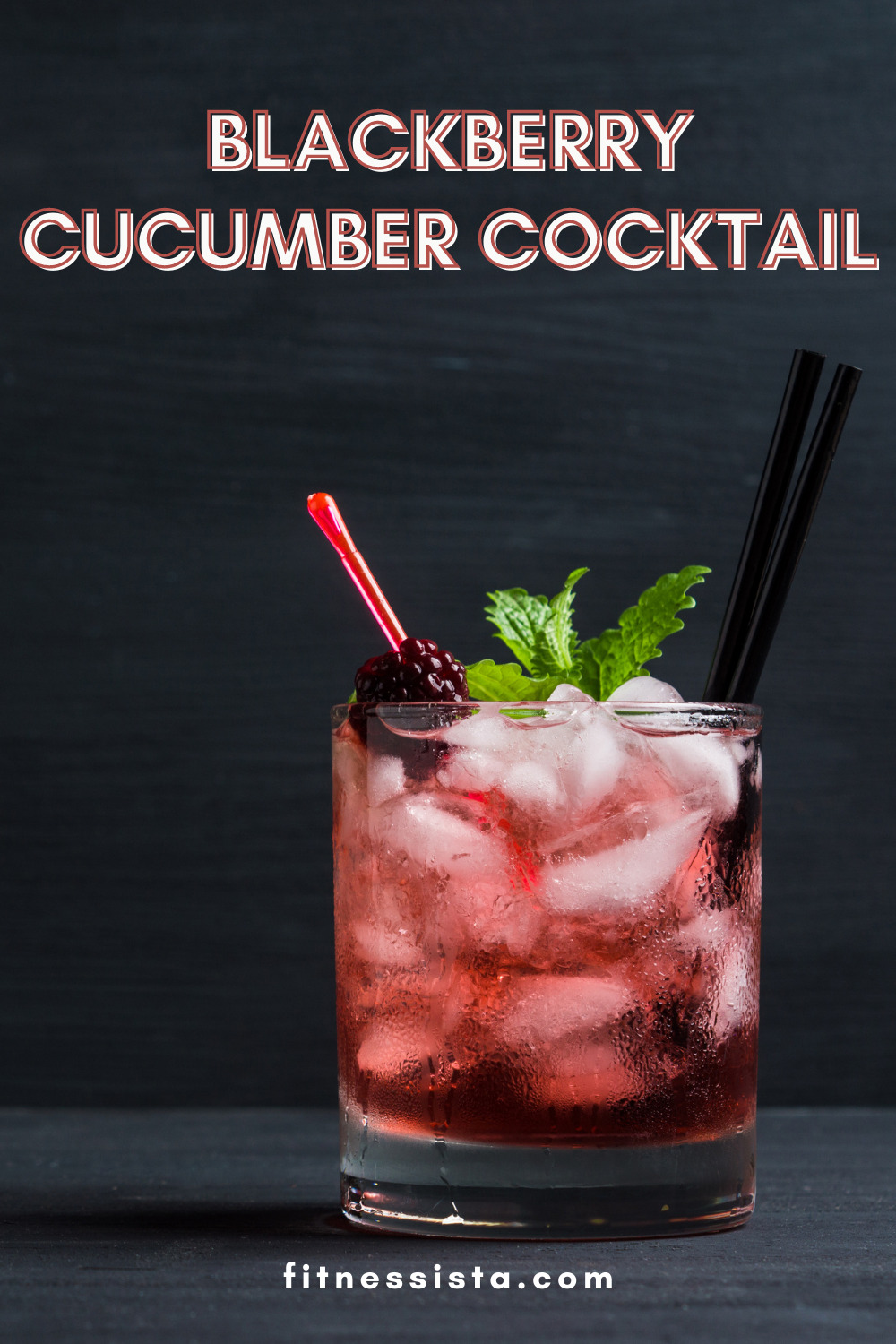
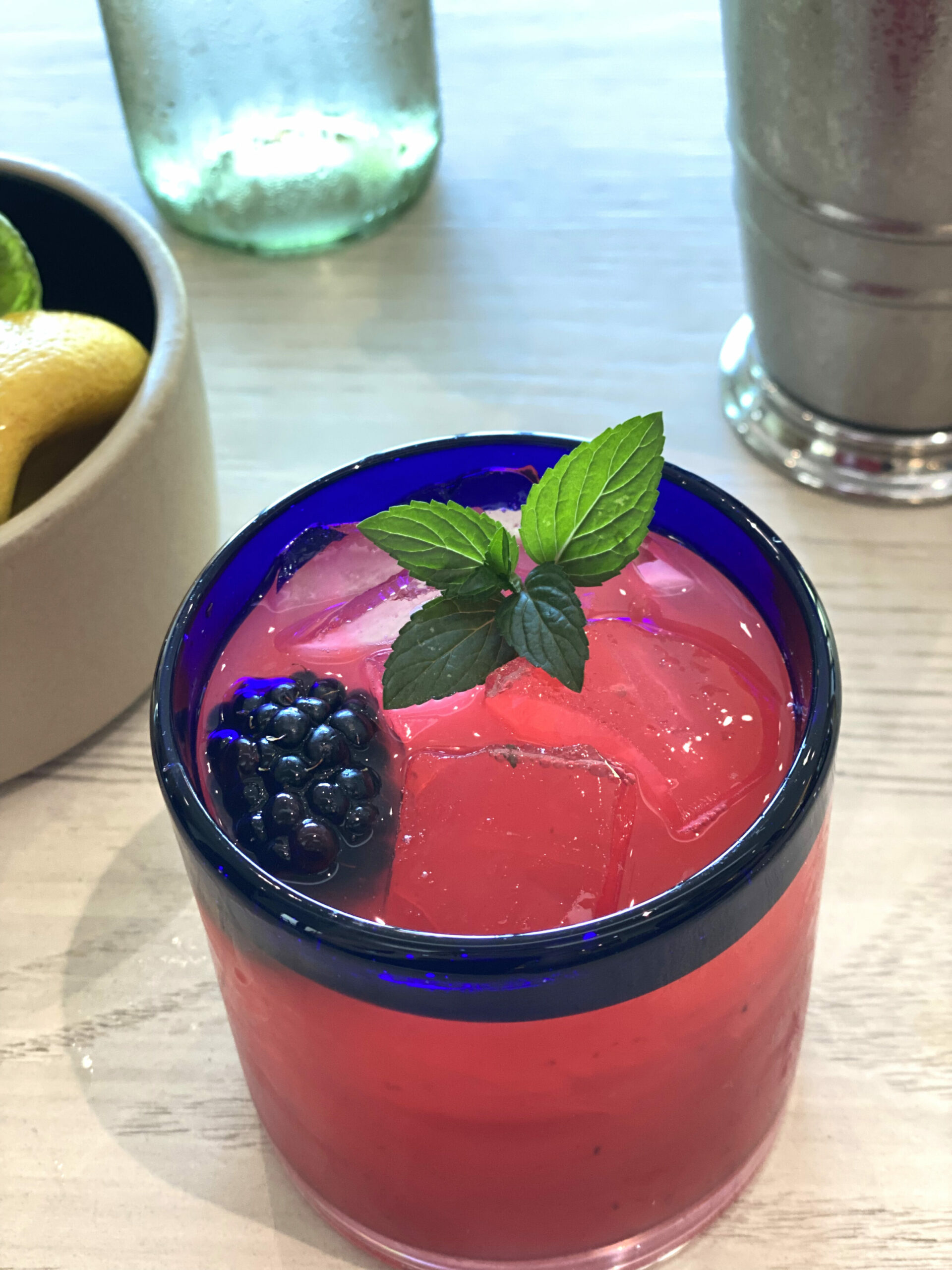
Sharing a recipe for a delicious and refreshing blackberry cucumber cocktail!
Hi hi! How’s the day going so far? I hope you’re having a great morning. I’m catching a yoga class and spending the rest of the day working on some stuff for Fit Team and the podcast.
For today’s post, I wanted to share a super delicious and EASY cocktail recipe. This one is courtesy of my brother Kyle, and we learned how to make this while we did his Cocktails in the Kitchen class at Miraval.
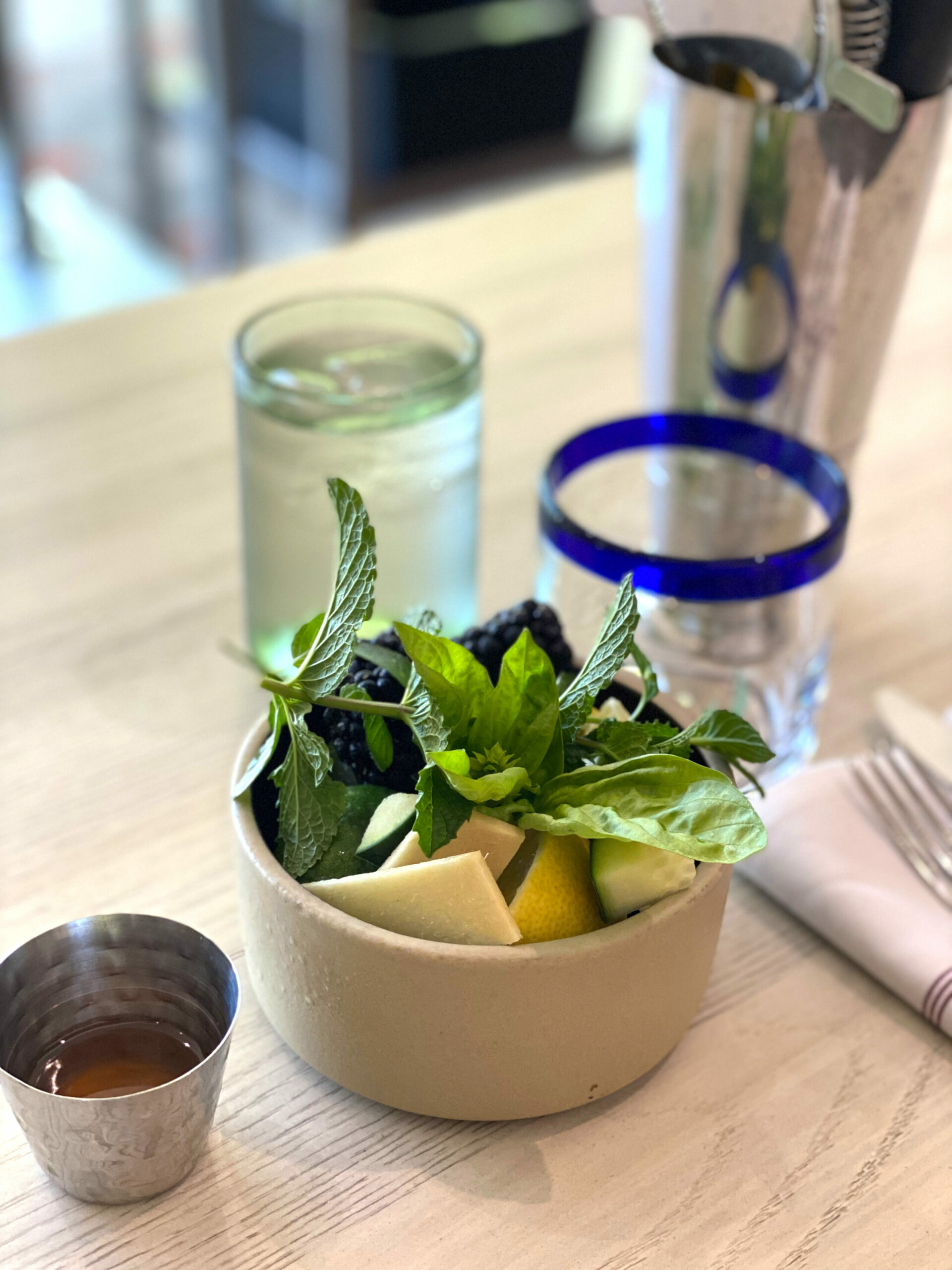
TBH, I haven’t experimented with cocktails too much. I feel like they can be intimidating, and while I can follow a recipe, I don’t tend to be very creative with cocktails. (Worth mentioning here that I do make a very lovely margarita, but that’s about where it ends.) He had our stations set up with fresh herbs, berries, tools, and gin, and before we knew it, we were cheers-ing each other with the freshest libation I’d had in a long time. I’m so pumped to share the recipe with you!
Blackberry Cucumber Cocktail
Ingredients
Cucumber
Mint
Basil
Blackberries
Simple syrup (equal parts honey and water)
Lemon
Lime
Gin
Ice
Instructions
Muddle all of the ingredients (minus the gin).
Next, add in the gin. Shake, strain, and garnish!
Kyle gave us an awesome tip for serving cocktails like this at parties:
Make a large batch of these and store in the fridge in a pitcher. Make one serving of these for guests while they’re over (so they can see the “wow” factor of it being prepared), but then serve the rest out of the pitcher that’s already ready to go and garnish.
I love this tip because making single cocktails has always been intimidating to me – I just don’t want people waiting around for their drinks while I prepare each one – so it’s a great idea to have a bunch ready to go and chilling in the fridge.
Another lesson I learned: I’m really into gin lately. I’m a wine or tequila girl, but I love the smoothness of gin and that it’s so neutral.
Here’s the full recipe if you want to give this one a try!!
Hi hi! Happy Friday! I hope you had a wonderful week. The Pilot was gone all week, so it was solo parent ops around here. We did the usual dance, soccer, homework, and school shuffle, enjoyed a dinner with madre and nana, and evening walks. The girls were awesome as always, but it takes a lot of mental energy to go all day until bedtime without someone to tag into the chaos. I’m pretty sure I’ll take a 3-hour nap this weekend lol.
Something else that’s been going on this week: sweet Caro has had a bit of a rough go. She’s an old gal and has some health issues, but things seemed to hit a peak this week. She was walking sideways and tripped over herself, and had multiple accidents in the house, so I called the vet. A few hours after it happened, she was acting normal again, but hasn’t been eating much. The vet is seeing her today, so we’ll see what they say. Thank you so much to those of you who have sent prayers and well wishes her way on IG.
What do you have going on this weekend? We have an event at the girls’ school, dinner plans with some friends, I’m catching a hot yoga class and teaching barre, and we’re celebrating my stepdad’s bday. I hope you have a fun and amazing weekend ahead.
It’s time for the weekly Friday Faves party. 🙂 This is where I share some of my favorite finds from the week and around the web. I always love to hear about your faves, too, so please shout out something you’re loving in the comments section below.
Friday Faves
Life:
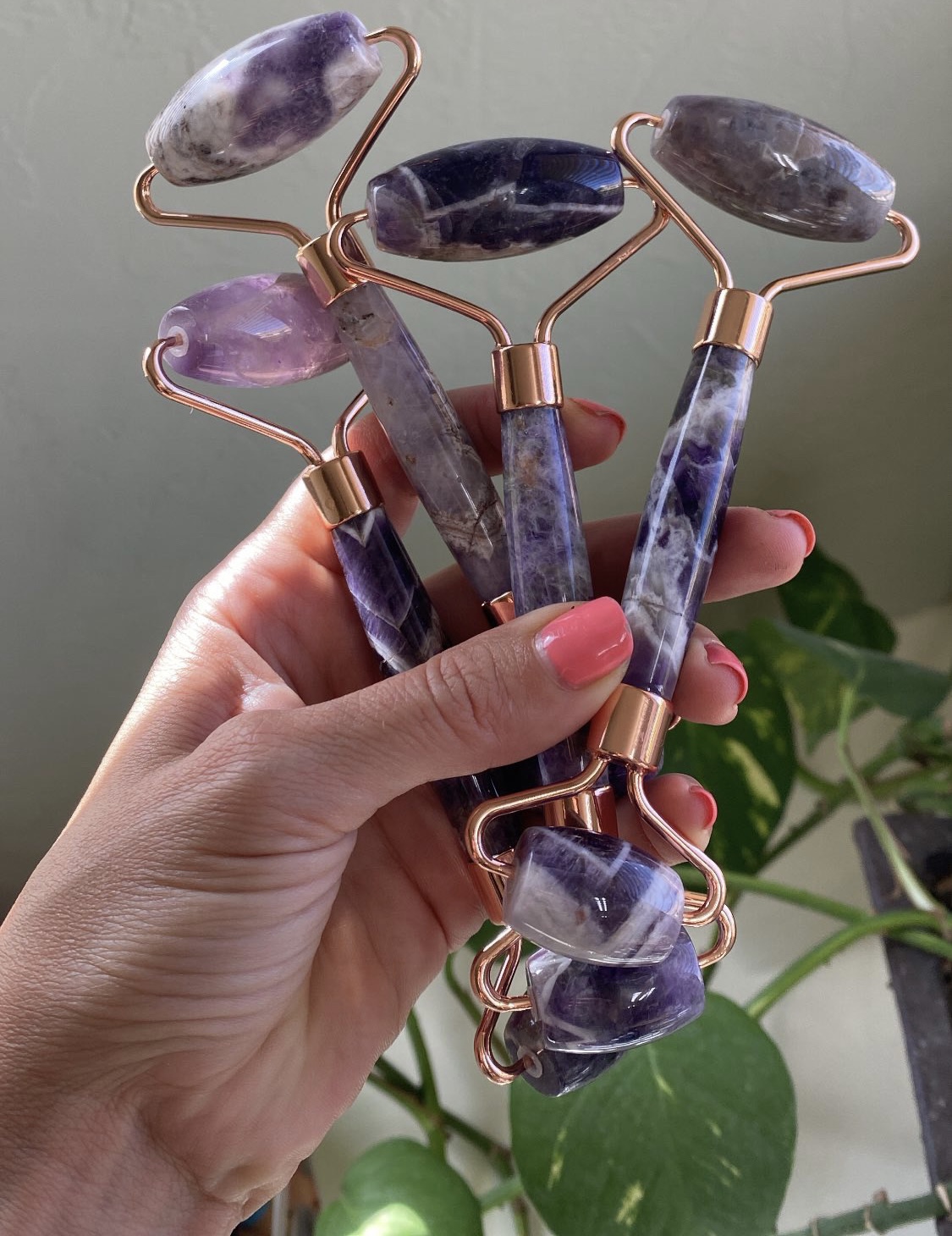
A trip to the gem show with my mom! I had badges to go to the JOGS gem and jewelry show -it’s a smaller one, as the gigantic one is in February – and we decided to check it out. We were pretty surprised by the amount of vendors and the selection of sparkly jewelry, gems, and crystals. I got a couple of things for myself, bracelets and sparkly backpack keychains for the crew, and some extras to share with friends and give away here on the blog.
This year’s blog holiday giveaway is already looking pretty epic, I’ve gotta say…
Fashion + Beauty:
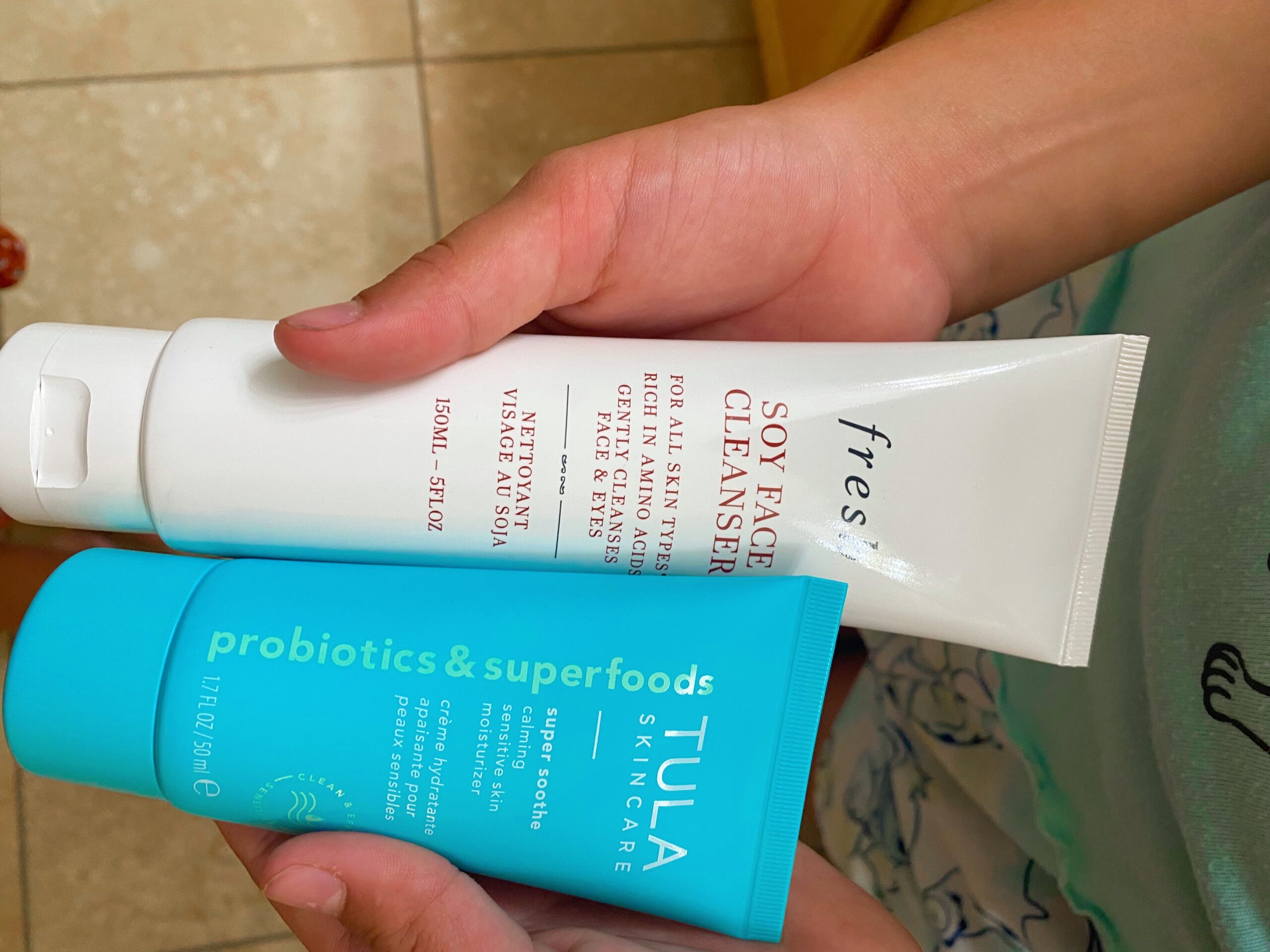
Let it be known that our tiny baby has an official skincare routine????? We wandered into Ulta because she was looking for face wash and moisturizer, and unfortunately the Beautycounter Coco cleanser wasn’t a good fit for her skin.
I wanted to get her something gentle with not-so-sketchy ingredients, and in the end, we decided on this face wash (which I’ve used in the past and it’s good for sensitive skin like ours) and this moisturizer. The moisturizer is hydrating without being greasy, and the combo of the two has been a good starting point for her skincare routine.
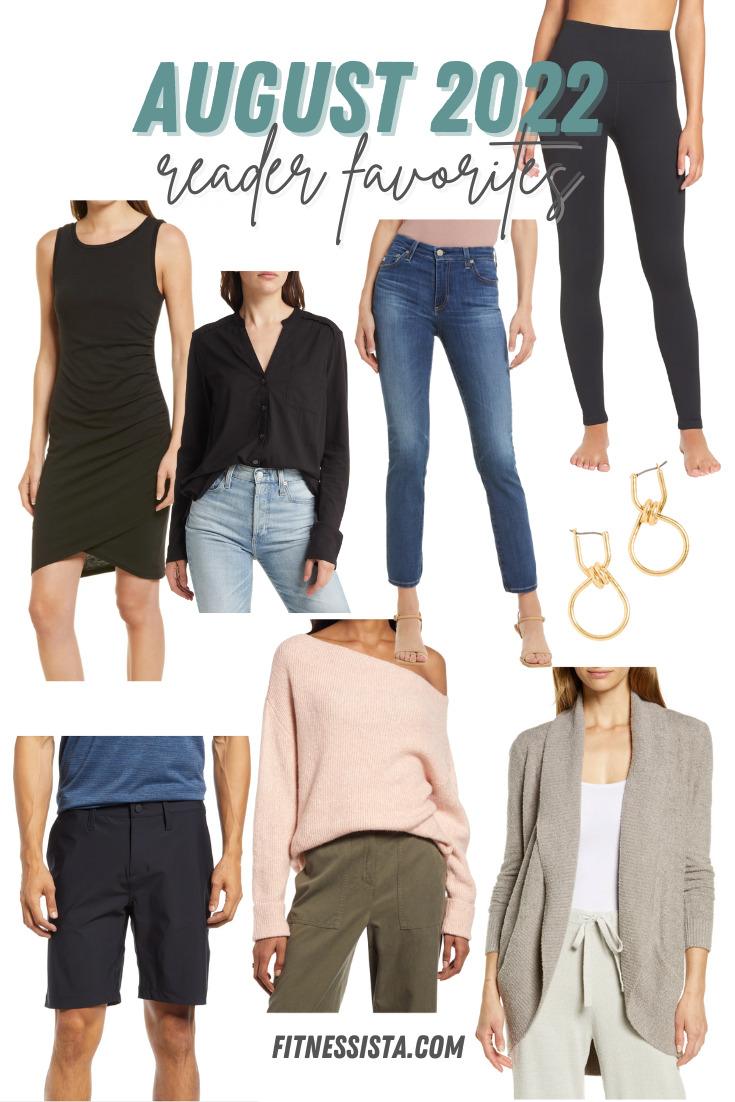
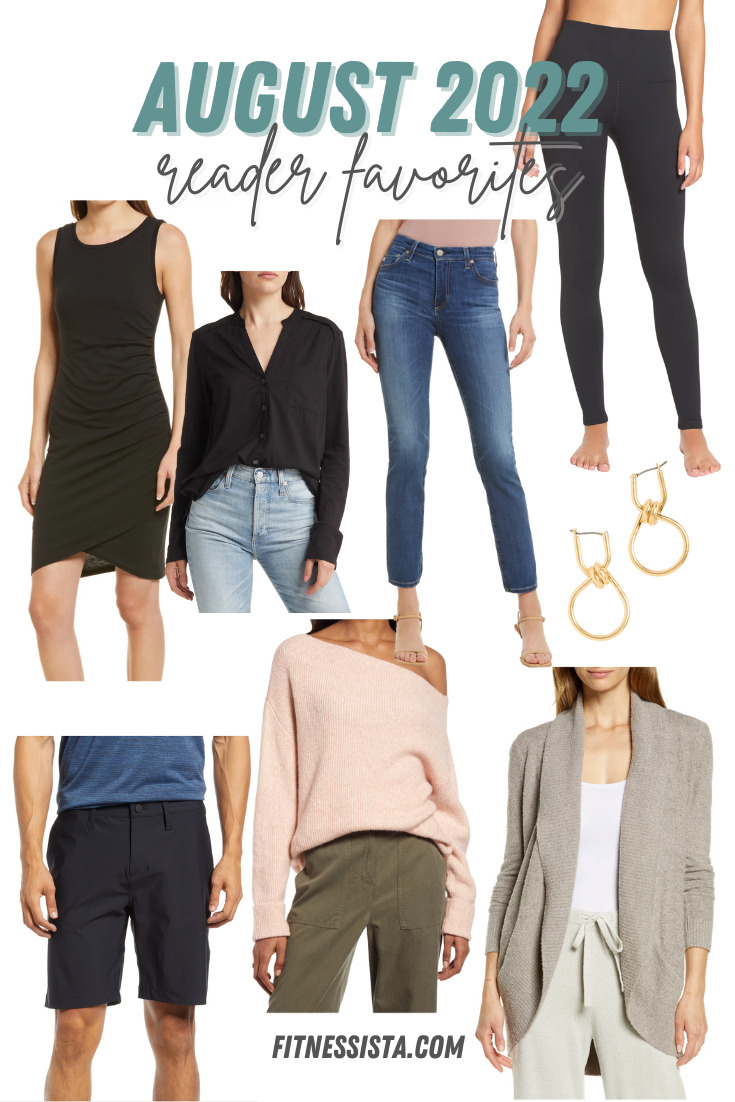
Your top picks from August! It’s always fun to look through analytics and see what products ya’ll are loving from the blog and my IG.
These earrings! I wear mine all the time and they look way more expensive than they are.
Fitness, health, + good eats:
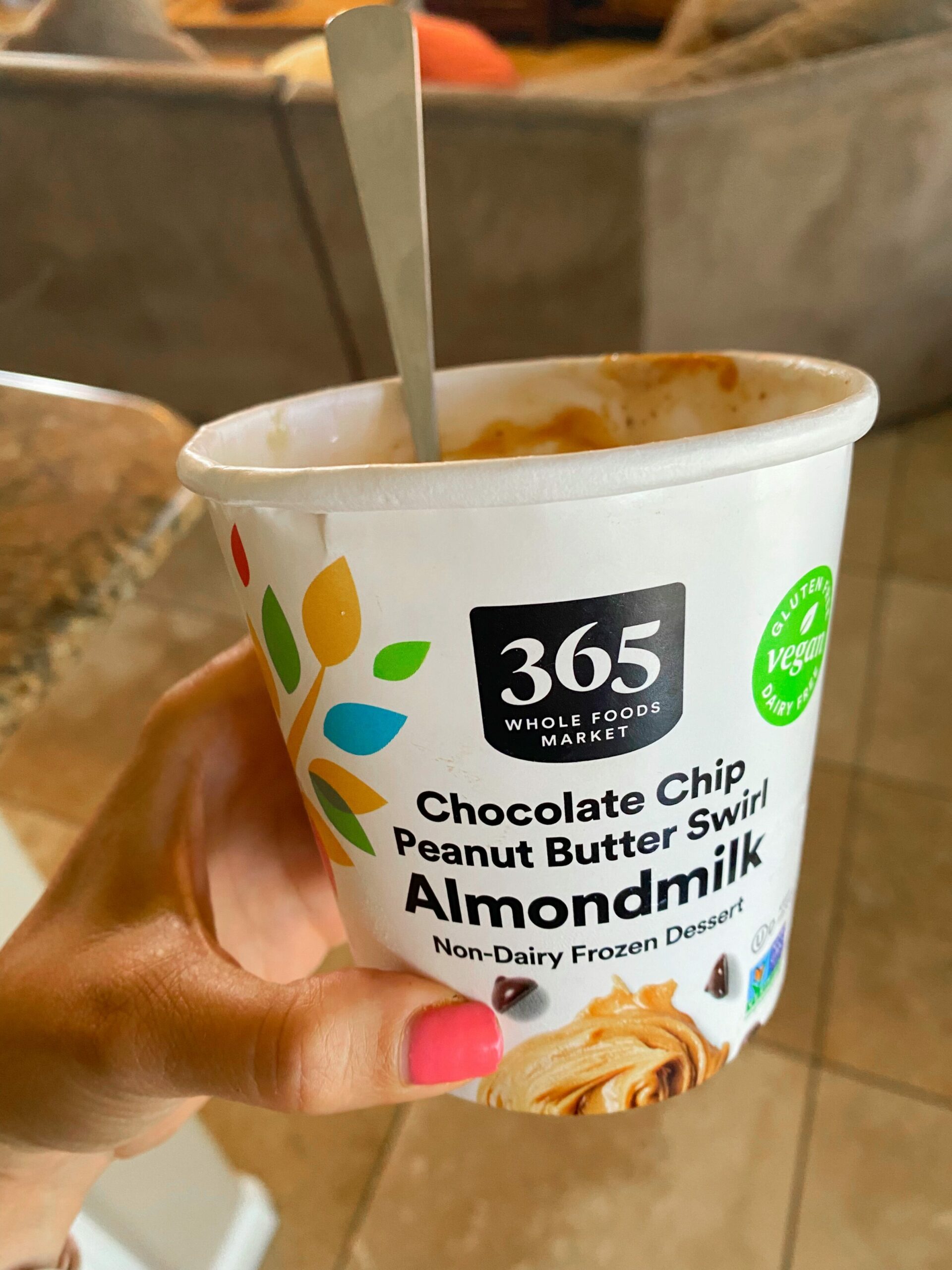
If you haven’t tried this ice cream from Whole Foods, get.on.it. We had a lil dinner party last weekend and dessert with pizookie with all of the toppings (4 types of ice cream, cherries, chocolate sauce, whipped cream, the kids went crazy for it). I got this ice cream, which as chocolate chips and peanut butter swirl. Usually peanut butter ice cream is disappointing because the flavor is muted and gets lost. This had huge ribbons of salty peanut buttery goodness that set my soul free. I’m not a huge ice cream person – give me cake or cookies any day – but I’ll definitely be getting this one again.
New blue light blockers! My friends at Oura sent me these glasses as a collaboration with Ra Optics. They’re VERY red lol but I notice a difference in sleep latency (the amount of time it takes to fall asleep), when I wear these after sundown. Blue light can inhibit our body’s ability to produce melatonin, which helps us wind down and fall asleep. We’re subject to blue light through lightbulbs and screens, and by blocking it out, it can help to reset circadian rhythm. The kids think I’m a wacko when I’m wearing these, but I think they’re super cool.