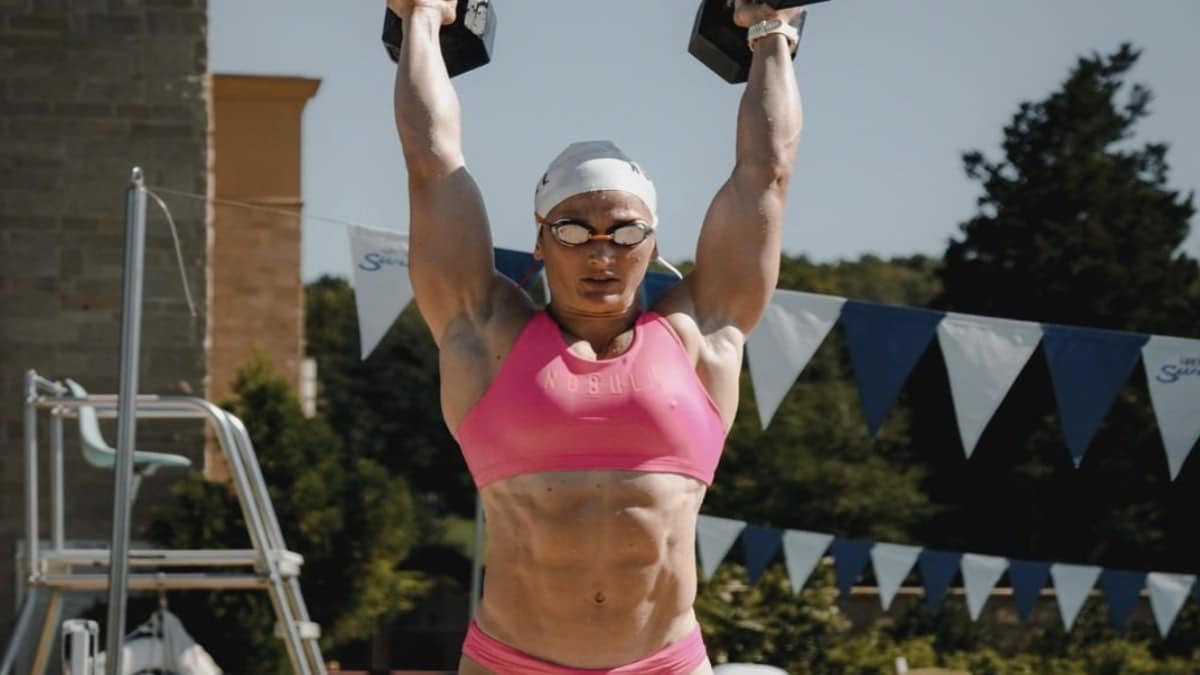
In early August, Tia-Clair Toomey made history by becoming the first Individual athlete to win six CrossFit Games titles. It’s undoubtedly a lofty achievement for a living strength sports legend. Given recent developments, Toomey’s milestone might be even grander than it was at first glance.
On Sept. 7, 2022, in a video posted to her YouTube channel, Toomey revealedshe suffered a back injury before the onset of the 2022 CrossFit Games. The CrossFitter did not clarify the precise nature of her injury but maintained that it was enough for her to consider whether she should or could compete in Madison, WI.
Since winning the recent CrossFit Games, Toomey has been taking time away to rest before she starts preparing for the next contest on her calendar. On Nov. 18-20, 2022, in Wollongong, Australia, Toomey plans to compete at the 2022 Down Under Championship on a team with Brooke Wells and Ellie Turner.
As the athlete looked ahead to that Australian competition, she quickly discussed what her unclear back injury meant for her latest CrossFit performance. While it didn’t end up hurting her overall finish, Toomey notes she had to take a recovery step back before putting the pedal to the (kettlebell) metal again.
“It’s really been about managing that [her back injury],” Toomey says about her plans since August’s CrossFit Games. “It was giving me quite a lot of feedback, and it was affecting my training in the lead-up to the Games.”
As a result of her injury, Toomey clarifies she’s been taking small steps to ramp up her performance back to an elite level. It seems to be a gradual process, where she won’t push it to the limit until she’s absolutely ready.
“I’m taking this off-season seriously and slowly easing into it, making sure I get my back into full form,” Toomey says. “I’m not going to be picking up a barbell or doing anything crazy. It’s really more about how I’m moving my body, making sure there isn’t any back pain…I’m doing more low-impact movements, just getting the body moving.”
Per Toomey’s video testimonial, the 2022 Down Under Championship will be her first Team appearance in roughly five years. With that contest still an approximate couple of months away at the time of this writing, the Australian competitor appears prepared to return completely healthy and maximize this latest opportunity.
“I’m pretty confident that I’ll be ready to go for that competition,” Toomey says. “I think it’ll be a great competition to get the body back on the competition floor. I love to compete. That’s what we do this for.”
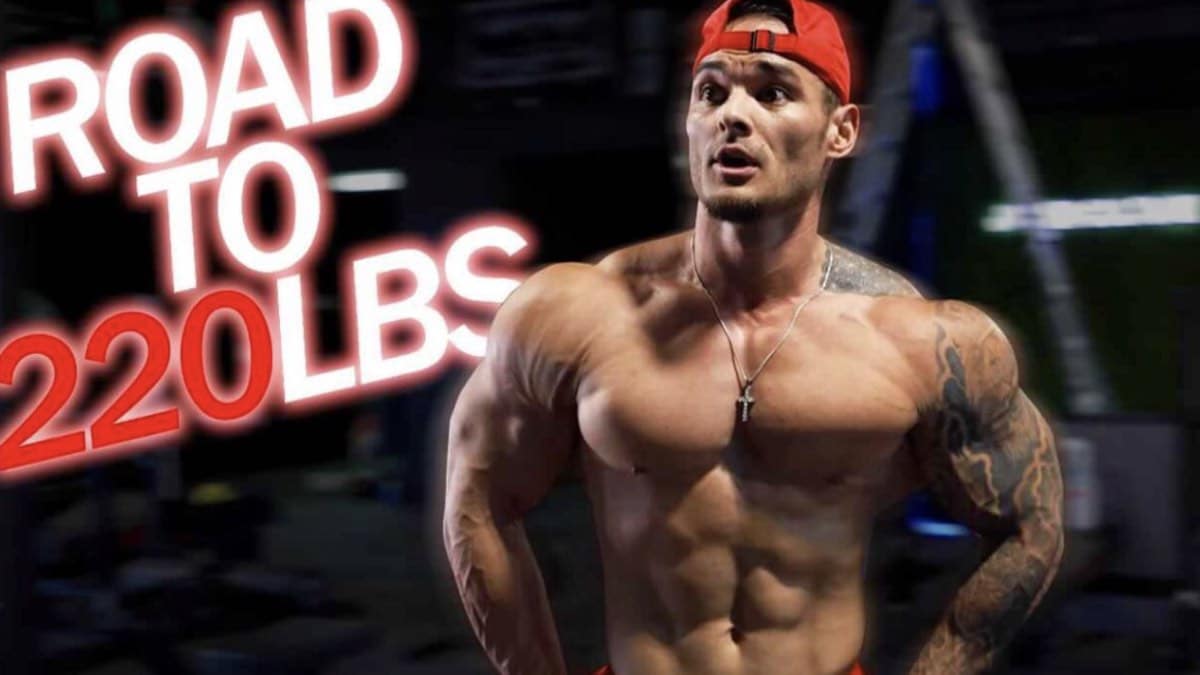
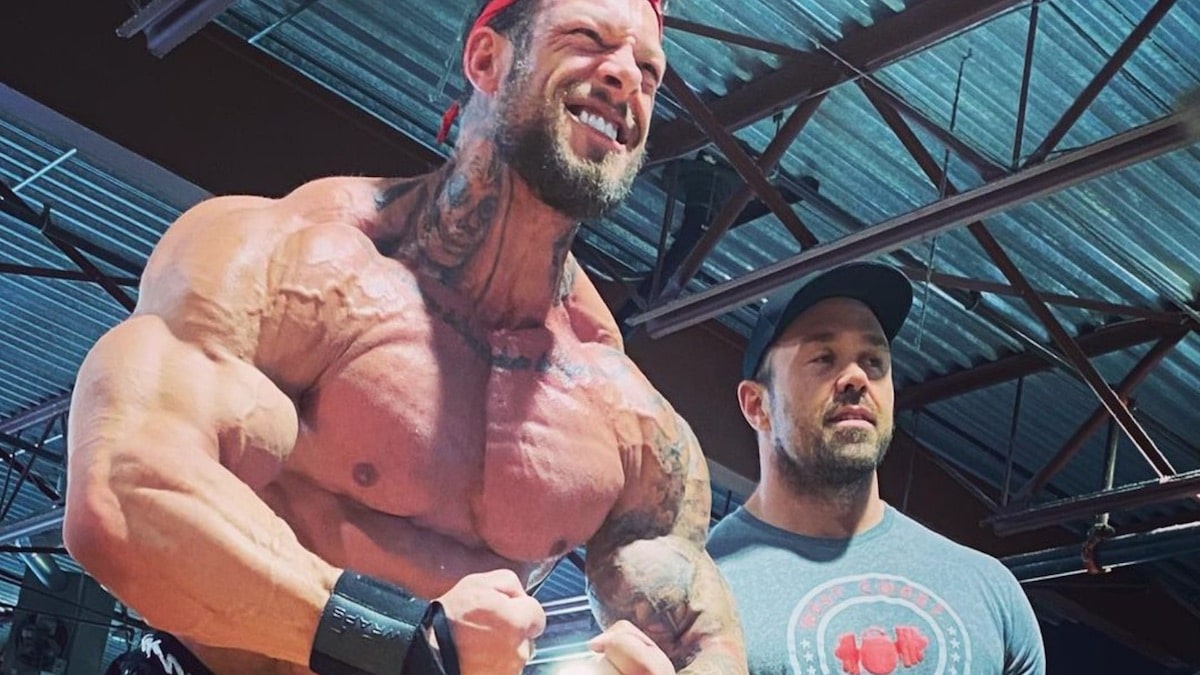
Jeremy Buendia was a dominant bodybuilding force through most of the 2010s. Thanks to a rare combination of mass and strength, the athlete won four consecutive Men’s Physique Olympia titles (2014-2017). But after falling short in fourth place at the 2018 Mr. Olympia and an initial comeback attempt that never quite materialized in 2020, it’s been a little while since Buendia posed competitively. That reality could change soon.
On Sept. 6, 2022, in a video on his YouTube channel, Buendia revealed he’s aiming to make another comeback to bodybuilding stages in the near future. What’s more, he’s bulking up in an attempt to compete at 220 pounds — roughly 37 pounds above his body weight from his championships heyday.
To address his current situation, Buendia clarifies that he will soon begin his formal off-season of training. The bodybuilder says his body weight at the time of the video is 192.4 pounds. He notes that this weight is a starting point for his goals as he embarks on another comeback attempt.
“Next week [September 12-18, 2022), I officially start my off-season, my bulk in preparation for my next competition,” Buendia says. “You guys, it’s been a long time since I’ve been on stage, since 2018. I took a lot of time off. I’m ready mentally, physically. I’m ready to get back after it. I’m eager to get back on stage and show you guys what I’m capable of doing.”
Note: There is no weight limit for this division, only height. Buendia stands at 5-foot-8 and may qualify under Class B in a typical Men’s Physique competition.
“I’m excited because I haven’t pushed my body this way in a long time,” Buendia says. ” … My body is healthy. I’m feeling really optimistic that I’m going to get to my biggest and best ever, preparing myself for battle in 2023.”
Aside from returning to the flow of competition, part of the motivation behind Buendia’s new comeback attempt appears to be related to reflection. As he alludes, the bodybuilder has noticed that the Men’s Physique Division, specifically, has improved dramatically since he was last a fixture. For example, even with Buendia’s own dynamic chest and arms makeup, recent winners like Brandon Hendrickson (2018, 2020-2021) and Raymont Edmonds (2019) could be seen as improved physical athletic specimens to some.
“The competition has gotten so much better since I was last on stage,” Buendia notes. “I’m excited to see these guys battle because it’s going to give me an idea of where I need to be next year to beat these guys.”
Understandably, as he works his way back to bodybuilding, Buendia wants to compare himself and see where he stands with his elite peers. More than anything, it seems he just wants another meaningful shot to go out on his own terms.
“After my loss in 2018, a lot of things hit the fan for me,” Buendia says. “Honestly, I felt that all my accomplishments, all four titles previously, lost their weight. I didn’t feel like I walked away from the stage the way I wanted to walk away from the stage.”
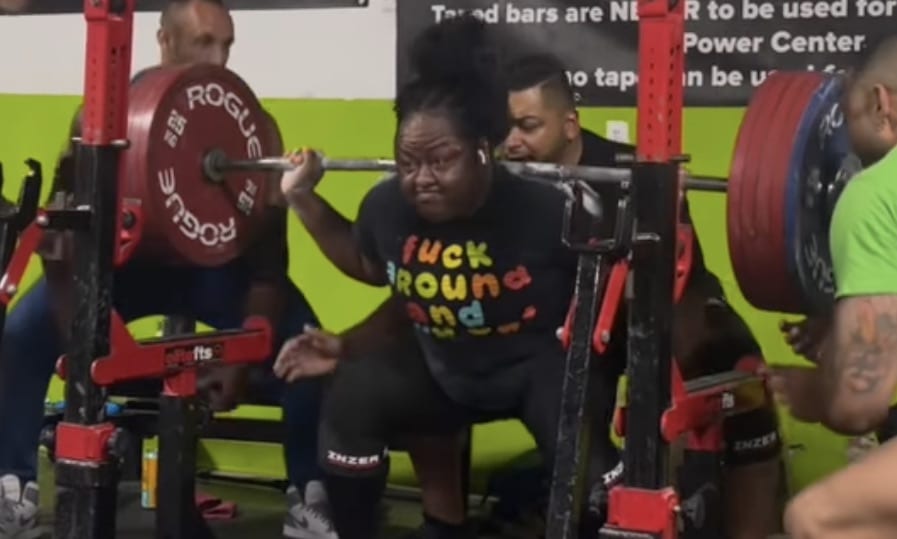
As she takes a step back to recalibrate, elite powerlifter Sherine Marcelle will not compete in any contests throughout the rest of the year. In the meantime, as the 90-kilogram athlete prepares for a formal return sometime in 2023, it seems she’s showing off incredible strength every time she shares updates on her training.
On September 7, 2022, Marcelle posted an Instagram clip where she squatted 263 kilograms (580 pounds)raw while wearing a lifting belt and knee sleeves during a training session. According to the caption of Marcelle’s post, it’s a new personal record (PR) for the powerlifter and more than the current World Record in her weight class of 90 kilograms.
Marcelle’s training feat might be even more notable in comparison to official marks. That’s because Marcelle’s squat PR unofficially exceeds Amanda Lawrence‘s all-time World Record in the 90-kilogram weight class by seven kilograms (15.7 pounds). Lawrence set her record by squatting 256 kilograms (564.3 pounds) at the 2020 USA Powerlifting Gainsgiving Open.
None of this recent precedent is new to Marcelle’s established high standards of late.
For example, in early June 2022, Marcelle notched a squat with wraps of 297 kilograms (655 pounds) for a new PR. That figure unofficially eclipsed Crystal Tate’s squat with wraps World Record of 290.3 kilograms (640 pounds) from the 2017 Xtreme Powerlifting Coalition (XPC) Finals. Then, in late August 2022, the powerlifter actually completed a squat four pounds over the current 90KG World Record twice. Plus, as she displayed on her Instagram just two days prior to her latest one-rep raw squat PR, Marcelle captured a 288-kilogram (635-pound) raw squat double PR.
At Marcelle’s current pace, logging a new PR and repeatedly making current records seem casual might be the baseline expectation for this star powerlifter. In other words: It’s all in a summer’s work for Marcelle.
Here’s an overview of Marcelle’s all-time raw competition bests:
As a seemingly passionate athlete, Marcelle doesn’t seem to be one to shy away from wearing her heart on her sleeve. A general perusal of her social media posts denotes Marcelle consistently expressing gratitude for her peers, her journey, and her “progress” as she carves out an impressive and illustrious powerlifting career.
Marcelle’s latest squat feat post, where she discusses successfully fighting off self-doubt, is no different as an insight into her mindset.
“These are the moments I live for,” Marcelle wrote in reference to her latest raw squat PR. “The ones where I doubt every being in me and still show up.”
IFBB Pro League bodybuilder Jamie Christian (also known as “The Giant”) is slated to compete in the 2022 Yamamoto Nutrition Pro Show in Milan, Italy on Sunday, Sept. 11th. The 6’5” bodybuilder claims to be the tallest Men’s Open pro in the world. Clearly, it takes a lot of food to keep a man his size training and prepared for competition.
Christian posted a video of his YouTube channel, filmed on Friday, Sept. 2, 2022, that featured his “refeed day” as part of his prep for the upcoming contest. He is working under the guidance of retired competitor and current coach Milos Sarcev.
In the beginning of the video, Christian explained that after being in a calorie deficit for nearly 15 weeks, this particular day of eating couldn’t have come at a better time.
“(The body) needs it,” he said to the camera. He went on to say that, in order to eat all those calories, it would take eight total meals throughout the day, as well as a workout shake that would have 150 grams of carbohydrates on its own.
Christian would later say that, with less than two weeks to go before the contest, he is still over 300 pounds and felt he was in the best shape of his life. He documented the entire day’s worth of food in the video. The individual meals, amounts (when explained), and approximate times (when given) were as follows.
Meal One (4:00a.m.): 150 grams of oats, 150 grams of banana, 65 grams of whey protein, 30 grams of peanut butter
Meal Two (6:30 a.m.): 100 grams of rice, 150 grams of turkey, 100 grams of banana, courgette (zucchini)
Meal Three, Pre-Workout: (Amounts of food not specified) Cream of rice, banana, blueberries, whey isolate, two Rice Krispies Treats, one cup of coffee
Workout: Pre-workout drink (75 grams of carbs), BCAA and essential amino acid shake
Meal Four, Post-Workout (3:00p.m.): (Not all amounts specified) Lucky Charms cereal, 50 grams of whey isolate
Meal Five (4:00p.m.): (Not all amounts specified) Rice cakes, turkey, rice, banana, courgette (zucchini)
Meal Six: 150 grams of oats, blueberries, one rice cake, whey protein
Meal Seven: (Not shown on video) 100 grams of rice, 150 grams of turkey, 100 grams of banana
Meal Eight (9:00p.m.): 100 grams of rice, 150 grams of turkey, 100 grams of banana
Meal Nine: 200 grams of ground beef, 20 grams of almond butter, 150 grams of oats, 100 grams of banana
Approximate Total: 7,000 calories, 360 grams of protein, 1,250 grams of carbs, 35 grams of fat
At the end of the video, Christian pulled up his shirt and showed the camera his abs. He discussed that his stomach was still flat and defined because the food he ate didn’t cause bloating or indigestion, in part because fat intake was kept low in every meal except the last.
I don’t even feel like I’ve eaten anything today.
Earlier in the video, he also theorized that keeping protein relatively low and walking for 10-minutes multiple times throughout the day improved his overall digestion.
When he competes in Italy, Christian will be looking for his first professional win as well as his first qualification to the Mr. Olympia contest, which is scheduled to take place the weekend of Dec. 16-18, 2022 in Las Vegas, NV.
Piercing pain at your temples, a throbbing ache in your forehead – we’ve all suffered the agony of headaches, and there are plenty of causes. Some of us are more likely to get them during or after exercise.
Good to know:
Headaches are divided into two types: primary and secondary.
Primary headaches are triggered by exertion, tension, or not enough sleep.
Secondary headaches, however, are a symptom of another more serious underlying condition like high blood pressure, an infection, substance withdrawal, or a stroke.
In this article, we’ll identify four common causes of headaches that can occur during and after exercise and give you tips for treating and preventing them. We’ll also uncover the truth about whether or not exercise can trigger migraines.
Important:
If you experience headaches that last for days, or if there are more days in a month that you suffer from headaches than without, you should consult a specialist. A medical professional can check to see if you are suffering from primary or secondary headaches, both of which can come from underlying conditions.
Table of contents:
4 Reasons Why You’re Suffering From Headaches During Or After Workouts
Reason #1: Sustained, Strenuous Exercise
Primary headaches caused by strenuous physical activity are called exertional exercise or exercise headaches. These are described as throbbing, migraine-like pain across the whole head (bilateral headaches) and last between five minutes and 48 hours.(1,2) An extreme exercise headache can also cause vomiting and vision problems. It’s important to take exercise-induced headaches seriously.
Headache prevention
Exertion headaches often develop if you skip your warm-up, your workout is too strenuous, or your body overheats. That can encompass high temperature indoors or outdoors, or when you are at high altitudes, like on a tough hike in the mountains.
One way to prevent exertion headaches is to reduce the intensity of your workouts. These tips forrunning in the summer can help you cope with the heat and avoid dehydration.
Reason #2: Poor posture
Bad posture, stress, and poor form when you work out can cause tension, which can lead to headaches during or after exercise. Tension headaches are described as a constant ache that is usually felt on both sides of the head.(3)
Try using heat, massage, or doingexercises to relieve neck pain to relax your muscles if you get a headache after workouts.
Reason #3: Dehydration
Whether it’s from exercise or just not drinking enough fluids, dehydration is one of the most common causes of post-exercise headaches.
Avoid dehydration by calculating how much water you should drink each day with our liquid requirement calculator:
Headache prevention
Make sure you are drinking enough throughout the day. To add variety, you can includespecial sports drinks that keep you hydrated and provide your body with important micronutrients.
Reason #4: Low blood sugar
Headaches after exercise are bad enough, but if you also feel weak, shaky, dizzy, or even nauseous, you may be experiencing the symptoms of low blood sugar and depleted energy stores. Always ensure that your body has enough energy to work out.
Headache prevention
If you notice the symptoms listed above when you’re exercising, you should take a break. You can refill your energy and increase your blood sugar byeating more carbohydrates.
There are also a few foods that can trigger headaches and migraines or make them worse – usually in combination with other causes. Avoid these potential headache triggers(4):
alcohol (especially wine or beer)
chocolate
caffeine
aged cheese
foods high in
monosodium glutamate
artificial sweeteners
and preservatives like nitrates or nitrites
Can exercise trigger migraines?
Research on the connection between migraines and exercise is not very extensive. However, there are studies that show that migraineurs (people who frequently suffer from migraines) can experience exercise-triggered migraines. It is believed that the exertional headaches and tension headaches mentioned above are more likely to lead to a migraine.(5) If you are at risk of migraines, it is even more important that you prevent the four causes of headaches after exercise.
The good news:
Studies also show that regular exercise can help prevent migraines or at least reduce the intensity of the pain. This is thanks to the endorphins produced during sports.(6,7)
Takeaway
Before you start working out, make sure you are hydrated and that your energy stores are full. Pay attention to your form and practice good posture while exercising. If you have a bad headache combined with dizziness, nausea, shakiness, and/or vomiting, stop your workout immediately and consult your physician. The same applies if you experience headaches that last several days.
***
if(!isRussia){
//check Cookie Opt out and User consent
if(!run_getCookie(“tp-opt-out”)){
!function(f,b,e,v,n,t,s){if(f.fbq)return;n=f.fbq=function(){n.callMethod?
n.callMethod.apply(n,arguments):n.queue.push(arguments)};if(!f._fbq)f._fbq=n;
n.push=n;n.loaded=!0;n.version=’2.0′;n.queue=[];t=b.createElement(e);t.async=!0;
t.src=v;s=b.getElementsByTagName(e)[0];s.parentNode.insertBefore(t,s)}(window,
document,’script’,’https://connect.facebook.net/en_US/fbevents.js’);
fbq(‘init’, ‘1594940627485550’); // Insert your pixel ID here.
fbq(‘track’, ‘ViewContent’);
}
}
Mention the triceps kickback in certain lifting circles and you might generate some side eye looks of disappointment or even a bit of mocking laughter. This short-sighted response comes from the exercise’s unfortunate and unfair reputation of being ineffective, or being performed only by people with “less-than-serious” goals.
The dumbbell kickback was once a staple of bodybuilding’s Golden Era from the 1950s to the ’70s. However, its popularity in ’80s mainstream fitness classes diluted its muscle-building connection and it began to be performed with extremely light weights for extremely high repetitions. “To tone up without building bulk” was the popular, if misguided, logic.
Credit: Reshetnikov_art / Shutterstock
Regardless of the misinformation, the triceps kickback is a very effective tool to target the biggest arm muscle — the triceps. The triceps are also a key muscle for performance through many upper body exercises. So forget what you might’ve heard about the exercise and learn the real reasons why you should include this exercise in your training regimen.
How to Do the Triceps Kickback
The basic single-arm dumbbell triceps kickback is an isolation (single-joint) exercise that focuses solely on triceps development. It’s a great way to emphasize peak contraction of the muscle.
Step 1 — Set Up in the Starting Position
Credit: BAZA Production / Shutterstock
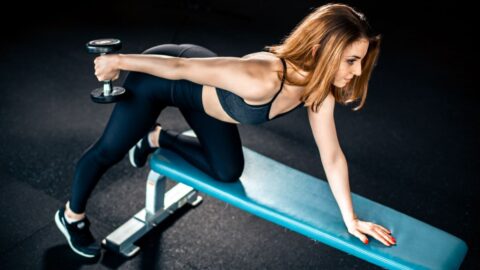
Stand in front of something sturdy, like a rack or a bench. Hold one dumbbell and get into a wide stance. Bend your knees slightly and lean forward at the hips while keeping a neutral spine. Aim to have your torso almost parallel to the floor. Place your free hand on the rack or bench for maximum balance and stability.
Pull your working arm up so your elbow is near your ribs and pinned close to your body. Let your forearm hang perpendicular to the floor with your palm facing in toward your body. Don’t look up or forward. Keep your head in line with your spine and your chin slightly tucked in.
Form tip: Flaring your elbow away from your body will only encourage cheating to move more weight and potentially strain your elbow joint. Keep your upper arm glued to your side. This is not an exercise to move super-heavy weight. Keep the load relatively light to ensure impeccable form.
Step 2 — Reach a Peak Contraction
Credit: IvanRiver / Shutterstock
Brace your core and exhale while flexing your triceps until your arm is completely straight. Squeeze at the top for a second to feel a maximum peak contraction. Your lower arm should be the only thing moving. This is an isolation exercise, so focus on only working the triceps.
Your hand, and the dumbbell, should pivot around your elbow. Treat your elbow like a hinge. No other part of your body should move.
Form tip: Be sure to reach full extension with each rep. In the top position, your entire arm should be nearly parallel to the ground. Because gravity offers minimal resistance against the weight in the bottom part of the movement, it’s essential to use a full range of motion and emphasize the contraction.
Step 3 — Return to the Stretched Position
Credit: MDV Edwards / Shutterstock
Slowly come back to the starting position while inhaling. Again, only your forearm should move. Pause very briefly in the bottom position to avoid quickly swinging the weight down and up.
Sure, momentum might allow you to move more weight, but you will diminish the range of motion and the time under tension — both crucial for muscle mass. Swinging the weight will also put more stress on the elbow joint. More joint strain with less muscle-building is not a great bargain.
Form tip: Start each set with your weaker or non-dominant side so you have more energy and more focus. Perform all repetitions and then match the same number of repetitions with your stronger arm, even if one side is capable of more reps. This will help to balance common strength or development discrepancies between left and right arms.
Triceps Kickback Mistakes to Avoid
This exercise can be prone to bad execution because it requires light weights, so a lifter can sometimes lose focus. Learn about the most common errors and how to avoid them.
Swinging the Weight
Let’s be real for a second: cheating a few reps at the end of a session won’t smite you instantly. It can sometimes even be beneficial, for experienced lifters using it as a deliberate intensity-boosting technique. But for the vast majority of people, you should avoid cheating and swinging the weight with kickbacks or nearly any exercise.
Credit: lunamarina / Shutterstock
If you swing and cheat, you will only actually work your triceps through a very short portion of the range of motion, and the exercise will provide a limited triceps-building stimulus. Moreover, this will result in more stress to the elbow joint and you don’t want to develop tendonitis — that’s the best way to keep having small arms.
Avoid it: Make sure you control the eccentric (lowering the weight), and even pause for a dead-stop at the bottom briefly. If you focus on only moving your forearm, you basically cannot cheat. If your elbow moves, you’ve started doing a dumbbell row, not a triceps kickback.
Not Locking Out Your Arm
If you don’t completely extend your arms and squeeze your triceps in a hard lockout, you lose most of the benefits of this exercise because of the resistance curve. At the start of the lift, there is almost no resistance at all because the dumbbell isn’t directly moving against gravity. The hardest part of the exercise is in the shortened range when the muscle is contracted.
Credit: MDV Edwards / Shutterstock
If you don’t lockout, which can happen if you try using too much weight, then you don’t really work your triceps’ most challenging part of the range of motion. That ends up making the exercise easier and less efficient for muscle growth.
Avoid it: Make sure you use a proper weight that allows you to fully lockout your arm. If you can’t pause at the top for a second, the weight is too much.
Benefits of the Triceps Kickback
Even though the exercise is often overlooked and disrespected, the triceps kickback has unique benefits for your triceps training and will help you get bigger, stronger arms.
Muscle Growth
This exercise is focused on directly training the triceps, specifically for hypertrophy (muscle growth). Indeed, this exercise thrives with lighter weight and a longer time under tension, which is a great way to build muscle and create an aesthetic physique. (1)
Credit: Bojan656 / Shutterstock
Moreover, as an isolation exercise, it is the perfect fit for developing a mind-muscle connection and accumulating triceps-specific volume without taxing other muscle groups, which are both beneficial for muscle growth. (2)(3)
Pressing Strength
Triceps strength, and the pushing pattern in general, are involved in many sports like volleyball, American football, combat sports, etc. And let’s not forget strength sports like powerlifting.
Sure, the triceps kickback won’t create pure neurological strength like training the heavy bench press or overhead press, but building larger triceps muscles can eventually improve strength. (4) So if you’re interested in performance, fit this into your accessory training.
Training the Shortened Range
Many triceps exercises such as skull crushers emphasize the lengthened range of motion and stress the stretched position. The triceps kickback, on the other hand, focuses on the shortened or contracted portion. Because of its resistance curve, the exercise is relatively easy in the stretched position and much more challenging in the peak contraction.
This can provide a novel stimulus, help develop a stronger mind-muscle connection, and unlock new gains, because training variety can be better for motivation and hypertrophy in itself. (5)
Easy on the Elbows
The triceps kickback can be invaluable for experienced lifters with cranky joints. Because the upper arm is in a higher position than the forearm, and joint isn’t being strained through the entire range of motion, the elbow can move more freely without significant stress.
If you have nagging pain in your elbows, shoulders, or wrists, or if you’re prone to tendonitis, make the kickback appear regularly in your training plan.
Muscles Worked by the Triceps Kickback
The aim of the exercise is to train your triceps, but some postural muscle will be recruited as well to hold the position.
Triceps Brachii
This is the biggest arm muscle and the main target of the kickback. It is made of three heads. Two of them (the medial and the lateral head) go from the elbow to the humerus (upper arm bone). These are responsible for extending the arm.
Credit: nkotlyar / Shutterstock
The long head also extends the arm, but because it is attached to the scapula, it also extends the shoulder and raises the arm. Because the upper arm is positioned alongside the torso, the triceps kickback emphasizes the lateral and medial heads.
Back
The whole back — upper back, lats, and lower back — work to maintain a parallel body position and stabilize the working arm during the kickback. The back’s involvement should be limited to the muscles working statically to hold your body’s position without movement.
However, if the kickback is performed improperly, the back muscles (specifically the upper back and lats) may become more significantly recruited, drawing muscular stress away from the triceps.
Who Should Do the Triceps Kickback
The goal of the kickback is to add meat onto your triceps. So if you’re looking for bigger, stronger arms — like plenty of people in the gym — you can include this lift in your training regimen.
Beginners
Some people advise that beginners to avoid single-joint exercises and focus primarily on the big basics (multi-joint compound lifts like presses). This is generally sound advice, but isolation work can also have benefits for newer lifters.
By improving the mind-muscle connection with specific muscles, they can feel that muscle work more effectively, which leads to better growth and body awareness. Exercises like the triceps kickback also help to directly train muscles which may be under-worked when compound exercises are overemphasized.
Physique Enthusiasts
Whether your goal is to look better or to compete in a physique show, the triceps kickback is a perfect fit. Performing this exercise allows you to increase triceps volume without fatiguing other muscle groups, leading to focused muscle growth.
This is very valuable, for instance, if you lack overall arm development, or if you need to create a balanced and symmetrical physique by correcting muscular imbalances.
Strength Athletes
If you’re an athlete that requires pressing strength such as a powerlifter, strongman/strongwoman, or CrossFit athlete, then triceps training is essential. Including the triceps kickback can be surprisingly effective for strength athletes.
The relatively light weight and high muscular tension allows them to increase triceps training volume without aggravating their elbows, which are usually already beaten up by heavy lifting.
How to Program the Triceps Kickback
The kickback is a single-joint exercise and as such, it is not ideal for moving heavy weights because additional muscles will be excessively recruited. The kickback is most effective using moderate to light weight to stimulate muscle growth and zero-in on working the triceps.
Moderate Weight, Moderate Repetitions
The time-tested bodybuilding scheme of three to four sets of 10 to 12 repetitions will be your kickback bread and butter. This is a very efficient way of increasing volume leading to muscle growth.
Light Weight, High Reps
This exercise can really shine with higher reps because of its resistance curve, cumulative time under tension, and its low impact on the joints. Performing two to four sets of 15 to 20 repetitions can serve as an amazing finisher to really scorch your triceps. It can also be a great way to start your arm workout by really warming-up your elbow joints.
Triceps Kickback Variations
The single-arm dumbbell kickback is a great exercise in itself, but you can tweak it to better suit your goals or provide a different feeling. Here are the main kickback variations.
Cable Triceps Kickback
Instead of using dumbbells, use a cable. Instead of attaching a handle, grab the cable by the “ball” at the end, just above the cable clip. This allows you to keep a neutral hand position without straining your wrists.
The exercise may not seem like much because of the relatively lighter weight, but the cable provides constant tension through the lift, even more than using a dumbbell. This stimulates the triceps throughout the entire range of motion, which will increase the time under tension and lead to improved muscle growth.
Pronated Kickback
This subtle variation was popularized by bodybuilding coach John Meadows. Using a pronated (palms-down) grip will emphasize the medial head of the triceps. Using two dumbbells at once also changes the total-body stability requirement.
Because your forearm is slightly rotated, this variation will also address forearm and wrist health. You can even perform a type of superset, beginning with reps of pronated kickbacks and then immediately transitioning to standard neutral-grip kickbacks.
Two-Arm Dumbbell Kickback
This variation is pretty straight-forward: Perform the standard triceps kickback with both arms at the same time. This will slightly decrease the weight you can lift because the muscle focus is “divided” between both arms.
This variation also requires more work from your core, back, and legs to stabilize yourself because you don’t have a free hand to brace on an outside support.
Triceps Kickback Alternatives
If you’re still not convinced to incorporate kickbacks, here are some alternatives that will share similar benefits to spice up your training. Variety will challenge the muscles differently, promoting new muscle growth.
Triceps Pushdown
If you’ve got access to a cable station, you can perform this fundamental exercise. The triceps pushdown, sometimes called a pressdown, emphasizes the peak contraction and isn’t very stressful on the elbow joints.
Use an attachment that allows you to extend your arms completely — a rope handle is often most effective. As with the kickback, be sure to keep your arms close to your body and only move your hands and forearms without swinging your elbows.
Decline Dumbbell Skull Crusher
The standard flat bench skull crusher is an effective exercise, but using a decline bench gives it a twist to focus more on the medial and lateral heads of the triceps. The arm angle doesn’t provide as much stretch or long head stimulation, but can offer more tension in the top position.
Using a pair of dumbbells allows your arms to move freely and reduce strain on your wrist and elbow joints, compared to performing the exercise the a barbell or EZ-curl bar.
Overhead Dumbbell Extension
If you want to emphasize the long head of the triceps, this variation is for you. Performing triceps extension with your arms extended above your shoulders will focus more on the lengthened range and will significantly recruit the long head because it’s involved in raising the arm.
Because this movement emphasizes the stretched position, be sure your elbows and shoulders are thoroughly warmed up. It’s not an ideal first-exercise in your triceps workout, but it can be a key player in building larger arms.
FAQs
Do I have to train my arms directly?
It depends on a few variable. If you’re a short-limbed lifter, your arms will probably be significantly stimulated with compound exercises like the bench press, overhead press, rows, and pulldowns. But if you’re dealing with long arms, you should train them directly because your leverage on big lifts is different and the biceps and triceps are often under-stimulated in those movements.
Ultimately, if you’re interested in having bigger arms, it’s a good idea to include at least some direct training, especially if you’re a more advanced lifter. If you’re a competitive athlete, you should skip direct arm training in-season and keep that energy for your sport-specific training. Accumulating too much training volume can cause burnouts, stagnation, or even regression.
I can’t stop my elbow from flaring. Why is that?
The first culprit could be weight. If the dumbbell is too heavy, flaring your elbow out will recruit extra muscles (in your back and shoulders) to help lift the load, but it’s at the potential detriment of your joints and it will reduce triceps activation.
If you’re certain that you can control the weight, it could be a matter of mobility. If your upper back or shoulder mobility is compromised, it will result in protruded, forward-pointing shoulders that prevent you from keeping your elbows close to you. You should include a mobility routine in your workouts with exercises like band pull-aparts and wall slides.
Let’s Get Pumping
The triceps kickback’s bad reputation is unfair and unfounded. Don’t let any misinformed knee-jerk reactions or cliches steer you away from this classic arm-builder. It’s a versatile movement that lets you hit your tris with light weight, high tension, and minimal joint strain. It’s definitely time to remind today’s gyms that kickbacks are for serious lifters.
References
Burd NA, Andrews RJ, West DW, Little JP, Cochran AJ, Hector AJ, Cashaback JG, Gibala MJ, Potvin JR, Baker SK, Phillips SM. Muscle time under tension during resistance exercise stimulates differential muscle protein sub-fractional synthetic responses in men. J Physiol. 2012 Jan 15;590(2):351-62. doi: 10.1113/jphysiol.2011.221200. Epub 2011 Nov 21. PMID: 22106173; PMCID: PMC3285070.
Calatayud J, Vinstrup J, Jakobsen MD, Sundstrup E, Brandt M, Jay K, Colado JC, Andersen LL. Importance of mind-muscle connection during progressive resistance training. Eur J Appl Physiol. 2016 Mar;116(3):527-33. doi: 10.1007/s00421-015-3305-7. Epub 2015 Dec 23. PMID: 26700744.
Schoenfeld BJ, Contreras B, Krieger J, Grgic J, Delcastillo K, Belliard R, Alto A. Resistance Training Volume Enhances Muscle Hypertrophy but Not Strength in Trained Men. Med Sci Sports Exerc. 2019 Jan;51(1):94-103. doi: 10.1249/MSS.0000000000001764. PMID: 30153194; PMCID: PMC6303131.
Reggiani C, Schiaffino S. Muscle hypertrophy and muscle strength: dependent or independent variables? A provocative review. Eur J Transl Myol. 2020 Sep 9;30(3):9311. doi: 10.4081/ejtm.2020.9311. PMID: 33117512; PMCID: PMC7582410.
Baz-Valle E, Schoenfeld BJ, Torres-Unda J, Santos-Concejero J, Balsalobre-Fernández C. The effects of exercise variation in muscle thickness, maximal strength and motivation in resistance trained men. PLoS One. 2019 Dec 27;14(12):e0226989. doi: 10.1371/journal.pone.0226989. PMID: 31881066; PMCID: PMC6934277.
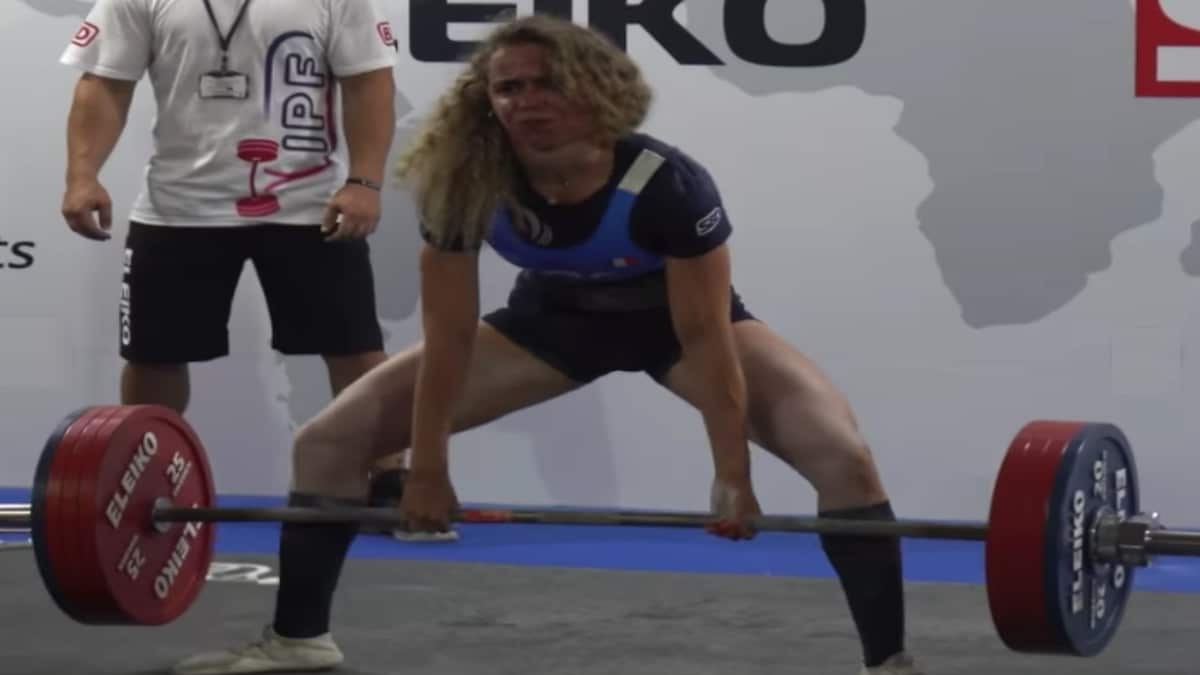
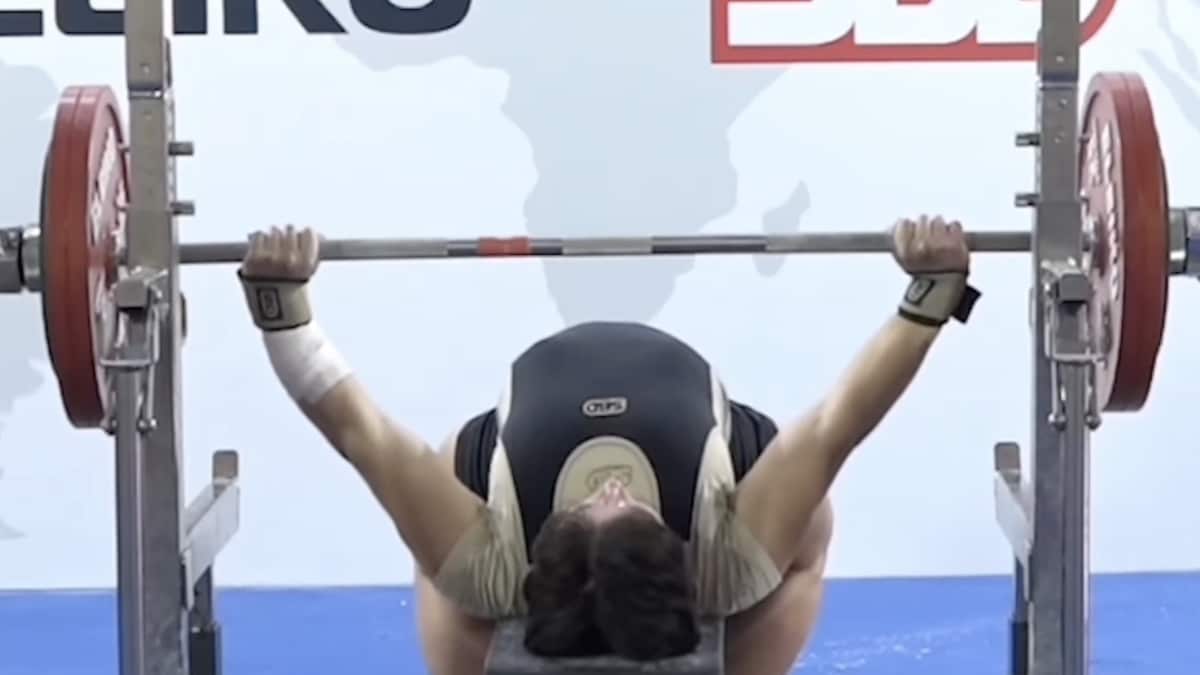
French powerlifter Samantha Eugenie is now the IPF World Junior Record holder in the raw deadlift for the 63-kilogram category. On Aug. 31, 2022, Eugenie pulled 216 kilograms (476.28 pounds) at the 2022 IPF World Junior Classic Powerlifting Championships in Istanbul, Turkey. You can see the lift in the Instagram post below, shared by the IPF.
Weighing in at 62.7 kilograms (138.2 pounds), Eugenie lifted in a sumo stance and used a mixed grip while wearing a singlet and a weight belt when she made the successful attempt. She went three for three on the deadlift, having pulled 200 kilograms (441 pounds) and 210.5 kilograms (464 pounds).
As of this writing, she is 11.5 kilograms (25 pounds) away from the all-time junior world record in the deadlift. Jordanne Panton pulled 227.5 kilograms (501.6 pounds) at the 2021 USAPL Europa Dallas Showdown meet.
Overall, Eugenie went eight for nine on the day, with her only miss being her second attempt at the squat with 172.5 kilograms (380 pounds), which she cleaned up on her third attempt. She went on to win the 63-kilogram world junior championship at the meet.
Samantha Eugenie (63KG) | All-Time Raw Competition Bests
Squat – 172.5 kilograms (380.3 pounds)
Bench Press – 105 kilograms (231.5 pounds)
Deadlift – 216 kilograms (476.2 pounds)
Total – 493.5 kilograms (1,088 pounds)
According to Open Powerlifting, this was the 20-year-old’s tenth powerlifting meet. The deadlift and bench press lifts are personal records as well. She was 10 kilograms short of her best squat effort. On May 14, 2022, Eugenie successfully squatted 182.5 kilograms (402.3 pounds) at the FFForce French Youth Athletic Strength Championships.
Eugenie may have been wearing the gold medal at the end of the meet, but she wasn’t satisfied with how her day went.
“To be honest I’m not proud of my performance. I did a lower total than my last comp and I know why. I will work harder for it to not happen again,” she wrote in the caption of her Instagram post. “I’m not proud of my total but I’m proud of the title and the journey to this day.”
As of this writing, there is no official word on when Eugenie will compete again. If she doesn’t compete again, then this record will cap off a year that also saw her break four junior world records at the French Nationals in May.
At 19 years of age, Agata Sitko has enjoyed a terrific 2022 season on the competitive lifting platform. Her latest output at the 2022 International Powerlifting Federation (IPF) World Classic Sub-Junior and Junior Championships in Istanbul, Turkey, from Aug. 27 to Sept. 4, 2022, is another impressive notch in the Polish athlete’s strength belt.
Sitko broke the raw bench press IPF world record in the 84-kilogram division with a 147.5-kilogram (325.2-pound) press. While Sitko’s figure came during a Sub-Junior and Juniors competition, it is a new all-time IPF world record for all age groups in her weight class.
Sitko ranked first overall in the 84-kilogram Juniors category. Here’s an overview of each of Sitko’s top raw stats from this contest, including a competition personal record (PR) in the deadlift:
2022 IPF World Classic Junior Championships | Agata Sitko (84KG)
Note: Sitko typically competes in the 76-kilogram division. Of her 13 sanctioned meets at the time of this article’s publication, nine were at 76 kilograms.
Even moving up a weight class, Sitko made seemingly effortless work of the previous bench press record. The Polish athlete’s new world record bench press surpassed Daniella Melo’s top mark from the 2021 IPF World Classic Championships by 10.5 kilograms (23.1 pounds).
Had Sitko stayed at76 kilograms, she would’ve surpassed her bench press record in that division by a smaller 2.5-kilogram (5.5-pound) margin.
Versatility on Display
In a year full of records and achievements, Sitko has staked a claim as a powerlifter to keep a keen eye on. For example, in seven 2022 contest appearances, Sitko won on six occasions. Sitko broke five equipped world records at the 2022 European Junior Championships in early May. She then eclipsed some of her marks with three new equipped world records at the 2022 World Games in mid-July.
Not many athletes can say they own the IPF raw total (585 kilograms (1,289.7 pounds)) and equipped world records (726 kilograms (1,600.56 pounds)) in the same division. Yet, according to the IPF database, that’s precisely the position Sitko sits in with her past accomplishments as a 76-kilogram competitor.
Note: With a 704.5-kilogram (1,553.1.pound) total from the European Championships, Sitko also possesses the IPF equipped total world record in the 84-kilogram weight class.
While it’s unclear what the next steps are for Sitko, it seems evident she’s pushing the petal to the barbell metal. Even as the leaves turn orange and the nights grow colder as fall approaches, it may not be long before the powerlifter adds another record to her resume.
Malik Bernoussi Triolet has been a competitive powerlifter for just over four years. In that time, the 18-year-old French athlete has had his moments, but perhaps never one that put him “on the map.” That may no longer be an issue.
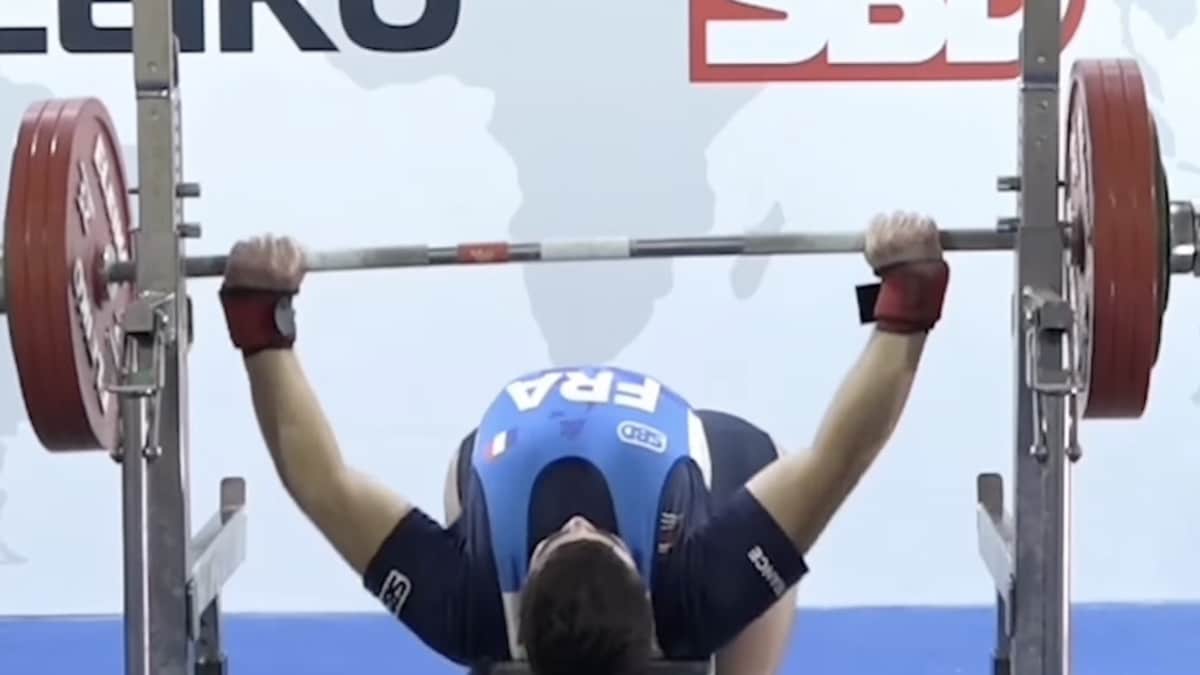
During the 2022 International Powerlifting Federation (IPF) World Classic Sub-Junior and Junior Championships, Triolet broke three raw Sub-Junior IPF World Records in the back squat, bench press, and total in the 93-kilogram weight class. He also captured a competition personal record (PR) on his best deadlift.
These respective stats were enough to vault Triolet to first place in his class. The contest featuring other young competitors like Triolet took place in Istanbul, Turkey, from Aug. 27 to Sept. 4, 2022. Here’s a rundown of Triolet’s top stats from his performance:
2022 IPF World Classic Sub-Junior Championships | Malik Bernoussi Triolet (93KG)
Squat — 282 kilograms (621.7 pounds) | Sub-Junior IPF World Record
Bench Press — 200.5 kilograms (442 pounds) | Sub-Junior IPF World Record
Total — 775 kilograms (1,708.6 pounds) | Sub-Junior IPF World Record
Because Triolet’s new bench press record surpassed his previous mark, the French athlete is now the first 93-kilogram Sub-Junior IPF athlete to press at least 200 kilograms (440.9 pounds). Triolet’s past best bench press was a 193-kilogram (425.5-pound) mark from the 2021 European Powerlifting Federation (EPF) European Classic Powerlifting Championships.
Meanwhile, Triolet’s squat record exceeded Jaime Santillana Izquierdo’s previous world record by 8.5 kilograms (18.7 pounds). As for the staggering total, Triolet eclipsed Jack Hopkins, who logged a 752.5-kilogram (1,659-pound) total at the 2021 EPF European Classic Championships.
Here’s an overview of some of the more notable results from Triolet’s career, who has only ever competed raw:
Malik Bernoussi Triolet (Sub-Juniors) | Notable Career Results
2018 Fédération Française de Force (FFForce) Premier Pas FA PL LAURAF (66KG) — First place/First career victory
2019 FFForce Challenge d’Hiver FA PL LAURAF (74KG) — First place
2020 FFForce Test Match Eleiko (83KG) — Fourth place
2021 IPF World Classic Powerlifting Championships (93KG) — Second place
2022 IPF World Classic Sub-Junior and Junior Powerlifting Championships (93KG) — First place
According to Open Powerlifting, Triolet has competed in 12 sanctioned contests since October 2018. He has four victories to his name. Triolet has finished off the podium on only three occasions and can now boast of his first career victory in a major international competition.
At the time of this writing, Triolet hasn’t made any formal indications toward an upcoming strength competition. That said, at 18 years old and already the owner of a world title, the sky is the limit for one of French powerlifting’s next stars.
Does your knee hurt after a run or other workout? It’s not always runner’s knee; you may be suffering from jumper’s knee or pes anserine bursitis. Here you will find an overview of the three most common knee problems and what you can do about them.
In order to diagnose which knee problem you suffer from, it is important to look at how you work out. All three knee problems can, indeed, develop in any sport. However, the jumper’s knee – as the name suggests – is more common among athletes who do sports involving jumping (e.g. volleyball) or stop-and-go movements (e.g. tennis, soccer). Runner’s knee and pes anserine bursitis, on the other hand, usually appear in runners.
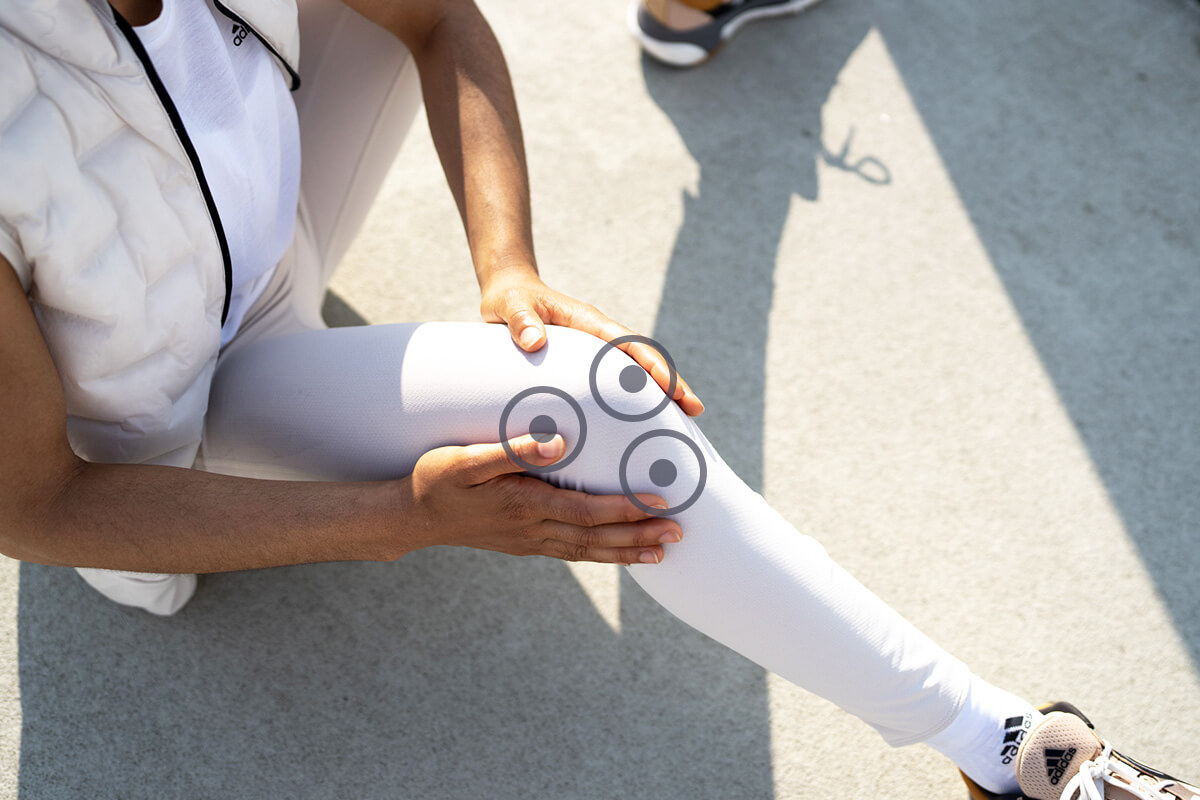
Step #3: Is Your Knee Tender to the Touch?
Tenderness is present in all three conditions:
With the IT band syndrome (also runner’s knee), the tenderness is on the outer side of the knee joint.
With the jumper’s knee, the tenderness can be felt in one spot directly on the patellar pole.
With pes anserine bursitis (also pes anserinus syndrome, inner knee pain, or medial knee pain) there is tenderness below the inner side of the knee joint.
Step #4: What Can I Do About the Pain in My Knee?
Treatment is necessary for all three conditions: ice and rest your knee! Avoid jumping or impact activities.
Foam rolling exercises and stretching can help. If you suffer from Iliotibial band syndrome (ITBS), jumper’s knee, or pes anserine bursitis, you can find helpful exercises and tips in the respective blog posts:
In a nutshell, these three knee problems can usually be distinguished by the location of the pain. The type of sport you do can also provide helpful information.
Please consider:
If the condition does not improve after treating it at home, you should definitely consult a medical professional for a clear diagnosis and additional treatment advice.
***
if(!isRussia){
//check Cookie Opt out and User consent
if(!run_getCookie(“tp-opt-out”)){
!function(f,b,e,v,n,t,s){if(f.fbq)return;n=f.fbq=function(){n.callMethod?
n.callMethod.apply(n,arguments):n.queue.push(arguments)};if(!f._fbq)f._fbq=n;
n.push=n;n.loaded=!0;n.version=’2.0′;n.queue=[];t=b.createElement(e);t.async=!0;
t.src=v;s=b.getElementsByTagName(e)[0];s.parentNode.insertBefore(t,s)}(window,
document,’script’,’https://connect.facebook.net/en_US/fbevents.js’);
fbq(‘init’, ‘1594940627485550’); // Insert your pixel ID here.
fbq(‘track’, ‘ViewContent’);
}
}