Padres con hijos muy enfermos encuentran consuelo y esperanza en la ayuda de hospicio en el hogar

Padres con hijos muy enfermos encuentran consuelo y esperanza en la ayuda de hospicio en el hogar

[ad_1]

Pomona, California.- Cuando conoces por primera vez a Aaron Martinez, de 17 meses, no es evidente que algo está catastróficamente mal.

Lo que ves es un hermoso niño pequeño con piel suave y brillante, abundante cabello castaño y una sonrisa cautivadora. Lo que escuchas son arrullos y gritos que no indican de inmediato que hay algo  mal.

Pero sus padres, Adriana Pinedo y Héctor Martínez, saben bien la dolorosa verdad.

Aunque los médicos y la partera de Adriana habían descrito el embarazo como “perfecto” durante los nueve meses, Aaron nació con la mayoría de las células cerebrales muertas, como resultado de dos accidentes cerebrovasculares y una hemorragia masiva que sufrió mientras estaba en el útero.

Los médicos no están seguros de qué causó las anomalías que dejaron a Aaron prácticamente sin función cognitiva ni movilidad física. Su voluminosa cabellera esconde una cabeza cuya circunferencia es demasiado pequeña para su edad. Tiene epilepsia, lo que desencadena múltiples convulsiones al día, y su sonrisa no siempre es lo que parece. “Podría ser una sonrisa; podría ser una convulsión”, dijo su madre.

Poco después del nacimiento de Aaron, los doctores le dijeron a Adriana, de 34 años, y a Héctor, de 35, que no había esperanza y que debían “dejar que la naturaleza siguiera su curso”. Meses después se enterarían de que los médicos no esperaban que el niño viviera más de cinco días. El día 5, sus padres lo pusieron bajo cuidados paliativos en el hogar, lo que ha continuado hasta su segundo año de vida.

La familia recibe visitas semanales de enfermeras de cuidados paliativos, terapeutas, trabajadores sociales y un capellán en el pequeño apartamento de una habitación que alquilan en una casa de familia, en una tranquila calle residencial en esta ciudad del Inland Empire.
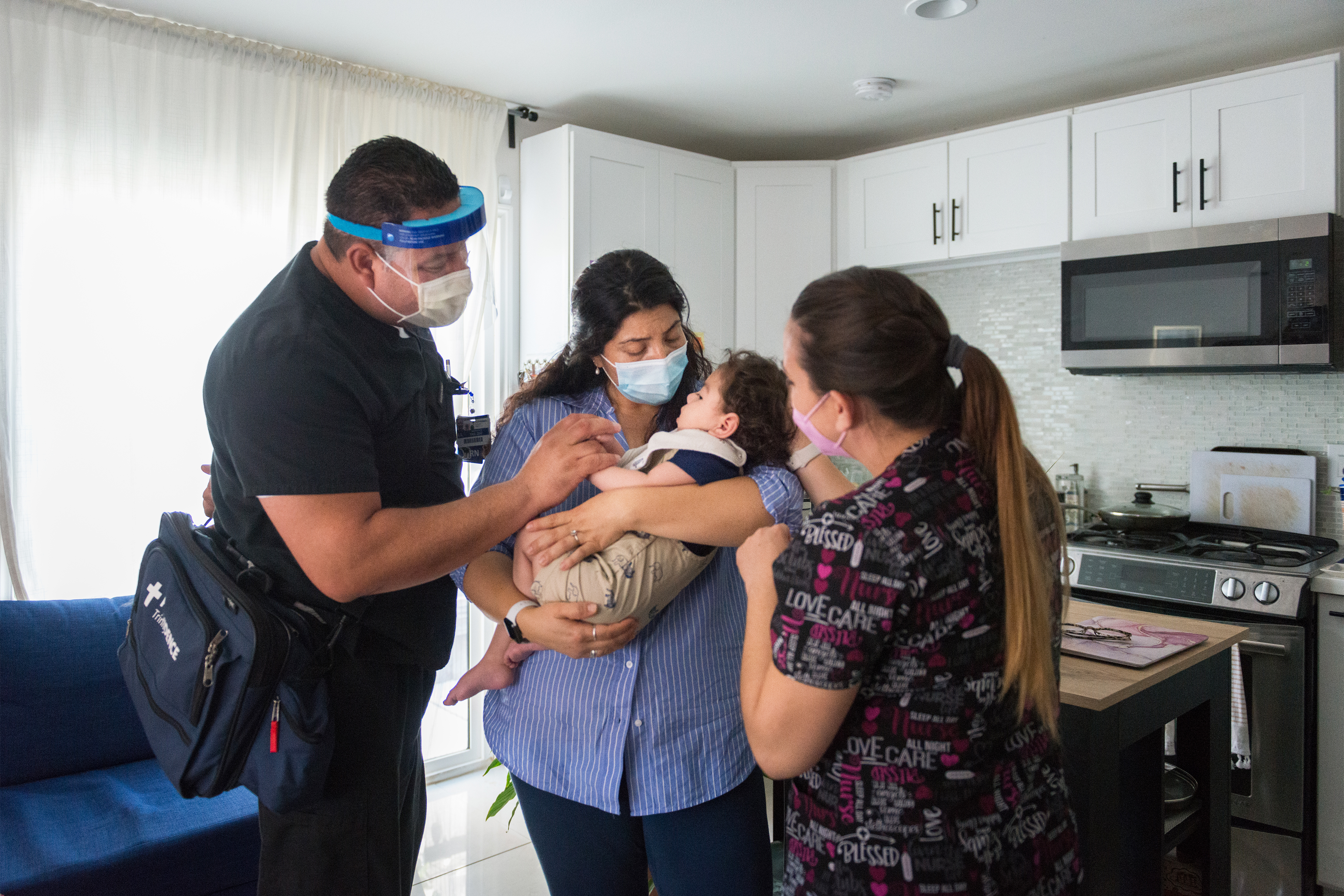
Adriana Pinedo sostiene a su hijo, Aaron Martínez, durante una visita de los enfermeros especializados Raúl Díaz (izq.) y Shannon Stiles. Pinedo describe las visitas semanales del cuidado de hospicio de enfermeras, terapeutas, trabajadores sociales y un capellán como “nuestro salvavidas”.(Heidi de Marco / KHN)

Uno de los criterios principales para el cuidado de hospicio, establecido por Medicare principalmente para personas mayores pero que también aplica a niños, es un diagnóstico de seis meses o menos de vida. Sin embargo, en el transcurso de 17 meses, el equipo médico de Aaron ha vuelto a certificar repetidamente su elegibilidad para cuidados paliativos.

Según una disposición de la Ley de Cuidado de Salud a Bajo Precio (ACA) de 2010, a los niños inscritos en Medicaid o en el Programa de Seguro Médico Infantil (CHIP) se les permite, a diferencia de los adultos, estar en cuidados paliativos mientras continúan recibiendo atención curativa, o para prolongar la vida. Las aseguradoras comerciales no están obligadas a cubrir esta “atención concurrente”, como se la denomina, pero ahora muchas la cubren.

A más de una década de su creación, se reconoce ampliamente que la atención concurrente ha mejorado la calidad de vida de muchos niños con enfermedades terminales, aliviado el estrés de la familia y, en algunos casos, mantenido la esperanza de una cura. Pero el acuerdo puede contribuir a un doloroso dilema para padres como Adriana y Héctor, quienes se debaten entre su feroz compromiso con su hijo y la futilidad de saber que su condición lo deja sin esperanza en un futuro.

“Podríamos perder una vida, pero si sigue viviendo así, perderemos tres”, dijo Adriana. “No hay calidad de vida para él ni para nosotros”

Los médicos de Aaron ahora dicen que posiblemente podría vivir por años. Su cuerpo no ha dejado de crecer desde que nació. Está en el percentil 96 de estatura para su edad y su peso está en el promedio.
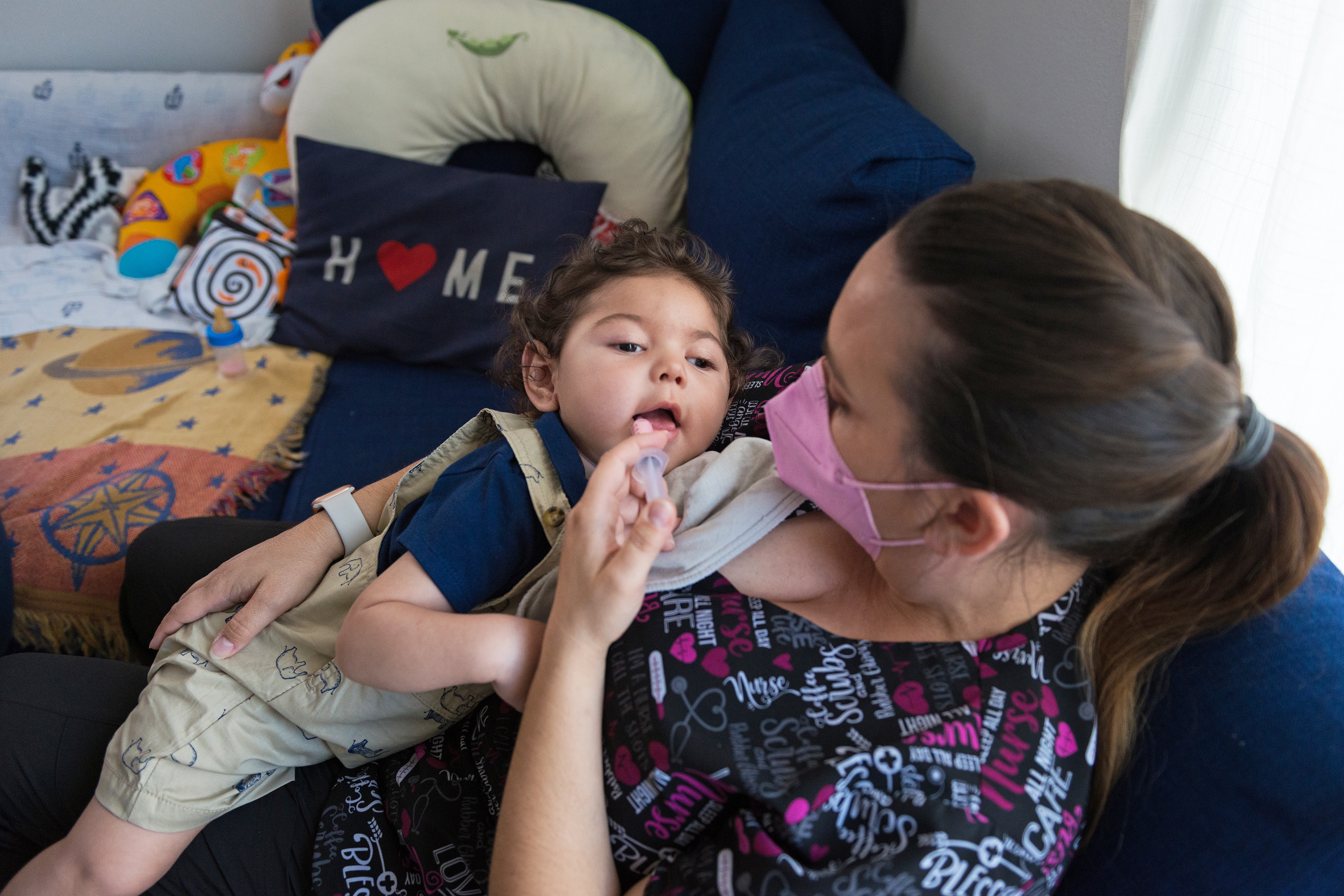
La enfermera de cuidados paliativos Shannon Stiles administra suavemente a Aaron Martinez un medicamento oral. Muchas organizaciones de cuidados paliativos son reacias a aceptar niños, cuyas necesidades médicas y emocionales son a menudo intensas y complejas.(Heidi de Marco / KHN)

Sus padres han hablado sobre “graduarlo” del hospicio. Pero nunca está estable por mucho tiempo, y agradecen las visitas del equipo de cuidados paliativos. Las convulsiones, a veces 30 al día, son un asalto persistente a su cerebro y, a medida que crece, se deben cambiar los medicamentos para controlarlas o recalibrar las dosis. Está en riesgo continuo de problemas gastrointestinales y acumulación de líquido potencialmente mortal en sus pulmones.

Adriana, que trabaja desde casa para una organización de salud pública sin fines de lucro, pasa gran parte de su tiempo con Aaron, mientras Héctor trabaja como paisajista. Dijo que ha elegido vivir el momento, porque de lo contrario su mente divaga hacia un futuro en el que “él podría morir, o no, y terminaré cambiando los pañales de un hombre de 40 años”.  Cualquiera de eso, dijo, “va a ser terrible”.

Si bien el cáncer es una de las principales enfermedades que afectan a los niños en cuidados paliativos, muchos otros, como Aaron, tienen defectos congénitos raros, deficiencias neurológicas graves o deficiencias metabólicas poco comunes.

“Tenemos enfermedades que las familias nos dicen que son uno de los 10 casos en el mundo”, dijo el doctor Glen Komatsu, director médico de TrinityKids Care, con sede en Torrance, que brinda servicios de hospicio en el hogar a Aaron y a más de 70 niños en los condados de Los Ángeles y Orange.

En los años previos a la implementación de ACA, defensores de la salud pediátrica presionaron mucho por la provisión de atención concurrente. Sin la posibilidad de cuidados para prolongar la vida o la esperanza de una cura, muchos padres se negaban a llevar a sus hijos con enfermedades terminales a un hospicio, pensando que equivalía a darse por vencidos.

Eso significaba que toda la familia perdía el apoyo que el hospicio puede brindar, no solo alivio del dolor y consuelo para el niño moribundo, sino atención emocional y espiritual para los padres y hermanos bajo presión extrema.

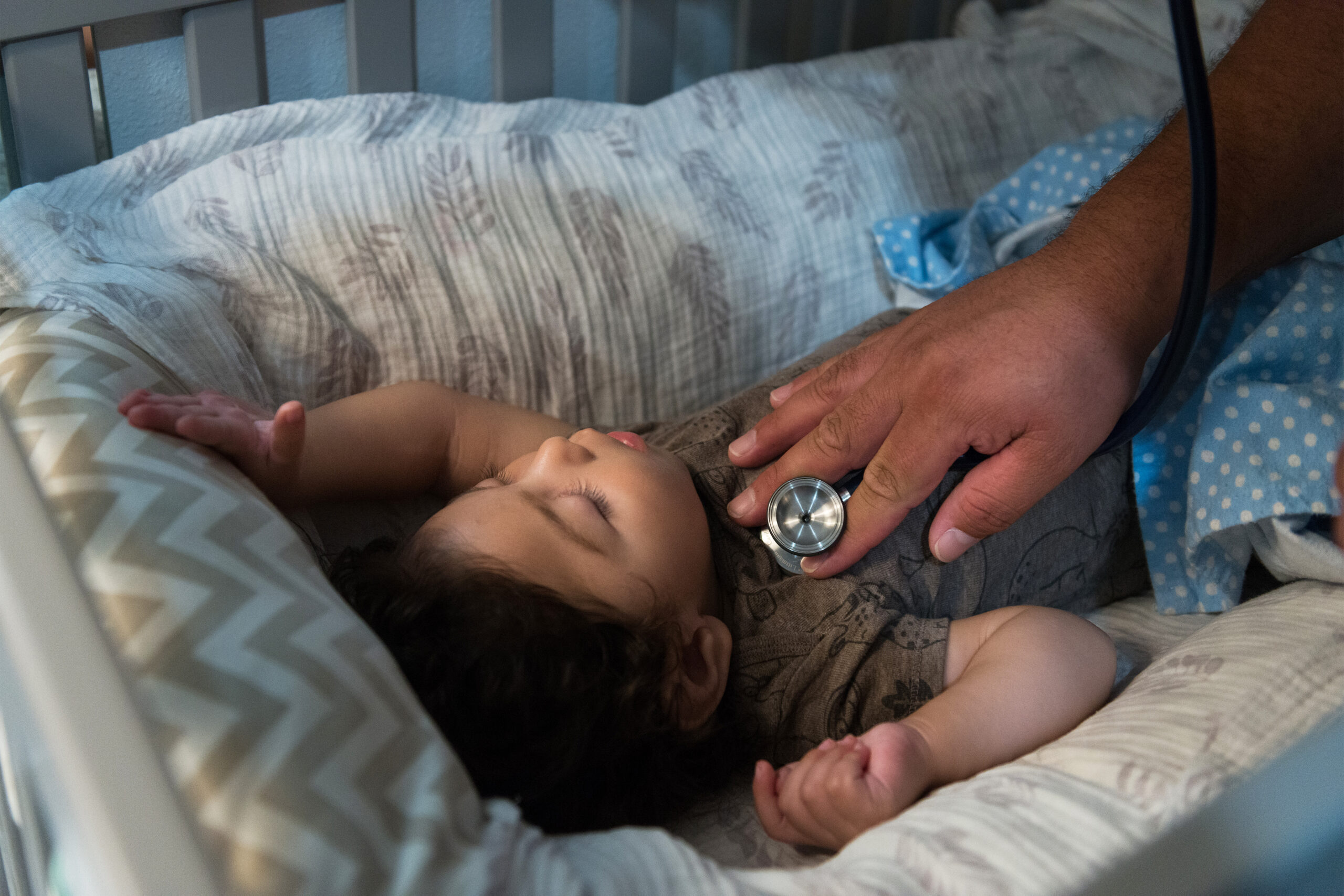
Aaron Martinez duerme en el dormitorio que comparte con sus padres en Pomona, California.(Heidi de Marco / KHN)

TrinityKids Care, administrado por Providence, el gran sistema nacional de salud católico, no solo envía enfermeras, trabajadores sociales y capellanes a los hogares. Para los pacientes participantes y sus hermanos, también ofrece proyectos de arte y ciencia, clases de ejercicios, películas y música. Durante la pandemia, estas actividades se llevaron a cabo a través de Zoom y voluntarios llevaban los suministros necesarios a los hogares de los niños.

La capacidad de obtener tratamientos que prolonguen sus vidas es una de las principales razones por las que los niños en cuidados concurrentes tienen más probabilidades que los adultos de sobrevivir al diagnóstico de seis meses de vida requerido para el hospicio.

“La atención concurrente, por su propia intención, muy claramente extenderá sus vidas, y al extender sus vidas ya no serán elegibles para cuidados paliativos si se utiliza el criterio de expectativa de vida de seis meses”, dijo el doctor David Steinhorn, médico de cuidados intensivos pediátricos en Virginia, que ha ayudado a desarrollar numerosos programas de cuidados paliativos infantiles en el país.

Otro factor es que los niños, incluso los enfermos, son simplemente más fuertes que muchas personas mayores.

“Los niños enfermos suelen estar sanos, excepto por un órgano”, dijo la doctora Debra Lotstein, jefa de la división de confort y cuidados paliativos del Children’s Hospital Los Angeles. “Pueden tener cáncer en el cuerpo, pero sus corazones y sus pulmones están bien, en comparación con una persona de 90 años que, de base, no es tan resistente”.

Todos los órganos vitales de Aaron Martinez, excepto su cerebro, parecen estar funcionando. “Ha habido momentos en los que lo traemos, y la enfermera mira el expediente y lo mira, y no puede creer que sea ese niño”, dijo Héctor, su padre.

Cuando los niños superan la expectativa de vida de seis meses, se les debe volver a certificar para permanecer en el hospicio. Steinhorn dijo que, en muchos casos, está dispuesto a volver a certificar a sus pacientes pediátricos indefinidamente.

Incluso con médicos que los defienden, no siempre es fácil para los niños recibir cuidados paliativos. La mayoría de los hospicios atienden principalmente a adultos y son reacios a aceptar niños.

“El hospicio dirá: ‘No tenemos la capacidad para tratar niños. Nuestras enfermeras no están capacitadas. Es diferente. Simplemente no podemos hacerlo’”, dijo Lori Butterworth, cofundadora de Children’s Hospice and Palliative Care Coalition of California en Watsonville. “La otra razón es no querer, porque es existencialmente devastador, triste y duro”.

Las finanzas también juegan un papel. El cuidado de hospicio en el hogar se paga a una tarifa diaria establecida por Medicare (un poco más de $200 por día durante los primeros dos meses, alrededor de $161 por día después) y generalmente es la misma para niños y adultos. Los niños, en particular aquellos con enfermedades raras, a menudo requieren cuidados más intensivos e innovadores, por lo que el pago no alcanza tanto.

La provisión de atención concurrente ha hecho que el cuidado de pacientes pediátricos sea más viable para las organizaciones de cuidados paliativos, dijeron Steinhorn y otros. Según ACA, muchos de los gastos de ciertos medicamentos y servicios médicos pueden trasladarse al seguro primario del paciente, dejando a los hospicios responsables por el alivio del dolor y la atención de confort.

Aún así, la cantidad relativamente pequeña de niños que mueren cada año por dolencias prolongadas difícilmente hace que el hospicio pediátrico sea una línea de negocios atractiva en una industria que anhela crecer, especialmente una en la que los inversores de capital privado están activos y buscan pagos grandes.

En California, solo 21 de 1,336 hospicios informaron tener un programa de cuidados paliativos pediátricos especializado, y 59 dijeron que atendían al menos a un paciente menor de 21 años, según un análisis de datos estatales de 2020 realizado por Cordt Kassner, director ejecutivo de Hospice Analytics en Colorado Springs, Colorado .

Los proveedores de cuidados paliativos que atienden a niños a menudo se enfrentan a un desafío más básico: incluso con la posibilidad de atención concurrente, muchos padres aún equiparan el cuidado de hospicio con la aceptación de la muerte.

Ese fue inicialmente el caso de Matt y Reese Sonnen, residentes de Los Ángeles cuya hija, Layla, nació con un trastorno convulsivo que no tenía nombre: su cerebro simplemente no se había desarrollado en el útero y una resonancia magnética mostró que “líquido había ocupado el espacio en donde no estaba el cerebro”, dijo su madre.
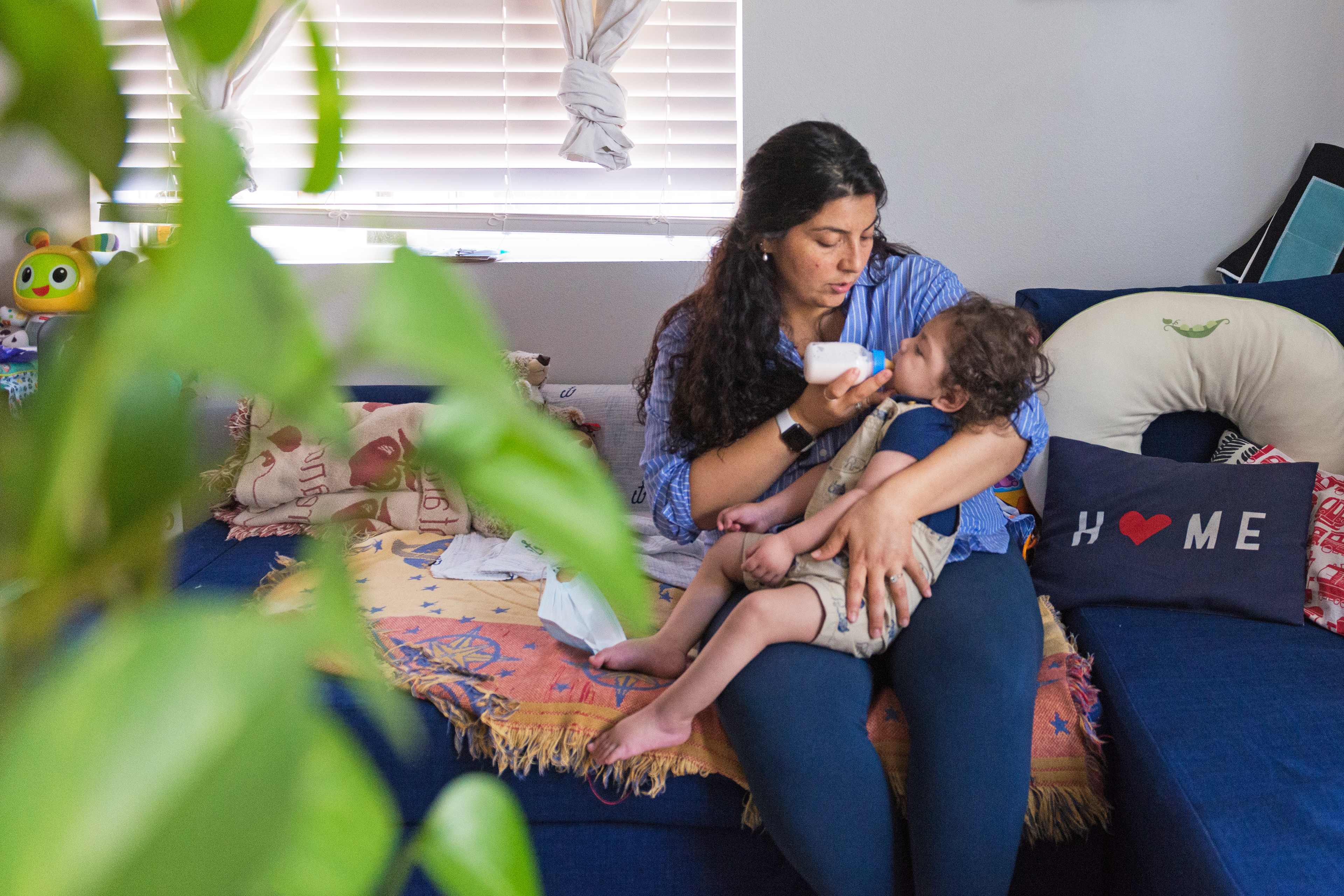
Adriana Pinedo pasa gran parte del día sola con su hijo. Ha decidido vivir en el momento, dice, porque de lo contrario, su mente divaga hacia un futuro en el que “Él podría no morir, o no, y terminaría cambiando los pañales de un hombre de 40 años”.(Heidi de Marco / KHN)

Cuando el equipo de Layla mencionó por primera vez el hospicio, “estaba en el auto hablando por teléfono y casi choco”, recordó Reese. “El primer pensamiento que me vino a la mente fue: ‘Es el final’, pero sentimos que ella no estaba cerca de eso, porque era fuerte, era poderosa. Era mi niña. Iba a superar esto”.

Aproximadamente tres meses después, cuando el sistema nervioso de Layla se deterioró y se retorcía de dolor, sus padres acordaron inscribirla en un hospicio con TrinityKids Care. Murió a las pocas semanas, poco después de su segundo cumpleaños. Estaba en los brazos de su madre, con Matt cerca.

“De repente, Layla exhaló una gran bocanada de aire. La enfermera me miró y dijo: ‘Ese fue su último aliento’. Literalmente estaba respirando su último aliento”, relató Reese. “Nunca quise volver a respirar, porque ahora sentía que la tenía en mis pulmones. No me hagas reír, no me hagas exhalar”.

Los padres de Layla no se arrepienten de su decisión de internarla en un hospicio. “Fue la decisión absolutamente correcta y, en retrospectiva, deberíamos haberlo hecho antes”, dijo Matt. “Estaba sufriendo y nosotros teníamos puestas anteojeras”.

Adriana Pinedo dijo que está “infinitamente agradecida” por el cuidado de hospicio, a pesar de la angustia por la condición de Aaron. A veces, la trabajadora social se detiene, dijo, solo para saludar y dejar un café con leche, un pequeño gesto que puede sentirse muy alentador. “Han sido nuestro salvavidas”, dijo.

Adriana habla de una amiga suya que tiene un bebé sano, también llamado Aaron, que está embarazada de su segundo hijo. “Están viviendo todas las cosas que estaban en nuestra lista. Y los quiero mucho”, dijo Adriana. “Pero es casi difícil de mirar, porque es como mirar las cosas que no obtuviste. Es como el día de Navidad, mirando a través de la ventana a la casa del vecino, y estás sentado allí en el frío”.

Sin embargo, parece palpablemente dividida entre ese remordimiento sombrío y el amor incondicional que los padres sienten por sus hijos. En un momento, Adriana se interrumpió a media frase y se volvió hacia su hijo, que estaba en los brazos de Héctor: “Sí, papi, eres tan lindo y sigues siendo mi sueño hecho realidad”.

Esta historia fue producida por KHN, que publica California Healthline, un servicio editorialmente independiente de la California Health Care Foundation.

[ad_2]

Source link

KHN’s ‘What the Health?’: Biden Declares the Pandemic ‘Over’

KHN’s ‘What the Health?’: Biden Declares the Pandemic ‘Over’

[ad_1]

Can’t see the audio player? Click here to listen on Acast. You can also listen on Spotify, Apple Podcasts, Stitcher, Pocket Casts, or wherever you listen to podcasts.

Click here for a transcript of the episode.

President Joe Biden’s declaration in a national interview that the covid-19 pandemic is “over” has complicated his own administration’s efforts to get Congress to provide more funding for treatments and vaccines, and to get the public to go get yet another booster.

Meanwhile, concerns about a return of medical inflation for the first time in a decade is helping boost insurance premiums, and private companies are scrambling to claim their piece of the health care spending pie.

This week’s panelists are Julie Rovner of KHN, Anna Edney of Bloomberg News, Joanne Kenen of the Johns Hopkins Bloomberg School of Public Health and Politico, and Lauren Weber of KHN.

Among the takeaways from this week’s episode:

  • Biden’s comment to “60 Minutes” that the pandemic was over — even though covid is still an issue — highlights the difficulty in communicating to the public how to transition from a public health crisis to a public health problem.
  • Much of the country may agree with the president, as evidenced by fewer people using face masks regularly and a decreased number of commercial restrictions related to covid. But several hundred people are still dying each day, a high toll often overlooked.
  • Insurance premiums appear to be on the upswing this fall, even though medical costs have not been rising as quickly as other parts of the economy in recent months. The increase may reflect insurers’ concerns that, coming out of the covid crisis, consumers will be seeking more medical services.
  • One aspect of health business that is driving up costs is the increased investment by private equity companies, which are expanding their reach beyond emergency room doctors and a few other specialties to a wider range of medical services, including gastroenterology and ophthalmology.
  • Another concern for the future of health costs is the move toward consolidation in health care. Among recent developments on that front were Amazon’s announcement it is moving into primary care with the purchase of One Medical and CVS’ decision to buy home health care company Signify Health.
  • Abortion policies continue to make news in various states. West Virginia passed a law that restricts nearly all abortions; several Utah Republican legislators sent cease-and-desist letters to abortion providers in their state; and Puerto Rico has a new political party campaigning on the issue of trying to curb the commonwealth’s liberal abortion law.
  • While Democrats hope the issue of abortion will swing more voters their way in the midterm elections, it’s not clear whether overall support for abortion will be a deciding issue for voters in more conservative states and bring any changes.

Plus, for extra credit, the panelists recommend their favorite health policy stories of the week they think you should read, too:

Julie Rovner: The Anchorage Daily News’ “Many Alaska Pharmacies Are Understaffed, Leading to Sporadic Hours and Patients Turned Away,” by Annie Berman

Joanne Kenen: Capital B’s “Clinicians Dismiss Black Women’s Pain. The Consequences Are Dire,” by Margo Snipe

Anna Edney: The Guardian’s “Fury Over ‘Forever Chemicals’ as US States Spread Toxic Sewage Sludge,” by Tom Perkins

Lauren Weber: KHN’s “Doctors Rush to Use Supreme Court Ruling to Escape Opioid Charges,” by Brett Kelman

Also mentioned in this week’s episode:

To hear all our podcasts, click here.

And subscribe to KHN’s What the Health? on Spotify, Apple Podcasts, Stitcher, Pocket Casts, or wherever you listen to podcasts.

KHN (Kaiser Health News) is a national newsroom that produces in-depth journalism about health issues. Together with Policy Analysis and Polling, KHN is one of the three major operating programs at KFF (Kaiser Family Foundation). KFF is an endowed nonprofit organization providing information on health issues to the nation.

USE OUR CONTENT

This story can be republished for free (details).

We encourage organizations to republish our content, free of charge. Here’s what we ask:

You must credit us as the original publisher, with a hyperlink to our khn.org site. If possible, please include the original author(s) and “Kaiser Health News” in the byline. Please preserve the hyperlinks in the story.

It’s important to note, not everything on khn.org is available for republishing. If a story is labeled “All Rights Reserved,” we cannot grant permission to republish that item.

Have questions? Let us know at [email protected]

[ad_2]

Source link

In Jackson, the Water Is Back, but the Crisis Remains

In Jackson, the Water Is Back, but the Crisis Remains

[ad_1]

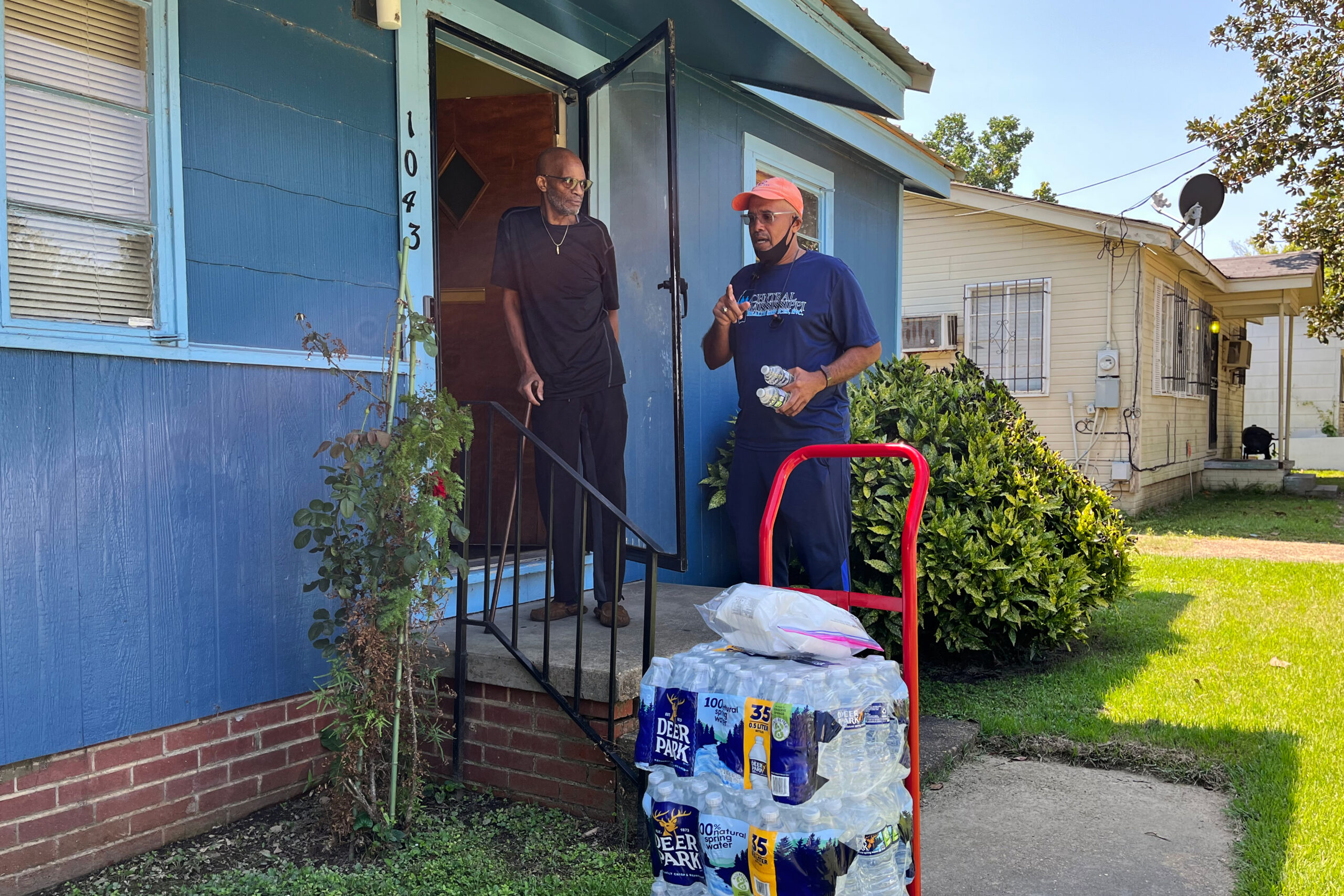
JACKSON, Miss. — In mid-September, Howard Sanders bumped down pothole-ridden streets in a white Cadillac weighed down with water bottles on his way to a home in Ward 3, a neglected neighborhood that he called “a war zone.”

Sanders, director of marketing and outreach for Central Mississippi Health Services, was then greeted at the door by Johnnie Jones. Since Jones’ hip surgery about a month ago, the 74-year-old had used a walker to get around and hadn’t been able to get to any of the city’s water distribution sites.

Jackson’s routine water woes became so dire in late August that President Joe Biden declared a state of emergency: Flooding and water treatment facility problems had shut down the majority-Black city’s water supply. Although water pressure returned and a boil-water advisory was lifted in mid-September, the problems aren’t over.

Bottled water is still a way of life. The city’s roughly 150,000 residents must stay alert — making sure they don’t rinse their toothbrushes with tap water, keeping their mouths closed while they shower, rethinking cooking plans, or budgeting for gas so they can drive around looking for water. Many residents purchase bottled water on top of paying water bills, meaning less money for everything else. For Jackson’s poorest and oldest residents, who can’t leave their homes or lift water cases, avoiding dubious water becomes just that much harder.

“We are shellshocked, we’re traumatized,” Sanders said.

Jackson’s water woes are a manifestation of a deeper health crisis in Mississippi, whose residents have pervasive chronic diseases. It is the state with the lowest life expectancy and the highest rate of infant mortality.

“The water is a window into that neglect that many people have experienced for much of their lives,” said Richard Mizelle Jr., a historian of medicine at the University of Houston. “Using bottled water for the rest of your life is not sustainable.”

But in Jackson an alternative doesn’t exist, said Dr. Robert Smith. He founded Central Mississippi Health Services in 1963 as an outgrowth of his work on civil rights, and the organization now operates four free clinics in the Jackson area. He often sees patients with multiple health conditions such as diabetes, hypertension, or heart problems. And unsafe water could lead to death for people who do their dialysis at home, immunocompromised individuals, or babies who drink formula, said Smith.

Residents filed a lawsuit this month against the city and private engineering firms responsible for the city’s water system, claiming they had experienced a host of health problems — dehydration, malnutrition, lead poisoning, E. coli exposure, hair loss, skin rashes, and digestive issues — as a result of contaminated water. The lawsuit alleges that Jackson’s water has elevated lead levels, a finding confirmed by the Mississippi State Department of Health.

While Jackson’s current water situation is extreme, many communities of color, low-income communities, and those with a large share of non-native English speakers also have unsafe water, said Erik Olson, senior strategic director for health and food at the Natural Resources Defense Council. These communities are more frequently subjected to Safe Drinking Water Act violations, according to a study by the nonprofit advocacy group. And it takes longer for those communities to come back into compliance with the law, Olson said.

The federal infrastructure bill passed last year includes $50 billion to improve the country’s drinking water and wastewater systems. Although Mississippi is set to receive $429 million of that funding over five years, Jackson must wait — and fight — for its share.

And communities often spend years with lingering illness and trauma. Five years after the start of the water crisis in Flint, Michigan, about 20% of the city’s adult residents had clinical depression, and nearly a quarter had post-traumatic stress disorder, according to a recent paper published in JAMA.

Jones, like many locals, hasn’t trusted Jackson’s water in decades. That distrust — and the constant vigilance, extra expenses, and hassle — add a layer of psychological strain.

“It is very stressful,” Jones said.

For the city’s poorest communities, the water crisis sits on top of existing stressors, including crime and unstable housing, said Dr. Obie McNair, chief operating officer of Central Mississippi Health Services. “It’s additive.”

Over time, that effort and adjustment take a toll, said Mauda Monger, chief operating officer at My Brother’s Keeper, a community health equity nonprofit in Jackson. Chronic stress and the inability to access care can exacerbate chronic illnesses and lead to preterm births, all of which are prevalent in Jackson. “Bad health outcomes don’t happen in a short period of time,” she said.

For Jackson’s health clinics, the water crisis has reshaped their role. To prevent health complications that can come from drinking or bathing in dirty water, they have been supplying the city’s most needy with clean water.

“We want to be a part of the solution,” McNair said.

Community health centers in the state have a long history of filling gaps in services for Mississippi’s poorest residents, said Terrence Shirley, CEO of the Community Health Center Association of Mississippi. “Back in the day, there were times when community health centers would actually go out and dig wells for their patients.”

Central Mississippi Health Services had been holding water giveaways for residents about two times a month since February 2021, when a winter storm left Jackson without water for weeks.

But in August, things got so bad again that Sanders implored listeners of a local radio show to call the center if they couldn’t get water. Many Jackson residents can’t make it to the city’s distribution sites because of work schedules, lack of transportation, or a physical impairment.

“Now, all of a sudden, I am the water man,” Sanders said.

Thelma Kinney Cornelius, 72, first heard about Sanders’ water deliveries from his radio appearances. She hasn’t been able to drive since her treatment for intestinal cancer in 2021. She rarely cooks these days. But she made an exception a few Sundays ago, going through a case of bottled water to make a pot of rice and peas.

“It’s a lot of adjustment trying to get into that routine,” said Cornelius. “It’s hard.”

The day that Jackson’s boil-water advisory was lifted, Sanders was diagnosed with a hernia, probably from lifting heavy water cases, he said. Still, the following day, Sanders drove around the Virden Addition neighborhood with other volunteers, knocking on people’s doors and asking whether they needed water.

He said he has no plans to stop water deliveries as Jackson residents continue to deal with the long-term fallout from the summer’s crisis. Residents are still worried about lead or other harmful contaminants lurking in the water.

“It’s like a little Third World country over here,” Sanders said. “In all honesty, we will probably be on this for the next year.”

KHN (Kaiser Health News) is a national newsroom that produces in-depth journalism about health issues. Together with Policy Analysis and Polling, KHN is one of the three major operating programs at KFF (Kaiser Family Foundation). KFF is an endowed nonprofit organization providing information on health issues to the nation.

USE OUR CONTENT

This story can be republished for free (details).

[ad_2]

Source link

Hemp-Derived Delta-8 Skirts Marijuana Laws and Raises Health Concerns

Hemp-Derived Delta-8 Skirts Marijuana Laws and Raises Health Concerns

[ad_1]

Suzan Kennedy has smoked marijuana, and says her Wisconsin roots mean she can handle booze, so she was not concerned earlier this year when a bartender in St. Paul, Minnesota, described a cocktail with the cannabinoid delta-8 THC as “a little bit potent.”

Hours after enjoying the tasty drink and the silliness that reminded Kennedy of a high from weed, she said, she started to feel “really shaky and faint” before collapsing in her friend’s arms. Kennedy regained consciousness and recovered, but her distaste for delta-8 remains, even though the substance is legal at the federal level, unlike marijuana.

“I’m not one to really tell people what to do,” said Kennedy, 35, who lives in Milwaukee and works in software sales. But if a friend tried to order a delta-8 drink, “I would tell them, ‘Absolutely not. You’re not putting that in your body.’”

The FDA and some marijuana industry experts share Kennedy’s concerns. At least a dozen states have banned the hemp-derived drug, including Colorado, Montana, New York, and Oregon, which have legalized marijuana. But delta-8 manufacturers call the concerns unfounded and say they’re driven by marijuana businesses trying to protect their market share.

So what is the difference? The flower of the marijuana plant, oil derived from it, and edibles made from those contain delta-9 tetrahydrocannabinol, the substance that produces the drug’s high, and can be legally sold only at dispensaries in states that have legalized marijuana. Similar products that contain delta-8 THC are sold online and at bars and retailers across much of the U.S., including some places where pot remains illegal. That’s because a 2018 federal law legalized hemp, a variety of the cannabis plant. Hemp isn’t allowed to contain more than 0.3% of the psychotropic delta-9 THC found in marijuana.

The concerns about delta-8 are largely focused on how it’s made. Delta-8 is typically produced by dissolving CBD — a compound found in cannabis plants — in solvents, such as toluene that is often found in paint thinner. Some people in the marijuana industry say that process leaves potentially harmful residue. A study published in the journal Chemical Research in Toxicology last year found lead, mercury, and silicon in delta-8 electronic cigarettes.

The FDA has issued warnings about the “serious health risks” of delta-8, citing concerns about the conversion process, and has received more than 100 reports of people hallucinating, vomiting, and losing consciousness, among other issues, after consuming it. From January 2021 through this February, national poison control centers received more than 2,300 delta-8 cases, 70% of which required the users to be evaluated at health care facilities, according to the FDA.

Delta-8 is “just the obvious solution to people who want to have access to cannabis but live in a state where it’s illegal,” said Dr. Peter Grinspoon, a primary care physician at Massachusetts General Hospital and a longtime medical cannabis provider. “You can either get in a lot of trouble buying cannabis, or you can get delta-8.”

Grinspoon described delta-8 as about half as potent as marijuana. But because of the lack of research into delta-8’s possible benefits and the absence of regulation, he would not recommend his patients use it. If it were regulated like Massachusetts’ medical and recreational marijuana programs, he said, harmful contaminants could be flagged or removed.

Christopher Hudalla, chief scientific officer at ProVerde Laboratories, a Massachusetts marijuana and hemp testing company, said he has examined thousands of delta-8 products and all contained contaminants that could be harmful to consumers’ health.

Delta-8 has “incredible potential as a therapeutic” because it has many of the same benefits as marijuana, minus some of the intoxication, said Hudalla. “But delta-8, like unicorns, doesn’t exist. What does exist in the market is synthetic mixtures of unknown garbage.”

Justin Journay, owner of the delta-8 brand 3Chi, is skeptical of the concerns about the products. He started the company in 2018 after hemp oil provided relief for his shoulder pain. He soon started wondering what other cannabinoids in hemp could do. “‘There’s got to be some gold in those hills,’” Journay recalled thinking. He said his Indiana-based company now has more than 300 employees and sponsors a NASCAR team.

When asked about the FDA’s reports of bad reactions, Journay said: “There are risks with THC. There absolutely are. There are risks with cheeseburgers.”

He attributes the side effects to taking too much. “We say, ‘Start low.’ You can always take more,” Journay said.

Journay said that he understands concerns about contaminants in delta-8 products and that his company was conducting tests to identify the tiny portion of substances that remain unknown, which he asserts are cannabinoids from the plant.

An analysis of 3Chi delta-8 oil conducted by Hudalla’s firm last year and posted on 3Chi’s website found multiple unidentified compounds that “do not occur naturally” and thus “would not be recommended for human consumption.” Delta-8 oil is still sold on 3Chi’s site.

Journay said the analysis found that only 0.4% of the oil contained unknown compounds. “How can they then definitively say that compound isn’t natural when they don’t even know what it is?” he said in an email.

“The vast majority of negative information out there and the push to make delta-8 illegal is coming from the marijuana industries,” Journay said. “It’s cutting into their profit margins, which is funny that the marijuana guys would all of a sudden be for prohibition.”

Delta-8 products do appear to be significantly cheaper than weed. For example, Curaleaf, one of the world’s largest cannabis companies, offers packages of gummies that contain 100 milligrams of delta-9 THC for $25, plus sales tax, at a Massachusetts dispensary. At 3Chi, gummies with 400 milligrams of delta-8 cost $29.99 online, with no tax.

Journay’s criticism of the marijuana industry holds some truth, said Chris Lindsey, government relations director for the Marijuana Policy Project, which advocates for legalization of marijuana for adults. “We see this happen in every single adult-use legalization state,” said Lindsey. “Their established medical cannabis industry will sometimes be your loudest opponents, and that’s a business thing. That’s not a marijuana thing.”

Still, the bans might not be working fully. In New York, which banned delta-8 in 2021, Lindsey said, it’s available at any bodega.

In July, Minnesota implemented a law that limits the amount of THC, including delta-8, allowed in hemp products outside of its medical marijuana program. News reports said the law would wipe out delta-8. But the state cannot “control what’s being sold over the internet outside of Minnesota and shipped in,” said Maren Schroeder, policy director for Sensible Change Minnesota, which aims to legalize recreational cannabis for adults.

Max Barber, a writer and editor in Minneapolis, remains interested in delta-8 despite his state’s restrictions. Even though he could likely obtain a medical marijuana prescription because he has an anxiety disorder and chronic sleep problems, he hasn’t pursued it because pot made his anxiety worse. He used CBD oil but found the effects inconsistent. In March 2021, he tried a 10-milligram delta-8 gummy.

“It got me pretty high, which I don’t enjoy,” he said.

Then he found what he considers the right dosage for him: one-third of a gummy, which he takes in the evening. He said he now gets between six and eight hours of sleep each night, has less anxiety, and is better able to focus. “I have become kind of an evangelist for delta-8 for everyone I know who has sleep problems,” said Barber, who bought enough gummies to last for months after the new law went into effect.

To address concerns about delta-8, the federal government should regulate it and make accessing cannabis easier for consumers, said Paul Armentano, deputy director of the National Organization for the Reform of Marijuana Laws.

He pointed to a recent study in the International Journal of Drug Policy showing that the number of Google searches for delta-8 in the U.S. soared in 2021 and that interest was especially high in states that restricted cannabis use. “In an environment where whole-plant cannabis is legally available, there would be little to no demand for these alternative products,” said Armentano.

Lindsey, of the Marijuana Policy Project, isn’t so sure that would matter. When he first learned of delta-8’s growing popularity in 2021, he thought it would go the way of drugs like K2 or Spice that he said fall between the regulatory rules long enough to get on shelves before eventually getting shut down.

“That didn’t materialize,” said Lindsey. “The more that we understand about that plant, the more of these different cannabinoids are going to come out.” And that, he said, will in turn spur interest from consumers and businesses.

KHN (Kaiser Health News) is a national newsroom that produces in-depth journalism about health issues. Together with Policy Analysis and Polling, KHN is one of the three major operating programs at KFF (Kaiser Family Foundation). KFF is an endowed nonprofit organization providing information on health issues to the nation.

USE OUR CONTENT

This story can be republished for free (details).

[ad_2]

Source link

Shattered Dreams and Bills in the Millions: Losing a Baby in America

Shattered Dreams and Bills in the Millions: Losing a Baby in America

[ad_1]

The day after his 8-month-old baby died, Kingsley Raspe opened the mail and found he had been sent to collections for her care.

That notice involved a paltry sum, $26.50 — absurd really, given he’d previously been told he owed $2.5 million for treatment of his newborn’s congenital heart defect and other disorders.

Raspe and his wife, Maddie, had endured watching doctors crack open the chest of their pigtailed daughter, Sterling, whom they called “sweet Sterly gurl.” The health team performed so many other procedures. But it couldn’t keep her — or her parents’ dreams for her — alive.

The bills lived on for them, as they do for many other families of premature and very sick infants who don’t survive.

“What a lasting tribute to the entire experience,” Kingsley said angrily. “The process was just so heartless.”

More than 300,000 U.S. families have infants who require advanced medical attention in newborn intensive care units every year. Some babies stay for months, quickly generating astronomical fees for highly specialized surgeries and round-the-clock care. The services are delivered, and in U.S. health care, billing follows. But for the smaller fraction of families whose children die, the burden can be too much to bear.

A patchwork of convoluted Medicaid-qualification rules seek to defray these kinds of bills for very sick children. But policies differ in each state, and many parents — especially those, like the Raspes, who have commercial insurance — don’t know to apply or think they won’t qualify.

Also, because many crises that befall premature or very sick babies are in-the-moment emergencies, there may not be time for the preapprovals that insurers often require for expensive interventions. That leaves parents in crisis — or in mourning — tasked with fighting with insurers to have treatment covered.

Three families detailed for KHN how medical bills compounded their suffering during a time when they were just trying to process their loss.

Bennett Markow

As the hospital in Reno, Nevada, was converting a parking garage into a covid-19 unit in November 2020, Bennett Markow came into the world four months early. He weighed less than a pound. His care team loved to sing “Bennie and the Jets” to him as a nod to the jet ventilator keeping his tiny lungs working.

On Jan. 20, 2021, when Bennett was 2 months old, his parents were told he needed to go to UC Davis Children’s Hospital in Sacramento, California, for specialized care that could keep him from going blind. The transfer team would be there in an hour. And the Nevada care team said that because it was an emergency, the family needn’t worry about their insurance or the method of transportation.

Bennett’s eye problem ended up being less severe than the doctors had feared. And Crissa Markow and her husband, A.J., were billed for the plane ride from REACH Air Medical Services, which turned out to be out of network. Jason Sorrick, vice president of government relations for REACH’s parent company, Global Medical Response, said the ride happened during a “lapse” in Bennett’s Medicaid coverage.

The Markows said there was no lapse. They hadn’t applied yet because they thought they wouldn’t qualify — the family is middle-class, and Bennett was on Crissa’s insurance. They did not know they should until a social worker at UC Davis gave them more information — after the flight.

Crissa Markow said her heart dropped to her toes when she realized she was being billed over $71,000, more than she makes in a year as a social worker. (The No Surprises Act, which aims to eliminate surprise billing, could have prevented some of the family’s headaches — but Bennett was born before it went into effect this year.)

Although Crissa was used to working toward solutions, the billing quagmires she found herself in while juggling Bennett’s care, her job, her other son, and the travel logistics to stay with Bennett about 2½ hours away from her home were overwhelming. Crissa estimates she spent six to eight hours a week dealing with medical bills to keep them from being sent to collections — which still happened.

Bennett died last July after doctors said his lungs could not fight anymore. The Markows spent their bereavement leave battling with insurers and other billing agencies.

Finally, Crissa called REACH, the air transport company, and said: “Look, my son died. I just want to be able to grieve, I want to focus on that. Dealing with this bill is traumatic. It’s a reminder every day I shouldn’t have to be fighting this.”

By October, the Markows had settled the bill with REACH on the condition that they not disclose the terms. Sorrick said that the company reaches agreements based on the financial and personal situations of each patient and their family and that the company’s patient advocates had talked to Crissa Markow 17 times.

“If every settlement amount was disclosed publicly, then those rates become the expectation of all patients and insurance providers,” Sorrick said. “Ultimately, that would lead to all patients wanting to pay below cost, making our services unsustainable.”

Crissa Markow’s employer-provided insurance paid $6.5 million for Bennett’s care, not including what was covered by Medicaid. The Markows paid roughly $6,500 out-of-pocket to hospitals and doctors on top of their REACH settlement. But it was not those amounts — which the couple would have happily paid to save their son — but the endless harassment and the hours spent on the phone that haunt them.

“I just wanted to be with Bennett; that’s all I wanted to do,” Crissa Markow said. “And I just spent hours on these phone calls.”

Jack Shickel

Jack Shickel was born with stunning silver hair and hypoplastic left heart syndrome. Even though he was surrounded by wires and tubes, the nurses at UVA Children’s Hospital would whisper to Jessica and her husband, Isaac, that they had a truly “cute” baby.

But his congenital disorder meant the left side of his heart never fully developed. Each year in the U.S., over a thousand babies are born with the syndrome.

After two surgeries, Jack’s heart could not pump enough blood on its own. He made it 35 days.

Weeks after his death, when the Shickels were trying to muddle through life without him in Harrisonburg, Virginia, they called the hospital billing department about two confusing bills. They were then told the full cost of his care was $3.4 million.

“I laughed and then cried,” Jessica said. “He was worth every penny to us, but that’s basically $100,000 a day.”

Bills from out-of-network labs and other prior approval notifications continued to overwhelm their mailbox. Eventually, they figured out how to get Medicaid. The Shickels ended up paying only $470.26.

Jessica got the final bills in March, seven months after Jack’s death.

She noted that all of this was happening as the University of Virginia Health System said it was rolling back its aggressive billing practices after a KHN investigation found the prestigious university hospital was putting liens on people’s homes to recoup medical debt.

UVA Health spokesperson Eric Swensen expressed condolences to the Shickel family and added that the health system works to help patients navigate the “complex process” of evaluating financial assistance, including Medicaid coverage.

After KHN reached out for comment, the Shickels got a call from UVA saying that the hospital was refunding their payment.

The hospital care team had given the family a pamphlet about what to do when grieving, but a more useful one, Jessica said, would have been titled “How Do You Deal With Medical Bills After Your Child Has Died?”

Sterling Raspe

Kingsley Raspe likes to say Sterling was “one special little lady” — not only did she have the same congenital heart defect as Jack Shickel, but she was also diagnosed with Kabuki syndrome, a rare disorder that can severely affect development. Sterling also had hearing loss, spinal cord issues, and a compromised immune system.

An explanation of benefits from the Raspes’ commercial insurance indicated the couple would need to pay $2.5 million for Sterling’s care — an amount so large the numbers didn’t all fit in the column. Even Kingsley’s suspicion that the $2.5 million charge was likely erroneous — in large part or in whole — didn’t erase the sheer panic he felt when he saw the number.

A computer programmer making $90,000 a year, Kingsley had decent insurance. He frantically Googled “medical bankruptcy.”

Sterling had been denied Medicaid, which is available to children with complex medical problems in some states. Kingsley had filed an application for the government insurance, which had to be submitted by mail from the family home in Gary, Indiana. In doing so, he broke the strict protocols on covid exposure set early in the pandemic at the Ronald McDonald charity house near the Illinois hospital where Sterling was being treated and jeopardized his ability to stay there.

In rejecting the application, Indiana cited an income threshold and other technical reasons.

Everyone kept telling Kingsley and Maddie to get divorced so Sterling would qualify for Medicaid. But that wasn’t an option for Kingsley, a British citizen who is in the U.S. on a green card after meeting Maddie on Tinder.

Ultimately, Kingsley’s insurer revised the faulty notice that he owed $2.5 million. The family was told the mistake had occurred because Sterling’s initial hospital stay and surgeries had not been preapproved, although Kingsley said the heart defect was discovered halfway through the pregnancy, making surgery inevitable.

Throughout Sterling’s life, Kingsley did his programming job at his daughter’s bedside, in her hospital room. As a web developer, he created visualizations that break down Sterling’s expensive care — it helped him make sense of it all. But he cries when he remembers those days.

He hates that Sterling’s life can be reduced to a 2-inch stack of printed-out medical bills and the phone calls he still must endure from errant billers.

Despite receiving a plethora of other bills in the tens of thousands, he and his wife eventually paid their $4,000 deductible, along with a smattering of smaller charges and fees for equipment rentals that weren’t covered. In April, Maddie gave birth to a son, Wren, and Kingsley said he knows Sterling served as her brother’s guardian angel.

“My daughter passed away. I’m not unscathed, but I’m not in financial ruin. The same can’t be said for every family,” he said. “How lucky am I? I went through the worst thing imaginable, and I consider myself lucky — what kind of weird, messed-up logic is that?”

Navigating the NICU

Contact your insurance company to talk through your NICU stay costs, including what is covered and what is not. If your baby’s not already on your plan, make sure to add them.

Speak to a social worker immediately about applying for Medicaid or the Supplemental Security Income program, known as SSI. If your child qualifies, it can dramatically reduce your personal cost for a child with extensive medical bills.

The March of Dimes offers a “My NICU Baby” app designed to help you wade through the overwhelming experience. The nonprofit says the app can help you learn about caring for your baby in the NICU and at home, as well as monitor your baby’s progress, manage your own health, and keep track of your to-do list and questions.

If particular insurers or bills are confusing, reach out to your state insurance office. All states offer consumer support, and some states have dedicated advocates who can help you.

Kingsley Raspe also compiled advice for other families navigating neonatal intensive care unit stays for their babies.

Bill of the Month is a crowdsourced investigation by KHN and NPR that dissects and explains medical bills. Do you have an interesting medical bill you want to share with us? Tell us about it!

[ad_2]

Source link

Journalists Dissect Medical Coding and Parse the President’s Words

Journalists Dissect Medical Coding and Parse the President’s Words

[ad_1]

KHN freelancer Helen Santoro discussed insurance coverage for transgender medical care on KCRW’s “Press Play with Madeleine Brand” on Sept. 21.

KHN chief Washington correspondent Julie Rovner discussed President Joe Biden’s statement that the covid-19 “pandemic is over” on Axios’ “Axios Today” podcast on Sept. 19.

KHN senior editor Andy Miller discussed the plan to restore the reputation of the Centers for Disease Control and Prevention on WUGA’s “The Health Report” on Sept. 18.

KHN (Kaiser Health News) is a national newsroom that produces in-depth journalism about health issues. Together with Policy Analysis and Polling, KHN is one of the three major operating programs at KFF (Kaiser Family Foundation). KFF is an endowed nonprofit organization providing information on health issues to the nation.

USE OUR CONTENT

This story can be republished for free (details).

[ad_2]

Source link

What Women Can Do to Prevent Heart Disease

What Women Can Do to Prevent Heart Disease

[ad_1]

Our third installment of our Women’s Health Month series features Azadeh Toofaninejad, DO, a cardiologist with Dignity Health Mercy Medical Group, sharing guidance on how heart disease affects women. Dr. Toofaninejad addresses symptoms to look out for, risk factors and lifestyle changes women can make to decrease their risk of heart disease.

Continue reading