Try These 3 Air Bike Workouts for Conditioning, Fat Loss, and More

Try These 3 Air Bike Workouts for Conditioning, Fat Loss, and More

[ad_1]

Modern air bikes are far from the creaky machines your parents had at the local Y decades ago. Today’s machines are overbuilt and imposing. With bigger fans, heavier components, and electronic performance monitors, these machines are designed to take, and deliver, a beating.

person in gym exercising on air bikeperson in gym exercising on air bike
Credit: Jacob Lund / Shutterstock

The Assault Bike® is one of a handful of modern fan-resistance, full-body stationary bikes, or “air bikes.” Similar machines include the Echo Bike, Airdyne Pro, and various other models. However, much like Rollerblade®, Q-tip®, or Band-Aid®, “Assault bike” has become known universally to encompass all brands of air bikes, or simply as a phrase used interchangeably with “air bike.”

Because air bikes work muscle groups in the arms and legs simultaneously and without reprieve, they may be the most efficient machine for conditioning, shedding unwanted bodyweight, and training all major metabolic energy pathways.

If you’re lucky enough to have access to an air bike, check out the brutal workouts below. 

Best Air Bike Workouts

Best Air Bike Workout for Conditioning

Due to their formidable and non-adjustable resistance, air bikes are thought to be more strength-based than spin bikes. (1) On a spin bike, individuals typically pedal at 70 to 110 revolutions per minute, whereas most riders on an air bike will reach 40 to 80 revolutions per minute. (1)

Unlike a spin bike, an air bike’s resistance progressively increases the harder and faster you ride. Altogether, air bikes may represent a preferable conditioning method for athletes with strength backgrounds and biases.

Air bikes also offer a more efficient method for training anaerobic capacity, or short-term, high-intensity endurance. Push hard enough on an air bike and you will lean hard into anaerobic glycolysis — a system that provides energy when demand outpaces our ability to deliver oxygen to the working muscles.

person straining on exercise bikeperson straining on exercise bike
Credit: Dr. Merrick Lincoln

You’ll also experience the physical anguish associated with anaerobic training. Lactate is a metabolic by-product of anaerobic glycolysis. Workouts that produce uncomfortably high levels of lactate tend to be perceived as “hard workouts.” (2)

Compared to Wingate cycling — the gold standard “all-out” test of anaerobic fitness — a max effort ride of equal duration on an air bike produces higher lactate levels. Moreover, these elevated lactate levels diminish more slowly. (3)

Now, lactate is not the direct cause of muscle “burning”. Rather, lactate is produced alongside hydrogen ions, which alters the pH of your tissues, likely creating the searing burn of high-intensity exercise. (4) Have trust in the pain. This suffering pays dividends in the form of improved conditioning and fitness

Modified Sprint Time-Trial Interval Training

Unless you’re a special type of masochist, you’re riding the air bike for the physiological benefits — the multi-system adaptations that improve our health and our ability to do more work inside and outside the gym.

Your go-to conditioning workout should be like a Swiss Army Knife — versatile yet manageable enough for practical use. Specifically, a robust conditioning workout should train all major energy systems (phosphocreatine, anaerobic glycolysis, and aerobic metabolism). A proper routine will also promote fatigue-resistance, tap into muscle fibers with massive potential for adaptation, and enhance your overall work capacity.

This air bike workout was inspired by a protocol developed by researchers out of Denmark. The original protocol consisted of six five-minute intervals at 85% of one’s maximum heart rate followed by two five-minute intervals with five 15-second all-out sprints followed by 45 seconds of active recovery. (5)

Only elite cyclists and triathletes were included in the Danish study, and the protocol made these extremely fit individuals fitter. For average folks, following an identical protocol would be insurmountable. Therefore, the volume and frequency of the program are modified.

Build towards the full, eight-interval protocol by adding one five-minute interval every month of consistent training. Repeat this workout once or twice per week, ideally after your resistance training or separated by at least six hours to avoid potential interference. 

  • How to Do it: Use your arms and legs to pedal during the high intensity intervals. You can use legs-only during the recovery periods. Warm-up thoroughly, and then perform three five-minute intervals at the fastest pace you can sustain for the duration, with two minutes rest or recovery between each interval. After the third recovery period, proceed into five shorter intervals with 15 seconds of an all-out sprint followed by 45 seconds of easy recovery pedaling. 
  • Sets and Reps: Three sets of five minutes moderate with two minutes recovery, followed by five sets of 15 seconds maximum effort with 45 seconds recovery.
  • Rest time: Rest two minutes between each five-minute interval. Rest 45 seconds between each 15-second interval.

Best Air Bike Workout for Fat Loss

Air bikes may be the most “recoverable” form of cardio. The training stress is distributed across both the upper and lower body rather than overworking one area for the duration of the session.

person on exercise bikeperson on exercise bike
Credit: Dr. Merrick Lincoln

Air bikes are also a ‘concentric-only’ exercise — meaning the involved muscle groups must overcome resistance with negligible eccentric, or “braking,” action. This makes them less likely to cause post-workout soreness.

High-load and/or high-volume eccentric exercise is associated with delayed onset muscle soreness (DOMS) and varying degrees of damage to the muscle cell at the microscopic level. (6) Ultimately, you’re less likely to be sore in the hours and days following a hard Assault bike workout compared to an eccentric-heavy mode of cardio (like jogging or jumping rope). As a bonus, concentric contractions are more energy demanding, which may result in greater energy expenditure during your workout.

Zone 2 Fat-Burning Workout

For a low-impact, total-body workout that is unlikely to leave you sore, you can’t beat Zone 2 cardio on an air bike. Zone 2 refers to low-to-moderate intensity aerobic exercise — 60 to 70% of your maximum heart-rate.

To find this range, first estimate your maximum heart rate as 220 minus your age (in years). Then, multiply that maximum heart rate by 0.6 and 0.7 to identify the upper and lower bounds of the training range.

If you’re not using a heart rate monitor, these numbers aren’t relevant and you can simply ride at the highest effort you can sustain while breathing only through your nose. If you break into open-mouth panting, you’re training too hard.

Aerobic training is driven by the breakdown of fats in the presence of oxygen. Non-endurance athletes benefit from aerobic training to improve body composition (e.g. fat loss), boost heart health, and enhance recovery between sets of resistance training.

person on exercise bikeperson on exercise bike
Credit: Dr. Merrick Lincoln

Aerobically trained muscles develop better vascularization and greater density of mitochondria over time. These adaptations help our muscles to do more work and potentially recover more quickly.

The air bike is ideal for aerobic training, because it trains large muscle groups in the upper and lower body. Unless you enjoy the monotony of a steady-state workout, break your Zone 2 work into segments to stay motivated. This fat loss workout consists of five segments with descending calorie targets — use the readout on the bike’s display to monitor progress.

As part of a fat loss plan, repeat this workout three to five times per week, ideally after your resistance training or separated by at least six hours to avoid potential interference with recovery and performance. 

  • How to Do it: Warm up, and then begin the workout pedaling with your arms and legs together. Instead of tracking time, pedal to burn 120 calories, 110 calories, 100 calories, 90 calories, and then 80 calories. The goal is to achieve “negative splits” by completing each calorie-segment slightly faster than the previous. Be sure to maintain Zone 2 intensity throughout the workout, either by using a heart rate monitor or by maintaining nose-only breathing.
  • Sets and Reps: Five calorie-segments: 120 calories, 110 calories, 100 calories, 90 calories, and 80 calories.
  • Rest time: Rest passively (“following” the momentum of the pedals and handles) or actively (very low-intensity pedaling) for 30 seconds after reaching each calorie target. It should be just enough time to grab a sip of water or towel off before going again.

Best Air Bike Workout Finisher

A “finisher” refers to a short metabolic conditioning workout added to the end of your primary workout. After hitting the weights, for example, hop on the air bike to empty the tank and ensure you’ve gotten the most out of your workout.

Since you’ve already trained, your levels of muscle glycogen (a form of stored and readily accessible energy) will likely be low. “Training low,” or training with low levels of glycogen, stimulates energy system adaptations. (2) With regular high intensity interval training, your muscles will build larger stores of accessible energy and better manage the metabolic byproducts of high intensity training.

Sprint Interval Training

Consider this sprint interval training (SIT) “finisher” to rev your metabolism and leave you feeling accomplished when you leave the gym. The workout allows incomplete recovery between short, high-intensity bouts of riding.

Because “fast energy” from the phosphagen system doesn’t fully replenish between bouts, anaerobic glycolysis and aerobic pathways will contribute progressively to the energy demands of the workout. (7)

Translation: You’ll train all three major energy pathways in this workout. Perform this workout at the end of one resistance training workout each week.

  • How to Do it: Because your weight training will have just ended, you should still be relatively warm. Perform just two minutes of easy pedaling and then begin the workout. Pedal with all-out effort, using arms and legs, for 20 seconds, every minute on the minute (EMOM). End with two minutes of easy pedaling. 
  • Sets and Reps: Perform intervals every minute on the minute for five minutes total.
  • Rest time: Using the EMOM approach, work for 20 seconds and rest for the remaining 40 seconds of each minute. The rest period can be active (low-intensity pedaling) or passive (following the moving handles and pedals).

How to Warm-Up for Air Bike Workouts

A proper warm-up primes the body for movement and peak performance. Body temperature and blood flow increase, boosting metabolism and oxygen delivery to the working muscles.

Joints begin moving more freely. You might start to sweat, which helps with temperature regulation when the real work starts. Give this warm-up a try before your next air bike workout. 

Air Bike Workout Warm-Up

  • Easy ride: Spend three minutes pedaling at a low level of effort.
  • Trunk rotations: Stay seated and brace your feet on the pegs. Maintain an upright posture as you rotate your trunk and reach forward with one arm. Alternate arms with each rotation. Perform 20 total repetitions, 10 per side. 
  • Legs-only ride: Rest your arms at your sides and ride for one minute at an “easy” effort using just your legs. 
  • Arms-only ride: Place your feet on the pegs and ride for one minute at an “easy” effort using just your arms.
  • Triple ramp-up: Pedal with your arms and legs together for 10 seconds at an “easy” effort. Increase to a “moderate” effort for 10 seconds. Transition to a “hard” effort for 10 seconds. Perform the entire sequence a total of three times (90 seconds).

The Most Effective Cardio Machine?

The air bike is unrelenting and versatile. You can push as hard as you’re able during interval training or you can ease off for steady-state aerobic work. Air bike workouts are great for metabolic conditioning and fat loss. They can be stand-alone conditioning or fat loss sessions, or you can tack them onto the end of a traditional workout for a sprint interval “finisher.” Once your recovery and adaptation take their course, air bike workouts set you up for better fitness and future gains.

But you’ve been warned — they can be brutal. 

References

  1. Schlegel, P., Křehký, A., Hiblbauer, J., & Faltys, V. (2022). Air biking as a new way for stress testing. Movement & Sport Sciences-Science & Motricité. Published online ahead of print. doi.org/10.1051/sm/2022001.
  2. Buchheit, M., & Laursen, P. B. (2013). High-intensity interval training, solutions to the programming puzzle. Sports Medicine43(5), 313-338.
  3. Schlegel, P., & Křehký, A. (2020). Anaerobic Fitness Testing in Crossfit. Acta Facultatis Educationis Physicae Universitatis Comenianae, 60(2), 217–228. 
  4. Robergs, R. A., et al. (2018). Lactate, not lactic acid, is produced by cellular cytosolic energy catabolism. Physiology33(1), 10-12.
  5. Gejl, K. D., Andersson, E. P., Nielsen, J., Holmberg, H. C., & Ørtenblad, N. (2020). Effects of acute exercise and training on the sarcoplasmic reticulum Ca2+ release and uptake rates in highly trained endurance athletes. Frontiers in Physiology11, 810.
  6. Hotfiel, T., et al. (2018). Advances in delayed-onset muscle soreness (DOMS): Part I: Pathogenesis and diagnostics. Sportverletzung· Sportschaden32(04), 243-250.
  7. Bogdanis, G. C., Nevill, M. E., Boobis, L. H., & Lakomy, H. K. (1996). Contribution of phosphocreatine and aerobic metabolism to energy supply during repeated sprint exercise. Journal of Applied Physiology80(3), 876–884. 

Featured Image: Boonkung / Shutterstock

[ad_2]

Source link
What It Costs to Get an Abortion Now

What It Costs to Get an Abortion Now

[ad_1]


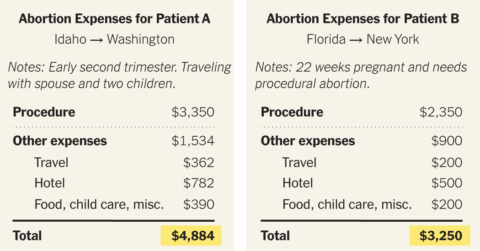
Charts of costs for three abortion patients, in which the cost of the procedure and other expenses including travel and lodging amount to as much as $4,884.


Abortion Expenses for Patient A

Idaho → Washington

Notes: Early second trimester. Traveling with spouse and two children.

Procedure

Other expenses

Travel

Hotel

Food, childcare, misc.

Total

$3,350

$1,534

$362

$782

$390

$4,884

Assisted by the Northwest Abortion Access Fund

Abortion Expenses for Patient B

Florida → New York

Notes: 22 weeks pregnant. Seeking procedural abortion.

Procedure

Other expenses

Travel

Hotel

Food, childcare, misc.

Total

$2,350

$900

$200

$500

$200

$3,250

Assisted by the Florida Access Network

Abortion Expenses for Patient C

Texas → Minnesota

Notes: Seeking medication abortion.

Procedure

Other expenses

Travel

Hotel

Food, childcare, misc.

Total

$700

$621

$508

$113

$1,321

Assisted by the Midwest Access Coalition


L.V. found out she was pregnant on Aug. 7. The next day she called Women’s Health and Family Care in Jackson, Wyo. — the only abortion provider in the state — to schedule an abortion.


She was told the procedure would typically cost $600 at the clinic, but a state law banning abortion might take effect soon. In that case, she would have to travel out of state, setting her back even more.


L.V., who asked to be identified only by her initials, panicked. She had recently been in a car accident and had outstanding medical and car bills to pay.


“When the clinic told me how much, my mouth dropped,” she said. She was told to contact Chelsea’s Fund, a Wyoming nonprofit that is part of a national network of abortion funds, to ask about financial assistance.


Abortion funds have for decades helped cover the cost of the procedure — about $500 in the first trimester and $2,000 or more in the second trimester — for those who cannot afford it. But they are playing a bigger role since the Supreme Court’s decision to overturn Roe v. Wade, taking in more donations and disbursing more money to more patients than ever before.


Total patients supported in 2022

Abortion funds are on pace to support more patients this year than last year.


A chart of patient counts for 10 abortion funds, in which they are on pace to support more patients this year than last year.


Northwest Abortion

Access Fund

New Orleans

Abortion Fund

N.M. Religious Coalition

for Reproductive Choice

Northwest Abortion Access Fund

New Orleans Abortion Fund

New Mexico Religious Coalition

for Reproductive Choice


Since the court’s decision, abortion has been banned in large parts of the Midwest and the South. Those seeking abortions must travel farther and stay longer, often spending thousands of dollars on added costs beyond the procedure itself, including flights, hotels, child care, food and gas.


About half of women who have abortions are living below the poverty line, and most states do not allow the use of state Medicaid funds to cover the cost of the procedure. Abortion funds have been inundated with callers seeking money and support.


Before the court’s decision, the Midwest Access Coalition handled around 30 cases each week. A typical patient’s expenses used to cost the fund around $1,000. The group now helps upwards of 50 people each week and spends twice as much.


“Our wraparound service cost is easily becoming $2,000 per client or more,” said Alison Dreith, the group’s director of strategic partnerships. “We’ve staffed up, we’re taking on this increased workload, but we’re still not going to be able to meet all of the need.”


Patient travel adds up as distances increase


Charts of costs for three abortion patients, in which the cost of the procedure and other expenses including travel and lodging amount to as much as $1,821.


Abortion Expenses for Patient G

Missouri → Illinois

Notes: Lives in rural Missouri and requires two flights, first to St. Louis then to Chicago.

Procedure

Other expenses

Travel

Hotel

Food, childcare, other.

Total

$560

$1,808

$1,158

$650

$2,368

Assisted by the Chicago Abortion Fund

Abortion Expenses for Patient H

Alaska → Washington

Notes: Early second trimester. Traveling from a remote area of Alaska.

Procedure

Other expenses

Travel

Hotel

Food, childcare, other.

Total

—*

$1,821

$1,125

$571

$125

$1,821

*Covered by Alaska Medicaid. Assisted by the Northwest Abortion Access Fund

Abortion Expenses for Patient I

Georgia → Florida

Notes: Eight weeks pregnant and wants medication abortion.

Procedure

Other expenses

Travel

Hotel

Food, childcare, other.

Total

$640

$800

$200

$500

$100

$1,440

Assisted by the Florida Access Network


Each abortion fund operates differently, but the process is generally the same: A patient must first confirm an appointment with a clinic, and then the fund will pledge a certain amount toward the cost of the procedure. Afterward, the clinic invoices the fund. Funds that offer practical support will often book flights or bus tickets and hotels for their clients. Money for food or gas might be sent via PayPal or Venmo, or offered to clients in cash.


A survey of abortion funds around the country shows that the cost of patient support has risen — in some cases steeply — since the court’s decision. Last year, the average patient pledge for the D.C. Abortion Fund was $250. In August of this year, that amount rose to $850.


Change in average spending per patient


Charts of average patient spending for 10 abortion funds. Average spending across all funds has generally risen so far in 2022 compared with all of 2021, and in some cases has risen steeply.


Northwest Abortion

Access Fund

New Orleans

Abortion Fund

New Mexico Religious Coalition

for Reproductive Choice


Northwest Abortion

Access Fund

New Orleans

Abortion Fund

New Mexico Religious Coalition

for Reproductive Choice


Northwest Abortion

Access Fund

New Orleans

Abortion Fund

New Mexico Religious Coalition

for Reproductive Choice


Note: Data for 2022 is through mid-August and, for some funds, even more recent. The average pledge amount for the North Dakota WIN Fund increased significantly in 2022 because of additional patient funding for long-acting reversible contraception.


“Part of what we’re seeing is folks coming to get care later in gestation,” said Alli Korman, the fund’s operations director. She said that because of long wait times — clinics nationwide are booked as much as three weeks out — and a more complicated landscape for patients to navigate, they must now delay care until later in pregnancy, when the procedure is more expensive.


More complicated procedures require more money


Charts of costs for three abortion patients, in which the cost of the procedure and other expenses including travel and lodging amount to as much as $4,305.


Abortion Expenses for Patient D

Wisconsin → Illinois

Notes: Needs hospital-based care because of a fetal anomaly. Traveling with two children.

Procedure

Other expenses

Travel

Hotel

Food, childcare, other.

Total

$3,450

$855

$75

$600

$180

$4,305

Assisted by the Chicago Abortion Fund

Abortion Expenses for Patient E

Texas → Washington

Notes: Medical complications. Has been waiting weeks for appointment. Texas doctor offered only complete hysterectomy.

Procedure

Other expenses

Travel

Hotel

Food, childcare, other.

Total

$2,125

$1,596

$1,160

$396

$40

$3,721

Assisted by the Northwest Abortion Access Fund

Abortion Expenses for Patient F

Illinois → Illinois

Notes: Scans revealed caller needs to be seen in hospital. Extended hotel stay over holiday weekend.

Procedure

Other expenses

Travel

Hotel

Food, childcare, other.

Total

$3,450

$359

$359

$3,809

Assisted by the Chicago Abortion Fund


Note: Data for 2022 is through mid-August and, for some funds, even more recent.


In 2020, the National Network of Abortion Funds, an organization of nearly 100 member funds around the country, received $1.9 million in individual donations.


In just the first week after the court’s decision in June, the network received more than $10 million in donations. Of that, $3.7 million went to the network, and an additional $6.7 million went directly to member funds. That windfall has allowed many of its members to spend more already this year than they pledged to patients in all of 2021.


Total patient spending in 2022

Abortion funds are on pace to spend more this year than last year.


A chart of spending for 10 abortion funds, in which seven of the 10 funds have already spent more this year than they had in all of 2021.


Northwest Abortion

Access Fund

New Orleans

Abortion Fund

N.M. Religious Coalition for

Reproductive Choice

Northwest Abortion Access Fund

New Orleans Abortion Fund

New Mexico Religious Coalition

for Reproductive Choice


Note: Data for 2022 is through mid-August and, for some funds, even more recent.


But abortion funds also face their own rising costs and uncertainty in a world after Roe. Many are run by volunteers, and they said they are struggling to keep up with the increasing volume and complexity of cases as more states move to ban abortion.


“Calls are taking twice as long, we’re having to re-explain to people this new shifting landscape, to reassure people that abortion is still legal — or to reset expectations because now they might have to travel several states over,” said A.J. Haynes, the board president of the New Orleans Abortion Fund, which saw the legal status of abortion in Louisiana change three times this summer.


Even after the flood of donations in recent months, more money is needed to cover paid staff members, data infrastructure and legal guidance.


“In October, we will be significantly rolling back the amount of support we are able to offer,” Ms. Haynes said. “We are simply unable to meet the needs of our callers with the funds we have available for the remainder of the year without a significant increase in support.”


Legal concerns add barriers and costs


Anti-abortion groups say some funds are operating in a legal gray area, if not in violation of state laws. In Texas and Oklahoma, private citizens may sue anyone who aids an abortion, while those who assist patients in Alabama in obtaining out-of-state abortions could face felony charges.


Kristan Hawkins, the president of Students for Life of America, said she expected abortion funds would come under more scrutiny. “There are questions of how these outside entities are operating and if they are now violating state laws to facilitate illegal abortions,” she said. “Lawmakers are asking those questions.”


Providers are already wary of new restrictions, and abortion funds said policy changes by some of the national reproductive rights groups have created more hurdles and expenses for their clients. In Idaho, where abortion is banned, patients who could travel to nearby Utah for the procedure are being denied medication abortion from the Planned Parenthood affiliate there over concerns about legal liability.


“That was really poorly communicated to us, and it creates a much greater burden on abortion funds working in these states,” said Riley Keane, a practical support lead at the Northwest Abortion Access Fund.


Given the ongoing uncertainty in many places, some funds have decided to spend what money they have now.


“We have been fully funding patients. We made the decision to get everyone their abortions because we don’t know what the legal landscape will be next month,” Eloisa Lopez, the executive director of the Abortion Fund of Arizona, said in an interview in August. On Friday, abortion became illegal in Arizona.


In Wyoming, a judge temporarily blocked the state’s abortion ban, and L.V. was able to secure an appointment. Chelsea’s Fund told her it could pay only $300, but another group, the Wyoming Abortion Fund, had agreed to cover the remaining $300.


“I expected them to come back to me and say ‘Oh we can only pay this much,’ ” she said. “I was so surprised. I didn’t have a plan. I would’ve just put it on my credit card and gone into even more debt.”

[ad_2]

Source link

Rhianon Lovelace Scores an Axle Deadlift World Record of 261.5 Kilograms (576.5 Pounds)

Rhianon Lovelace Scores an Axle Deadlift World Record of 261.5 Kilograms (576.5 Pounds)

[ad_1]

On Sept. 24, 2022, during the 2022 Arnold Strongman (AS) UK in Birmingham, England, strongwoman Rhianon Lovelace captured a 261.5-kilogram (576.5-pound) axle deadlift. The pull is a World Record in the heavyweight and 64-kilogram weight classes. Lovelace already owned the record in her own class and notched that mark of 233.5 kilograms (515 pounds) from the Clash Pro Series 2022 Clash of the 64s this past May. 

Per a post on her Instagram, Lovelace competed at the 2022 AS UK with a body weight of 63 kilograms (138.9 pounds). That means Lovelace’s axle deadlift World Record was 4.1 times her body weight. Lovelace worked from a conventional stance while utilizing a lifting suit, lifting belt, and lifting straps to help with her record pull. 

[Related: The 5 Best Exercises for Tall People]

To celebrate her record and winning the first-ever Arnold Pro UK title a day before, Lovelace couldn’t seem to find the appropriate words to describe her historic achievement in an initial Instagram post. 

“I have no words,” Lovelace wrote. “To hit the [record] after competing for two days and winning the first ever Arnold Pro UK, I’m speechless.”

As the athlete would later note, she decided to reflect on and be appreciative of her journey and resolve in another post.

“After competing for two successful days (with tough competition, so I couldn’t take it easy) to win the Arnold Pro Title, running off three hours of sleep, I was doubting myself,” Lovelace wrote. “I knew I was going to need to go somewhere dark to get this done.”

[Related: Workout Splits Explained — How They Work and Why You Need Them]

Even without her axle deadlift World Record and Arnold Pro title, it was already quite the successful 2022 competitive year for Lovelace. 

In late May 2022, during the British Powerlifting Union (BPU) Single Lift British Championships, Lovelace broke the British raw powerlifting deadlift record with a pull of 241 kilograms (530 pounds). Later, while competing at the 2022 Berkshire’s Strongest competition in mid-July 2022, Lovelace broke the overall strongwoman deadlift World Record with a pull of 282.5 kilograms (623 pounds) — exceeding her own record from the 2020 Strength Shop Record Breakers contest by over 20 pounds. (Note: The athlete won both contests.)

Finally, in August 2022, she won her fourth consecutive Britain’s Strongest Woman title. She has not lost that contest since making her debut in 2018. 

[Related: How to Do the Goblet Squat for Lower Body Size and Mobility]

Now in possession of a larger axle deadlift World Record, Lovelace was not shy in expressing what her accomplishment at a major international contest might have meant for strong women on a wider scale.

“We are witnessing the dawn of a new era of Strongwoman!” Lovelace wrote. “A time where the best Women are welcomed to the biggest stages in the sport, witnessed by thousands. The rise of strongwomen!”

Featured image: @rhianon.lovelace.kaosstrength on Instagram

[ad_2]

Source link

Pound Cake with Apples, French Style

Pound Cake with Apples, French Style

[ad_1]

Pound Cake with Apples, French Style

The other day, I was listening to an episode of Splendid Table, one of my favorite food podcasts, and heard something that stuck with me…

The guest was Aleksandra Crapanzano, author of Gateau: The Surprising Simplicity of French Cakes. She talked about how, in France, people often make snacking cakes to enjoy each day: “Being able to make a simple cake that they can nibble on all week, and just when you want that bite of something sweet, it’s there. That to me is that French home cake. It means family, it means after school, it means beach totes, and picnic baskets, and long train rides… It means all that.”

After the podcast, I immediately opened Aleksandra’s charming book to search for a recipe that could make use of the apples I had just picked up at the market, and it didn’t take long to find her Quatre-Quarts, or pound cake — which is so easy, she says, that it’s one of the two cakes French kids memorize in pre-school. (The other is a classic yogurt cake, also in the book.) It’s tender and buttery and endlessly adaptable. As she writes in the introduction, “The trick is having an arsenal of recipes that, once learned, become mere blueprints… It looks easy because it is easy.” Sold.

Quatre-Quarts (Pound Cake)
From Gateau: The Surprising Simplicity of French Cakes, by Aleksandra Crapanzano

“The lack of a leavener such as baking powder or baking soda is not a mistake. It is simply not needed, as the eggs provide the lift.” (For the apple pound cake, see variations below recipe.)

4 large eggs
1 cup granulated sugar
14 tablespoons unsalted butter, preferably European, melted and slightly cooled
2 teaspoons vanilla extract
The grated zest of 1 lemon or orange
1 1/2 cups plus 1 tablespoon cake flour (or all-purpose flour)
1/2 teaspoon fine sea salt

Preheat the oven to 350°F. Butter and flour a 9×5 loaf pan.

Separate the eggs and let them come to room temperature. In a good-sized mixing bowl, whisk the egg yolks to break them up a bit. Add the sugar and whisk until they are thick and pale. Add the melted butter, vanilla, and lemon zest and whisk until smooth. Add the flour and stir with a rubber spatula until no streaks remain.

Using electric beaters or in a stand mixer, beat the egg whites until they form soft peaks. Add the salt and beat until they form stiff peaks. Stir a quarter of the whites into the yolk mixture to lighten it. Then gently fold in the remaining egg whites into the batter.

Pour the batter into the prepared pan and bake for 55 minutes, or until a knife inserted into the center of the cake comes out nearly clean. Allow the cake to cool for 10 minute in the pan, then remove to a wire rack.

Serve at room temperature. If not eating the cake until later, allow it to cool all the way to room temperature, then wrap it in plastic and store at room temperature.

Variations (there are dozens more in the book)

Cinnamon Apple (shown in top photo)
Reduce the vanilla to 1 teaspoon. Add 2 teaspoons cinnamon powder when adding the melted butter. Add 2/3 cup chopped peeled apples to the batter before folding in the egg whites. Consider adding 1/2 toasted walnut pieces as well.

Chocolate
Unfortunately chocolate chunks will sink, but you can add 1 cup mini chocolate chips to the batter before folding in the egg whites. Toss them in 2 teaspoons of flour before adding them. For a mocha version, add 2 teaspoons espresso powder when adding the melted butter.

Blood Orange
Replace the lemon zest with the zest of 1 blood orange, and add 1 tablespoon of its juice or 2 teaspoons Solerno, a Sicilian liqueur made from blood oranges.

P.S. Apple crisp and same-day easy peasant bread.

[ad_2]

Source link

Q&A: AION Labs’ new startup aims to streamline the drug discovery process

Q&A: AION Labs’ new startup aims to streamline the drug discovery process

[ad_1]

This week Israel-based AION Labs, an AI-enabled drug discovery partnership between global pharma and tech companies like AstraZeneca, Merck, Pfizer, Teva, Israel Biotech Fund and Amazon Web Services, announced the formation of a new startup company dubbed OMEC.AI.

OMEC.AI aims to build a computational platform using AI that can help researchers assess the clinical trial readiness of a drug candidate, identify hidden safety liabilities, and suggest experiments to close any identified gaps. 

Gill sat down with MobiHealthNews to discuss OMEC.AI, how the startup came about, and the data it will use within its AI computations to meet its intended results.

MobiHealthNews: Can you tell me about OMEC.AI and its goals?

Gill: Our whole venture creation model is built on three pillars. The first pillar is always starting with a big challenge that, if it was solved, would be truly impactful for patients and, of course, a very strong viable company addressing an industry-needed opportunity.

Secondly, we seek the best scientists and founders to be able to address that challenge with a very lengthy and strenuous in-depth evaluation process.

Third, we set them up as a new startup company with funding, then systematically mentor them for success and support them by giving them the data and everything else necessary for them to be successful.

All of that is conducted not just by the AION Labs team, but really hands-on by our partners in a codevelopment model where everyone works together from day one to help build this company and make it successful for four years.

In this case, OMEC.AI has three supporters from amongst our partners: Pfizer, AstraZeneca and Merck (the German Merck, EMD Serono). Those three are direct investors in OMEC.AI and will have equity in the company, but no IP rights. They each appoint champions from within their R&D organizations to help them and work with them systematically to develop the technology, and have taken part in defining the challenge as well as selecting the candidates.

OMEC.AI is addressing how we take the process of deciding which drug candidate should go into clinical trials, which is probably the most pivotal decision in the pharmaceutical R&D process. Once you decide which drug candidate to bet on as a pharmaceutical or biotech executive, then it goes into a process of investment of hundreds of millions of dollars that you never stop unless the science just fails.

So, really what our partners wanted to do is use artificial intelligence to be able to create a technological platform that would help them make better decisions and ultimately lower the attrition rate and make these drugs safer and more efficient for patients. 

The challenge was, how do we take all this data preclinical data that’s generated plus other sources of data  and create an AI-based platform that would be able to test the drug and tell you what its chances of success are during the clinical trial phases before it goes into humans? And right now, that process is done basically manually with very little technological insights.

Ultimately, we know that the vast majority do not reach approval in the market because they failed at some point during the process. So there’s obviously an unmet need and something that digital and computational technologies should be able to solve if you bring the right people to do that. And that’s what we sought out to find. 

MHN: Who are the people you found to set up this team, and what will they be looking to solve?

Gill: They are two artificial intelligence veterans that have worked at the forefront of technology in the AI field in the automotive industry, primarily. They worked at Mobileye, an autonomous driving company that is based out of Israel, but was sold to Intel for $15 billion.

So, they came to us with a technological approach of being able to create a platform that can integrate the data, and in a very ambitious manner that there’s going to be high risk, but also high reward. And our partners love their approach – the R&D partners met with them.

So those three companies, AstraZeneca, Pfizer and Merck, together with Amazon Web Services will support them as well. So they’ll have those four companies, as investors, or supporters and in the case of Amazon, working hand-in-hand with them to be able to develop the technology. We also received a grant from the [Israeli] government to support them. So they receive financing of $2 million, basically, as a pre-seed round. And they’re starting to work this month. 

MHN: You mentioned it’s high-risk but high-reward. Can you tell me what some of those risks might be? 

Gill: Well, it’s unproven that you can [do this]. To this date, there currently isn’t a technology that can do what they’re trying to do. So, that’s the risk. Can we really create an AI platform with the data accessible to them to be able to ultimately test every type of drug before it goes into clinical trials? To be able to tell pharma, investors or whoever would be a user whether or not this drug candidate has a high probability of success or a high probability of toxicity? That’s something they’re going to try to do. It’s yet to be done. So, therefore, it’s by definition, high risk.

MHN: AI is really only as good as the information that’s put into it. What’s interesting is you have Merck, AstraZeneca, Pfizer and others involved in the project. Is the data coming from each one of these companies? Is there selective data that’s being utilized?

Gill: So, the companies have all committed to providing the data necessary for them to do whatever they need based upon what they have. It’s not like Pfizer is going to say, okay, take all of our historical data without careful selection. The partners are happy to share their data with the startup.

They’re committed to doing that, and they want to do that to help them develop their technology. But they don’t want to share with each other, and they’re not allowed to share with each other, because that would be anticompetitive by definition. So, we’re creating a platform to enable them to be able to share that data in a federated manner in accordance with all best practices.

MHN: What do you hope this program leads to eventually? What do you hope this company can solve?

Gill: What we’re trying to achieve at AION Labs in general, and then specifically for this company, is creating great independent-growth AI-based startups for the biotech field so we can help scientists and researchers – not to replace them, but to really empower them by bringing new technological capability, so that they can optimize the whole process of drug discovery and development.

[ad_2]

Source link

How to Manage Shift Work

How to Manage Shift Work

[ad_1]

Medical professional working late

Most people’s sleep issues can be solved by simply prioritizing sleep and making a few changes. Turn off the phone at night, pick a bedtime and stick to it, get more light during the day, eat dinner early (or not at all), stay physically active, don’t let the day’s anxieties and tasks build up and accumulate and weigh on your mind. Basic stuff. Not easy for everyone to follow, but it’s a standard roadmap you know will work if you follow it. 

What if your sleep issues are out of your control? What if you’re a night shift worker who has to stay awake when you’re supposed to sleep and sleep when you’re supposed to be awake? You can’t just switch jobs—you and your family need food, shelter, and money. There’s no easy way to say it: night shift work has no easy solution. 

We evolved with a circadian rhythm that hews to the day-night cycle, and staying up at night and maintaining cognitive alertness when we’re supposed to be sleeping has longterm ramifications to our health and happiness. That’s just a fact.

Night shift work has been linked to a number of health issues:

  • Heart disease
  • Diabetes
  • Asthma
  • Breast cancer
  • Obesity

It’s a tough situation, balancing the physiological demands of a diurnal mammal (you) with the demands of a job in direct opposition to the former. What can a shift worker do, save finding a new career path?

Embrace Your Situation

For all intents and purposes, this is your life. It may change down the road, but you are a shift worker for now. Accept it. It’s not ideal, but it will be a lot worse if you go about your days (er, nights) lamenting your situation. Even just looking in the mirror every day and verbally reminding yourself that “I am a shift worker and I’m going to get through this” will help. Fighting or avoiding the reality of a situation, instead of accepting and working with it, will only heap more stress and cortisol on your shoulders (and more fat on your belly).

Much of the link between shift work and obesity can be explained by stress. One study found that among Brazilian shift workers, work-related stress was responsible for the majority of shift work-related obesity. Minimize stressing out about your predicament and you’ll mitigate the issue.

Be Strict About Your Diet

Hew as closely as you can to the Primal eating plan. Don’t give in to vending machine wares and stale day-old donuts lurking in greasy pink boxes leftover from the dayshift. Get even more serious about putting quality fuel in your body than ever before. If that means cooking your own food exclusively to avoid gluten and seed oils, so be it. In your circadian misaligned state, your sensitivity to bad food will be heightened.

Adhere to a Healthy Lifestyle

Eating right and exercising regularly become absolute non-negotiable when you’re doing shift work. Studies show that many of the health conditions linked to night shift work can actually be minimized if you adhere to a healthy lifestyle. The problem is that most night shift workers do not adhere to a healthy lifestyle. Therefore, the circadian misalignment makes unhealthy food harder to resist and daily exercise harder to stick with. You have to rise above your lot in life and be better. Luckily, you are better. Right?

Train Wisely

You are starting from behind. Lifestyle stressors beset you on all sides. Your body’s abilities to recover and perform are dampened, and the last thing you want to do is add another couple heaping tablespoons of stress to the mix. As such, you must choose your workouts wisely. If it were me working night shifts for an extended period of time I’d mostly skip metabolic conditioning. No long CrossFit WODs, no extended Tabata sessions, no half marathons, nothing that spikes cortisol and leaves you breathless and on the verge of puking.

Once-a-week sprints with full recovery? Sure. Long walks? Great. Heavy lifting? Go for it, but keep it heavy and intense and keep the volume low. If you’re doing PBF style bodyweight exercises, consider adding resistance and keeping the reps low.

Two days a week of lifting is perfect; three may be too much. Keep an eye on how you feel. If you stall on the same weight twice, drop the weight or the volume. If you can’t recover in between sprints, make them shorter by ten yards until you can.

As for timing, it’s probably a good idea to train before your shift starts. Train, eat a big meal to recover, and then start your shift. Or, train after you wake up in the “morning.”

Trick Your Body

This is probably the most important strategy. Your body expects light when awake and darkness when asleep. You can’t totally replace sunlight and nighttime, but you can get pretty close.

When you’re at work, keep the lights on. If you work outdoors at night—say, as a cop, a security guard, or in the military—consider light therapy.

Two hours before your shift is up, put on some blue blocking orange goggles to make your body think it’s “night” and prepare for bed. Keep them on when you venture out into the light and don’t remove them until you’re ready for bed.

Keep your bedroom shades drawn, block out any light sources, and keep your bedroom as dark as possible. The idea is to mimic daytime light conditions during your waking hours and nighttime light conditions during your “evening” and sleeping hours to the best of your ability.

Fast During Your Shift

Here’s how the typical shift worker handles food: They snack constantly. They eat junk. Donuts in the break room, vending machine chips. Big massive meals just to keep the boredom at bay and reduce the stress they’re feeling from being up in the middle of the night.

Here’s what happened in a recent study of shift workers:

One group ate normally. They ate their regular food during their shift as they always do. As expected, their glucose tolerance suffered and they had very high blood glucose responses when they ate a meal after their shift. They also suffered a circadian misalignment between their central and peripheral body clocks.

Another group fasted during their shift. They ate no food at all while on night shift. Their glucose tolerance was better and they had normal blood glucose responses when they ate a meal after their shift. There was no circadian misalignment between their central and peripheral body clocks.

As you can see, fasting during the night shift didn’t just improve glucose tolerance. It also improved circadian alignment, which may have a beneficial or protective effect on many of the physiological systems night shift normally disrupts.

Go Low-Carb During Your Shift

If you have to eat during your shift, go low-carb or keto. Your glucose tolerance is going to be poor no matter what you do—you can’t get around the circadian disruption of glucose tolerance—so you’d better just reduce the amount of exogenous glucose in your diet. Think of yourself like a type 2 diabetic who can’t handle glucose during your shift, and eat accordingly.

Use Melatonin

Melatonin has been shown to improve shift workers’ sleep and wakefulness patterns.

In one study, compared to placebo and no treatment at all, 5 mg melatonin taken at “desired bedtime” improved the sleep and alertness of cops working a night shift. They got better sleep when they wanted it and felt more alert at night while on the beat.

A later study had similar findings. Increasing dosages of melatonin (up to 3 mg) in patients undergoing simulated late shift work was actually able to shift their circadian phases (as evidenced by changes in body temperature and melatonin secretion). Sleep and alertness (at the right times) also improved. They took fewer naps.

If I were taking melatonin to deal with a night shift, I would take it as soon as I got off work to help me prepare for sleep at home. The quicker you can take it after your shift and get to sleep, the more aligned you’ll be.

Take at least 3 mg melatonin at your desired bedtime, and be consistent with it.

Don’t Go Crazy on Coffee and Embrace Black Tea

Don’t rely on coffee, especially if you display the hallmarks of cortisol problems: belly fat accumulation and poor performance in the gym. Or, at least cut way back. Consider going for black tea instead, which has been shown to normalize cortisol. If you keep drinking coffee (let’s face it, it’s delicious), try not to rely on it. Have a cup at the start of your shift – since it’s “morning” for you – but no more.

Ultimately, what the human animal does best is adapt, often to some pretty horrible conditions. Consider how many people go about their days without apparent problems and live long lives eating the modern processed diet. Consider the amount of unimaginable cruelty, war, genocide, and famine occurring today and throughout all history, and still people live on. So you can handle shift work. Maybe not for the rest of your life, maybe not for ten years without serious ramifications to your health and quality of life, but you can handle shift work now and in the near future. Just don’t get complacent. Start, today, working toward the goal of getting off shift work, because no amount of supplementation, smart training, diet perfection, and artificial light trickery will make up for a lifestyle that contradicts your basic physiology.

Any shift workers in here? What’s worked for you? What hasn’t? Let us know in the comment section!

https://www.marksdailyapple.com/cortisol/

Primal Kitchen Ranch

About the Author

Mark Sisson is the founder of Mark’s Daily Apple, godfather to the Primal food and lifestyle movement, and the New York Times bestselling author of The Keto Reset Diet. His latest book is Keto for Life, where he discusses how he combines the keto diet with a Primal lifestyle for optimal health and longevity. Mark is the author of numerous other books as well, including The Primal Blueprint, which was credited with turbocharging the growth of the primal/paleo movement back in 2009. After spending three decades researching and educating folks on why food is the key component to achieving and maintaining optimal wellness, Mark launched Primal Kitchen, a real-food company that creates Primal/paleo, keto, and Whole30-friendly kitchen staples.

If you’d like to add an avatar to all of your comments click here!

[ad_2]

Source link

Few Places Have More Medical Debt Than Dallas-Fort Worth, but Hospitals There Are Thriving

Few Places Have More Medical Debt Than Dallas-Fort Worth, but Hospitals There Are Thriving

[ad_1]

PROSPER, Texas — Almost everything about the opening of the 2019 Prosper High School Eagles’ football season was big.

The game in this Dallas-Fort Worth suburb began with fireworks and a four-airplane flyover. A trained eagle soared over the field. And some 12,000 fans filled the team’s new stadium, a $53 million colossus with the largest video screen of any high school venue in Texas. Atop the stadium was also a big name: Children’s Health.

Business has been good for the billion-dollar pediatric hospital system, which agreed to pay $2.5 million to put its name on the Prosper stadium. Other Dallas-Fort Worth medical systems have also thrived. Though exempt from taxes as nonprofit institutions, several, including Children’s, notched double-digit margins in recent years, outperforming many of the area’s Fortune 500 companies.

But patients aren’t sharing in the good times. Of the nation’s 20 most populous counties, none has a higher concentration of medical debt than Tarrant County, home to Fort Worth. Second is Dallas County, credit bureau data shows.

The mismatched fortunes of hospitals and their patients reach well beyond this corner of Texas. Nationwide, many hospitals have grown wealthy, spending lavishly on advertising, team sponsorships, and even spas, while patients are squeezed by skyrocketing medical prices and rising deductibles.

A KHN review of hospital finances in the country’s 306 hospital markets found that several of the most profitable markets also have some of the highest levels of patient debt.

Overall, about a third of the 100 million adults in the U.S. with health care debt owe money for a hospitalization, according to a poll conducted by KFF for this project. Close to half of those owe at least $5,000. About a quarter owe $10,000 or more.

Many are pursued by collectors when they can’t pay their bills or hospitals sell the debt.

“The fact is, if you walk into a hospital today, chances are you are going to walk out with debt, even if you have insurance,” said Allison Sesso, chief executive of RIP Medical Debt, a nonprofit that buys debt from hospitals and debt collectors so patients won’t have to pay it.

Community Shadowed by Debt

Across the Dallas-Fort Worth metro area — the nation’s fourth-largest — the impact has been devastating. 

“Medical debt is forcing people here to make incredibly agonizing choices,” said Toby Savitz, programs director at Pathfinders, a Fort Worth nonprofit that assists people with credit problems. Savitz estimated that at least half their clients have medical debt. Many are scrimping on food, neglecting rent, even ending up homeless, she said, “and this is not just low-income people.” 

David Zipprich, a Fort Worth businessman and grandfather, was forced out of retirement after hospitalizations left him owing more than $200,000.

Zipprich, 64, had spent a career in financial consulting. He owned a small bungalow in a historical neighborhood near the Fort Worth rail yards. His daughters, both teachers, and his four grandchildren lived nearby. He had health insurance and some savings, and he’d paid off his mortgage.

Then in early 2020, Zipprich landed in the hospital. While driving, his blood sugar dropped precipitously, causing him to black out and crash his car.

Three months later, after he was diagnosed with diabetes, another complication led to another hospitalization. In December 2020, covid-19 put him there yet again. “I look back at that year and feel lucky I even survived,” Zipprich said.

But even with insurance, Zipprich was inundated with debt notices and calls from collectors. His credit score plummeted below 600, and he had to refinance his home. “My stress was off the charts,” he said, sitting in his neatly kept living room with his Shih Tzu, Murphy.

Overall in Tarrant County, 27% of residents with credit reports have medical debt on their records, credit bureau data analyzed by KHN and the nonprofit Urban Institute shows. In Dallas County, it’s 22.5%.

Loading…

That’s more than five times the rate in the largest counties in New York, data shows. The Texans also owe a lot more — the median amount of medical debt on credit records in Tarrant and Dallas counties is nearly $1,000, compared with $400 or less in New York.

Last year, Zipprich returned to work, taking a job in New Jersey that required he commute back and forth to Texas. He recently quit, citing the strain of so much travel. He’s now job hunting again. “I never thought this would happen to me,” he said.

Who Is Responsible?

Even small debts can have potentially dangerous consequences, discouraging patients from seeking needed care. Angie Johnson, a 28-year-old schoolteacher, cut short her honeymoon so she and her husband could pay off more than $1,100 she owed a physical therapy center owned by Baylor Scott & White, a mammoth Dallas-based hospital system.

Johnson said the center, where she’d gone after a knee injury, initially said her visits would cost $60. “Then they billed me hundreds,” she said. “I don’t go to the doctor unless I absolutely have to because it’s so expensive.”

Hospital industry leaders blame the patient debt on health insurers, citing the rise of high-deductible plans and other efforts that limit coverage. “The last thing that hospitals want is for their patients to face financial barriers,” said Molly Smith who leads public policy at the American Hospital Association. “Hospitals are in there trying to work on behalf of patients.”

Despite repeated requests from KHN, none of the medical systems around Dallas-Fort Worth would discuss their finances or the debt carried by patients.

But Smith and other hospital leaders point to billions of dollars of free or discounted care that hospitals nationwide provide every year. “Hospitals have been pretty darn generous,” said Stephen Love, president of the Dallas-Fort Worth Hospital Council. “If other parts of the community did as much as hospitals, we wouldn’t be in this problem.”

Unlike drug companies, device makers, and many physician practices, most U.S. hospitals are nonprofit and must provide charity care as a condition of their tax-exempt status.

Regardless of tax status, medical centers in markets with high medical debt do provide more charity care, according to an analysis by KHN and the Urban Institute, a Washington think tank. That’s important, said Dr. Vikas Saini, president of the Lown Institute, a nonprofit that grades hospitals on their quality and community benefits. But he asked: “Is a hospital truly serving its community if it’s pushing so many into debt?”

Around Dallas-Fort Worth, major medical systems frequently tout their commitment to the region and its patients.

When Texas Health Resources, a Dallas-based nonprofit system with more than $5 billion in annual revenue, opened a new hospital tower in Fort Worth earlier this year, Barclay Berdan, the system’s chief executive, said the building “reinforces Texas Health’s long-standing commitment to the Fort Worth community.” The nine-story, $300 million tower is one of more than a half-dozen new hospitals and major expansions around the Dallas-Fort Worth area since 2018.

The big building spree has been accompanied by big bottom lines.

From 2018 to 2021, Texas Health, which owns hospitals in North Texas, had an average operating margin of almost 6%, according to a KHN analysis of publicly available financial reports.

Other major systems in the area, including Baylor, Children’s Health, and HCA, the nation’s largest for-profit hospital company, did even better, KHN found. Cook Children’s, the region’s second major pediatric system, had an average operating margin of nearly 12%.

By comparison, profits at most of the 25 Fortune 500 companies based around Dallas-Fort Worth, such as ExxonMobil, were less than 6% in 2019, according to Fortune data.

Loading…

Approaching a Tipping Point

Hospitals have thrived in other markets with high patient debt, KHN found.

In Charlotte, North Carolina, where a quarter of residents have medical debt on their credit reports, hospitals recorded an average operating margin of 13.6% from 2017 to 2019.

The average margin at hospitals in and around Gainesville and Lakeland, two central Florida markets where a quarter of residents also carry medical debt, topped 9%. In Tulsa, Oklahoma, which has the same level of debt, margins have averaged 8.5%.

Overall, U.S. hospitals recorded their most profitable year on record in 2019, with an aggregate operating margin of 6.5%, according to the federal Medicare Payment Advisory Commission. Total margins, which include income from investments, were even higher.

“You might think that hospitals in communities where patients have a lot of debt would be less profitable, but that doesn’t seem to be the case,” said Anuj Gangopadhyaya, a senior Urban Institute researcher who worked with KHN on an analysis of hospital finance and consumer debt data in U.S. hospital markets.

In fact, the analysis found, there is no apparent relationship between the profits of hospitals in a market and how much medical debt residents have. So while hospitals in places like Charlotte and Tulsa may be comfortably in the black, in other places with high patient debt such as Amarillo, Texas, and Columbia, South Carolina, hospitals are struggling, data shows.

Industry experts say the most profitable medical centers — like those around Dallas-Fort Worth — have developed business models that allow them to prosper even if their patients can’t pay.

One key is prices. These hospitals maximize what they charge for everything from a complex surgery to a dose of aspirin. Most of those charges are picked up by health insurers, which still pay a much larger share of hospital bills than patients do, even those with the highest deductibles.

Across the country, many medical systems have strengthened their market power in recent years by consolidating, buying up smaller hospitals and physician practices, which enables the hospital systems to charge even more.

Dallas-Fort Worth has the highest medical prices in Texas, according to the Health Care Cost Institute, a nonprofit that tracks costs nationwide. And in a state where most markets have relatively low medical prices, in-patient care at Dallas-Fort Worth hospitals was 13% more expensive than the national median in 2020.

In addition to charging more, the most profitable hospitals frequently squeeze more savings from their operations, holding down what they pay workers, for example, and securing better contracts from suppliers. “Hospitals have had to get leaner and meaner,” said Kevin Holloran, a senior director at Fitch Ratings who tracks nonprofit health systems for the bond rating firm.

It’s unclear how much longer this business model can endure.

Across the country, many small and rural hospitals have closed in recent years. Even some larger systems are now losing money, as inflation and rising labor costs put new pressure on bottom lines.

As bills rise, hospitals are having a harder time collecting. Last year, nearly 1 in 5 patient bills generated by hospitals for people with insurance topped $7,500, according to an analysis of hospital billing records by Crowe LLP, a Chicago-based accounting and consulting firm. That was more than triple the rate in 2018.

“These are bills that fewer and fewer patients out there can afford,” said Brian Sanderson, a senior Crowe health care consultant and former hospital executive. Indeed, hospitals manage to collect less than 17% of patient balances that exceed $7,500, according to Crowe’s analysis.

“The rates at which patient balances are growing is just unsustainable for our health systems,” Sanderson said, predicting that most will never be able to collect bills of this size. “It’s trending to the ridiculous.”

Robert Earley, a former Texas state legislator who used to head Fort Worth’s public health system, compared today’s hospitals to shrimpers in the Gulf Coast district he once represented.  

“They wanted to pull so much shrimp out of the bay that they didn’t think about whether there’d be any there long term,” Earley said, recalling his constituents’ struggles. “I worry that those of us in health care aren’t asking ourselves enough if this system is sustainable.”

How the Research Was Done

To explore connections between hospital profits and patient debt, KHN and the Urban Institute examined data from each of the nation’s 306 hospital markets, also known as hospital referral regions.

Researchers calculated medical debt in each hospital referral region using 2019 credit bureau data maintained by the Urban Institute. They then compared the debt load in each market to the average operating margin for hospitals in that market over three years from 2017 to 2019, weighting each hospital’s margin by the number of adjusted admissions.

The margins data comes from hospital cost reports that hospitals file annually with the federal Centers for Medicare & Medicaid Services. These reports are aggregated by the nonprofit Rand Corp., which supplied the data to KHN and the Urban Institute.

[ad_2]

Source link

$2,700 Ambulance Bill Pulled Back From Collections

$2,700 Ambulance Bill Pulled Back From Collections
,700 Ambulance Bill Pulled Back From Collections

[ad_1]

Peggy Dula is as surprised as she is relieved. The 55-year-old resident of St. Charles, Illinois, had been fighting a $2,700 ambulance bill for nearly a year. Now, the amount she owes from her September 2021 car wreck appears to be zero.

This summer, KHN, NPR, and CBS News spotlighted Dula in the Bill of the Month series. The initial $3,600 charge for Dula’s ambulance ride was significantly higher than the charges received by her two siblings, who were riding in her car at the time and were transported to the same hospital. The siblings rode in separate ambulances, each from a different nearby fire protection district. All three were billed different amounts for the same services. Dula’s injuries were the least serious, but her bill was the most expensive.

Even after Dula’s insurer paid $900, her bill from Pingree Grove and Countryside Fire Protection District was still roughly twice what each of her siblings had been charged.

Dula’s attempts to resolve the bill were unsuccessful.

Paramedic Billing Services, the company that handles billing for Pingree Grove, said she’d have to dispute charges directly with the fire protection district. But Dula said she couldn’t get a fire district representative on the phone. Then, in June, she received a letter from collections agency Wakefield & Associates seeking payment for her ambulance bill.

Dula remained resolute about not paying until the price was lowered to be more in line with what her siblings had been charged. But the collections agency was equally firm. And that’s where the bill stood for months, in a stalemate.

Last week, Dula called the hospital where she was transported after the crash. She had recently received a bill from the hospital saying she owed nearly $1,500, but when she called she was told her balance was zero. The surprise resolution of her hospital bill prompted her to call Wakefield & Associates to check on her ambulance bill. She said she was told the bill had been pulled back from collections and her balance was zero.

The apparent resolution came approximately a month after “CBS Mornings” covered Dula’s Bill of the Month saga. Wakefield & Associates confirmed to KHN that the bill had been pulled back and that her balance with the agency is zero. Pingree Grove Fire Chief Kieran Stout did not return multiple requests for comment.

“It feels great,” Dula said. “It was a real monkey on my back.”

KHN (Kaiser Health News) is a national newsroom that produces in-depth journalism about health issues. Together with Policy Analysis and Polling, KHN is one of the three major operating programs at KFF (Kaiser Family Foundation). KFF is an endowed nonprofit organization providing information on health issues to the nation.

USE OUR CONTENT

This story can be republished for free (details).

We encourage organizations to republish our content, free of charge. Here’s what we ask:

You must credit us as the original publisher, with a hyperlink to our khn.org site. If possible, please include the original author(s) and “Kaiser Health News” in the byline. Please preserve the hyperlinks in the story.

It’s important to note, not everything on khn.org is available for republishing. If a story is labeled “All Rights Reserved,” we cannot grant permission to republish that item.

Have questions? Let us know at [email protected]

[ad_2]

Source link

Hospitals often reap profits in places where many patients carry medical debt : Shots

Hospitals often reap profits in places where many patients carry medical debt : Shots

[ad_1]

Aerial view of downtown Fort Worth, Texas. Some hospitals in Texas and around the U.S. are seeing high profits, even as their bills force patients into debt. Of the nation’s 20 most populous counties, none has a higher concentration of medical debt than Tarrant County, home to Fort Worth.

Jupiterimages/Getty Images


hide caption

toggle caption

Jupiterimages/Getty Images

Aerial view of downtown Fort Worth, Texas. Some hospitals in Texas and around the U.S. are seeing high profits, even as their bills force patients into debt. Of the nation’s 20 most populous counties, none has a higher concentration of medical debt than Tarrant County, home to Fort Worth.

Jupiterimages/Getty Images

PROSPER, Texas — Almost everything about the opening of the 2019 Prosper High School Eagles’ football season was big.

The game in this Dallas-Fort Worth suburb began with fireworks and a four-airplane flyover. A trained eagle soared over the field. And some 12,000 fans filled the team’s new stadium, a $53 million colossus with the largest video screen of any high school venue in Texas. Atop the stadium was also a big name: Children’s Health.

Business has been good for the billion-dollar pediatric hospital system, which agreed to pay $2.5 million to put its name on the Prosper stadium. Other Dallas-Fort Worth medical systems have also thrived. Though exempt from taxes as nonprofit institutions, several, including Children’s, notched double-digit margins in recent years, outperforming many of the area’s Fortune 500 companies.

But patients aren’t sharing in the good times. Of the nation’s 20 most populous counties, none has a higher concentration of medical debt than Tarrant County, home to Fort Worth. Second is Dallas County, credit bureau data show.

The mismatched fortunes of hospitals and their patients reach well beyond this corner of Texas. Nationwide, many hospitals have grown wealthy, spending lavishly on advertising, team sponsorships, and even spas, while patients are squeezed by skyrocketing medical prices and rising deductibles.

A KHN review of hospital finances in the country’s 306 hospital markets found that several of the most profitable markets also have some of the highest levels of patient debt.

Overall, about a third of the 100 million adults in the U.S. with health care debt owe money for a hospitalization, according to a poll conducted by KFF for this project. Close to half of those owe at least $5,000. About a quarter owe $10,000 or more.

Many are pursued by collectors when they can’t pay their bills or hospitals sell the debt.

“The fact is, if you walk into a hospital today, chances are you are going to walk out with debt, even if you have insurance,” said Allison Sesso, chief executive of RIP Medical Debt, a nonprofit that buys debt from hospitals and debt collectors so patients won’t have to pay it.

A community shadowed by debt

Across the Dallas-Fort Worth metro area — the nation’s fourth-largest — the impact has been devastating.

“Medical debt is forcing people here to make incredibly agonizing choices,” said Toby Savitz, programs director at Pathfinders, a Fort Worth nonprofit that assists people with credit problems. Savitz estimated that at least half their clients have medical debt. Many are scrimping on food, neglecting rent, even ending up homeless, she said, “and this is not just low-income people.”

David Zipprich, a Fort Worth businessman and grandfather, was forced out of retirement after hospitalizations left him owing more than $200,000.

Zipprich, 64, had spent a career in financial consulting. He owned a small bungalow in a historical neighborhood near the Fort Worth rail yards. His daughters, both teachers, and his four grandchildren lived nearby. He had health insurance and some savings, and he’d paid off his mortgage.

Then in early 2020, Zipprich landed in the hospital. While driving, his blood sugar dropped precipitously, causing him to black out and crash his car.

Three months later, after he was diagnosed with diabetes, another complication led to another hospitalization. In December 2020, covid-19 put him there yet again. “I look back at that year and feel lucky I even survived,” Zipprich said.

David Zipprich, a Fort Worth financial consultant and grandfather, was forced out of retirement after hospitalizations left him owing more than $200,000.

Laura Buckman for KHN and NPR


hide caption

toggle caption

Laura Buckman for KHN and NPR

David Zipprich, a Fort Worth financial consultant and grandfather, was forced out of retirement after hospitalizations left him owing more than $200,000.

Laura Buckman for KHN and NPR

But even with insurance, Zipprich was inundated with debt notices and calls from collectors. His credit score plummeted below 600, and he had to refinance his home. “My stress was off the charts,” he said, sitting in his neatly kept living room with his Shih Tzu, Murphy.

Overall in Tarrant County, 27% of residents with credit reports have medical debt on their records, credit bureau data analyzed by KHN and the nonprofit Urban Institute shows. In Dallas County, it’s 22%.

That’s more than five times the rate in the largest counties in New York, data shows. The Texans also owe a lot more — the median amount of medical debt on credit records in Tarrant and Dallas counties is nearly $1,000, compared with $400 or less in New York.

Last year, Zipprich returned to work, taking a job in New Jersey that required he commute back and forth to Texas. He recently quit, citing the strain of so much travel. He’s now job hunting again. “I never thought this would happen to me,” he said.

Who is responsible?

Even small debts can have potentially dangerous consequences, discouraging patients from seeking needed care. Angie Johnson, a 28-year-old schoolteacher, cut short her honeymoon so she and her husband could pay off more than $1,100 she owed a physical therapy center owned by Baylor Scott & White, a mammoth Dallas-based hospital system.

Johnson said the center, where she’d gone after a knee injury, initially said her visits would cost $60. “Then they billed me hundreds,” she said. “I don’t go to the doctor unless I absolutely have to because it’s so expensive.”

Angie Johnson of Waxahachie, Texas, says the physical therapy center she went to after a knee injury initially told her visits would cost $60. “Then they billed me hundreds,” she says.

Laura Buckman for KHN and NPR


hide caption

toggle caption

Laura Buckman for KHN and NPR

Angie Johnson of Waxahachie, Texas, says the physical therapy center she went to after a knee injury initially told her visits would cost $60. “Then they billed me hundreds,” she says.

Laura Buckman for KHN and NPR

Hospital industry leaders blame the patient debt on health insurers, citing the rise of high-deductible plans and other efforts that limit coverage. “The last thing that hospitals want is for their patients to face financial barriers,” said Molly Smith who leads public policy at the American Hospital Association. “Hospitals are in there trying to work on behalf of patients.”

Despite repeated requests from KHN, none of the medical systems around Dallas-Fort Worth would discuss their finances or the debt carried by patients.

But Smith and other hospital leaders point to billions of dollars of free or discounted care that hospitals nationwide provide every year. “Hospitals have been pretty darn generous,” said Stephen Love, president of the Dallas-Fort Worth Hospital Council. “If other parts of the community did as much as hospitals, we wouldn’t be in this problem.”

Unlike drug companies, device makers, and many physician practices, most U.S. hospitals are nonprofit and must provide charity care as a condition of their tax-exempt status.

Regardless of tax status, medical centers in markets with high medical debt do provide more charity care, according to an analysis by KHN and the Urban Institute, a Washington think tank. That’s important, said Dr. Vikas Saini, president of the Lown Institute, a nonprofit that grades hospitals on their quality and community benefits.

But Saini asked: “Is a hospital truly serving its community if it’s pushing so many into debt?”

Around Dallas-Fort Worth, major medical systems frequently tout their commitment to the region and its patients.

When Texas Health Resources, a Dallas-based nonprofit system with more than $5 billion in annual revenue, opened a new hospital tower in Fort Worth earlier this year, Barclay Berdan, the system’s chief executive, said the building “reinforces Texas Health’s long-standing commitment to the Fort Worth community.” The nine-story, $300 million tower is one of more than a half-dozen new hospitals and major expansions around the Dallas-Fort Worth area since 2018.

The big building spree has been accompanied by big bottom lines.

From 2018 to 2021, Texas Health, which owns hospitals in North Texas, had an average operating margin of almost 6%, according to a KHN analysis of publicly available financial reports.

Other major systems in the area, including Baylor, Children’s Health, and HCA, the nation’s largest for-profit hospital company, did even better, KHN found. Cook Children’s, the region’s second major pediatric system, had an average operating margin of nearly 12%.

By comparison, profits at most of the 25 Fortune 500 companies based around Dallas-Fort Worth, such as ExxonMobil, were less than 6% in 2019, according to Fortune data.

Approaching a tipping point

Hospitals have thrived in other markets with high patient debt, KHN found.

In Charlotte, N.C., where a quarter of residents have medical debt on their credit reports, hospitals recorded an average operating margin of 13.6% from 2017 to 2019.

The average margin at hospitals in and around Gainesville and Lakeland, two central Florida markets where a quarter of residents also carry medical debt, topped 9%. In Tulsa, Okla., which has the same level of debt, margins have averaged 8.5%.

Overall, U.S. hospitals recorded their most profitable year on record in 2019, with an aggregate operating margin of 6.5%, according to the federal Medicare Payment Advisory Commission. Total margins, which include income from investments, were even higher.

“You might think that hospitals in communities where patients have a lot of debt would be less profitable, but that doesn’t seem to be the case,” said Anuj Gangopadhyaya, a senior Urban Institute researcher who worked with KHN on an analysis of hospital finance and consumer debt data in U.S. hospital markets.

In fact, the analysis found, there is no apparent relationship between the profits of hospitals in a market and how much medical debt residents have. So while hospitals in places like Charlotte and Tulsa may be comfortably in the black, in other places with high patient debt such as Amarillo, Texas, and Columbia, S.C., hospitals are struggling, data shows.

Industry experts say the most profitable medical centers — like those around Dallas-Fort Worth — have developed business models that allow them to prosper even if their patients can’t pay.

One key is prices. These hospitals maximize what they charge for everything from a complex surgery to a dose of aspirin. Most of those charges are picked up by health insurers, which still pay a much larger share of hospital bills than patients do, even those with the highest deductibles.

Across the country, many medical systems have strengthened their market power in recent years by consolidating, buying up smaller hospitals and physician practices, which enable the hospital systems to charge even more.

Dallas-Fort Worth has the highest medical prices in Texas, according to the Health Care Cost Institute, a nonprofit that tracks costs nationwide. And in a state where most markets have relatively low medical prices, in-patient care at Dallas-Fort Worth hospitals was 13% more expensive than the national median in 2020.

In addition to charging more, the most profitable hospitals frequently squeeze more savings from their operations, holding down what they pay workers, for example, and securing better contracts from suppliers. “Hospitals have had to get leaner and meaner,” said Kevin Holloran, a senior director at Fitch Ratings who tracks nonprofit health systems for the bond rating firm.

It’s unclear how much longer this business model can endure.

Across the country, many small and rural hospitals have closed in recent years. Even some larger systems are now losing money, as inflation and rising labor costs put new pressure on bottom lines.

As bills rise, hospitals are having a harder time collecting. Last year, nearly 1 in 5 patient bills generated by hospitals for people with insurance topped $7,500, according to an analysis of hospital billing records by Crowe LLP, a Chicago-based accounting and consulting firm. That was more than triple the rate in 2018.

“These are bills that fewer and fewer patients out there can afford,” said Brian Sanderson, a senior Crowe health care consultant and former hospital executive. Indeed, hospitals manage to collect less than 17% of patient balances that exceed $7,500, according to Crowe’s analysis.

“The rates at which patient balances are growing is just unsustainable for our health systems,” Sanderson said, predicting that most will never be able to collect bills of this size. “It’s trending to the ridiculous.”

Robert Earley, a former Texas state legislator who used to head Fort Worth’s public health system, compared today’s hospitals to shrimpers in the Gulf Coast district he once represented.

“They wanted to pull so much shrimp out of the bay that they didn’t think about whether there’d be any there long term,” Earley said, recalling his constituents’ struggles. “I worry that those of us in health care aren’t asking ourselves enough if this system is sustainable.”

Diagnosis: Debt is a reporting partnership between KHN and NPR exploring the scale, impact, and causes of medical debt in America.

KHN (Kaiser Health News) is a national newsroom that produces in-depth journalism about health issues. It is an editorially independent operating program of KFF (Kaiser Family Foundation).

[ad_2]

Source link

Should You Eat More Often for a Better Metabolism?

Should You Eat More Often for a Better Metabolism?

[ad_1]

Can you trust your hunger or should you schedule your meals?

You may have heard that eating 6 small meals per day will boost your metabolism and help you lose weight. Or maybe the exact opposite – that fasting is great for weight loss.  

There is a lot of confusion about meal frequency in the health and fitness industry.

But don’t worry – there’s one rule to rule them all.

The number one rule of meal frequency

The best number of meals a day for you is whatever it takes to meet your nutritional needs. Here’s what that means…

What you eat –  which macronutrients –  and how much you eat matters more than how often you eat. 

Some people find it easier to eat  three  times. Others are able to better adjust the amount of food they eat if it is spread out in smaller meals so they never get hungry. That’s why the right number of meals for you is whatever is the easiest to meet your nutritional needs throughout the day. Simple as that.

Why?

The fact is:

If you want to lose fat or gain weight the most important thing is to adjust your calorie intake accordingly.

Remember, eating smaller meals won’t speed up your weight loss if the calories stay the same. And here’s why…

Your meal timing and metabolism questions answered

Will eating small meals often speed up your weight loss?

It is a fact that meal digestion increases your metabolic rate. But, it depends on the amount of calories and not how often you eat. Eating 900 calories in three small meals or just one big meal doesn’t make a difference.(1) As long as calories stay the same, eating more often won’t make a significant difference for weight loss, according to research.

Does skipping meals cause “starvation mode” that stops you from losing weight?

When you eat less, your metabolism has less to digest. So, restricting your calories will slow down your metabolic rate, whether you skip meals or not. But – a slower metabolic rate is most likely not the reason why your weight loss stalled. . Actually, your weight loss will naturally slow down once you have less to lose. It doesn’t mean you are in “starvation mode” and have to eat more often.

This common myth causes people to eat more and sabotage their diets. (Exceptions include conditions like anorexia and rare diseases such as marasmus.)

“Starving yourself” with a severe caloric restriction is not advised for health reasons beyond weight management, such as malnutrition that could lead to other serious health issues.

Should you eat right after your workout if you want to gain muscle?

If your goal is to build muscle, there are a couple of scientifically proven tips to increase muscle protein synthesis.(3) Consuming high-quality protein up to 2 hours after your workout can help muscle recovery and gain. For optimal gains, you should consider eating 20-40g of protein (0.25–0.40 g/kg body mass/dose) approximately every 4 hours. If you are not exercising, the timing is not crucial and you should care most about the total protein intake per day to build more muscle.

Still, you might be left wondering – are there any reasons why you should eat more or less often?

Should you eat more or less often?

Consider eating less often if…

  • The “smaller meals approach” is complicated for you
  • You want to think less about food but still stick to your planned calories

  • You can’t lose weight even by restricting calories
  • You have digestive problems – a longer break between meals gives your body a chance to digest food completely

Looking for a change? Intermittent fasting can be a great way to lose weight and/or spend less time on food planning.

Is it safe to experiment with intermittent fasting?

In general, yes. But it’s not advised if you are younger than 18, pregnant, diabetic, underweight, or have had an eating disorder.

Consider eating more often (4 or more meals a day) if…

  • You want to gain weight but can’t eat so many calories in one meal
  • You have a very active job and high calorie demands
  • You are an athlete and need specific nutrient timing around your workouts
  • You feel “hangry” (hungry + angry) all the time (maybe you should try foods that keep you full longer?)

Key takeaways

  • There is no magical number of meals a day that will work for everyone. Trust your hunger – if you like to eat smaller meals more frequently, then go for it. If not, feel free to eat less often.
  • You don’t have to force yourself to eat on a schedule, but it would be good to create a habit of eating the same number of meals each day. Why? According to research, meal irregularity can have negative effects on your health. Whether it’s 2 meals, 3 meals, 6 meals a day – try to choose a number of meals that you can stick to most days of the week.
  • Don’t forget the number one rule: the best number of meals for you depends on what your body needs to meet your goals.

Not sure how much macronutrients you need? Use the protein intake calculator and carb calculator to find out what is the optimal amount for your goals!

***

if(!isRussia){
//check Cookie Opt out and User consent
if(!run_getCookie(“tp-opt-out”)){
!function(f,b,e,v,n,t,s){if(f.fbq)return;n=f.fbq=function(){n.callMethod?
n.callMethod.apply(n,arguments):n.queue.push(arguments)};if(!f._fbq)f._fbq=n;
n.push=n;n.loaded=!0;n.version=’2.0′;n.queue=[];t=b.createElement(e);t.async=!0;
t.src=v;s=b.getElementsByTagName(e)[0];s.parentNode.insertBefore(t,s)}(window,
document,’script’,’https://connect.facebook.net/en_US/fbevents.js’);
fbq(‘init’, ‘1594940627485550’); // Insert your pixel ID here.
fbq(‘track’, ‘ViewContent’);
}
}

[ad_2]

Source link