Mitchell Hooper stormed the professional strongman scene with an outstanding debut at the 2022 World’s Strongest Man (WSM). Just months later, the star is already in a place where he may keep stacking achievements on top of achievements.
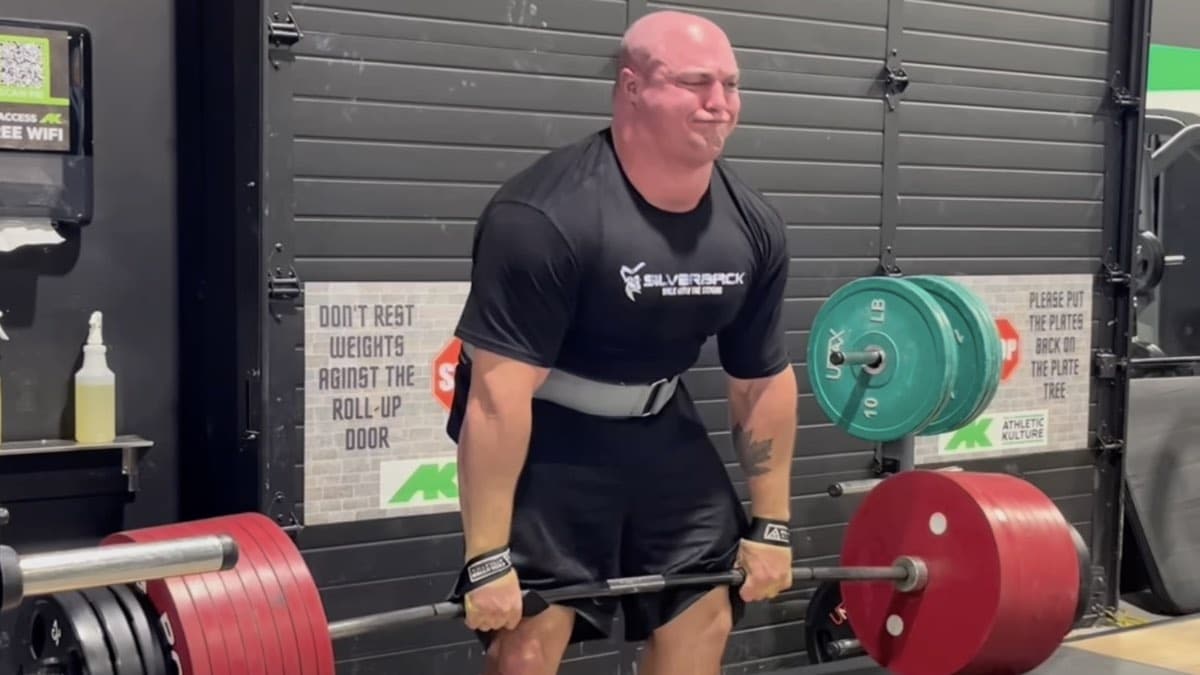
On Oct. 11, 2022, Hooper shared an Instagram clip of himself completing a raw 488.6-kilogram (1,075-pound) 19-inch deadlift. According to the caption of the Canadian athlete’s post, it’s a new personal record (PR). Hooper wore a lifting belt and lifting straps and completed the pull in his socks.
Hooper wrote that he completed his deadlift from a 19-inch position for “strongman reasons.” What he’s alluding to is the 2022 Rogue Invitational, which will take place on Oct. 28-30, 2022, in Austin, TX. At the time of this writing, the contest’s events have not been announced. It appears Hooper is preparing his strength for a related deadlift as a contingency.
The Canadian strongman has shown off plenty of eye-opening training displays of strength in recent months.
Should Hooper transfer his power to Austin and win, it will mark his third consecutive victory in a strongman competition. The athlete previously won his first pro contest at the 2022 Arnold Strongman Classic UK in late September. Then, in early October 2022, he followed that performance with his first career victory on the Giants Live circuit at the 2022 Giants Live World Tour Finals. Perhaps even more impressively, if Hooper finishes in the top three again, it will be his sixth straight appearance on a strongman podium dating back to the 2022 Giants Live Strongman Classic.
Here’s the current roster of athletes Hooper will try to topple at the 2022 Rogue Invitational:
Hooper has enjoyed a meteoric rise in his early strongman career, and it doesn’t seem like he plans to slow down any time soon. At his rapid pace, this 26-year-old phenom could very well cement himself as a prominent fixture in the sport for years to come.
Months removed from an unfortunate tear of his left triceps tendon in May 2022, Daniel Ryjov is back to doing what he best — notching impressive feats of upper-body strength.
On Oct. 10, 2022, Ryjov uploaded an Instagram video of himself completing a 143-kilogram (315-pound) bench press for an astonishing 55 reps during a training session. While unconfirmed, Ryjov implies the feat might be a potential reps World Record for the weight on his loaded barbell. The athlete performed softer lockouts of the majority of reps and wore a lifting belt, wrist wraps, and elbow wraps, which might have been a continued precaution for his injury.
Ryjov’s incredible comeback from his triceps injury aside, his jaw-dropping bench press AMRAP (As Many Reps As Possible) display might be even more impressive when put into proper juxtaposed context.
For example, the National Football League (NFL) Scouting Combine record for the bench press is 51 reps from Justin Ernest. However, the weight for that record is 102 kilograms (225 pounds). Ryjov not only logged four more reps than Ernest, he did it with 40.8 kilograms (90 pounds) more on his barbell. Similarly, professional strongmen Brian Shaw and Robert Oberst tried their hands at the NFL Combine record for 225 pounds in July 2020. Shaw captured 44 reps, while Oberst had 42. Similarly, Ryjov has bested both of the elite athletes’ figures while pressing more weight.
This isn’t the first recent instance where Ryjov showed his upper-body strength and power were returning.
One week prior to this recent record, in early October 2022, the athlete scored 100 reps of a 225-pound bench press for a self-proclaimed World Record. (Note: It is unclear whose World Record he passed, though Larry Wheels did bench press 225 pounds for 70 reps in 2018).
In addition, he became the first known person to complete at least 100 reps of a 225-pound bench press. This stunning display followed Ryjov logging 90 reps with 225 pounds in mid-August 2022, where it seemed he was still focusing primarily on recovery from his injury rather than pushing himself to the limit.
Judging by his social media and the accomplishments he shares, it appears Ryjov has been exclusively focusing on augmenting his bench press for a little while. The athlete does have two powerlifting competitions to his name — earning first place at the 2016 Revolution Powerlifting Syndicate (RPS) InsurreXtion V and a first-place performance at the 2017 United States Powerlifting Association (USPA) SMG’s March Mayhem — but has not competed on a sanctioned lifting platform since.
At the time of this writing, Ryjov hasn’t hinted at the next bench-press barrier he’ll try to break through. Though, if he’s returning to a place of total health, Ryjov could indeed be a pioneer with another milestone soon enough.
Hi friends! Happy Friday! What’s going on this weekend? P has a soccer game, we’re meeting friends for dinner, and I’m making a baby meal for a friend with newborn twins. I hope you have a lovely weekend ahead! Read on for a lil giveaway at the end of this post, too. 🙂 Edited: giveaway has ended! Winners announced below.
This week was a good one. They all seem to go by so quickly lately that I need to remind myself to sloooowwww down. I feel like I’m going to blink and it’s going to be Valentine’s Day.
If you’re feeling like everything is happening earlier in the year and way too quickly, take some time to plan out things that purposefully make you slow down. I’m trying to do the same! Little things like Uno in the evening, walks as a family, reading a book (even though I’m surrounded by laundry to fold), and sitting together for meals makes a huge difference.
(Halloween decor is up! We didn’t go too wild but we have Jack and Sally in the window, our usual pumpkin displays, and our little Halloween table)
It’s time for the weekly Friday Faves party! This is where I share some of my favorite finds from the week and around the web. I always love to hear about your faves, too, so please shout out something you’re loving in the comments section below!
Friday Faves 10.7 (+ a giveaway)
Fashion + beauty:
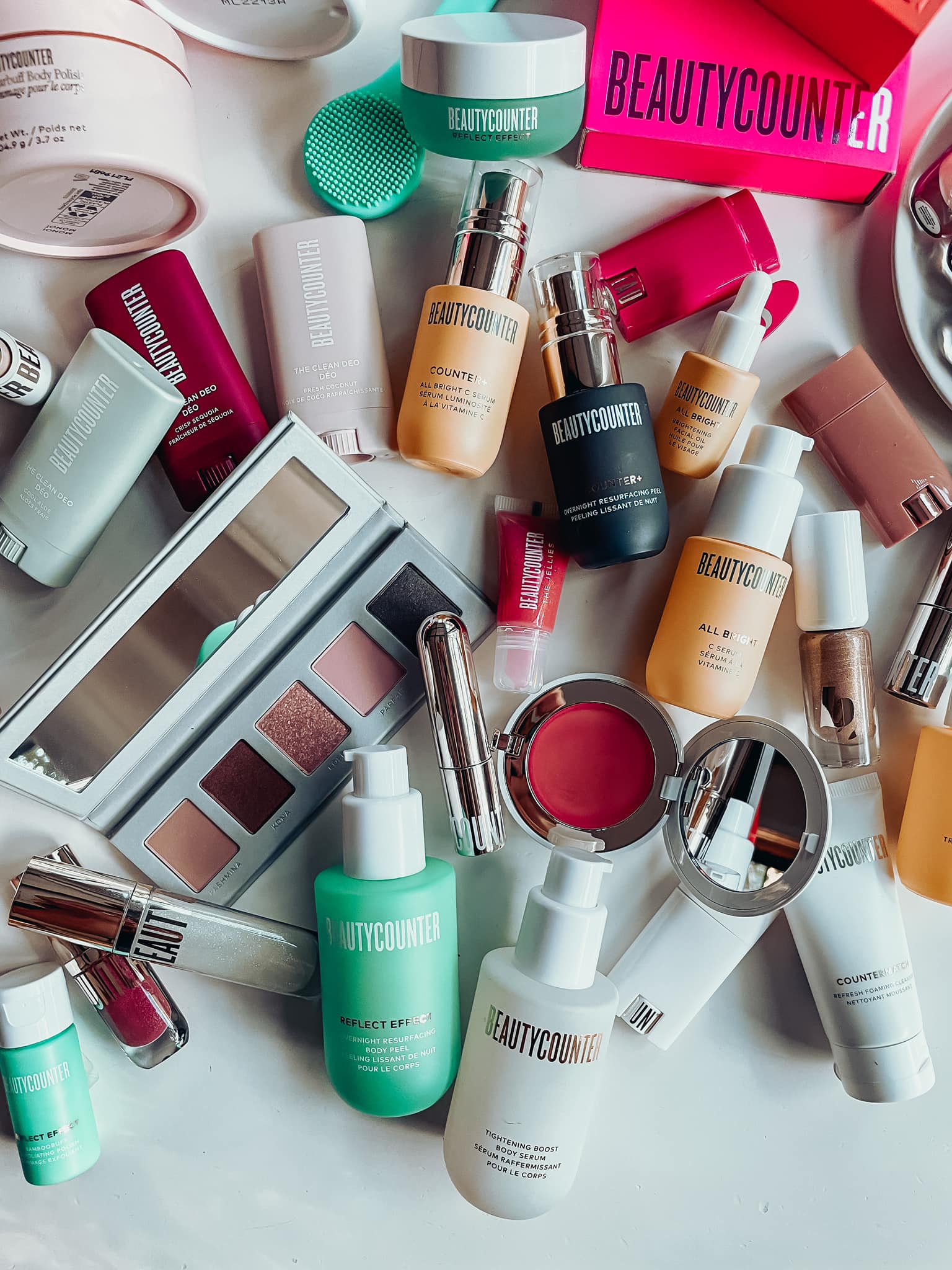
Beautycounter holiday is heeeeere! SO much great stuff! If you’re shopping for holiday gifts, I would order soon because some of our top sets tend to sell out. It’s hard to get into the holiday shopping mindset – I’m still in a tank top over here! – but I’m also trying to get as much shopping done as early as possible.
Here are some of my favorite BC holiday picks:
Mini Beyond Gloss vault. LOVE these for stocking stuffers! I also break sets apart to give to Liv’s friends over the holidays. I feel much better giving the kiddos makeup with safer ingredients and love these for myself, too. They’re not sticky and have the perfect glossy shine.
Best in Clean Heroes. If you’ve been wanting to try Beautycounter, this is such a great intro to our bestsellers. You’re able to try out smaller sizes of our hero products at a bundled discount. This is another great one to break apart for stocking stuffers.
Multi Masker set. You can try out our extremely popular charcoal mask and our new AHA mask, which has bamboo exfoliants, a bouncy texture, and makes skin feel smooth and amazing. If you’re looking to up your mask game, this is it.
Good Scents Hand Cream Trio. This is one of my all-time fave holiday products! I like to stash these in my purse and the car for dry winter hands. They smell lovely, too.
Essentials Eye Palette. SO many gorgeous neutrals for fall, and they use responsibly-sourced mica for shimmer.
The best store-bought salad kits! So many of our faves on this list, like the Dill Pickle, Everything but the Bagel, and Trader Joe’s Vegan Ranch.
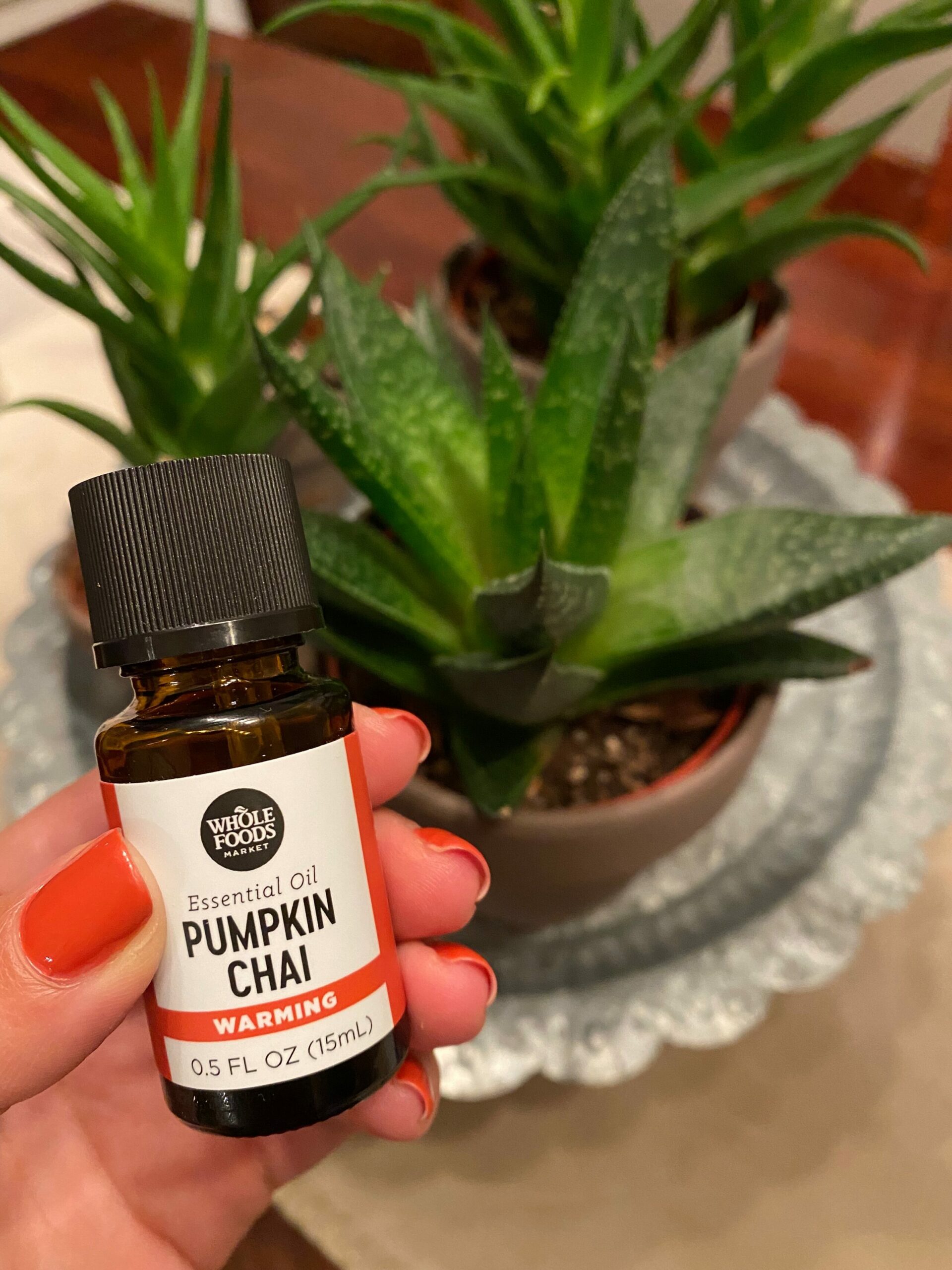
LOVE this essential oil! I found it at Whole Foods and have been diffusing it all week. It smells just as lovely as a fall candle and has great ingredients.
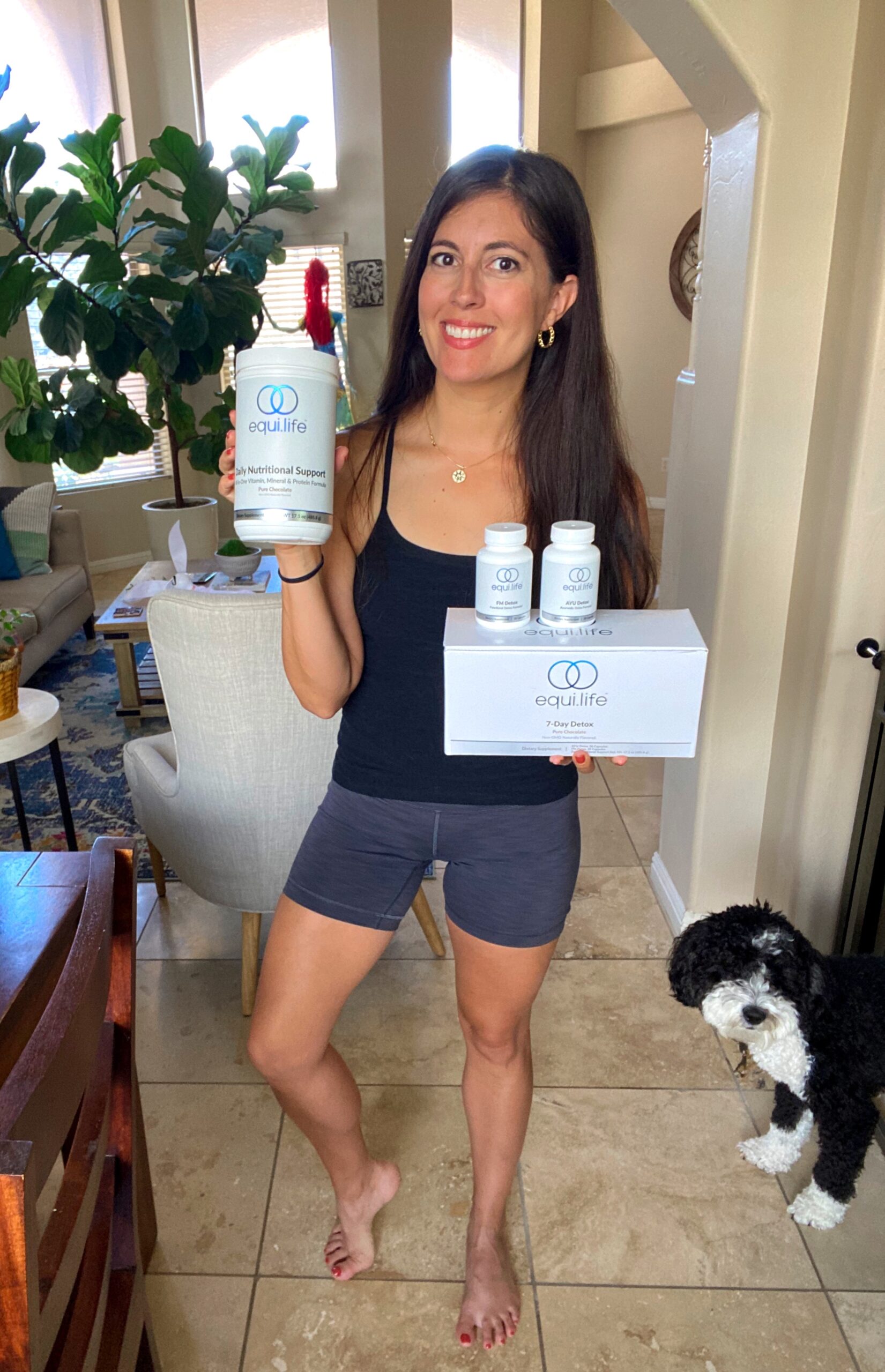
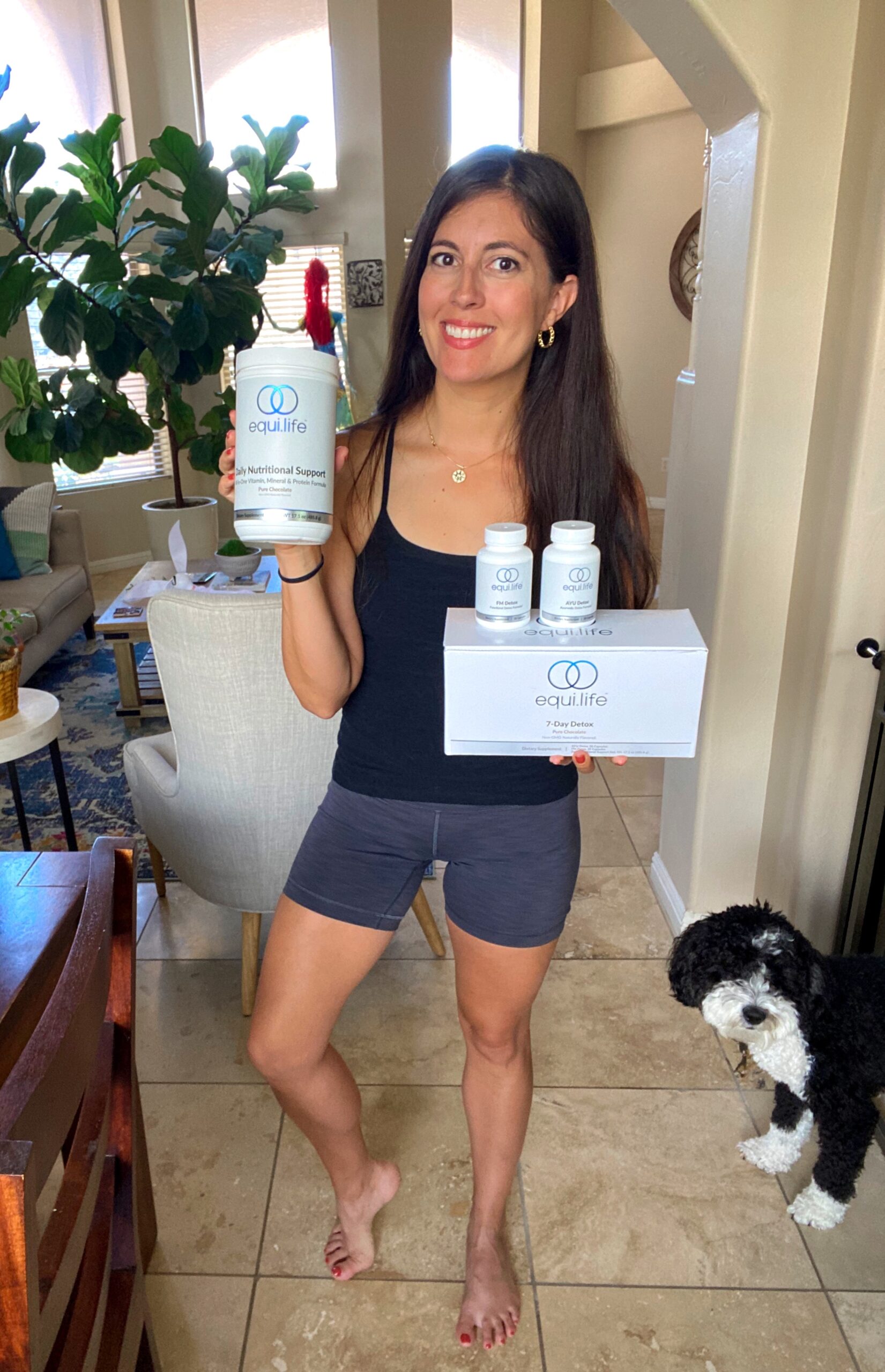
I’m so pumped so many of you are joining me on the detox journey starting on October 17! Read the details here and if you know you’re in, you can click here and use FITNESSISTA20 for 20% off. I did an IG live with the creator of the program, Dr. Stephen Cabral, and we chat about toxins, minimizing our exposure, and an info session about the detox with Q&A. Here’s the video!
It’s giveaway time! EquiLife is kindly gifting three of you a detox kit (valued at $99 each) to join in. If you end up winning and have already purchased, you’ll be refunded. (So if you know you’re in, don’t hesitate to order so you have everything ready to go!) I’ll pick the winners this Monday at noon PST and will email the winners, too.
GIVEAWAY HAS CLOSED! Congrats to the winners! Sara S., Tera, and @natalierwg
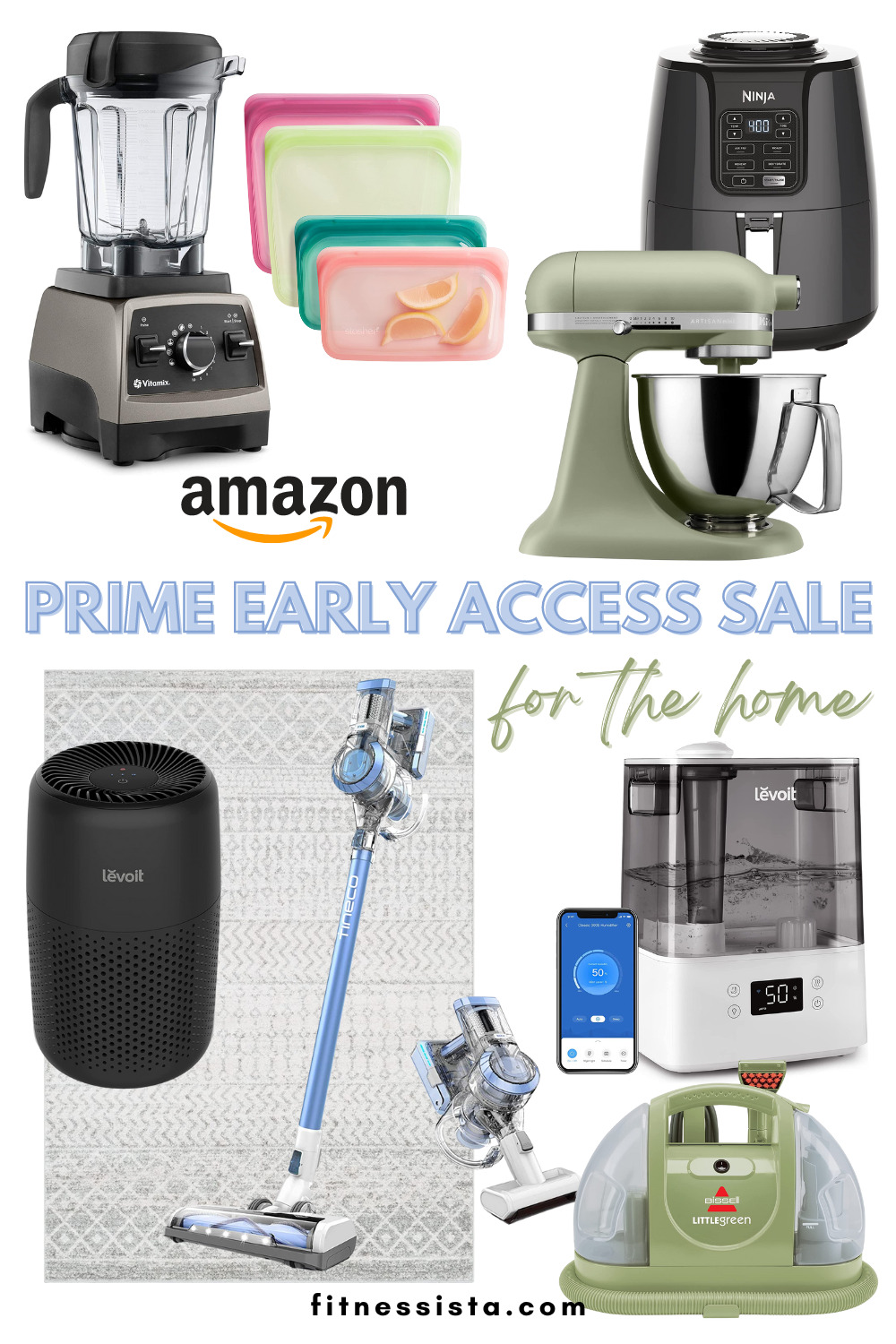
Sharing the best of the best for the Prime Early Access sale! This is when you can get Black Friday-ish deals before the holidays and so many of my faves are discounted right now. *Affiliate links are included below that allow me to earn a small commission I use to keep this lil blog running. Thank you so much to those of you who shop my links – I appreciate it so much.
Hi friends! How are ya? I hope you’re having a wonderful morning so far. I’m headed to a juice date with a friend and running some last-minute errands before the crew is out of school for fall break! I CAN’T WAIT.
Today, I’m excited to share all of the good stuff from the Prime Early Access sale. This is when you can get Black Friday type deals early, before the holidays.
When I found out this sale event was on the way, I was pumped for two reasons:
1) I can order holiday gifts NOW. I feel like the holidays keep going by way too quickly, and it’s become my goal to have everything done and wrapped by the week after Thanksgiving. Aint got no time to be stressed about gifts when there are so many fun events to enjoy.
2) This is my chance to get things around the house we’ve been needing at a sweet discount. We desperately need a new vacuum, and if you’re in the market for electronics or home goods, this is the perfect chance to get it.
Big sales like this tend to be overwhelming, so I sorted through the spreadsheets of goods way in advance to find the best stuff for you!
A kindle paper white. I’ve been wanting one for myself, especially since I get distracted when I read on my phone or the iPad. It will be so nice to have something solely for books.
A Hape wood bike for toddlers. We bought Hape products when Liv was a baby and they were the highest quality baby toys; many of them lasted for P to use them too.
An air fryer! If you’ve been fighting getting one of these – I did it, too – I highly recommend it. It’s the best for anything frozen or potato-related, and we use it multiple times a week.
Stasher bags! I use these for travel and for kids’ snacks and lunches. They’re well-made and I’m glad we’re able to use less disposable practice with these.
Surely you’ve heard the terms ‘muffin top’ and ‘love handles’ to describe the excess fatty areas around the waist. And many of us are wanting to lose belly fat but aren’t really sure where to begin.
Whether it’s for health reasons, to lessen the risk of disease,(1) or simply because you want to feel more confident in your skin – tightening up your belly can be really tough. And the truth is, core exercises alone aren’t the best way to lose belly fat.
Reducing belly fat takes time and continuous effort
You should work on improving your nutrition first to encourage overall fat loss (and not specific exercises to lose belly fat which is secondary.)
Chronic stress can prevent the midsection weight from coming off.
Hormones can also have effects on weight loss and weight gain and can be the cause of the inability to lose or keep weight off.(2)
Again, the core area is often slower to show results after transitioning to a healthier diet and exercise routine, so the best way to lose belly fat is to stay consistent with your workouts and healthy diet and have patience with getting the results you want.
The healthy benefits of a strong core:
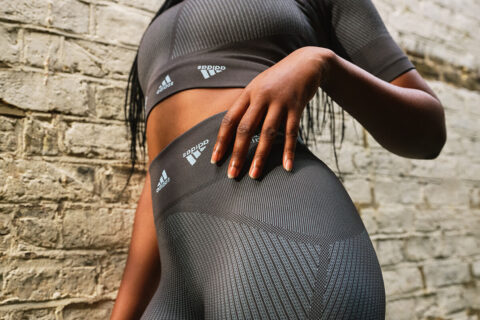
Having a strong core is beneficial for the whole body, not only the appearance of having toned abs. A strong core can prevent injuries, improve posture, and help with balance and performance. Check out these 20 core exercises and learn how to build your own workout in Workout Creator in the adidas Training app.
The healthiest and best way to lose belly fat
Your health and fitness journey should be driven by a desire for a healthier lifestyle rather than feeling pressured to meet any outside expectations on appearance. Trying to fix a certain “flaw” often leads to crash diets and useless exercises. Plus, it weighs on your confidence.
With an unhealthy approach to losing unwanted belly fat, you’ll likely invest in quick fixes like unhealthy diets and exercise routines in the hope that you’ll see the results you want faster. But if you don’t see the results faster or you lack the energy you need to perform your normal activities, you will feel frustrated and might even be tempted to completely give up.
A more rewarding approach would be to focus on your body as a whole, because in truth, there are no special exercises that get rid of love handles. Your body is the vehicle with which you experience life – improving your overall wellness will make you healthier, happier, and more content overall – not just fit better in your jeans.
Here are four practical steps to take to achieve a healthier body…
4 tips to reduce muffin top long-term
The following tips are prioritized based on how much of an impact they have on reducing belly fat. We suggest applying these tips in order to see optimal success.
1. Cut calories (moderately, but consistently!)
Putting your body in a fat loss mode is the only way you will eventually lose the excess abdominal fat and keep it off.
Is there a specific diet that is recommended to lose belly fat?
No, as long as you are able to maintain the necessary deficit and not eat too little, you are doing it right. Think about what is the least amount of calories I need to cut to see results – not what is the lowest number of calories I can function on. This expert diet review will teach you all you need to know!
Here are some more ways to cut calories and lose belly fat:
2. Eat more protein & less sugar
Protein supports your body transformation
Protein is the building block of your body and it becomes especially important when you are trying to change your body composition. Protein is not just crucial for building muscles; it is also extremely important when trying to lose fat. By eating enough protein your body will not lose muscle mass. Plus, it makes you feel full longer. Find out all you need to know about protein.
Are you vegan?
There are plenty of ways to ensure that you get enough protein on a vegan diet. And one great vegan protein source has been found in pea protein.(3)Learn more about other vegan protein sources in this post.
Sugar can mess up your plans
Sugar goes by many different names and is often a hidden additive in many foods. When you consume too much added sugar, your body becomes used to it – even “addicted” to it – and starts to have more cravings for it. Obviously, reaching for a banana or other fruit to satisfy the urge for sweets is better – even though it still has plenty of natural sugar.
Sugar cravings can make it extremely hard to maintain the calorie deficit. So what should you do? Consider a30-day no-sugar challenge and see how that experience shapes your view of nutrition.
Do I really have to cut all sugar to lose belly fat?
Not really. Losing weight is not about extremes. You can still eat occasional desserts and sweets. And there’s always the option of delicious AND low-calorie treats. The key is not to over-indulge – keep sweets to smaller portion sizes and maintain a steady calorie deficit.
3. Get more sleep
The importance of sleep is often underestimated when it comes to weight loss. You can read countless studies and lists of benefits of sleep, but nothing will be as convincing as simply doing an experiment yourself. Often we are not aware of how sleep-deprived we are and the consequences it has on our appetite, cravings, mood, energy,and motivation. Understandingcommon sleep myths will help you grasp how sleep works.
Make it a priority to get the best quality sleep you can for a couple of days and observe how it affects your cravings and moods. If you find yourself battling insomnia, there are things you can try to conquer better sleep. This sleep calculator will help you determine the optimal wake-up time based on sleep cycles.
4. Fix your workout plan
Just because it’s the last tip on our list doesn’t mean workouts aren’t important for losing muffin top. But remember, they can’t make up for poor nutritional habits.
If you don’t have a workout plan – get one! Why not start with theFit & Strong in 3 Weeks plan on the adidas Training app?
If you do have a workout plan, it’s time to evaluate its effectiveness:
Is your training plan focused on “ab workouts for love handles”? Doing targeted ab work shouldn’t be your top priority. Focus on full-body workouts and add extra ab work only if time allows.
Do you work out less than three times per week? Aim for at least three workouts per week. And if you find it especially hard to add in those extra times for exercise, consider a super effective HIIT workout.
Are your workouts always the same? Your plan should include a variety of exercises so that you don’t get used to the same routine.
Are special exercises for love handles the best way to reduce lower belly fat?
Isolated exercises focused on your midsection are not going to slim the area.Instead, you need to stay consistent with a full-body exercise routine and maintain a moderate calorie deficit in order to lose body fat.
Do ab workouts make a difference in getting rid of muffin top and love handles?
While abs workouts don’t speed up your weight loss, there is definitely value in training your abs. Your midsection transfers force throughout the body and stabilize your posture while helping to prevent injuries. Having a strong core assists you in your overall fitness performance.
Bottom line:
Shifting to a healthier lifestyle starts with how you speak of your body; negative self-talk doesn’t benefit you. Instead, make adjustments for a healthier lifestyle to honor your body. Start by changing your eating habits, making sure to get enough sleep and protein, stopping ravenous sugar cravings, and adjusting your workout plan.
If you do this, your lifestyle will change in a healthier direction.
***
if(!isRussia){
//check Cookie Opt out and User consent
if(!run_getCookie(“tp-opt-out”)){
!function(f,b,e,v,n,t,s){if(f.fbq)return;n=f.fbq=function(){n.callMethod?
n.callMethod.apply(n,arguments):n.queue.push(arguments)};if(!f._fbq)f._fbq=n;
n.push=n;n.loaded=!0;n.version=’2.0′;n.queue=[];t=b.createElement(e);t.async=!0;
t.src=v;s=b.getElementsByTagName(e)[0];s.parentNode.insertBefore(t,s)}(window,
document,’script’,’https://connect.facebook.net/en_US/fbevents.js’);
fbq(‘init’, ‘1594940627485550’); // Insert your pixel ID here.
fbq(‘track’, ‘ViewContent’);
}
}
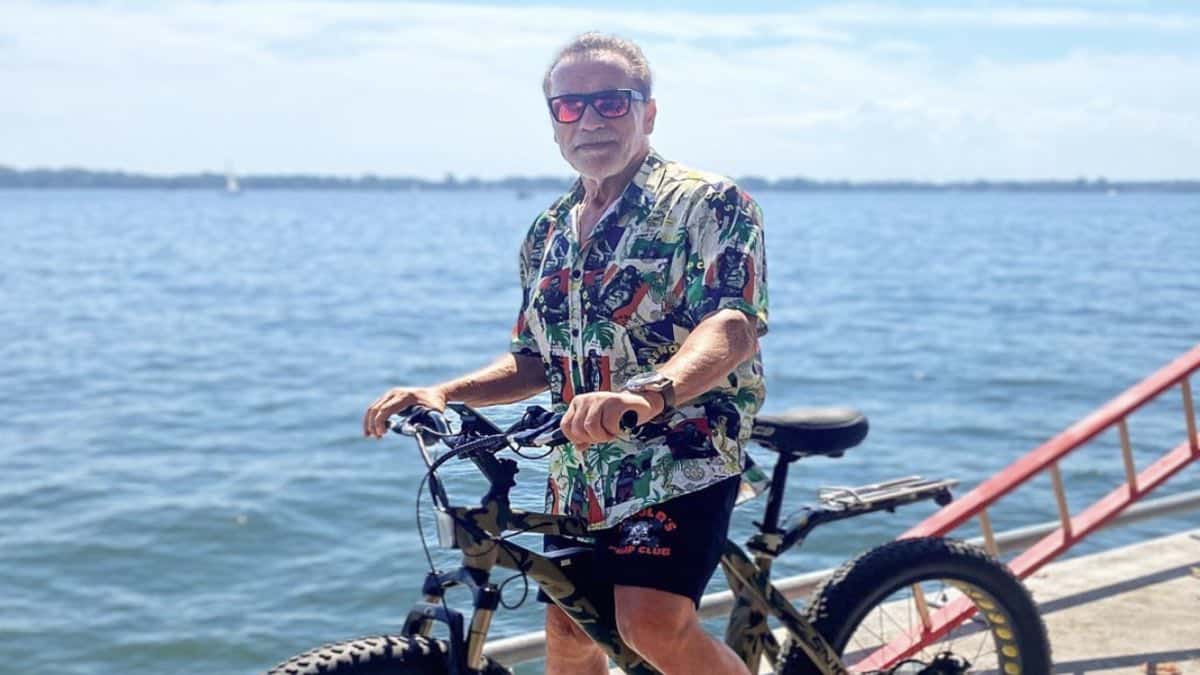
As a legendary bodybuilder and Hollywood icon, Arnold Schwarzenegger built his success through a commitment to fitness, strength, and nutrition. It’s that same commitment the living legend used to raise money for a recent good cause.
On Oct. 10, 2022, Schwarzenegger revealed that his charity, After-School All-Stars, raisedover $5 million during the weekend of Oct. 7-9, 2022. Part of the proceeds came from personal training sessions led by Schwarzenegger, who charged individuals $150,000 per workout. Other segments of the funds came from Schwarzenegger auctioning off clothes, memorabilia, and even a ride in his tank. Schwarzenegger conducted the training sessions at the famous Gold’s Gym in Venice, CA.
In a post on his Instagram, Schwarzenegger expressed appreciation for his donors and how they’ll help those in need.
“We raised over five million dollars last night for [After-School All-Stars],” Schwarzenegger wrote. “Thank you to all of our donors. I started this program with a vision of keeping kids safe and growing between 3-6 p.m., but we couldn’t serve 100,000 kids in 60 cities without you.”
In a video shared by TMZ from part of the charity event, Schwarzenegger broke down why he thinks after-school programs, in general, are vital to helping youth.
“Kids are like a muscle,” Schwarzenegger explained. “If you train and use it every day, it will grow. The kids grow really well if we attend to them, help them, push them, support them, and be there for them. That’s the bottom line.”
According to the fitness luminary, with houses across the country working to pay bills and put food on the table, someone has to fill in the gaps for children.
“I think there’s a huge vacuum in America right now, where kids aren’t getting enough attention,” Schwarzenegger says in the clip. “More than 70 percent of kids come from households with both of the parents working — that means there is no one there after 3 o’clock when they get out of school. That’s why we have to fill that vacuum. That’s what after-school programs are all about.”
Established in 1992 by Schwarzenegger, After-School All-Stars is a national non-profit that aims to offer comprehensive after-school programs for children of low-income backgrounds. Currently, the organization serves nearly 100,000 kids across more than 400 schools in 13 states all over the United States.
Pushing forward a cause like this is nothing out of the ordinary for Schwarzenegger. In 2020, per Rolling Stone, the three-time Mr. Olympia donated $1 million to frontline and healthcare workers during the early throes of the COVID-19 pandemic. According to FOX 11 Los Angeles, in late 2021, around the American holiday season, the Terminator star donated 25 homes to military veterans in the state of California
For Schwarzenegger — a fitness and acting jack-of-all-trades — it seems philanthropy is an essential way of giving back after his success.
Ronnie Coleman might be retired from competitive bodybuilding, but that doesn’t mean he doesn’t keep a close eye on the current state of the sport. With the 2022 Mr. Olympia on the horizon, the eight-time winner of the prestigious contest (1998-2005) maximized an opportunity to dispense his expertise.
On Oct. 10, 2022, Coleman uploaded a video to his YouTube channel where he breaks down who he feels are the top contenders for this year’s Olympia title. In a stacked field, Coleman centers on two-time reigning champ Mamdouh “Big Ramy” Elssbiay as his overall winner. Still, he offers thoughtful insights on everyone trying to topple the massive Egyptian athlete.
“He’s [Walker] got great shoulders and great arms,” Coleman said. “As far as his chest, he’s got a decent-sized chest, it just needs to be a little bit wider. For the most part, he needs to work on his conditioning, and he’s going to do pretty good against these current competitors.”
Hunter Labrada
Coleman appreciates Labrada’s overall build but thinks his current v-taper and back muscles need work for the athlete to be a serious contender.
“I think once he [Labrada] gets his separation going, once he works on his hamstrings, he’ll have some nice hamstrings,” Coleman said. “But for the most part, he got a pretty good wide back, but he probably needs to be just a little bit wider because his v-taper isn’t all that good right now.”
Blessing Awodibu
For Coleman, Awodibu has the necessary aesthetic to stand out, but he needs more polish on his arms and legs.
“He’s [Awodibu] got great ab shots and a great side serratus shot,” Coleman clarified. “He probably needs more separation in his legs from the front there. A lot of trap work. His traps aren’t too good right here, but I think if he can get his traps up, get some roundness on his arms, and a little bit more separation on his legs, then he’d be pretty good.”
Križánek might have recently earned his International Federation of Bodybuilding and Fitness (IFBB) Pro Card, but Coleman still thinks the ascending athlete has a lot of ground to make up.
“Križánek’s got some freaky arms,” Coleman said. “A nice and big chest, but he needs some width on it, I’d say. I don’t see a lot of width on his back. That’s not a good backshot. He doesn’t have a v-taper going. Now, I see, he has great arms, though. But they are kind of throwing off his physique.”
Hadi Choopan
After years of finishing near the top, Coleman thinks Choopan is potentially on the brink of Olympia greatness.
“Hadi [Choopan], I see great things ahead for him,” Coleman maintained. “This guy can probably win the Olympia once he puts it all together. He’s not that far off at all. Hadi .. keep it up, my man.”
“With all this size, and the great v-taper he’s [Elssbiay] got, and the biggest shoulders you’ve ever wanted to see, I don’t see nobody taking him out, nobody at all,” Coleman noted. “So, Big Ramy, congrats on your third Olympia, my friend. I think you’re going to take it again.”
To Coleman, Bonac is one of the true dark horses at the 2022 Mr. Olympia. He believes that with a little polish here and there, Bonac could make noise on stage.
“This guy [Bonac] could be unstoppable,” Coleman said. “He’s got nice peaks from the backs on his arms, he’s got a good Christmas tree, and he’s got a nice wide back. Yeah, I think he can do some real damage.”
Chinedu Andrew Obieaka, aka “Andrew Jacked”
While Coleman thinks Jacked can be a force in bodybuilding, the legend made it seem as if the young phenom needs a little more time before he’s at the top of the Olympia mountain.
“Andrew [Jacked] has a nice physique going,” Coleman said. “He’s got nice arms on him. The only thing I can tell he needs to work on is his back. That comes in time. As you can see, he’s got a nice backshot. You get that bad boy separated and a little bit thicker in his upper back, and he will be hard to beat. He’d probably kill these guys in these Open shows they got.”
To close the video, Coleman made his official prediction for the top 10 at the Mr. Olympia, with Elssbiay sitting on top:
Ronnie Coleman | 2022 Mr. Olympia Top 10 Prediction
*Note: Clarida, winner of the 212 Olympia in 2020 and consistent top-placing competitor in the 212 division, has not confirmed if he would compete in the Open division at the time of this writing.
Whether anyone can beat Elssbiay and prevent his potential three-peat remains to be seen. Even if Coleman doesn’t see it happening, the Mr. Olympia should be a fascinating competition this late fall.
The 2022 Mr. Olympia will take place on Dec. 16-18, 2022, in Las Vegas, NV.
We believe proper sleep is so critical for health, we discuss it with each one of our coaching clients. Today, we’ll share our tips for sleeping like a log with you too.
Here’s what we’ll cover in our Ultimate Guide to Getting Better Sleep:
Let’s get right to it so you can go hit the hay.
Why Do I Need to Sleep? (Why Sleep is Awesome)
Sleep is freaking important, and you should get more of it!
Article over, I’m going on break!
Kidding.
Before we cover why sleep is important, let’s talk about what happens when you don’t get enough.
For example: If you manage to only get four hours of sleep, a sleep-deprived body can actually act similarly to an intoxicated body. [1]
Getting less sleep than average regularly? This is correlated with increased body fat percentage, more issues with insulin sensitivity, and even a disproportionate decrease in lean muscle mass when eating a caloric deficit.[2]
We all know missing sleep can make us grouchy, miserable, unfocused, and unproductive.
I know I’m going to have a crappy day in the gym when I don’t get enough sleep the night before. I know not sleeping enough AFTER a workout day can further hinder the muscle-building process. So, what else happens when you don’t get enough sleep?
Here are some potential consequences of forgoing sleep:
Brain shrinkage. Studies have found a correlation between sleep deprivation and brain atrophy.[3] While correlation doesn’t prove causation, it’s believed that disrupting sleep impacts our ability to restore and heal our organs, including our brains.
Raised blood pressure.Insufficient sleep might increase your blood pressure.[4] A lack of sleep can impact your central nervous system and your body’s ability to regulate blood pressure.
Increased risk of obesity and diabetes. Certain metabolic diseases, like diabetes, are associated with sleep deprivation. This study found that disrupted sleep might influence our hormones, perhaps increasing our chance of insulin resistance.[5]
Shortened lifespan. When you add up the increased risk of disease from too little sleep, it’s no wonder that a meta-analysis found a lack of sleep is associated with an increase in all-cause mortality.[6]
Not good.
Conversely, let’s talk about the awesomeness that is sleep. Here are the benefits associated with getting enough shut-eye:
Sleep will enhance your memory performance and creative problem-solving skills. You know, those things that make you smart.[7]
Sleep can boost your athletic performance. And we all know appearance is a consequence of fitness.[8]
Sleep triggers the release of human growth hormone (HGH), which plays a huge role in muscle and cellular regeneration.[9]
Sleep cuts your risk for the common cold and other basic illnesses. Less sick days at work = more productivity, more awesome, more leveling up.[10]
Sleep makes you more resilient to daily stress..aka more willpower!
Moral of the story: Sleep is awesome.
This is going to lead to a natural question…
How Much Sleep Do I Need?
There’s some debate on exactly how much sleep a person needs.[11]
But there are some best practices.
7 to 9 hours is widely accepted as the ideal target for a good night’s rest. The National Sleep Foundation promotes this range, and researchers in the UK did a study that corroborated the recommendation.[12]
We’ll roll with 7 to 9 hours as an ideal target for a good night’s sleep.
I should note, that there is a small percentage of people who have a “rare” gene that allows them to get by on 6 hours of sleep or less.
“Steve, I’m sure I’m one of those mutants who only needs 6 hours of sleep. Sounds like I’m good to go, right?”
As much as we all want to be part of the X-Men…
I used the word rare there intentionally because only about 4 in 100,000 people have this specific mutation.[13]
Realistically, you probably don’t have the special gene that makes you need less sleep. Sorry.
This is why the American Academy of Sleep Medicine and the Sleep Research Society both recommend “healthy adults” get at least 7 hours of sleep.[14]
Knowing you need to get 7 hours of sleep is one thing. But knowing is only half the battle…
So let’s get to the root of the problem for most:
“I know I need to sleep more, but my day is too busy and I just can’t get to bed sooner or wake up earlier.”
First and foremost, you’re not alone. According to a recent report from the Centers for Disease Control and Prevention, nearly a third of all working Americans get six hours or fewer of sleep a night.[15]
Does any of this sound like you?
I am always freaking tired, and I need five cups of coffee to get through the day.
Even on days when I get enough sleep, I wake up groggy.
I get to ‘bed’ but I toss and turn and it takes me forever to fall asleep.
I hit snooze half a dozen times before miserably crawling out of bed.
Let’s see if we can fix these issues.
What Does Good Sleep Look Like? (The Perfect Night)
Let’s imagine a perfect night:
You go to bed at a time that you’re happy with. You’re not stressed out because you didn’t just watch The Walking Dead, you’re reading a good fiction book in bed that’s putting you closer to sleep rather than checking your smartphone or screwing around on the internet (damn you Twitch.tv).
You sleep uninterrupted through the night. You have kickass dreams.
When you wake up, whether naturally or with an alarm…you immediately get out of bed, without a single snooze, and you feel damn good. You then crush your morning routine and dominate your day.
If you’re looking at your screen and laughing right now, you’re not alone. I’d guess this is a pipe dream for a huge majority of our society because they’re not sure how sleep actually works, and thus have NOT made sleep a priority.
It’s time to start looking at sleep as one of your most important tasks. Like I said,we value it so much here, that we bring up sleep duration and quality with every single member of our 1-on-1 Online Coaching Program.
What Are the Stages of Sleep?
Like the Indiana Jones movies, sleep can vary in quality.
Let’s take a quick look at the different stages of sleep first.
We have Rapid Eye Movement (REM) Sleep, and Non-Rapid Eye Movement Sleep:[16]
Non-REM Sleep Stage 1: Where you’re kind of asleep…but not really…but working on it. This lasts about 5-10 minutes.
Non-REM Sleep Stage 2: Your heart rate slows, your body temperature decreases, and you start to drop further into slumber…this can last about 20 minutes or so.
Non-REM Sleep Stage 3 and 4: also called “slow-wave sleep,” and each can last up to 30 minutes. These stages are where you get “deep sleep.”
REM Sleep:This is the point of the night where your eyeballs flail around your eye socket. It’s also when dreaming occurs, and one of the most important stages for mental functioning the next day.
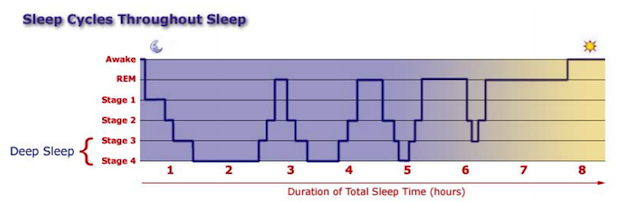
Your body goes through these stages in order, but as you repeat sleep cycles (which are 90 minutes), the duration can shift dramatically.
Sleep Junkies provides a pretty good graph of different sleep cycles (in their article on sleep and alcohol), which we’ll borrow below:
In this example of “Cycle 5” the sleeper barely spends any time in “deep sleep,” but much more time in REM sleep.
Our bodies are cray like that.
What’s with the different stages of sleep?
During the deep stages of NREM sleep (3 and 4), our bodies build bone and muscle (like after you strength train), repairs tissue, and boosts our immune system.[17]
When your body kicks into REM sleep, this is when your brain has increased activity and leads to dreaming, while your body is the most ‘paralyzed’ and knocked out. Some studies say that REM is most important for restoring brain functions. [18]
What’s crazy is that your entire morning can be dictated by what stage of sleep you were in before waking up. If you’ve ever only slept a few hours and woke up feeling great, or conversely slept plenty of hours but woke up groggy, this could explain it!
How to Get Better Sleep (The Single Best Advice on Better Shuteye)
We have a circadian rhythm (a daily biological clock) that ebbs and flows throughout the day.
Our body uses outside stimuli and our own activity to produce certain hormones at certain times to make our body more prepared for the required functions at that time (alertness vs restfulness).
Look at it from an evolutionary perspective – way back in the day (which was a Wednesday):
When the sun rose, our bodies are signaled “the day has begun! get cracking!” We reduce the hormones that make us sleepy, and produce more hormones that allow us to do the things that need to get done.
As the sun went down, our body starts to produce more melatonin, which produces that sleepy feeling and encourages us to rest/recover. Our only option for light back then was a candle or campfire. If that went out, we’d have moonlight and nothing else.
While sleeping, our bodies knew to cut back on urine production, decrease body temperature, decrease heart rate, and muscle activity. Our brains are still highly active during our sleeping.
Unfortunately, these days, our bodies aren’t tied to the rise and fall of that giant ball of gas above us.
Instead, we can use electricity, alarm clocks, computer screens, smartphone screens, and all other sorts of outside stimuli to adjust our natural sleeping schedule.
This means that our bodies often have no effin’ clue what time it is!
Outside of our circadian rhythm, we have another biological system that tells us when to go to bed: the chemical adenosine.[19]
Think of it as “sleep pressure.” As soon as you wake up, your body starts to produce adenosine. When it hits a certain threshold, you get tired and start thinking about your pillow.
You really want your circadian rhythm and adenosine buildup in sync. When they’re not, it’s terrible.
You may have experienced it: jetlag comes about when you’re in a different part of the world than your home, so the change in daylight throws off your circadian rhythm.
For example, let’s say it was daylight when I left London and it’s daylight when I arrive in New York 10 hours later.
But your sleep pressure system doesn’t know this, so it’s trying to send you to bed, despite it being high noon.
Here’s when things can really go haywire: you finally get to bed in New York, but your circadian rhythm is still linked to London (which is now morning), so it starts making you more alert despite being nighttime in Manhattan.
And insomnia ensures…
This brings us to the single best advice on getting better sleep: do what you can to go to bed and wake up at the same time every day.[20]
Even on weekends whenever possible.
This helps your circadian rhythm and adenosine buildup stay in line with each other. Things get awful when these two systems are out of whack.
This isn’t our only piece of advice on getting better sleep!
Here are 10 more tips on engineering a perfect night’s rest:
#1) Avoid screens as you get closer to bedtime. Why avoid screen time? A couple of things to consider:
There is some evidence that the light emitted from electronic devices interferes with our circadian rhythm.[21] Artificial light, specifically blue light, is thought to confuse our body’s internal block. To capitalize on this concern, companies are now selling blue light-blocking glasses, which are advertised as sleep aids. Studies done on the effectiveness of these blue light blockers are mixed.[22]
What else can be going on? Our devices are designed to monopolize our attention, which means we spend more time on our phones instead of sleeping. We’ve all been there. This is why there’s an association between social media use and sleep deprivation.[23]
#2) Consider purchasing red lightbulbs to use in your bedroom lamps, so your bedroom is a place of soft light rather than bright/harsh light.[24]
#3) Keep your bedroom cool (but not too cold). Outside of light, our bodies use temperature as a signal to go to bed.[25] It gets colder at night, so this shift in temperature tells our body it’s time to go to sleep. Personally, I’ve found that keeping my bedroom cool helps me fall asleep. It’s been a real game-changer. What’s the sweet spot? Experiment a little here, but shoot for somewhere between 60-67 degrees Fahrenheit (15-19 Celsius). Just don’t go too cold, which can also disrupt your rest.
#4) Consider getting black-out curtains for your bedroom windows, especially if you live in a city. Living in a city, there’s always something bright and shiny happening outside my window – it wasn’t until I purchased super dark curtains to cover up my windows that I noticed an improvement in my ‘fall-asleep time.’
#5) Earplugs or a white noise machine might be a good idea. Sounds and other forms of ear pollution can be a distraction when you’re trying to sleep. White noise machines might drown some of this out, and studies show they do help, but some good ole fashioned earplugs could do the trick too.[26]
#6) No TV in bed. This might be incredibly difficult for you if you’ve been falling asleep to TV for years. Instead of falling asleep with the blue glow of a TV at the foot of your bed, read a book – trust me, it will put you right to sleep.[27]
#7) Get in the habit of reading fiction. Reading puts me to sleep within a few minutes most night, though only if I’m reading fiction. When reading non-fiction, my mind starts to race with all of the new ideas and things I could be working on. Either read real books or read on a Kindle, no iPads!
#8) Buy the right TYPE of Mattress for you: I slept on a soft mattress with two mattress pads for a few months years ago and wondered why I woke up with lower back pain every day. Turns out, my back was jacked up, and the soft mattress made things even worse. Since switching to a firm mattress, I wake up without back pain. Lesson learned here: I’m not smart.
#9) A lot of this can depend on HOW you sleep! Are you a side sleeper? Back sleeper? Stomach sleeper? Turns out there are some evolutionary reasons why some styles work better than others! Personally, I use the “half-military crawl position” outlined by Tim Ferriss (scroll down to tip 11 for the position).
#10) Have allergies? Try a hypoallergenic pillowcase! Your allergies could be affecting you while you sleep, and having the proper pillowcase can make a world of a difference.
How to Get More Sleep
So we’ve covered how to get BETTER sleep, what if you also need to get more of it?
In order to start getting more sleep, sleep must become more of a priority. If you constantly stay up too late because things need to get done, evaluate how your time is spent after work. Seriously, think about it!
Are you doing the important tasks first? Or are you messing around on the internet and not starting your tasks until late in the evening.
Are you watching late-night shows long after they’ve become enjoyable, simply because your DVR records them?
Are you checking your smartphone while in bed, watching Twitch, or using your laptop to watch more shows you don’t really care about on Netflix?
Yes, I understand we have parents who read Nerd Fitness and have to stay awake and function on minimal sleep (I commend you, and wish you luck!).
However, for many of us, less sleep is often a result of disorganized priorities and poor use of our time.
Here are the best practical tips for giving you the greatest chance at getting into bed earlier:
Don’t drink caffeine after lunch if possible. Caffeine can have an effect up to 6 hours after consumption. We love caffeine for many reasons (in moderation); however, you want to make sure it’s not consumed too late or your body will revolt.
Turn off the electronics sooner. I have to enforce a “laptops closed by 8PM” or a “TV off after 10PM” rule on many nights or I never get to bed. I get lost in Internetland far too easily. Putting in actual barriers really helps. If you find yourself checking Facebook and Twitter and other sites incessantly, BLOCK YOURSELF from those sites after a certain time.
Stop watching crap TV shows!Just because it exists doesn’t mean you need to watch it. Pick a FEW shows you watch on Netflix, but be wary of the “auto-play” next episode! Netflix is counting on you to be lazy to watch another episode accidentally instead of getting sleep.
Shift things by 15 minutes every week. If you want to get to bed sooner, don’t just try to get to bed an hour earlier than normal. You’ll probably lie in bed for that whole hour wondering why you can’t fall asleep, stressing yourself out and making things worse (remember our lesson on circadian rhythm). I shifted my pattern by waking up 15 minutes earlier and getting to bed 15 minutes sooner. Then I repeated that process over a series of weeks. Eventually, you can shift your bedtime by an hour or two, but do it gradually!
How to Wake Up (The NF Sleep Calculator)
Is there any more annoying sound in the world than the “beep beep beep” of an alarm clock?
Well, maybe this.
But you get the point.
So here you are, dreaming about riding a dragon, doing improv with Liam Neeson, and playing poker with Iron Man and Spock…and that damn alarm clock wakes you up. You are now incredibly groggy and miserable.
Here’s what’s happening: Remember earlier how we talked about different sleep cycles? Depending on which cycle you were woken up during, your body can struggle to move from “asleep” to “wide awake.”
Wake up in the right phase and you can feel energized and ready to go.
Wake up in the wrong phase and you will feel lethargic and sleepy.
Because we’re often waking up at times when we’re not ready to wake up, timing can be everything when it comes to getting out of bed.
Have no fear! Let’s give you a timetable to base your sleep schedule on, so your alarm clock isn’t so jarring.
Here are some assumptions we’ll use:
You need about 15 minutes to fall asleep.
A sleep cycle is 90 minutes.
You want 5 or 6 sleep cycles (our 7-9 hours range).
THE NERD FITNESS SLEEP CALCULATOR
Wake up: 5am
Bedtime for 5 Sleep Cycles (7.5 hr): 9:15pm
Bedtime for 6 Sleep Cycles (9 hr): 7:45pm
Wake up: 6:30am
Bedtime for 5 Sleep Cycles (7.5 hr): 10:45pm
Bedtime for 6 Sleep Cycles (9 hr): 9:15pm
Wake up: 8am
Bedtime for 5 Sleep Cycles (7.5 hr): 12:15am
Bedtime for 6 Sleep Cycles (9 hr): 10:45pm
You get the gist. Try to time your alarm clock to a natural break between sleep cycles.
Technology might help here too!
Set a “go to bed” alarm, rather than a wake-up alarm! Remind yourself WHEN you should go to sleep. Bonus points if you can rig it to also shut off your wifi so that you actually have nothing exciting left to do in your house except read a book and go to sleep!
Try a dawn-simulator alarm clock. Rather than waking yourself up in pitch black with a disgusting beeping noise, why not gradually rise as if there was a natural sunrise in your room?
Feel free to sing the first line of “Circle of Life” at this point. I just did.
Also, DON’T SNOOZE!
Instead of snoozing, set your alarm for 30 minutes later and SKIP snoozing entirely. If this is an issue for you, put your alarm across the room so you need to physically get out of bed to turn it off!
Here are a couple more tips to help your alertness in the morning:
Still feeling groggy? Go for a walk first thing.A mile every morning, if you can. Heck, do it while walking to Mordor! Walking outside and seeing that blue sky can trigger your body to release the hormones that encourage you to feel more awake and alive.
Consider blue light therapy during the day. Productivity guruTim Ferriss swears by it, and the reviews are overwhelmingly positive, so I’ll be testing one out during the winter months to see if my mornings are marked by increased energy. If you’ve used one and had positive/negative experiences, I’d love to hear about it in the comments.
Am I a Night Owl or a Lark? (Why Am I Not a Morning Person?)
According to studies, about 1 in 10 people are true morning people (“larks”), while 2 in 10 are considered “night owls.” The rest fit somewhere in the middle as “hummingbirds.”
What this means: Some of us are more alert at certain times of the day and naturally want to rise earlier or stay up later. [28]
Now, the difference between the two extremes isn’t as DRASTIC as we’ve made it out to be. Humans can never be truly naturally nocturnal – we don’t have night vision (yet…).
We’re not programmed to operate during the middle of the night. But, we CAN use our natural tendencies to help us be more efficient and productive during certain parts of the day.
We can change and adapt. Just like those who successfully work a night shift job (tips on that here), many who consider themselves a night owl may find they can become a morning person if they set themselves up for success.
I used the excuse for years of being a “night owl” to screw around all day and work from midnight to 4 AM each night, when it really just required a shifting of my priorities and productivity hacks.
What this all means: Identify your biological clock and try to adjust around it if possible. However, if your job requires you to get up early or stay up later, most of us can make an adjustment. Don’t let your poor habits blame “being a night owl” like I used to.
Should I Take Naps? (How to Nap During the Day)
Although generally not part of a day here in the States, we’re actually programmed to desire a quick nap in the early afternoon.[29]
In other countries, naps are more socially acceptable (Siesta? Si, por favor!). If you feel bad that you get tired in the early afternoon, it’s not because you’re lazy. It’s because you’re naturally wired for naptime. Now, you might still be lazy, but it’s not related to your nap schedule.
So, behold the power of the power nap:
Didn’t get enough sleep last night? Only have 20-30 minutes for a quick break? Try the caffeine-fueled power nap.
Fun fact: If you’ve slept less than normal, taking a 90-minute nap the following day could lead to an increased amount of REM sleep in that nap.[30]
What Is Sleep Apnea? (What’s the Best Treatment for Sleep Apnea?)
Sleep apnea is a condition where someone periodically stops breathing while sleeping.
While there are a few different versions of sleep apnea, the most common is “Obstructive Sleep Apnea,” which occurs when throat muscles become overly relaxed.
A telltale sign of obstructive sleep apnea is loud snoring, although not everyone who snores has sleep apnea.
Sleep apnea can potentially be pretty serious, what with the whole not breathing thing going on. It depends on the severity of the condition.
If it’s serve, not breathing correctly could majorly disrupt sleep, to the point of increasing the risk of certain diseases.[32]
How do you know if your sleep apnea is mild or severe?
Unfortunately, the only way to really be sure is to head to the doctor. If you go to your primary care physician, they will likely refer you to a sleep specialist to find out.
If you feel tired in the morning despite getting plenty of sleep, and a partner or loved one complains that you snore, it might be worth looking into a sleep apnea diagnosis.
I will mention that being overweight can contribute to obstructive sleep apnea, so weight loss could be a possible treatment.
I’ve got a couple of resources to help you start your journey:
How to Lose Weight (Without Dieting): check out our guide on the 5 rules for sustainable weight loss. If you’re not sure where to start, start there.
Our 1-on-1 Online Coaching Program: if you want a trained professional to tell you exactly what to do, check out our coaching program. Many clients jumpstart their weight loss journey with the help of a NF Coach, and the results they’ve achieved can be incredible.
In the meantime, try a different sleeping position (like the aforementioned half-military crawl position to keep your passages open).
What Is Second Sleep? (Waking up in the Middle of the Night)
Biphasic Sleep is sleeping in two distinct periods.
We’re gonna go back in the day again: during winter months, nighttime could last 12-14 hours.
With our bodies’ production of melatonin (the “sleepy time” hormone) kicking into high gear when that sun drops, people had nothing else to do (no TV, PS4, or iPads) and would fall asleep early. Then they would wake up for an hour or two in the middle of the night to read, pray, or think, and then fall back asleep for another 4-5 hours before waking up for the day.
If you’ve ever gone to bed at a normal hour, and then woke up in the middle of the night without being able to fall back asleep for an hour or so, you know what I’m talking about.
Here’s the thing: this is actually quite natural![33]
Rather than freaking the heck out and lying in bed wondering why you can’t fall asleep…consider it something that is more common than our current sleep schedule.[34] Don’t be afraid to turn on the light (red light!) and read a book or use the time for meditation until you can fall back asleep.
This one ‘mental shift’ alone can keep your stress levels down and let you get back to sleep faster and provide you with BETTER sleep.
4 Tips and Tricks to Hack Sleep
#1) Macrodozing:
I stumbled across the BEST biohack for optimal human performance.
It’s tricky, but here’s what to do:
Lie in bed with your eyes closed, for like, 7-9 hours.
If you can actually pull this off, productivity for the next 16 hours will be INSANE.
I often spend my nights in bed thinking and worrying about all of the things I need to do the next day. Instead of stressing out about it, take a minute and write down the things you need to do the next day. Then set it aside.
A notebook, a post-it note, an Evernote file, whatever.
Do a brain-dump and clear your head so you can focus on reading A Game of Thrones without thinking about the next day’s tasks.
#3) Want to control your dreams? It’s called “Lucid Dreaming,” it’s possible, but requires work. I’ve only been able to do it once, but haven’t given up hope that it can become a more common occurrence! Ultimately, this allows you to live out a real-life version of Inception.
#4) Have way too much time on your hands and not constricted by societal norms? Try Polyphasic sleep and then tell me how it goes 🙂 It didn’t work for Kramer, but it might work for you!
(But it probably won’t).
Start Sleeping Better Tonight (Next Steps)
Like, anything, that which gets measured gets improved.
Now, if you’re somebody that isn’t really detail-oriented, just start by picking ONE or two changes above, and focus on building that Hard Hat Habit. However, if you like to nerd out about certain details, why not nerd out about your sleep?
Starting tomorrow morning, when you wake up, recap the previous day with a journal entry:
What time did you wake up, and what time did you actually get out of bed?
How many times did you hit snooze?
After work, how much television did you watch? After you finished watching, did you go right to bed? Did you fall asleep with the TV on?
How long did you lie in bed before actually falling asleep (obviously this will be tough to tell, but you can estimate).
A quick recap on what to do:
Change one or two things about your current strategy.
Turn off the computer 15 minutes earlier.
Stop watching TV in bed.
Read fiction.
Limit the amount of blue light and screen activities that amp you up at night.
No more snoozing.
Set the alarm clock across the room.
Go for a walk in the morning outside.
If you want to use technology:F.Lux for your computer, red bulbs in the bedroom, Sunrise alarm clock for waking up without disturbing deep sleep.
That should just about do it for today’s article.
If you’re looking for where to go from here, I’ve got some options for you. But I’m only gonna tell you, because you’ve been a good sport this whole article.
NEXT STEPS IF YOU WANT TO GO FARTHER!
#1) Our 1-on-1 Online Coaching Program: a coaching program for busy people to help them lose weight, get strong, and level up their lives!
We take sleep so seriously, we discuss it with each and every client.
#2) If you want an exact blueprint for getting in shape, check out Nerd Fitness Journey! Our fun habit-building app helps you exercise more frequently, eat healthier, and level up your life (literally).
If you follow our Sleep missions, you’ll learn to improve your night rituals while earning XP! Sah-weeeet.
Try your free trial right here:
#3) Join our amazing free community, the Nerd Fitness Rebellion! Not only is it free to join, but we’ll provide you with loads of free goodies when you sign-up:
Get your Nerd Fitness Starter Kit
The 15 mistakes you don’t want to make.
Full guide to the most effective diet and why it works.
Complete and track your first workout today, no gym required.
Now, I’d love to hear from you:
What questions do you have about sleeping?
How have you learned to be better at it?
What are you still struggling with?
Have you tried sunrise alarm clocks or blue-light devices?
You’ve heard about being “down to your last dime,” but how about being “down to your last dumbbell?”
Maybe a hard economy forced the fire sale of your once epic home gym. Maybe you’re making do at a poorly equipped hotel gym. Or maybe you’re on a road trip with limited space for strength equipment.
Hryshchyshen Serhii / Shutterstock
No matter the scenario, these single-dumbbell workouts will help you turn strife into strength, lean times into lean mass, and hardship into a hard body. But don’t expect charity gains. You’re going to have to work for it.
Best Single-Dumbbell Workouts
Best Single-Dumbbell Workout for Muscle Gain
Training to put on muscle without the niceties of a fully equipped gym? Fortunately, muscle gain occurs across a wide range of repetitions and using weights ranging from light to heavy (e.g. 30% to more than 80% of maximum). (1)(2)(3)(4)
As such, a single dumbbell of moderate weight may be the most utilitarian tool for whole-body hypertrophy training. With thoughtful exercise selection and a time-saving strategy like agonist-antagonist supersets, you’ve got a no-frills recipe for growth.
For this single-dumbbell hypertrophy workout, a moderate weight works best (e.g. 15 to 50 pounds). Training to failure is not “required” for noteworthy gains. (5)(6) For best results with limited equipment, however, you will need to take these sets to a high level of effort. (4) That is, each set should approach failure. Select a number of repetitions that leaves between one and four repetitions “in the tank.”
Build Size with One Weight
This full-body workout uses paired exercises and an emphasis on single-arm or single-leg movements to get the most from minimal equipment. Begin targeting the back and chest. Like a standard row, the wide dumbbell row hits the mid-back (middle trapezius and rhomboids) but may better train the rear deltoids. (7)(8) Elevating one hand during the push-up will increase the difficulty of the exercise by achieving a greater stretch across pectoralis major (chest) in the bottom position.
Next you’ll tackle legs. During the single-leg Romanian deadlift, you can use a sturdy object, such as a chair or bench, for balance assistance and to keep the focus on your hamstrings rather than stabilizing muscles. But be disciplined. Do not push with your support hand.
You’ll end the session with some direct arm work. You’re welcome. By bracing your upper arm against your thigh during the concentration curl, you eliminate “cheating” from body sway and shoulder flexion. The long head of triceps is lengthened across the shoulder during the overhead triceps extension, making this exercise superior for muscle growth. (9)
Wide Dumbbell Row
How to Do it: Brace your free arm on a flat bench with your feet in a stable stance. Grab the dumbbell with your working arm and pull it “up and out.” In the top position, your elbow should be nearly in line with your shoulder and away from your ribs. Keep your torso level and avoid rotating as you pull and lower the weight.
Sets and Reps: 3 sets to muscular fatigue, per arm. Depending on the weight of your dumbbell, repetitions may range from six to 30 or more.
Rest time: No rest between arms. No rest before moving to the next exercise.
Single-Arm Emphasis Push-Up
How to Do it: Lie on the ground with one hand on the dumbbell and the other hand flat on the floor. Keep your spine and legs straight as you lower into a deep push-up. The chest of the elevated hand will be put into a significant stretch. Press up until the non-elevated hand is locked out. Perform an even number of repetitions with each hand elevated.
Sets and Reps: 3 sets to muscular fatigue.
Rest time: No rest between arms. Rest 90 seconds before repeating the previous exercise.
Single-Leg Romanian Deadlift
How to Do it: Stand near a chair or the back of an incline bench while holding a dumbbell in one hand. Use the bench, as needed, for stability. Lift the leg of the working side slightly off the ground and softly bend the opposite knee. Bend at your hips as you “reach” the dumbbell toward your foot on the ground. Allow your working-side leg to rise into the air behind you. Keep your torso straight and don’t bend at the spine. Pull your torso back to stand upright.
Sets and Reps: 3 sets to muscular fatigue, per leg. Depending on the weight of your dumbbell, repetitions may range from six to 30 or more.
Rest time: No rest between legs. No rest before moving to the next exercise.
How to Do it: Face away from a flat bench while holding a dumbbell in one hand. Place the same-side leg behind you, resting your shoelaces on the bench. Squat down with your front leg and allow your back knee to drop to the floor. Keep your shoulders pulled back and your torso upright during the movement. Drive through your front foot to stand upright.
Sets and Reps: 3 sets to muscular fatigue, per leg. Depending on the weight of your dumbbell, repetitions may range from six to 30 or more.
Rest time: No rest between legs. Rest 90 seconds before repeating the previous exercise.
Concentration Curl
How to Do it: Sit on a bench with your feet wider than shoulder-width. Grab a dumbbell with a palms-up grip in one hand and rest the triceps of that arm near the same-side knee. Curl the weight toward your face. Don’t allow your legs or torso to swing the weight up. Lower the weight to full straight-arm extension.
Sets and Reps: 3 sets to muscular fatigue, per arm. Depending on the weight of your dumbbell, repetitions may range from six to 30 or more.
Rest time: No rest between arms. No rest before moving to the next exercise.
Single-Arm Overhead Extension
How to Do it: Sit upright on a flat bench. Press a dumbbell overhead with one arm. Keep your torso tight and upright. Lower the weight behind your head until your hand is roughly in line with the top of your head. Keep your elbow pointed generally toward the ceiling, don’t allow it to move significantly. Only your hand should move with the weight.
Sets and Reps: 3 sets to muscular fatigue, per leg. Depending on the weight of your dumbbell, repetitions may range from six to 30 or more.
Rest time: No rest between arms. Rest 90 seconds before repeating the previous exercise.
Best Single-Dumbbell Workout for Fat Loss
Circuit training, a method of exercise that links multiple exercises together with minimal rest between each, is effective for improving body composition. In addition to decreasing body fat percentage and increasing muscularity, circuits may also promote modest improvements in aerobic fitness and strength. (10)(11)
Single-dumbbell exercises are ideal for circuit training because they require minimal setup. Machine-based circuit training obviously requires plenty of equipment, but it also requires monopolizing more than one’s fair of the gym. Single-dumbbell circuit training can just as easily be done in a small corner of a busy gym or a lonely motel room.
One-Dumbbell Fat-Burning Circuit
A light dumbbell works well for this whole-body resistance training circuit — 10 to 30 pounds should work for most lifters, depending on your strength and fitness level. It uses a descending repetition scheme, with each exercise performed for progressively fewer reps, to accommodate fatigue as you continue to work.
Perform the exercises in order, rest briefly, and then repeat the entire sequence for a total of three rounds.
Single-Arm Dumbbell Row
How to Do it: Take a staggered stance with your front foot next to the dumbbell. Your working arm will be opposite your front foot — left foot forward with your right arm working, and vice versa. Brace your non-working forearm on your front thigh. Grab the dumbbell with your working arm and row toward your back hip. Maintain a neutral grip with your palm facing your leg. Lower the weight to a full stretch, nearly reaching ankle-level.
Sets and Reps: 3 x 30 per arm.
Rest time: No rest between arms. No rest before moving to the next exercise.
Single-Arm Floor Press
How to Do it: Lie down with the dumbbell in one hand and your elbow resting on the ground. Bend your legs with your feet flat. Press the weight above your chest to full lockout. Lower under control. Do not bounce your arm off the ground between repetitions.
Sets and Reps: 3 x 25 per arm.
Rest time: No rest between arms. No rest before moving to the next exercise.
Goblet Squat
How to Do it: Stand up while holding the dumbbell in the “goblet position,” supporting the dumbbell with both hands in front of your chin or neck. Keep your elbows close to your torso. Squat down as low as possible while keeping your upper body vertical. Keep your feet flat on the floor throughout each repetition.
Sets and Reps: 3 x 20
Rest time: No rest before moving to the next exercise.
Dumbbell Good Morning
How to Do it: Hold the dumbbell to your upper chest using both hands. Slightly bend your knees while pushing your hips back and bending at the waist. When your upper body is nearly parallel to the ground, “pull” with your glutes and hamstrings to return upright. Keep a neutral spine during the movement. Don’t allow your back to round forward.
Sets and Reps: 3 x 15
Rest time: No rest before moving to the next exercise.
Single-Arm Arnold Z Press
How to Do it: Get on the ground in a “long-sitting position” with your legs extended in front of you and your upper body straight. Hold the dumbbell in front of your working-side shoulder with your palm facing your body. As you press overhead, rotate the dumbbell so your palm faces forward in the top position. Reverse the movement as you lower the weight.
Sets and Reps: 3 x 10 per arm.
Rest time: No rest between arms. Rest 60 seconds before repeating the first exercise.
Best Single Dumbbell Workout for Conditioning
A complex is a series of lifts performed in immediate succession with the same piece of equipment. Barbell and kettlebell complexes are extremely popular, and for good reasons. They train all major energy systems, build multi-joint strength, and fortify your grip. But the humble dumbbell does not get the notoriety it deserves for complexes.
As a unilateral (single–arm) implement, it hammers the core while its balanced center of mass may be more user-friendly than a kettlebell for certain Olympic lift-inspired exercises, such as the dumbbell snatch.
One-Dumbbell Conditioning Complex
The exercises in this conditioning complex are power- and strength-based, which would tend to tax the quick-energy phosphagen system when performed in isolation. However, as the repetitions and rounds of the complex add up, you will lean hard into the anaerobic glycolysis and aerobic systems. Meaning this single-dumbbell complex is a multi-functional conditioning workout.
Perform all repetitions with the dumbbell in your left hand, followed by all repetitions with the dumbbell in your right hand, before immediately moving on to the next exercise.
Dumbbell Snatch
How to Do it: Start with the dumbbell in the “hang position” between your knees — your feet should be slightly wider than shoulder-width and your palm facing your body. Drive through your hips and knees toward the ceiling. Carry that momentum through the dumbbell as you “zip” the weight in front of your midline and “flick” it into the overhead position. Lockout with a straight arm. Lower the weight with control to the starting position and repeat.
Sets and Reps: 3 to 5 x 4 per arm.
Rest time: No rest between arms. No rest before moving to the next exercise.
Front-Loaded Reverse Lunge
How to Do it: Hold the dumbbell at shoulder-level with your thumb near your shoulder. Step backward into a deep lunge position with your leg on the same side as the weight. Keep your torso upright and resist the weight pulling your upper body to the side. When your rear knee is close to the ground, drive through your front leg to return to a standing position. Perform all reps with one leg, then switch hands and repeat with the opposite leg.
Sets and Reps: 3 to 5 x 4 per leg.
Rest time: No rest between legs. No rest before moving to the next exercise.
Dumbbell Push Press
How to Do it: Combine a mini-squat and ballistic overhead press to drive the weight overhead. Begin with the dumbbell near your shoulder and your palm facing your head. Squat down several inches before exploding upward as you press overhead to full lockout. Lower the weight under control.
Sets and Reps: 3 to 5 x 4 per arm.
Rest time: No rest between arms. No rest before moving to the next exercise.
Single-Arm Overhead Squat
How to Do it: Challenge your trunk stability and shoulder complex mobility with this full-body squat. Press the weight to lockout overhead and widen your stance. Squat as low as possible without moving your locked out arm overhead. Keep your torso as upright as possible and resist any rotation or twisting.
Sets and Reps: 3 to 5 x 4 per arm.
Rest time: No rest between arms. Rest 90 seconds before repeating the first exercise.
Best Single Dumbbell Workout for Strength
Heavy bilateral (double-limb) movements with barbells and machines tend to be the go-to exercises for strength in traditional gyms. But if all you’ve got is a single dumbbell, you’re going to have to make it work.
An effective strategy for enhancing strength is “accentuated eccentric training.” Accentuated eccentrics apply greater loads during the negative or lowering phase of the exercise than those applied during the concentric phase. (12) Weight releasers are commonly used for accentuated eccentric training, but this specialized device only works for one repetition, as the extra weight is jettisoned at the bottom of the first repetition. More importantly, it’s not compatible with dumbbell training.
Fortunately, accentuated eccentric loading can be accomplished by performing a unilateral, or single-sided, exercise with the assistance of the other limb during the concentric (lifting) phase. In plain English, you will use your off-side arm or leg to “help” during the upward phase of the lift and lower the weight with only your working side.
Build Strength with Just One Weight
Just as training to failure is not essential for muscle hypertrophy, it is not a requirement for strength. (6) You can and will build strength with not-to-failure sets of these exercises as long as your dumbbell is moderately heavy (e.g. 30 to 70 pounds, depending on your strength).
Half-Kneeling Single-Arm Overhead Press
How to Do it: Kneel on the ground with the weight on the same side as the down knee. Use your off-side arm to assist in lifting the dumbbell from the bottom of the movement to lockout. Lower the weight using only your working-side arm. For each repetition, use the non-working arm to help lift the weight.
Sets and Reps: 2 to 6 x 4 to 6 per arm.
Rest time: Rest two minutes between sets.
Skater Squat
How to Do it: Stand on your working leg while holding the dumbbell in the front rack position, hugged to your upper chest with both hands. Squat down until your off-side knee gently contacts the floor. Dig your off-side foot into the floor to assist back to a standing position. If you are unable to perform skater squats with control, place a pillow or stack of textbooks under your off-side knee to limit the range of motion.
Sets and Reps: 2 to 6 x 4 to 6 per leg.
Rest time: Rest two minutes between sets.
Single-Leg Good Morning
How to Do it: Begin standing on one leg with the dumbbell in the front rack position, hugged to your upper chest with both hands. Hinge forward at the hips with minimal knee bend. Allow your back leg to rise into the air until your torso is nearly parallel to the ground. In the bottom position, bring your off-side foot to the floor to assist your return to a standing position. Perform all reps with one leg before switching sides.
Sets and Reps: 2 to 6 x 4 to 6 per leg.
Rest time: Rest two minutes between sets.
How to Warm-Up for Single-Dumbbell Workouts
A typical warm-up consists of five to ten minutes of general aerobic exercise followed by several lighter sets of the exercises that will be included in the workout. Since you’ve only got one dumbbell, cardio equipment and lighter “work-up sets” are out of reach.
Credit: Dusan Petkovic / Shutterstock
However, even in these desperate times, a warm-up is important to get the most out of your workout. Consider jogging or ropeless jump rope (“pogo hops”) to elevate your body temperature.
For squats, lunges, Romanian deadlifts, and good mornings, a bodyweight warm-up of three sets of 10 to 12 reps should suffice. For non-bodyweight exercises, perform non-challenging, low-repetition sets of the primary movements you will train in the workout.
One Weight is All it Takes
Performed with intent and intensity, single-dumbbell workouts can build muscle size, promote fat loss, improve conditioning, and develop strength. These workouts can be useful when you find yourself in less-than-ideal scenarios where equipment is limited or you can deliberately program a single-dumbbell workout as an exercise in minimalism. Benefits of single-dumbbell training include versatility, the potential for unilateral loading for a challenging stimulus to the core, and the ability to efficiently perform accentuated eccentric exercises. Next time you are “down to your last dumbbell,” a single-dumbbell workout might change your outlook from grim to grateful.
References
Lasevicius, T., et al. (2018). Effects of different intensities of resistance training with equated volume load on muscle strength and hypertrophy. European Journal of Sport Science, 18(6), 772-780.
Jenkins, N. D., et al. (2017). Greater neural adaptations following high-vs. low-load resistance training. Frontiers in Physiology, 8, 331.
Schoenfeld, B. J., et al. (2021). Loading recommendations for muscle strength, hypertrophy, and local endurance: a re-examination of the repetition continuum. Sports, 9(2), 32.
Pareja‐Blanco, F., et al. (2017). Effects of velocity loss during resistance training on athletic performance, strength gains and muscle adaptations. Scandinavian Journal of Medicine & Science in Sports, 27(7), 724-735.
Vieira, A. F., et al. (2021). Effects of resistance training performed to failure or not to failure on muscle strength, hypertrophy, and power output: a systematic review with meta-analysis. The Journal of Strength & Conditioning Research, 35(4), 1165-1175.
Grgic, J., et al. (2021). Effects of resistance training performed to repetition failure or non-failure on muscular strength and hypertrophy: a systematic review and meta-analysis. Journal of Sport and Health Science.
Hedrick, A., & Herl, M. (2021). Technique of the Unilateral Dumbbell Wide Row. Strength & Conditioning Journal, 43(4), 121-123.
García-Jaén, M., et al. (2021). Electromyographical responses of the lumbar, dorsal and shoulder musculature during the bent-over row exercise: a comparison between standing and bench postures (a preliminary study). Journal of Physical Education and Sport, 21(4), 1871-1877.
Maeo, S., et al. (2022). Triceps brachii hypertrophy is substantially greater after elbow extension training performed in the overhead versus neutral arm position. European Journal of Sport Science, 1-11.
Ramos-Campo, D. J., et al. (2021). Effects of resistance circuit-based training on body composition, strength and cardiorespiratory fitness: a systematic review and meta-analysis. Biology, 10(5), 377.
Schmidt, D., Anderson, K., Graff, M., & Strutz, V. (2015). The effect of high-intensity circuit training on physical fitness. The Journal of sports medicine and physical fitness, 56(5), 534-540.
Wagle, J. P., et al. (2017). Accentuated eccentric loading for training and performance: A review. Sports Medicine, 47(12), 2473-2495.
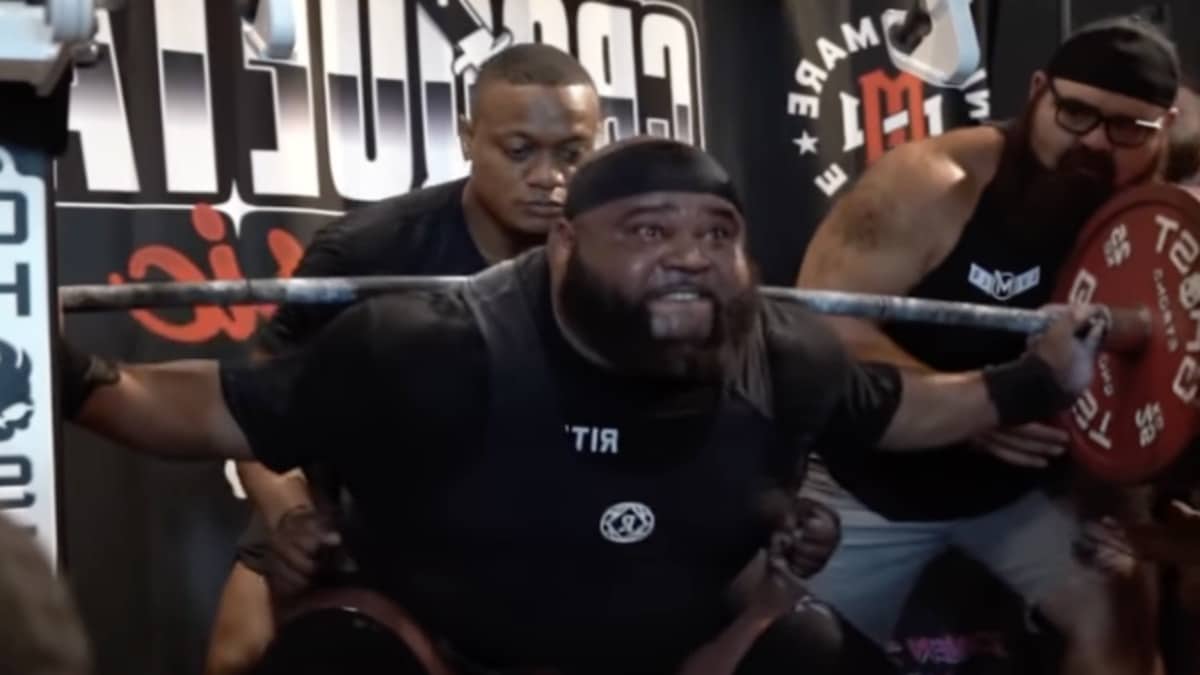
On Oct. 9, 2022, during the World Raw Powerlifting Federation (WRPF) The Croqueta Classic, Craig Foster scored a 465-kilogram (1,025.1-pound) raw back squat while competing in the +140-kilogram division. Per Foster’s caption in an Instagram post recapping his performance at the contest, the top squat is a new personal record (PR) for the powerlifter.
Foster’s new all-time competition best raw squat officially matches his all-time competition best with wraps from the 2022 WRPF Ghost Clash in February 2022. The athlete donned a lifting belt, knee sleeves, and wrist wraps to help him with his leg power achievement. (Note: At the time of this writing, in terms of official results, Foster’s PR squat is all that is clear about his recent performance.)
In addition to notching a new PR, Foster further cemented himself in the annals of powerlifting history. Foster’s 465-kilogram (1,025.1) squat is the third-heaviest raw squat ever, behind Ray Williams (490 kilograms/1,080.2 pounds) and Jezza Uepa (470 kilograms/1,036.1 pounds).
Not the best day but the most fun I’ve had in a meet in a long time.
Foster might be among the current athletes unofficially chasing Williams’ World Record crown atop the squat mountain. One of his other notable peers is Jesus Olivares, who eclipsed the 1,000-pound squat barrier for the first time in a mid-September 2022 workout. However, according to Open Powerlifting, Foster’s new top squat still paces ahead of Olivares’ best on an official basis by 15 kilograms (33.1 pounds), leaving Foster with pole position to potentially challenge Williams’ figure in time.
Here’s a complete overview of Foster’s all-time raw competition bests:
*Note: Foster may have scored new PRs on his other lifts during the 2022 WRPF The Croqueta Classic, but that is unknown at the time of this writing.
In a career that dates back to December 2017, Foster can boast four victories and has never failed to qualify for the podium. Here’s a rundown of some of the more notable results from Foster’s competitive resume:
*Craig Foster | Notable Career Results
2018 United States Powerlifting Association (USPA) Florida State Championships (Open/Raw) — First place
2019 USPA Battle of the Bay V (Open/Raw) — First place
2019 USPA Florida Throwdown (Open/Raw) — First place
2020 WRPF The Showdown (Open/Raw) — Second place
2021 WRPF Kern US Open (Open/Raw) — Third place
2021 WRPF The Bucked Up Showdown (Open/Raw) — Second place
2022 WRPF Ghost Clash (Open/Wraps) — Third place
*Note: Results from Foster’s performance at the 2022 WRPF The Croqueta Classic have not been included because, at the time of this article’s publication, it is also unclear where he stood at the end.
With a new squat PR in his back pocket, Foster might be tempted to focus on his training for a little while. The athlete hasn’t yet alluded to any potential upcoming competitions. That said, for one of the greatest powerlifting squatters ever, it might be only a matter of time before Foster is making waves again.
Featured image: @craig_pawgking_foster on Instagram