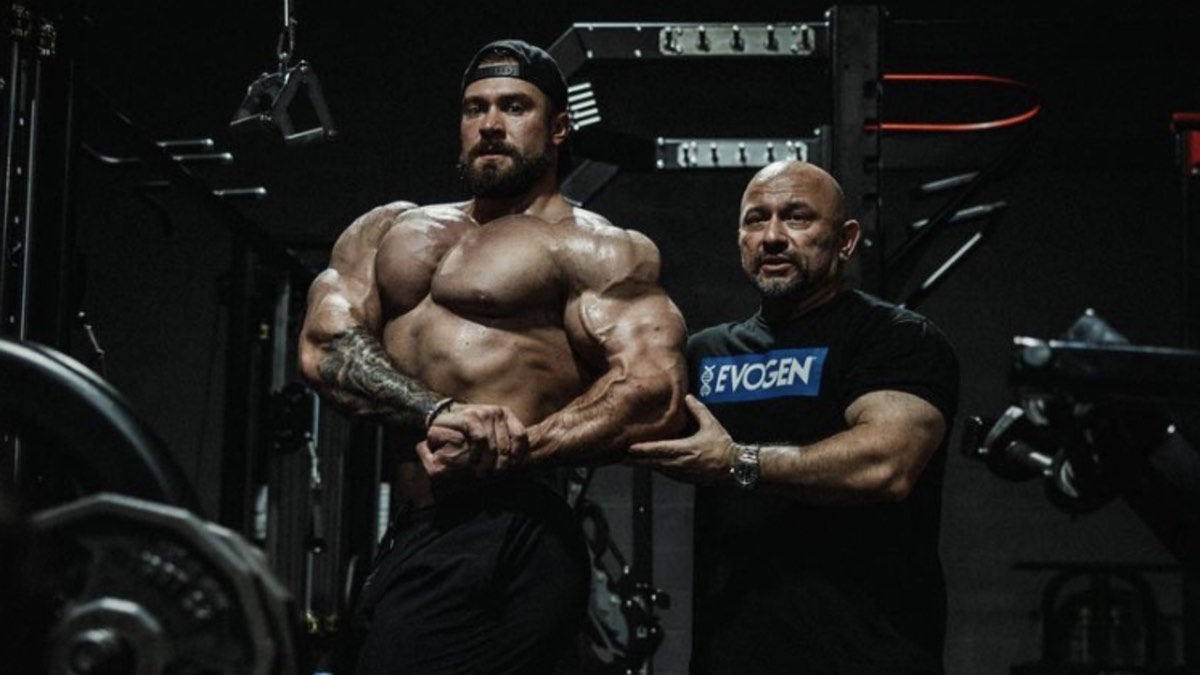
On Oct. 22, 2022, reigning three-time Classic Physique Olympia champion (2019-2021) Chris Bumstead announced that the legendary Hany Rambod would be his coach for the final stages of his 2022 Olympia training. As he prepares to vie for a historic fourth consecutive Classic Physique Olympia title, Bumstead made the news official in a video posted to his YouTube channel on the same day.
Rumors had circulated for a little while that Bumstead would soon be working in tandem with Rambod. The champion bodybuilder acknowledged those not-so-subtle murmurs, noting that the “secret’s out.”
Bumstead’s transition to Rambod as his coach comes on the heels of the athlete ending a partnership with fellow bodybuilder Iain Valliere. Considering Rambod’s history and pedigree, Bumstead’s decision might be a wise one.
The coach/nutritionist has developed a reputation for being one of the best in the business. Rambod can say that thanks to a hand in helping bodybuilding legends like Phil Heath and Jay Cutler capture their vast assortment of Olympia titles.
Rambod can also boast of working with ascending stars Derek Lunsford and perennial Olympia contender Hadi Choopan. If there’s one person that can help Bumstead to a “four-peat,” it might be the coach in Rambod — who’s been a part of 20 different Olympia titles to date.
To address the news from his perspective, Rambod said that he expressed initial surprise when Bumstead first contacted him in August 2022.
“It definitely came from left field,” Rambod explained. “A lot of people think this has been going on for a long time. It really hadn’t.”
According to Bumstead, Rambod had reservations about starting work with Bumstead at the beginning of his formal Olympia prep, rather than having extra months in the off-season to prepare. The two seemed to ultimately come to an agreement that they’re professionals and have been around the block in terms of experience.
“It’s not my first rodeo, it’s not (Rambod’s) first rodeo,” Bumstead clarified. “We’ll make it work. I’m excited.”
While he’s working with a bodybuilding coaching great, Bumstead faces a tall task to continue his streak of Classic Physique Olympia titles. The competitor he originally dethroned in 2019, Breon Ansley, will try to make his last run in this division a memorable one. Meanwhile, usual top-level performer, Terrence Ruffin, seems to be chomping at the bit to finally break through on the Olympia stage.
Whether Bumstead can hold off his similarly talented peers is a question that will only have an answer on Dec. 16-18, 2022, in Las Vegas, NV.
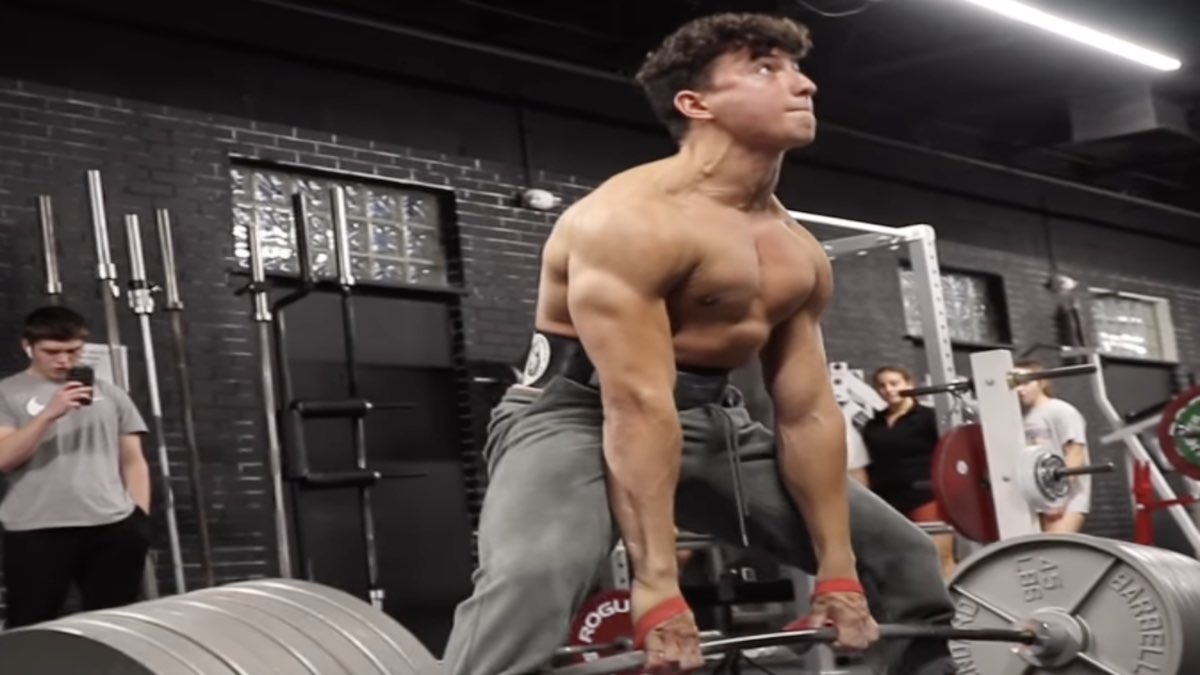
One need only see Nabil Lahlou lift once to verify why he’s the so-called “French Phenom,” per his Instagram bio. The 23-year-old powerlifter is a prolific competitor, and his latest demonstration of strength was a doozy.
On Oct. 22, 2022, Lahlou shared an Instagram clip of himself capturing a 362.9-kilogram (800-pound) raw deadlift during a training session. According to Open Powerlifting, the feat is a personal record (PR) for Lahlou by 44.9 kilograms (99 pounds). It’s a significant and rapid jump forward for Lahlou, who previously pulled 317.9 kilograms (701 pounds) during the 2022 United States Powerlifting Association (USPA) Drug-Tested The Good Guys UN Invitational. (Note: That meet was roughly only two weeks earlier.) The athlete wore a lifting belt and utilized lifting straps to help with this latest achievement.
For Lahlou, the 800-pound deadlift might be even more impressive, considering his body composition.
Per Lahlou’s Instagram post, the athlete weighed 163 pounds (73.9 kilograms) at the time of his lift. That means his massive pull was 4.9 times his body weight. Factor in Lahlou apparently not even planning to deadlift before he was “feeling the warm-ups,” and this milestone resembles something quite eye-opening for a young star powerlifter.
Here’s an overview of Lahlou’s all-time raw competition bests:
In terms of his overall resume, Lahlou doesn’t have many blemishes. Since he began competitive powerlifting in November 2020, there have been just three instances in Lahlou’s career where he hasn’t finished with an outright victory.
Here’s a rundown of some of the more notable results of Lahlou’s career:
Nabil Lahlou | Notable Career Results
2020 USPA Drug-Tested NOVA Fall Classic (Juniors 20-23/Raw) — First place
2021 USPA Drug-Tested PWRBLD Gym March Madness Powerlifting Meet (Juniors 20-23/Raw) — First place
2021 USPA Drug-Tested District Championships (Juniors 20-23/Raw) — First place
2021 World Raw Powerlifting Federation (WRPF) Drug-Tested Nationals (Juniors 20-23/Raw) — First place
2021 USPA Kentucky State Championships (Open/Raw) — First place
2021 USPA Beast of the East (Open/Raw) — First place
2022 USA Powerlifting (USAPL) Got Em’ Mustache Classic (Juniors/Open/Raw) — First place
2022 USPA Drug-Tested The Good Guys UN Invitational (Open/Raw) — First place
Lahlou has participated as a 67.5-kilogram competitor since the 2022 USPA Drug Tested King of the Cave in June 2022. This was his weight class for much of his career before a shift to the 75-kilogram category from December 2021 to June 2022. At the time of this writing, it is not clear if he plans to make a transition back to this division or another.
When Lahlou competes next is uncertain. However, should he return to the 75-kilogram weight class while notching this deadlift in said next contest, it would break the current World Record of 362.4 kilograms (799.1 pounds) held by Adlet Moldagaliev. Such a staggering mark would act as a perfect notch in the belt for this “phenom.”
If you take in all the macronutrients – fats, carbohydrates, and protein – then you shouldn’t have to worry about your workout performance and recovery, right?
It’s not quite that simple. There are certain foods that help you get the most out of your cardio and strength workouts. But don’t forget to pay attention to what you eat on rest days, because this can really impact how fast you recover.
Table of contents
Workout Days and Rest Days: What should I eat before, during, and after workouts?
Cardio Days
Before a cardio workout: Three hours before training: include carbs from whole foods, protein, and fats in your meal. Try out thissweet potato skins recipe. If you eat less than one hour before training: opt for a shake or smoothie that includes carbs and protein, but is low in fiber so that it’s easy to digest.
During the workout: Hydrate with water and/or an electrolyte drink, especially in warm weather. If you are exercising for more 90 minutes, have a sports drink that contains carbs. Most people burn between 30 to 60 g of carbs per hour, depending on body size and metabolism.
After a cardio session: Plan to wait 45-60 minutes after exercising to eat; this will help you maximize your time in the fat burning zone.(1) Your post exercise meal should contain carbs and protein from whole foods in a ratio of 3:1. There is no need for fast-digesting refined carbs, since the carbs from whole foods will replenish your glycogen stores by the next day. However, if you do plan to work out twice a day, you will need to consume some fast-acting carbs after the first workout. These include white bread, white flour pasta, rice, or potatoes.
If you need help determining the amount of carbs that you need to take in for the day, check out the Runtastic Carb Calculator here:
Strength Training Day
Before the workout: Two to three hours before training: include carbs from whole foods, protein, and fats in your meal. You can try our easy recipe for a spicy shakshuka. If you eat less than one hour before training, opt for a shake or smoothie that includes carbs and protein.
During strength training: Take in some BCAAs (Branch Chain Amino Acids). BCAAs are a group of three amino acids: leucine, isoleucine, and valine. They are considered the building blocks of muscle protein. Also, since BCAA supplements require no digestion, they bypass the liver and go right into the bloodstream for instant use by the muscles. Consuming BCAAs during exercise has been shown to increase the rate of muscle protein synthesis and reduce the extent of muscle damage and soreness post workout.(2)
After your workout: Plan to eat about 30 minutes after a strength session.(3,4) You want to get the nutrients in quickly so that you can replenish your muscles and allow them to grow stronger. Eating protein combined with high-carb foods after exercise prevents protein breakdown and stimulates synthesis, encouraging faster recovery and adaptation.
What Should I Eat on Rest Days?
Rest days are the perfect time to try out some low carb recipes. You don’t need to top up your carb stores or add extra protein to your meals since you’re not exercising. Make sure that you’re consuming enough healthy fats such as coconut oil, olive oil, avocado, and grass fed butter. Fats can slow digestion, but this is something you don’t have to worry about on a non-workout day. On rest days there’s no need to stick to a schedule of when to eat. Wait until hunger strikes to consume your meals. How about a low carb pizza?
Low-Carb Pizza with a Cauliflower Crust
Ingredients
For the dough:
1 cauliflower
2 eggs
60 g mozzarella (grated)
30 g Parmesan (grated)
1 Tbsp Italian seasoning
Salt & pepper (to taste)
For the toppings:
150 g tomato sauce
180 g mozzarella (grated)
Fresh basil (to taste)
Oregano (to taste)
Cherry tomatoes (to taste)
Instructions
Preheat the oven to 200°C (400°F). Line a baking sheet with parchment paper.
Rinse the cauliflower well and cut into small florets.
Bring a pot of water to a boil. Place the cauliflower florets in a sieve and prop over the steaming water. Cover with a pot lid and steam for 5 minutes.
Then put the cauliflower in a food processor and pulse until it has a rice-like consistency. Squeeze the cauliflower in a dish towel to get rid of the excess water.
Now it is time for the dough: mix the cauliflower, eggs, mozzarella, Parmesan, Italian seasoning, salt and pepper.
Transfer the mixture to the baking sheet and shape the dough to form a rectangle (or circle). Bake for 15 minutes (until the crust is golden brown).
Spread the tomato sauce on the crust and top it with cheese and cherry tomatoes.
Then put the cauliflower pizza back in the oven for 5 minutes.
Garnish with fresh basil and oregano.
Amount Per Serving:
Calories
224
% Daily Value*
Total Fat14
21.5%
Saturated Fat
0
Trans Fat
Cholesterol
0
Sodium
0
Total Carbohydrate7
2.3%
Dietary Fiber
0
Sugars
Protein17
Vitamin A
Vitamin C
Calcium
Iron
* Percent Daily Values are based on a 2,000 calorie diet. Your daily values may be higher or lower depending on your calorie needs.
adidas Runtastic Blog
Carbohydrates, Fat, and Protein: What should I eat on which workout days or rest days?
It’s important to eat quality carbs, fats, and protein every day.
However, you should align your sports nutrition with the type of training you’re doing:
On cardio days make sure to top up your carb stores, because having carbs beforehand fuels long endurance training and it also enhances shorter intensity training.
Aftera cardio workout, wait 45-60 minutes before eating to maximize your fat burning window.
On a strength day top up on protein before training.(5) This can reduce markers of muscle damage, and the less damage that is done to your muscles, the faster you will recover. It also supplies your body with amino acids, which can boost your muscle building capabilities.
Afterstrength training, consume your food within 30 minutes so that your muscles can recover and rebuild right away.
Would you like to learn more about macronutrients? Click on the banner to reach our articles on fats, carbohydrates, and protein.
***
if(!isRussia){
//check Cookie Opt out and User consent
if(!run_getCookie(“tp-opt-out”)){
!function(f,b,e,v,n,t,s){if(f.fbq)return;n=f.fbq=function(){n.callMethod?
n.callMethod.apply(n,arguments):n.queue.push(arguments)};if(!f._fbq)f._fbq=n;
n.push=n;n.loaded=!0;n.version=’2.0′;n.queue=[];t=b.createElement(e);t.async=!0;
t.src=v;s=b.getElementsByTagName(e)[0];s.parentNode.insertBefore(t,s)}(window,
document,’script’,’https://connect.facebook.net/en_US/fbevents.js’);
fbq(‘init’, ‘1594940627485550’); // Insert your pixel ID here.
fbq(‘track’, ‘ViewContent’);
}
}
After almost three years away from competitive strength sports, Hafthor Björnsson is ready to go full throttle again and dial up the unique power that helps him live up to the nickname of “The Mountain.”
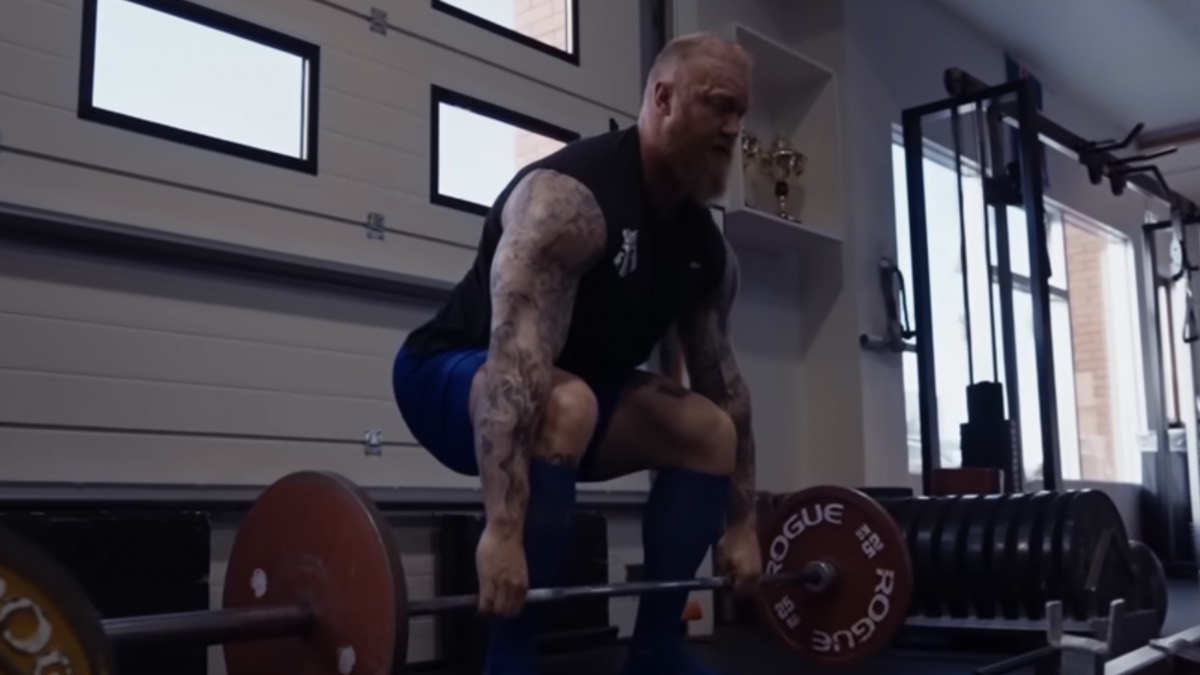
On Oct. 22, 2022, Björnsson shared a video on his YouTube channel where he trains and works through a light deadlift session while making a significant career announcement — he will be making a return to sanctioned powerlifting. The athlete disclosed that his first powerlifting appearance since December 2018 will happen on Dec. 3, 2022, but did not clarify what the competition is specifically.
Judging by Björnsson’s tenor while revealing his return to powerlifting, it seems the athlete will use this first undisclosed meet as a trial run of sorts. He wants to see “how the bar will react” while he lifts raw — a lifting style that can be a far cry from the lifting straps, wraps, and fully-equipped set-up of some strongman events.
In terms of setting reasonable expectations for himself as a powerlifter, Björnsson is aiming high. He wants to record a total of at least 1,000 kilograms (2,204.6 pounds). Björnsson’s all-time raw competition best total as a powerlifter is 1,100 kilograms (2,425 pounds) from the 2018 World Raw Powerlifting Federation (WRPF) Thor’s Powerlifting Challenge.
Here’s an overview of Björnsson’s all-time raw competition bests from his powerlifting career:
*Hafthor Björnsson | All-Time Raw Competition Powerlifting Bests
*Note: According to Open Powerlifting, Björnsson has never recorded a raw squat during an official powerlifting contest.
**Note: According to Open Powerlifting, Björnsson has never competed in a three-lift raw powerlifting meet. This total includes only a bench press and deadlift.
Björnsson’s announcement of a powerlifting return comes on the heels of his “partial” comeback to strongman. In mid-October 2022, the 2018 World’s Strongest Man (WSM) champion revealed that he would push to break his own weight-over-bar World Record at the 2022 Rogue Invitational on Oct. 28-30. The current weight-over-bar mark from the 2019 Arnold Strongman Classic — which, again, Björnsson owns — is a weight of 56 pounds thrown over a height of 20’2″.
Should Björnsson officially surpass that record figure, he alluded to a future where he may try to break his own deadlift World Record of 501 kilograms (1,104.5 pounds) from the 2020 World’s Ultimate Strongman “Feats of Strength” series. In the event that the potential goal is successful, Björnsson would naturally be the first-ever strongman to deadlift over 501 kilograms.
For an impeccably strong athlete like Björnsson, it appears he wants to rekindle the passions that pushed him to the top of the strength sports world. At this rate, knowing what Björnsson brings to the table, who’s to say the strongman/powerlifter won’t excel on a consistent level again?
In mid-July 2022, Križánek announced that he would be switching to the IFBB Pro League. A few months later, in October 2022, he earned his official IFBB Pro League card by winning the 2022 Amateur Olympia Italy. Now, with his first IFBB Pro League contest — the 2022 EVLS Prague Pro — on the horizon, the athlete shared a look at where he stands physique-wise in an Oct. 21, 2022, Instagram post. (Note: That contest will take place on Oct. 29, 2022, in Prague, Czech Republic.)
For someone vying for a roster spot in December’s Olympia, Križánek certainly looks the part of a shredded, well-trained mass dynamo. With a potentially momentous performance awaiting Križánek at the 2022 EVLS Prague Pro, he preceded this physique update with a short breakdown of a recent chest workout that he posted to his YouTube channel on Oct. 20, 2022.
Should Križánek transfer his training output and recent success to the stage in Prague, a victory would garner him automatic qualification to the 2022 Mr. Olympia. If he does not win, the athlete would need to take home a top-five result, at minimum, to earn points in the Olympia qualification standings. (Note: Only the top three in each bodybuilding division will qualify for the Olympia on a points basis. The points qualification period ends on Nov. 20, 2022.)
According to the IFBB website, the 2022 EVLS Prague Pro is a Tier 3 contest. That means second through fifth-place finishers will earn successive points ranging from six to three. With zero IFBB Pro League contests to his name, these points would be Križánek’s first as a professional in the event he doesn’t win outright.
It’s been quite a long and winding competitive journey for Križánek over the past few months. A victory in 2022 EVLS Prague Pro would assuredly not end it. The bodybuilder, like his peers, has aspirations of excelling on the Olympia stage. At his rapid pace of progression, it’s not clear what, if anything, could halt those dreams.
The 2022 Mr. Olympia will take place on Dec. 16-18, 2022, in Las Vegas, NV.
Featured image: @ifbb_pro_michalkrizokrizanek on Instagram
“Good things come after failure. You just have to keep working.” In any other context, this statement reads as banal self-help advice. But relative to lifting, it’s sage wisdom gleaned from bodybuilders and the ever-growing science of muscle hypertrophy.
Forced reps, also known as “assisted reps,” are a popular intensification technique performed by lifters to extend an exercise set past muscular failure.(1)(2)
Credit: antoniodiaz / Shutterstock
By forcing you to work past your limit, forced reps have the potential to unlock new muscle growth. But as with any form of advanced training, this technique must be used appropriately. Here, you will find practical and evidence-based recommendations for integrating forced reps into your lifting routine.
Guide to Forced Reps
How Forced Reps Work
Forced reps enable a lifter to perform additional repetitions past the point of muscular failure. Anecdotally, they’re among the most challenging and motivating methods of training. Better yet, there’s developing mechanistic support for their effectiveness.
To perform forced reps, you lift to momentary muscle failure and then use external assistance to immediately continue performing more repetitions. Unlike drop sets, another common intensification technique, there’s no need to strip plates off the bar, move the pin on the weight stack, or exchange your dumbbell for lighter ones.
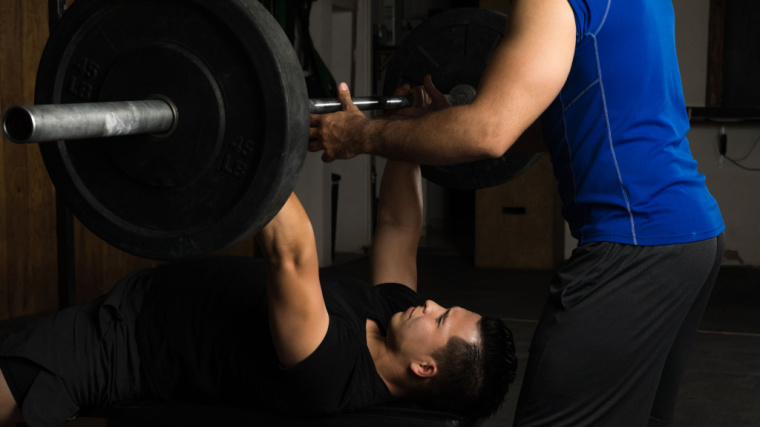
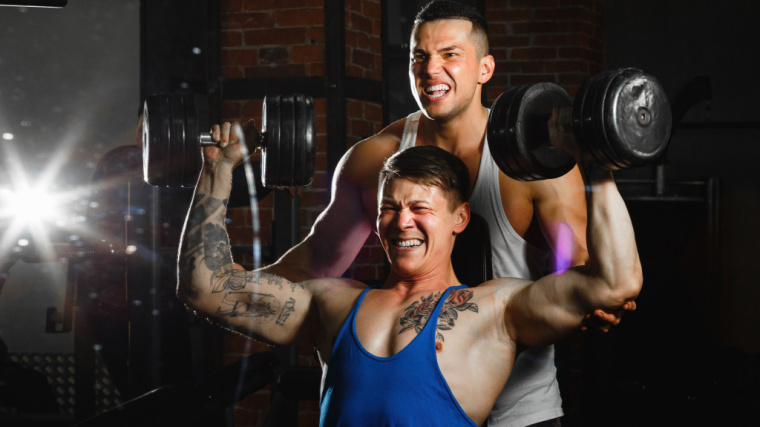
With forced reps, your training partner simply steps in to assist you to perform the additional repetitions. Specifically, your training partner provides just enough help to allow you to grind through the “sticking point,” or most challenging portion, of the repetition.
Credit: Hodoimg / Shutterstock
Forced reps are thought to accelerate muscle growth via increased metabolic stress.(2) Additionally, forced reps may allow you to reap benefits from greater repetition volume, more time under load, and an intensified lifting experience.
How to Perform Forced Reps
Forced reps require the assistance of a training partner to enable the set to continue past failure. An attentive, relatively strong, and highly motivating training partner is worth their weight in gold.
Once you’ve secured a quality training partner, you must communicate before the set of forced reps begins. Discuss the exercise to be performed, how you would like your partner to assist your forced reps, when your partner should begin assisting, and how many forced reps you plan to perform past failure. Here’s exactly what you need to cover with each topic.
Exercise Selection
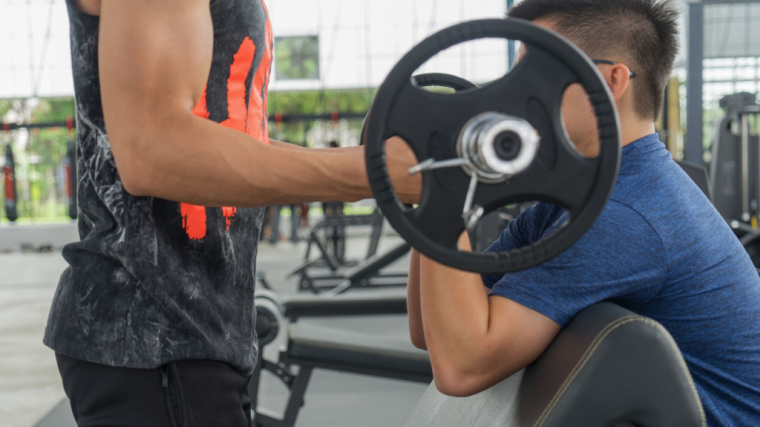
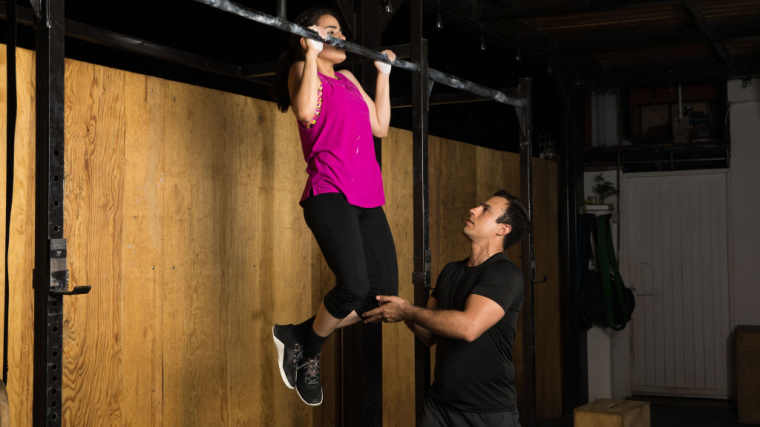
Non-ballistic free weight and machine-based exercises work best for forced reps. The technique can be performed with single-joint or multi-joint exercises. Among the countless exercises that could be selected, common exercises used for forced reps include pull-ups, seated overhead press, Smith machine squats, bench press, leg press, leg extensions, biceps curls, and leg curls.(3)(4)
Some exercises, however, are difficult or downright ridiculous for use with forced reps. For example, it would be very awkward for your partner to assist you in performance of forced reps for deadlifts. Even many free weight rows can be awkward to assist. Machine-based rows, landmine rows, or chest-supported T-bar rows tend are better options because they allow your partner to maintain favorable body mechanics while assisting the forced reps.
Carefully consider the exercises you select for forced reps. Obviously, each exercise should target a muscle group or movement pattern you wish to overload, but if taking a specific exercise beyond failure seems sketchy, find an alternative movement or skip it.
How Forced Reps Are Assisted
Instruct your partner to provide the minimum amount of assistance necessary to allow you to continue the set.(1)(4) The specific technique for applying assistance varies based on the lift. The technique for assisting forced reps is generally consistent with technique for spotting, though exercises not traditionally spotted will require some creativity.
Your partner should assist from the barbell during upper body barbell exercises, from the wrists during dumbbell presses, and through the torso during pull-ups, dips, squats, lunges, and step-ups. Note: assisting (and spotting) the latter two exercises is technically demanding and requires practice to perform safely.
For machine-based forced reps, technique will vary based on the exercise and equipment design. Be sure that your partner is positioned out of harm’s way and does not get their limbs or digits caught in pinch points on the machine.
When Forced Reps Are Assisted
Experienced lifters can pin-point exactly where in the repetition they will tend to “fail” during common exercises. This part of the lift is called the “sticking point.” When your repetition grinds to a halt in the sticking point, your partner will help you through it.
Inevitably, the sticking point occurs during the concentric (positive or lifting) phase of the lift. This is because muscle contractions are 20-50% stronger during the negative (eccentric or lowering phase) than during the positive.(5) Assuming fatigue affects both phases of the exercise equally, you will require assistance during the concentric phase of the exercise and little to no assistance during the eccentric.
The sticking point varies by exercise, but in general it occurs near the bottom, stretched position of presses, dips, and squats, and toward the top, contracted portion of the repetition for rows and pull-ups.
Although your partner should remain attentive to your performance through the entire repetition, you should clue them in to the specific point of the repetition they are most likely to be needed, to create a smoother and safer forced rep experience.
Determining the Number of Forced Reps
Finally, before starting your set, inform your partner how many forced repetitions you have planned.
Although you may not be able to predict the exact number of straight, unassisted repetitions you will be able to complete before failure, you must decide how many forced reps your partner will facilitate once you’ve reached failure. A skilled training partner will then fine-tune the amount of help provided to ensure you are successful yet thoroughly challenged. An unskilled training partner will shout, “Now three more,” when, in fact, you only have one more.
A discussion on programming recommendations for forced reps is provided below. But first, let’s explore the physiological demands of forced reps and determine for whom they’re best suited.
Physiological Effects of Forced Reps
As you might expect, forced reps impose considerable demand on the body and increase the need for recovery.(6)(7) They also stimulate acute changes in testosterone, growth hormone, and cortisol levels.(7)(8) This section examines the effects of forced reps and their potential significance to hypertrophy (muscle-building) and performance.
Neuromuscular and Metabolic Effects of Forced Reps
Immediately after working sets, forced reps cause greater reductions in muscle activity compared to traditional sets to muscular failure.(7) These changes have been measured experimentally via surface electromyography (sEMG). Although sEMG is not necessarily a measure of recruitment, these reductions may hint to the presence of neural fatigue as the central nervous system becomes progressively less able to stimulate motor units.(6)(7)(9)(10)
Credit: KimSongsak / Shutterstock
Prolonged and repeated muscle contractions occur during forced reps. Therefore, they are thought to exhaust more pools of muscle cells than traditional sets.(8) After performing forced reps, substantial fatigue occurs to the working muscle.(6) Calcium is an ion essential to muscle contraction, and its release may be impaired during fatiguing muscle contractions. (10)
Metabolites such as hydrogen, lactate, and inorganic phosphate are produced during repeated muscle contractions with minimal rest.(7)(10)(11) Although these metabolites may hasten fatigue, the metabolic stress they induce may enhance hypertrophy.(10)(11)(12)
Mechanical Effects of Forced Reps
Three related studies reported greater short-term reductions in maximum strength following forced repetitions compared to traditional sets to failure.(6)(7)(8) The earliest study compared two “leg day” workouts of squats, leg presses, and leg extensions — one used forced reps for every set and the other ended sets at muscular failure. (7)
Both workouts resulted in reductions in strength for up to 72 hours for both types of training, but forced reps caused greater reductions in strength during, immediately after, and twenty-four hours after the workout.(7) A later study showed decreased force production for the first 500 milliseconds of muscle contraction following forced reps.(6)
Altogether, these findings illustrate the effectiveness of forced reps for training fast twitch muscle fibers, which tend to have great potential for growth but prolonged recovery demands. (6)(13)
Hormonal Effects of Forced Reps
Forced reps are associated with robust anabolic hormone responses including increased serum testosterone, free testosterone, and growth hormone.(7)(8) Increased cortisol, a catabolic hormone, has also been reported following forced reps.(7)(8)
Resist the temptation infer any long-term outcomes from these findings. The relationship between acute hormone responses and desirable training outcomes (e.g. hypertrophy) remains questionable.(12)(14) Spiking certain hormones, like testosterone, briefly during or after exercise is quite different than maintaining elevated hormone levels throughout the day or week.
Who Should Perform Forced Reps
For muscle growth, the superiority of training to failure relative to not-to-failure has been questioned, both by gym rats and proverbial lab rats. (3) Forced reps take sets to the point of failure and blow right through it. To be clear, no one “needs” to perform forced reps to make gains, but it can be a useful technique to spark new muscle growth after stagnating and it can reinvigorate a stale period of training.
Although there remains a lack of research supporting most “advanced training techniques” such as forced reps, there is plenty of anecdotal and physiological support for their use.(1)(12) However, forced reps may benefit some trainees more than others.
Consider Your Training Goal
You probably associate forced reps with bodybuilding. Spoiler alert: That’s probably the best use of this training technique. Individuals training for strength or power are best served focusing prioritizing not-to-failure training.(3)(15)(16)
Interestingly, some research showed small improvements in bench press three-repetition maximum (strength) and bench press throw (power) following six weeks of forced reps. (4) Unfortunately, the forced reps strength-boosting study did not measure muscle hypertrophy.
Credit: antoniodiaz / Shutterstock
For those looking for muscle gain, forced reps are more appealing, and there is a strong case for using forced reps for muscle gain based on volume. Resistance training volume is closely related to hypertrophy. More volume is associated with more muscle gain.(17)
While there is undoubtedly an upper limit on this relationship, a lifter will complete more total repetitions (and thereby, more total volume) using forced repetition sets than an equal number of traditional sets.
Additional volume also appears to explain the hypertrophy benefit of to-failure training compared to not-to-failure training.(18) Along the same lines, the additional volume completed past failure during forced reps may result in superior muscle gain for a lifter who would otherwise have stopped at or before failure.
Consider Your Training Status and Experience
Since beginners are extremely responsive to resistance training, it’s not necessary or prudent to program to-failure resistance training, let alone forced reps.(19)
On the other hand, intermediate and experienced trainees often require more variability in their training.(20) That is, more frequent changes in volume, intensity, and other resistance training parameters are indicated. Since forced repetitions are an intensification method that also promotes additional repetition volume, they may be appealing for more advanced lifters.
Lifters with longer training histories have been shown to experience greater androgen responses (testosterone and free testosterone) and growth hormone release than novice lifters when training with forced reps.(8) Although we must interpret these acute hormonal effects cautiously, as previously noted, it is suggested that well-trained and experienced lifters may preferentially benefit from forced reps.
Programming Recommendations for Forced Reps
Forced reps undoubtedly cause high levels of fatigue, but if you’re an advanced lifter, you’re probably thinking, “I’ve been training for umpteen years. Pfft, I can handle it.”
While advanced lifters may stand to benefit more from forced reps than beginners, research shows they also experience more profound neuromuscular fatigue following forced reps.(6) This is probably because advanced lifters are better able to tap into high threshold motor units and get more out of their sets. Basically, advanced lifters are better trained, but also better able to bury themselves under fatigue.
When fatigue outpaces recovery for too long, bad things happen. There’s the potential for non-functional overreaching, which results in non-productive training and, as a cantankerous soup vendor might say, “No gains for you.”
Even more haunting is the threat of true overtraining, which results in decreased performance even after recovery.(21) Informed programming and a well-designed approach helps to avoid these undesirable effects.
Number of Forced Repetitions
How many reps should you “force” per set? Even if you complete just one or two forced reps, you’re still doing more than a traditional set to failure. The published research protocols cited throughout this article included an average of three or four forced reps per set.(4)(6)(7)(8)
This seems like a reasonable recommendation. More forced reps result in a more intense set and, presumably, greater recovery demand. Diminishing returns can be expected as you add even more forced reps, because your training partner invariably does progressively more of the work for you. Don’t let your set of bench press forced reps become their set of barbell row forced reps.
So, for the sake of your next training session, gains, recovery, and your lifting partner, limit forced reps to five or fewer per set.
Number of Forced Rep Sets
To mitigate the risk of non-functional overreaching and overtraining, plan your forced reps sessions, and remember, there’s no need to get greedy. Previous research on forced reps compared three groups who performed short-duration training cycles of forced reps.
One group performed an average of one set of forced reps per session, another group hit an average three forced rep sets per session, and the final group completed an average of four forced rep sets per session. Remarkably, all groups improved similarly over the course of the training study.(4)
The take-home message? There does not seem to be an additive benefit to multiple sets of forced reps. An intelligent lifter might plan forced reps for only the final set of an exercise during a time-limited intensification block of training.
Frequency of Forced Rep Sets
While advanced trainees can thrive during short-term periods of high-intensity and high-frequency training, it certainly isn’t the rule.(22) Data from acute studies on forced reps suggest 48-72 hours of recovery should be allocated between workouts including forced reps.(4)(7)(8)
Don’t use the technique every day of the week. Even when targeting different body parts, the cumulative fatigue (both muscular and neuromuscular) will quickly get to be too much to recover from and your performance, and results, will suffer for it.
Training Load for Forced Rep Sets
An important consideration for forced reps is load, or training weight. How heavy should your forced rep sets be? Although they can certainly be effectively performed using very heavy loads, forced reps are best programmed using moderate loads. A general recommendation is to use your 6RM to 12RM load. That is, select a weight you’d normally lift between six and 12 times before failing.
As previously established, forced reps are best for those with hypertrophy goals. Considering that muscle growth occurs across a wide range of repetitions and loads, the use of very heavy loads unneeded.(16)(23)(24)
Moreover, assisting forced reps with very heavy loads is more technically demanding for your training partner. Extremely light loads, while easier for your training partner to handle, take more time and are likely to result in prolonged fatigue relative to heavier loads.(25)
Periodizing Forced Reps
Throwing an occasional set of forced reps into your normal routine is likely harmless and good fun. But forced reps, like other intensification techniques, are best programmed judiciously and for short, focused periods of time.
For example, you might add forced reps during the final week before a deload. Or program forced reps regularly across a four- to six-week hypertrophy training block intended to produce overreaching. In both cases, gains are made during recovery. If you’re going to train hard using forced reps, plan to recover harder with sufficient sleep, high-quality nutrition, and relative rest.
Force Gains with Forced Reps
Forced reps, or assisted reps, are a technique well-suited for intermediate and advanced lifters who want to gain muscle, have a trusted training partner, and are willing to take their recovery as seriously as their training.
References
Hackett, D. A., & Amirthalingam, T. (2015). A brief review of forced repetitions for the promotion of muscular hypertrophy. Strength & Conditioning Journal, 37(5), 14-20.
Schoenfeld, B. (2011). The use of specialized training techniques to maximize muscle hypertrophy. Strength & Conditioning Journal, 33(4), 60-65.
Willardson, J. M., Norton, L., & Wilson, G. (2010). Training to failure and beyond in mainstream resistance exercise programs. Strength & Conditioning Journal, 32(3), 21-29.
Drinkwater, E. J., et al. (2007). Increased number of forced repetitions does not enhance strength development with resistance training. The Journal of Strength & Conditioning Research, 21(3), 841-847.
Schoenfeld, B. J., et al. (2017). Hypertrophic effects of concentric vs. eccentric muscle actions: a systematic review and meta-analysis. The Journal of Strength & Conditioning Research, 31(9), 2599-2608.
Ahtiainen, J. P., & Häkkinen, K. (2009). Strength athletes are capable to produce greater muscle activation and neural fatigue during high-intensity resistance exercise than nonathletes. The Journal of Strength & Conditioning Research, 23(4), 1129-1134.
Ahtiainen, J. P., Pakarinen, A., Kraemer, W. J., & Häkkinen, K. (2003). Acute hormonal and neuromuscular responses and recovery to forced vs. maximum repetitions multiple resistance exercises. International Journal of Sports Medicine, 24(06), 410-418.
Ahtiainen, J. P., Pakarinen, A., Kraemer, W. J., & Hakkinen, K. (2004). Acute hormonal responses to heavy resistance exercise in strength athletes versus nonathletes. Canadian Journal of Applied Physiology, 29(5), 527-543.
Vigotsky, A. D., et al. (2018). Interpreting signal amplitudes in surface electromyography studies in sport and rehabilitation sciences. Frontiers in Physiology, 985.
Wan, J. J., Qin, Z., Wang, P. Y., Sun, Y., & Liu, X. (2017). Muscle fatigue: general understanding and treatment. Experimental & Molecular Medicine, 49(10), e384-e384.
Goto, K. et al. (2005). The impact of metabolic stress on hormonal responses and muscular adaptations. Medicine & Science in Sports & Exercise, 37(6), 955-963.
Schoenfeld, B., et al. (2021). Resistance training recommendations to maximize muscle hypertrophy in an athletic population: Position stand of the IUSCA. International Journal of Strength and Conditioning, 1(1), 1-30.
Lievens, E., et al. (2020). Muscle fiber typology substantially influences time to recover from high-intensity exercise. Journal of Applied Physiology, 128(3), 648-659.
Schoenfeld, B. J. (2013). Postexercise hypertrophic adaptations: a reexamination of the hormone hypothesis and its applicability to resistance training program design. The Journal of Strength & Conditioning Research, 27(6), 1720-1730.
Izquierdo, M., et al. (2006). Differential effects of strength training leading to failure versus not to failure on hormonal responses, strength, and muscle power gains. Journal of Applied Physiology, 100(5), 1647-1656.
Pareja‐Blanco, F., et al. (2017). Effects of velocity loss during resistance training on athletic performance, strength gains and muscle adaptations. Scandinavian Journal of Medicine & Science in Sports, 27(7), 724-735.
Schoenfeld, B. J., Ogborn, D., & Krieger, J. W. (2017). Dose-response relationship between weekly resistance training volume and increases in muscle mass: A systematic review and meta-analysis. Journal of Sports Sciences, 35(11), 1073-1082.
Vieira, A. F., et al. (2021). Effects of resistance training performed to failure or not to failure on muscle strength, hypertrophy, and power output: a systematic review with meta-analysis. The Journal of Strength & Conditioning Research, 35(4), 1165-1175.
Lasevicius, T., et al. (2022). Muscle failure promotes greater muscle hypertrophy in low-load but not in high-load resistance training. Journal of Strength and Conditioning Research, 36(2), 346-351.
DeWeese, B. H., Hornsby, G., Stone, M., & Stone, M. H. (2015). The training process: Planning for strength–power training in track and field. Part 1: Theoretical aspects. Journal of sport and health science, 4(4), 308-317.
Bell, L., et al. (2020). Overreaching and overtraining in strength sports and resistance training: A scoping review. Journal of Sports Sciences, 38(16), 1897-1912.
Zourdos, M. C., et al. (2016). Efficacy of daily one-repetition maximum training in well-trained powerlifters and weightlifters: a case series. Nutricion Hospitalaria, 33(2), 437-443.
Lasevicius, T., et al. (2018). Effects of different intensities of resistance training with equated volume load on muscle strength and hypertrophy. European Journal of Sport Science, 18(6), 772-780.
Schoenfeld, B. J., et al. (2021). Loading recommendations for muscle strength, hypertrophy, and local endurance: a re-examination of the repetition continuum. Sports, 9(2), 32.
Haun, C. T., et al. (2017). Molecular, neuromuscular, and recovery responses to light versus heavy resistance exercise in young men. Physiological Reports, 5(18), e13457.
Max Shethar is no typical 20-year-old. Whereas many young people his age might focus on fitting general exercise into their otherwise packed schedules, the powerlifter spends much of his time training and refining his strength craft. That commitment is starting to pay off more and more.
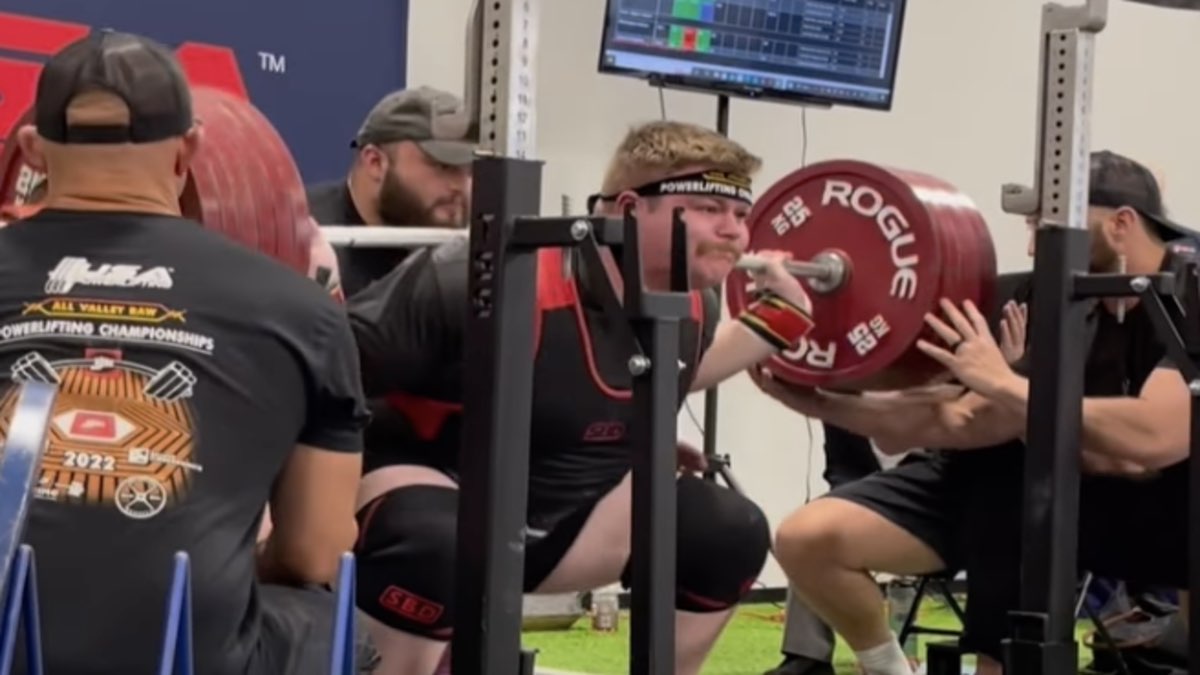
On Oct. 23, 2022, Shethar (+140KG) shared a video of himself capturing a 342.3-kilogram (755-pound) raw back squat during the 2022 USA Powerlifting (USAPL) All-Valley Raw Championships. The contest took place in Bozeman, MT, on Oct. 22, 2022. According to Open Powerlifting, Shethar’s top squat is a new competition personal record (PR). The athlete wore a lifting belt, knee sleeves, and wrist wraps to help with the accomplishment.
In addition to a new competition PR squat, a couple of other Instagram posts detailed that Shethar logged a 210-kilogram (463-pound) raw bench press PR. It wasn’t a PR try, but Shethar also made an unsuccessful attempt at deadlifting 355.1 kilograms (783 pounds) but could not lock out the rep. He would have to settle for a final pull of 330 kilograms (727.5 pounds). The athlete wore just wrist wraps for his bench press and just a lifting belt while deadlifting.
Here’s a complete overview of Shethar’s performance at the 2022 USAPL All-Valley Raw Championships:
Max Shethar (+140KG) | 2022 USAPL All-Valley Raw Championships Top Stats
This isn’t the first instance Shethar has shined on a sanctioned lifting platform this year.
In mid-June 2022, during a first-place performance at the 2022 United States Powerlifting Association (USPA) Drug Tested Matt Hurley Memorial Meet, the powerlifter broke two Juniors 18-19 World Records in the +140-kilogram division. The record marks were a 365-kilogram (804.7-pound) deadlift and a 907.2-kilogram (2,000-pound) total.
It was much of the same excellence for Shethar, sans any new records, during a first-place result at the 2022 USAPL Big Iron Classic State Championships. To this stage, since March 2017, he has never lost a powerlifting competition.
Here’s a rundown of some of the official results from Shethar’s career to date:
Max Shethar | Career Results*
2017 USA Powerlifting (USAPL) Washington State Championships (93KG) — First place | Teen 1 division
2018 USAPL Washington State Championships (125KG) — First place | Teen 1 division
2018 USAPL Raw Nationals (125KG)— First place | Teen 2 division
2019 USPA Drug Tested Washington State Open (+140KG) — First place | Juniors 16-17 division
2021 USPA Ragnarok Invite II (140KG) — First place | Open/Juniors 18-19 division
2022 USAPL Big Iron Classic State Championships (140KG) — First place | Open/Teen 3 division
2022 USPA Drug Tested Matt Hurley Memorial Meet (+140KG) — First place | Open/Juniors 18-19 division
(*Note: At the time of this writing, the full results for the 2022 USAPL All-Valley Raw Championships contest have not been published, making it unclear precisely where Shethar finished.)
After scoring his new PRs, Shethar might already have his next ambition in place. After joining the 800-plus-pound deadlift club in the summer of 2022, the athlete could be on a rapid path to an 800-plus-pound squat in the coming months. Whenever he does compete next; it’s apparent that Shethar may put on a show either way.
Picking up two dumbbells and walking around might not appear to be anything special. It looks too easy. No challenge at all, maybe some cardio and working your grip a little bit. But once you start taking the farmer’s walk seriously, you’ll realize there’s so much more to carrying weights than meets the eye.
Credit: Svitlana Hulko / Shutterstock
Your shoulders, grip, forearms, and lungs soon burn with every step, and any deviations in your walking pattern will be felt twofold while lugging around dumbbells. Besides strengthening your grip to open all the pickle jars, carries can boost your mental toughness, which has a huge carryover to your lifts and daily activities.
As great as the classic farmer’s walk is, there are plenty of effective variations to diversify your game plan. Here are some of the best loaded carry variations, the muscles particularly trained by carrying heavy weights, and the things to watch out for to get the best out of your carries.
Best Loaded Carry Variations
Offset Carry
Offset carries train your body with mismatched weights, requiring your core to work overtime to stabilize your core as you move. Because the load is distributed asymmetrically, your body will want to tilt sideways. The challenge is in not allowing that to happen.
With the offset carry, there is a more significant demand on your core to maintain stability and a neutral spine. The greater difference in the offset, the greater the need for core stability and strength to maintain good posture, even if using the same total load. Holding 60 pounds in one hand and 40 pounds in the other is less challenging than holding 80 pounds in one hand and 20 pounds in the other.
When to Use it
You can program the offset carry at the start of your training session, as part of your warm-up or core work before hitting your main workout. Use can also perform it as a superset and pair it with a press, squat, or any exercise that doesn’t demand too much grip strength. For example performing alandmine press for six to 12 reps, then immediately performing theoffset carry for 40 yards per side.
How to Do it
Although you can use dumbbells, kettlebells allow several specific offset carry variations. Hold a heavier load on one side of the body, with your arm hanging straight and your palm facing your leg. Hold a weight roughly 50% lighter in your opposite arm. This can either be locked out overhead or in the “rack position” with your arm bent and your thumb near your shoulder.
With a kettlebell, you can also use a “bottoms-up” position, with your arm bent, elbow pointed forward, and the bottom of the kettlebell aimed at the ceiling. This will require you to squeeze the handle extremely hard to maintain the bell’s vertical position.
Figure-8 Trap Bar Carry
One drawback of any loaded carry is that it requires a lot of space to move and some gyms don’t have 20 or 40 yards of clear space to walk. This is the perfect opportunity to take the trap bar figure-8 carry for a literal spin.
Walking in a figure-8 pattern allows you to get more yards out of a limited space. The trap bar makes turns easier as it places less rotational torque on your lower back than dumbbells do.
When to Use it
The movement brings the opportunity go heavy, as the trap bar allows you to carry more load than dumbbells. Use this carry when training space is limited. Program it at the start of your training when your grip is fresh.
How to Do it
Stand in the center of the trap bar, hinge at your hips and slightly bend your legs to grab the handles. Keep a neutral spine and brace your core as you deadlift weight to a standing position. Walk in a figure-8 pattern — go forward for several steps, turn slowly to one side, continue forward, turn slowly to the other side, and repeat.
Resist the urge to hurry. Walking at a controlled, deliberate pace will make your turns easier and safer, and it extends your time under tension. Keep your shoulders down and your chest up. When you’re finished walking for distance or total time, stabilize the weight before lowering it with control.
Trap Bar Overhead Carry
The overhead carry can be great for shoulder health and upper body strength, but not everyone can carry a barbell locked out overhead due to wrist or elbow issues. Enter the trap bar with the neutral handles to put your joints in a more user-friendly position.
Setting the trap bar in a squat rack at shoulder-height works best. With the weight overhead, watch every step you take due to total-body demand and instability.
When to Use it
Use the trap bar overhead carry if you have any wrist or elbow pain when supporting a barbell in the overhead position. Overhead carries are especially demanding of your upper back and shoulder stabilizers, so the movement is best trained early in your workout before those support muscles are fatigued from other exercises.
How to Do it
Set up the trap bar in a squat rack at shoulder-height with the handles pointed down. Step inside the trap bar, facing the direction you are walking. Perform an overhead press and hold the locked out position. Walk slowly straight ahead for a set distance or time. Stand still and carefully turn around before walking back into the squat rack. Lower the weight to the pins and rest.
Trap Bar Suitcase Carry
The suitcase carry is single-arm farmer’s walk, performed with the load in one arm hanging at your side. The offset load is an way to strengthen your lateral core (abdominals and obliques) while building your grip.
The trap bar suitcase carry takes this movement up a notch as the weight is more off-center, forcing your obliques to work harder. You can also potentially use more weight on a trap bar than any dumbbell variation to further your strength gains.
When to Use it
The trap bar suitcase carry works well to emphasize your oblique muscles and stabilizers on the sides of your core. This is another variation to plug in when you want to challenge yourself with heavier loads, or when your available dumbbells only go so high. Perform the exercise as part of your warm-up or early on in your training before grip strength and core stability are exhausted from other movements.
How to Do it
Stand the trap bar on its side and load plates on both ends. Grab the center of the bar, and with your shoulder down, chest up, and shoulders level, and walk slowly with good posture. Once you have gone your programmed distance, put the trap bar down and rest it on the side of your leg. Then hold it with one hand as you turn around. Swap sides and repeat.
Unilateral Chaos Carry
Adding a band around the handle of kettlebell or through the center of a weight plate creates tremendous instability because of the oscillations or “micro-bounces” created with each step. This will light up your core, grip, and shoulder stabilizers.
Gripping the band places unique demands on your grip strength because it’s tough to hold on to. The single-sided load will also increase the challenge to your oblique muscles.
When to Use it
If you have access to resistance bands, this is an excellent variation to incorporate. It’s ideal for focusing on shoulder stabilizer strength and rotator cuff health. You can do this as part of your warm-up or pair it with an exercise during your workout that doesn’t require too much grip strength, like a squat or a press variation.
How to Do it
Wrap a heavy looped band around the kettlebell handle (sometimes called the “horn”) or slide it through the center hole of a weight plate. Holding the band closer to the load makes this exercise easier because there will be less room to bounce. Sliding your hand farther from the weight will increase the difficulty. Keep your shoulder down away from your ear and your chest up. Don’t let your shoulders tilt to compensate for the weight. Walk for distance or time, place the weight down, and then repeat with the opposite hand.
Barbell Overhead Carry
The barbell overhead carry puts your whole body under tension. Every step will test your single-leg balance, strength, concentration, and mental toughness. It also might be one of the most eye-catching movements you can do.
Because the weight is so far from your center of gravity, a little goes a long way. Start on the lighter side, somewhere around 60% of your barbell overhead press one-repetition maximum. This also makes it less difficult to get the weight into position, so you can focus on holding the lockout as you walk.
When to Use it
This is one of the most challenging loaded carry variations because it works every muscle from head to toe and requires laser-like focus. Perform this early in your training before fatiguing any muscles, after your general warm-up and before your main workout.
How to Do it
Set up the barbell in a squat rack near head-height. A wider-than-shoulder-width grip works well for most people, but adjust to your individual arm length and mobility. Press the barbell overhead and ensure your wrists are neutral, elbows are locked out, and your biceps are even or behind your ears. Walk slowly and with total control. Pause and carefully rotate to return the barbell to the squat rack.
Bottoms-Up Kettlebell Waiter’s Carry
The instability of holding a kettlebell “bottoms-up” forces you to squeeze the squeeze the daylights out of the kettlebell’s handle to maintain its inverted position. This does wonders for your grip strength and carries over to increased recruitment of your shoulder stabilizers. (1)
The bottoms-up kettlebell waiter’s carry helps to build your rotator cuff, shoulder stability, and lateral core strength. Your forearm and grip muscles are also called into action non-stop, so don’t be surprised if your grip burns out before your abs or shoulders.
When to Use it
If you’re coming back from a shoulder injury or if you lack the shoulder mobility needed to maintain an overhead carry, this is a great exercise to strengthen your shoulders, rotator cuff, and upper back. If you dislike side planks, this is a good alternative to work your obliques without laying still for 60 boring seconds.
How to Do it
Grip one kettlebell and bring it to shoulder-height with your thumb toward your face and the bell pointed to the ceiling. Bend your elbow and create a roughly 90-degree angle from your forearm through your elbow to your shoulder. Make sure your wrist is neutral and the kettlebell’s handle sits centered in the meat of your hand. With good upright posture, walk straight ahead, swap hands, and repeat.
Bottoms-Up Kettlebell Overhead Carry
This is a more challenging progression of the bottoms-up waiter’s carry. You’ll get increased intensity with a reduced load because of the extra muscular tension needed to hold the bottoms-up KB overhead.
Because the load is farther from your center of gravity, it’s much harder to balance the weight with each step. Your core, shoulder, and arm will be highly activated for the entire set.
When to Use it
When you feel comfortable with the bottoms-up waiter’s carry, use the same load and progress to this alternative. It’s an efficient way to train your upper back, shoulders, and core, with an emphasis on the obliques and shoulder stabilizers.
How to Do it
Grip a kettlebell firmly with the bottom of the bell facing the ceiling. Use a neutral-grip with your thumb toward your face, and press the weight overhead while maintaining the bottoms-up position. Keep your wrist neutral and your pinky facing forward. Walk with the weight locked out overhead. After a set distance or time, lower the weight, switch hands, and repeat.
Zercher Carry
The front-loaded position of the Zercher carry challenges your upper back, core, arms, and legs while dealing with holding the weight in the crooks of your elbows. This helps build some mental toughness, total-body conditioning, and rock-solid anterior core (abdominal and hip) strength.
If you want to improve your ability to deal with physical and mental discomfort, this exercise is for you. However, if supporting a barbell in the crook of your arms is too much, the movement can be performed with an EZ-bar or even a sandbag or duffel bag filled with random objects for heft.
When to Use it
The Zercher carry is tough, no doubt about it. It works well as part of a conditioning circuit to improve fat loss or as a standalone session for mental toughness.
How to Do it
Set up a loaded barbell around hip-height in the squat rack. Squat down and cradle the barbell in the crooks of your elbows with your palms facing you. Clasp your hands together for added strength and stability, pull your shoulders back, and stand up without rounding your back. Avoiding shrugging your shoulders up as you walk. Pause after a set distance or time, turn around, and return to the squat rack. Try not to collapse when the set is done.
Bear Hug Sandbag Carry
When most people think of loaded carries, they think of fairly traditional exercises using balanced and symmetrical implements that give you convenient handles to hold. But how often does that perfect scenario happen outside of the gym? Not often, and that’s why it pays to get a bit awkward with asymmetrical loads like the sandbag carry. (2)
By manipulating unevenly distributed weight, like a floppy sandbag, your body is challenged to recruit a variety of stabilizers in most joints including your ankles, hips, and shoulders.
When to Use it
Whenever you have access to a sandbag, this exercise is great to include as part of a conditioning or fat-loss circuit. It can also be performed as a finisher, for either time or distance, at the end of your training.
How to Do it
Place the sandbag on a flat bench, or leave it on the floor for even more lower body work. Squat down and slide your hands under the bag to set your grip. Pull the bag close to your body as you stand upright. Hug the bag to your torso and stabilize your upper body. Walk upright, maintaining total body tension for safety and effectiveness. Keep the bag close to your body as you walk. Don’t allow the weight to pull your upper body out of alignment as your arms and shoulders fatigue.
Plate Pinch Carry
The plate pinch tests your “pinch grip” strength, which is different from “support grip” (trained in movements like the suitcase carry) or “crushing grip” (trained with bottoms-up movements). The pinch grip specifically strengthens your fingers and thumbs, as well as your forearms.
This is an excellent exercise for football players, rugby players, and combat sports athletes to improve sport-specific grip strength. Stronger hands and fingers will also carry over to boost any pulling exercises, making your grip less of a weak link.
When to Use it
This movement is best trained at the end of your workout because you don’t want to exhaust your finger strength before other exercise, which will interfere with your strength work. Pairing it with a biceps exercise will give your forearms a nice pump.
How to Do it
In each hand, grab a weight plate by the outer ring using just your fingertips and thumb, not “sinking” your entire hand onto the weight. Pull your chest up and set your shoulders down to maintain good posture. Walk straight ahead, paying careful attention to your finger fatigue as you walk. Be careful not to unexpectedly drop the weight on your feet.
Muscles Worked by Carries
Most carry variations work similar muscles, but certain variations can emphasize your upper back, or core strength, shoulder stability, or more. Generally, loaded carries and their variations train the muscles of your back, core, and arms.
Forearms
Any time you pick up a weight, your forearm flexors (on the bottom of your forearm) and extensors (on the top side) co-contract to grip and to keep your wrists in a neutral position.
Credit: technomolly / Shutterstock
Your forearm muscles will be more heavily recruited in movements that keep your arms down by your side and relatively less recruited in overhead movements.
Upper Back
Keeping your shoulders down and your chest up while walking with a load will put your upper back to work overtime. The upper back is composed of several muscles including the trapezius, rhomboids, and rear deltoids (shoulders). These muscles work together to control your shoulder blades, which are held in a static contraction during any walking exercise.
Rotator Cuff
Your small rotator cuff muscles are engaged when you grip anything in your hands. Its primary role is, essentially, to keep your upper arm in its socket. Loaded carries will attempt to push or pull your arm out of position, and the rotator cuff is required to constantly fight to maintain a strong, stable position.
Deltoids
You shoulder muscles (deltoids), along with your rotator cuff, work isometrically to give your shoulders the stability it needs to carry heavy things. Supporting a locked out position overhead or holding your arms in front of your body (as in the sandbag bear hug or Zercher carry) will increase recruitment of the shoulders, specifically the anterior (front) head.
The lateral and posterior heads (side and rear) are more significantly recruited during overhead or “arms-at-your-side” carries.
Core
Your core muscle — the abdominals, obliques, and lower back — work isometrically to keep your spine neutral and to maintain good posture while carrying things. A stronger core can help to reduce your overall risk of injury.(3) Any exercise emphasizing a single-side of the body (like the offset carry) will drastically increase the challenge to your core muscles.
Glutes
When you’re carrying a load, every single step you take will engage your glutes to keep you balanced and to propel you forward through a little thing called hip extension. Hip extension is what drives your leg back behind your body (and, at the same time, pulls your body forward in motion), and it’s a key function of the glutes.
Interestingly, the glutes have been shown to be more heavily recruited in single-arm carries, like the suitcase carry, compared to front-loaded carries like the Zercher carry. (4)
Carry Form Tips
Although you “can” carry some things with less than optimal posture — the sandbag bear hug can be tricky here— it’s more efficient and safer if you don’t let your posture slip. To get all the benefits of carries, it’s best to walk under load with good posture. Keep your shoulders punched back and pulled down away from your ears, keep your chest up, and aim to keep your shoulders and hips level without being pulled sideways.
Credit: Gerain0812 / Shutterstock
When you’re new to performing loaded carries, start with the by-your-side variety like the suitcase carry or even the plate pinch carry. The further away the load is from your body’s center, like any overhead carry, the more stability and balance demands increase. If you lack the shoulder mobility to press overhead, stick to carries with a lower arm position while working on your shoulder mobility.
Although increasing the load you carry is often the name of the game, it pays to vary your load and distance depending on your specific goals. If you’re after fat loss or improved conditioning, reduce the weight, shorten the rest period between sets, and increase the total distance. If your goal is strength, increase the load and decrease the distance to shift focus.
Carry Away For Gains
Loaded carries are some of the biggest bang for your buck exercises. They can have a huge carryover to your lifts inside the gym and the activities of daily living because they strengthen key muscle groups in your legs, hips, abs, and shoulders. They can improve your strength, mental toughness, posture, and balance. All you have to do is pick up a weight and walk. Work your way though these variations and you’ll soon find out they sound simple, but they’re far from easy.
References
Gontijo, L. B., Pereira, P. D., Neves, C. D., Santos, A. P., Machado, D., & Bastos, V. H. (2012). Evaluation of strength and irradiated movement pattern resulting from trunk motions of the proprioceptive neuromuscular facilitation. Rehabilitation research and practice, 2012, 281937. https://doi.org/10.1155/2012/281937
Sell, Katie PhD, CSCS1; Taveras, Kurt BS2; Ghigiarelli, Jamie PhD, CSCS1. Sandbag Training: A Sample 4-Week Training Program. Strength and Conditioning Journal: August 2011 – Volume 33 – Issue 4 – p 88-96 doi: 10.1519/SSC.0b013e318216b587
Huxel Bliven, K. C., & Anderson, B. E. (2013). Core stability training for injury prevention. Sports health, 5(6), 514–522. https://doi.org/10.1177/1941738113481200
Neumann, D. A., & Cook, T. M. (1985). Effect of load and carrying position on the electromyographic activity of the gluteus medius muscle during walking. Physical therapy, 65(3), 305–311. https://doi.org/10.1093/ptj/65.3.305
The biggest obstacle most lifters face has nothing to do with heavy weights, exercise technique, or anything in the gym. Plenty of people tackle their workouts with plenty of focus, discipline, and enthusiasm. The trouble is most don’t run into trouble in the squat rack as often as they do in the fridge.
Let’s be honest: Nutrition is often less glamorous than training. Straining and grinding in the gym is more appealing than deciding whether you should have the double-chicken burrito bowl with half rice and half beans or the double-steak burrito with no rice and extra guac.
Credit: ArtOfPhotos / Shutterstock
Plenty of well-designed training plans have been steered off-track because they weren’t supported by an equally well-designed nutrition plan.
Getting enough calories, carbs, protein, and fats can mean the difference between packing on size and hitting PRs or spinning your wheels and burning out. Here’s how to set up a “diet plan” that will help you build muscle and move heavier weights.
Calorie Requirements
Your total calorie intake is the be-all, end-all of gaining muscular body weight. No matter how finely tuned your workout program is, no matter how many grams of protein you’re eating every day, if your total calories are lacking, your body simply won’t have the raw materials to create new muscle tissue. (1)
Fortunately, nudging your body into growth-mode doesn’t have to involve 10-egg omelets, straight olive oil shooters, or gut-busting blender bombs loaded with peanut butter, oats, and whole milk. You can flip the muscle-building switch by adding roughly 300 to 500 calories per day. (2)
Credit: Skydive Erick / Shutterstock
It could be as simple as eating your standard menu and adding one big glass of milk with an extra scoop of protein powder or having an after-lunch snack of a tuna salad sandwich and an apple. While that might not sound like some people’s idea of a traditional “bulking diet,” it’s a ballpark number that reinforces your ability to tackle the hardest training sessions, lift heavier, recover more completely, and build lean body mass (muscle). (3)
Perhaps more importantly, this surplus intake can also help to avoid potential drawbacks from training with insufficient calories. Too much training on too few calories can affect everything from workout recovery and performance to hormone levels and cardiovascular health. (4)
Just be sure not to tip the scales, literally, too far in your pursuit of size. Research has shown that a caloric surplus can be beneficial for size and strength, but there’s a point of diminishing returns where you gain more body fat than muscle, and strength gains won’t keep pace with your increasing body weight, which reduces your overall power and relative strength. (1)
To stay in the “enough, but not too much” zone, you’ll want to do a little math. Your body weight (in pounds) x 25 is a rough guideline to find your maximum intake. Anything beyond that point is likely going to push you into the red zone of low-quality gains.
Start with a more reasonable and sustainable addition of just a few hundred calories on top of your current daily diet and monitor your progress to adjust weekly or biweekly as needed.
Macros for Muscle and Strength
If calories were a sports car, macronutrients would be the tires, steering wheel, and engine — protein, carbohydrates, and fats are three essential components that determine whether or not you’ll actually get you where you want to go.
Every gram of protein and carbohydrate each contain four calories, while every gram of fat contains nine calories. While you might instinctively think “more fats equals more calories equals more size,” it’s not that simple.
Specific attention to your macronutrient breakdown will determine if your increased body weight comes from gaining lean muscle mass or simply gaining body fat. (5)
Protein
Protein is fundamentally “the muscle macro.” It’s composed of amino acids which are required for creating new muscle tissue. In fact, muscle protein synthesis and muscle protein breakdown are the two primary processes triggered by weight training which will determine whether or not you build muscle. (6)
Because protein plays such a significant role in muscle-building, it’s critical that you take in enough each day. One gram of protein per pound of bodyweight is a long-touted guideline for daily intake. Although an abundance of research suggests a more accurate .74 grams per pound of bodyweight to be the upper limit, beyond which, higher protein intake doesn’t trigger any additional growth.(7)
Sorry carnivores, but triple-bodyweight protein intake won’t lead to triple the gains. However, interestingly, when a calorie surplus includes a very high protein intake, the protein was shown to have what researchers called “a protective effect against fat gain during times of energy surplus.” (5) Translation: high calories with high protein leads to muscle growth and relatively less fat gain.
While animal-based products (meat, poultry, fish, eggs, and dairy) are the most common and most efficiently absorbed sources of protein, vegan and vegetarian foods have shown to be equally effective for supporting performance and recovery, but slightly less efficient for supporting muscle growth. (8)
Carbohydrates
Some nutrition plans manipulate carbohydrates because it can be an efficient way to trigger fat loss, but when it comes to building muscle and fueling weight training workouts, carbs are sometimes not given particular attention.
Having ample carbs throughout the day can support muscle growth by decreasing muscle protein breakdown. Carbs also provide energy and endurance during relatively high volume training (plenty of exercises, sets, and/or reps). (9)
Credit: MDV Edwards / Shutterstock
Ideally, aim for a total carb intake of two to three grams per pound of bodyweight per day to support performance, growth, and recovery. (10) If you’re weight training five or more days per week, lean towards a higher intake. If you’re training less often or following a low-volume training plan, your needs will be relatively lower.
While the majority of your carbs should come from whole-food sources like grains, legumes, tubers, and fruit, you should monitor the intake of simple carbs (sugar). Particularly when combined with excess calories, relatively high sugar intake is associated with fat gain. Keeping your simple sugar intake to roughly 10% of your daily calories will work towards minimizing this unwanted gain. (11)
Fats
Because they’re the most calorie-dense macronutrient, dietary fats require a keen approach when you’re increasing calories. It’s dangerously easy to overflow your calorie intake from excessively high fats.
Certain types of fats, specifically Omega-3s found in fish, have been shown to support muscle protein synthesis which can lead to more muscle growth. (12) Adequate fat intake is also important for supporting hormone levels, cardiovascular health, and your immune system. (13)
As part of a muscle-building, strength-boosting plan, aim to keep your fat intake 30% to 40% of your total daily calories. For example, if you’re eating 3,000 calories per day, that’s 900 to 1200 calories from fat. Because one gram of fat contains nine calories, it ends up at roughly 100 to 130 grams per day.
For optimal results, stick with natural animal fats (those found in animal-based protein sources), as well as nuts, olives, avocados, and coconuts. Overly processed liquid fats, like many bottled vegetable oils, can be counterproductive for long-term health and performance.
Meal Timing and Frequency
Three big, hearty meals per day has been a time-tested approach for old school bodybuilders, strongmen, and strength athletes. Eating smaller meals more frequently — as often as every two or three hours — is a relatively new approach modern lifters have had some success with.
A higher meal frequency is typically associated with fat loss plans, though it’s debatably effective. (14) The concept can also be applied to lifters wanting to gain muscular body weight.
Credit: Monkey Business Images / Shutterstock
One significant factor is the individual’s habits, mindset, and overall digestion. Some lifters find it more practical to eat three relatively large meals per day, while others may have trouble regaining their appetite for lunch several hours after a big breakfast.
In the latter case, eating fewer calories more often is a way to reach the daily calorie target with minimal discomfort. The compromise with high-frequency meals is the necessity of interrupting your daily routine on a consistent basis to unpack and inhale a small meal.
Both methods can be effective as long as they deliver the target daily nutrition. However, extremely low-frequency eating — one or two meals per day — can make it more challenging to reach the daily calorie and macro goal. This reduced meal approach is also less efficient for stimulating protein synthesis, which makes it less effective for building muscle. (15)
The Anabolic Window Myth
Most experienced lifters have heard about “the anabolic window” — the crucial time period immediately after weight training where your body has been stimulated to such a degree that it will transmogrify any and all calories into heaps of new muscle tissue.
Bodybuilders in the 1950s would drink whole milk during their workouts, hardcore powerlifters have eaten peanut butter and jelly sandwiches between sets, and modern day lifters would sip on half-gallon concoctions of the latest scientific formulas. All in the hopes of catching the crucial window.
While it’s true that your body is in a highly responsive state during and immediately after a training session, it isn’t nearly as narrow as the “90 minutes or less” mantra that echoes through the gym.
Credit: PintoArt / Shutterstock
Having protein during a workout was shown to decrease muscle protein breakdown (a good thing for growth). (16) However, rather than a slim 60 or 90-minute “window,” a large amount of research supports a more broad approach that’s highly effective. Having a meal (or drink) containing protein and carbs within a six-hour window of your workout can efficiently maximize muscle protein synthesis and support optimal recovery. (17)
In fact, your body remains ready to efficiently put nutrients to use for recovery and growth for up to 24 hours after hard training. You could, in theory, neglect the “anabolic window” entirely, eat your standard meals at your standard times, and use those protein and carb-laden calories for muscle-building.
Many lifters find their appetite stimulated by intense training, and they tend to drink water during their workouts. Both are quick and simple opportunities to add quality calories to your day with minimal effort and maximum benefit.
Serious Training Needs Serious Eating
If want maximum results, you can’t just hit it hard in the gym and slack off when you head to your car. At best, you’ll end up spinning your wheels and struggling unnecessarily for every drop of progress. At worst, you’ll end up going backwards because poor recovery will your workouts harder and harder. If your goals include adding lean muscle and hitting big lifts, you won’t get there until you treat the spice rack as seriously as the squat rack.
Tips to Eat for Muscle and Strength
Still trying to skip the “boring nutrition stuff” and just want some quick takeaway points? No problem. Here are some ‘just do these’ ideas to kickstart new growth and bigger gains.
Credit: Ground Picture / Shutterstock
Building muscle doesn’t mean gorging. Add 300 to 500 calories per day, mostly from protein. Track progress before adding more calories.
Know your body and your appetite. Either plan on having “breakfast, lunch, workout shake, and dinner” or eat smaller meals five to seven times per day (having food every two to three hours). Your total calories should remain the same.
Aim for one gram of protein per pound of bodyweight. Having slightly less is still effective. Eating a bit more protein won’t build“extra muscle,” but may potentially fight against fat gain.
Aim for two to three grams of carbs per pound of bodyweight, primarily from whole-food sources and relatively low sugar. Using soda and candy as caloric filler may only hurt your physique.
Set your dietary fat intake at 30% to 40% of your total daily calories, most of which will likely come naturally from your protein sources.
For maximum results, have a pre-workout meal within three hours of starting your workout, drink protein and carbohydrates during training, and have a post-workout meal within three hours of ending your workout.
References
Ribeiro, A. S., Nunes, J. P., Schoenfeld, B. J., Aguiar, A. F., & Cyrino, E. S. (2019). Effects of Different Dietary Energy Intake Following Resistance Training on Muscle Mass and Body Fat in Bodybuilders: A Pilot Study. Journal of human kinetics, 70, 125–134. https://doi.org/10.2478/hukin-2019-0038
Slater, G. J., Dieter, B. P., Marsh, D. J., Helms, E. R., Shaw, G., & Iraki, J. (2019). Is an Energy Surplus Required to Maximize Skeletal Muscle Hypertrophy Associated With Resistance Training. Frontiers in nutrition, 6, 131. https://doi.org/10.3389/fnut.2019.00131
Garthe, I., Raastad, T., Refsnes, P. E., & Sundgot-Borgen, J. (2013). Effect of nutritional intervention on body composition and performance in elite athletes. European journal of sport science, 13(3), 295–303. https://doi.org/10.1080/17461391.2011.643923
Melin, A. K., Heikura, I. A., Tenforde, A., & Mountjoy, M. (2019). Energy Availability in Athletics: Health, Performance, and Physique. International journal of sport nutrition and exercise metabolism, 29(2), 152–164. https://doi.org/10.1123/ijsnem.2018-0201
Leaf, A., & Antonio, J. (2017). The Effects of Overfeeding on Body Composition: The Role of Macronutrient Composition – A Narrative Review. International journal of exercise science, 10(8), 1275–1296.
Stokes, T., Hector, A. J., Morton, R. W., McGlory, C., & Phillips, S. M. (2018). Recent Perspectives Regarding the Role of Dietary Protein for the Promotion of Muscle Hypertrophy with Resistance Exercise Training. Nutrients, 10(2), 180. https://doi.org/10.3390/nu10020180
Morton, R. W., Murphy, K. T., McKellar, S. R., Schoenfeld, B. J., Henselmans, M., Helms, E., Aragon, A. A., Devries, M. C., Banfield, L., Krieger, J. W., & Phillips, S. M. (2018). A systematic review, meta-analysis and meta-regression of the effect of protein supplementation on resistance training-induced gains in muscle mass and strength in healthy adults. British journal of sports medicine, 52(6), 376–384. https://doi.org/10.1136/bjsports-2017-097608
Pohl, A., Schünemann, F., Bersiner, K., & Gehlert, S. (2021). The Impact of Vegan and Vegetarian Diets on Physical Performance and Molecular Signaling in Skeletal Muscle. Nutrients, 13(11), 3884. https://doi.org/10.3390/nu13113884
Mata, F., Valenzuela, P. L., Gimenez, J., Tur, C., Ferreria, D., Domínguez, R., Sanchez-Oliver, A. J., & Martínez Sanz, J. M. (2019). Carbohydrate Availability and Physical Performance: Physiological Overview and Practical Recommendations. Nutrients, 11(5), 1084. https://doi.org/10.3390/nu11051084
Richard B Kreider, Colin D Wilborn, Lem Taylor, Bill Campbell, Anthony L Almada, Rick Collins, Mathew Cooke, Conrad P Earnest, Mike Greenwood, Douglas S Kalman, Chad M Kerksick, Susan M Kleiner, Brian Leutholtz, Hector Lopez, Lonnie M Lowery, Ron Mendel, Abbie Smith, Marie Spano, Robert Wildman, Darryn S Willoughby, Tim N Ziegenfuss & Jose Antonio (2010) ISSN exercise & sport nutrition review: research & recommendations, Journal of the International Society of Sports Nutrition, 7:1, DOI: 10.1186/1550-2783-7-7
Te Morenga L, Mallard S, Mann J. Dietary sugars and body weight: systematic review and meta-analyses of randomised controlled trials and cohort studies BMJ 2013; 346 :e7492 doi:10.1136/bmj.e7492
Gordon I. Smith, Philip Atherton, Dominic N. Reeds, B. Selma Mohammed, Debbie Rankin, Michael J. Rennie, Bettina Mittendorfer; Omega-3 polyunsaturated fatty acids augment the muscle protein anabolic response to hyperinsulinaemia–hyperaminoacidaemia in healthy young and middle-aged men and women. Clin Sci (Lond) 1 September 2011; 121 (6): 267–278. doi: https://doi.org/10.1042/CS20100597
Venkatraman JT, Leddy J, Pendergast D. Dietary fats and immune status in athletes: clinical implications. Medicine and Science in Sports and Exercise. 2000 Jul;32(7 Suppl):S389-95. DOI: 10.1097/00005768-200007001-00003. PMID: 10910295.
Schoenfeld, B. J., Aragon, A. A., & Krieger, J. W. (2015). Effects of meal frequency on weight loss and body composition: a meta-analysis. Nutrition reviews, 73(2), 69–82. https://doi.org/10.1093/nutrit/nuu017
Schoenfeld, B.J., Aragon, A.A. How much protein can the body use in a single meal for muscle-building? Implications for daily protein distribution. J Int Soc Sports Nutr 15, 10 (2018). https://doi.org/10.1186/s12970-018-0215-1
Greenhaff, P. L., Karagounis, L. G., Peirce, N., Simpson, E. J., Hazell, M., Layfield, R., Wackerhage, H., Smith, K., Atherton, P., Selby, A., & Rennie, M. J. (2008). Disassociation between the effects of amino acids and insulin on signaling, ubiquitin ligases, and protein turnover in human muscle. American journal of physiology. Endocrinology and metabolism, 295(3), E595–E604. https://doi.org/10.1152/ajpendo.90411.2008
Schoenfeld, B. J., & Aragon, A. A. (2018). Is There a Postworkout Anabolic Window of Opportunity for Nutrient Consumption? Clearing up Controversies. The Journal of orthopaedic and sports physical therapy, 48(12), 911–914. https://doi.org/10.2519/jospt.2018.0615
By a relative timeline, Zen McCollum is only at the start of his powerlifting career. However, with the way the 22-year-old has pushed full steam ahead to this point, it might be hard not to view the 120-kilogram-plus athlete as an accomplished veteran.
On Oct. 19, 2022, McCollum shared a video to his Instagram profile where he notched a 390-kilogram (860-pound) single-ply squat double during a training session. Per the caption of his post, the feat is a personal record (PR). In addition to wrist and knee wraps, McCollum wore a lifting suit and lifting belt to help with the figure.
McCollum’s squat double PR is connected to his ongoing preparation for the 2022 International Powerlifting Federation (IPF) World Equipped Open Powerlifting Championships. That contest will take place on Nov. 14-20, 2022, in Viborg, Denmark. It will be just the second appearance for McCollum in an international competition after a second-place Juniors finish during the 2022 IPF World Junior Equipped Powerlifting Championships.
As the reigning equipped Powerlifting America (AMP) National Champion in the 120-kilogram-plus weight class, McCollum has amassed quite the individual resume at a young age. After starting his career largely as a raw competitor, McCollum appears to have transitioned to a single-ply, equipped focus. That shift in attention has seemingly paid off as the athlete can count six out of seven victories where he competed single-ply.
According to Open Powerlifting, here’s an overview of some of the more notable results of McCollum’s career to date:
Zen McCollum (+120KG) | Notable Career Results
2017 USA Powerlifting (USAPL) Rocky Mountain State Games (Teen/Raw) — First place | First career victory
2017 USAPL Raw National Championships (Teen/Raw) — Second place
2018 USAPL Gorilla Warfare II Pandora’s Box (Teen/Raw) — First place
2018 USAPL Raw Nationals (Teen/Raw) — Second place
2019 USAPL Colorado State Championships (Teen/Raw) — First place
2019 USAPL Southwest Regionals (Open/Single-ply) — First place
2021 USAPL Revenge of the Kilo Monster (Open/Raw) — First place
2022 AMP Nationals (Junior/Open/Raw/Single-ply) — First place
2022 IPF World Junior Equipped Powerlifting Championships (Juniors-Single-ply) — Second place
McCollum will likely have to bring his A-game to capture his first-ever international victory in Denmark. That probably won’t be an issue for an athlete who has started his competitive career on a rocket-like ascent.