They’re leading the way in part because the federal government has made only limited efforts, says Lisa McCorkell, a co-founder of the Patient-Led Research Cooperative. The international group was founded in spring 2020 by researchers who are also long COVID patients.
“It’s a big reason why long COVID isn’t talked about as much,” McCorkell says. “It’s definitely a national issue. But it trickles down to state and local health departments, and there’s not enough resources.”
The government clinics may be accessible to people without insurance and often are cheaper than clinics at private hospitals.
Harborview has treated more than 1,000 patients with long COVID, and another 200 patients are awaiting treatment, says Jessica Bender, MD, a co-director of the University of Washington Post-COVID Rehabilitation and Recovery Clinic in Seattle’s First Hill neighborhood.
The group Survivor Corps offers lists by states of clinics. While the publicly run clinics may be less expensive or even free for some patients, methods of payment vary from clinic to clinic. Federally qualified health clinics offer treatment on a sliding scale. For instance, the Riverside University Health System in California has federally qualified centers. And other providers who are not federally qualified also offer care paid for on a sliding scale. They include Campbell County Health in Wyoming, where some residents are eligible for discounts of 25% to 100%, says spokesperson Norberto Orellana.
At Harborview, Bender says the public hospital’s post-COVID clinic initially began with a staff of rehabilitation doctors but expanded in 2021 to include family and internal medicine doctors. And it offers mental health programs with rehabilitation psychologists who instruct on how to deal with doctors or loved ones who don’t believe that long COVID exists.
“I have patients who really have been devastated by the lack of support from co-workers [and] family,” Bender says.
In Campbell County, WY, the pandemic surge did not arrive in earnest until late 2021. Physical therapists at Campbell County’s Health Rehabilitation Services organized a rehabilitation program for residents with long COVID after recognizing the need, says Shannon Sorensen, rehabilitation director at Campbell County Health.
“We had patients coming in showing chest pain, or heart palpitations. There were people trying to get back to work. They were frustrated,” Sorensen says.
Myalgic encephalomyelitis and chronic fatigue syndrome activists have embraced the fight to recognize and help long COVID patients, noting the similarities between the conditions, and hope to help kickstart more organized research, treatment and benefits for long COVID sufferers and ME/CFS patients alike.
In Ft. Collins, CO, disability activist Alison Sbrana has long had myalgic encephalomyelitis. She and other members of the local chapter of ME Actionhave met with state officials for several years and are finally seeing the results of those efforts.
Colorado Gov. Jared Polis has created the full-time position of policy adviser for long COVID and post-viral infection planning.
“This is one way forward of how state governments are (finally) paying attention to infection-triggered chronic illnesses and starting to think ahead on them,” Sbrana says.
New York City’s Health + Hospitals launched what may be the most expansive long COVID treatment program in the nation in April 2021. Called AfterCare, it provides physical and mental health services as well as community support systems and financial assistance.
A persistent issue for patients is that there isn’t yet a test for long COVID, like there is for COVID-19, says Amanda Johnson, MD, assistant vice president for ambulatory care and population health at New York Health + Hospitals. “It’s in many ways a diagnosis of exclusion. You have to make sure their shortness of breath isn’t caused by something else. The same with anemia,” she says.
Vermont is one of several states studying long COVID,says Mark Levine, MD, the state health commissioner. The state, in collaboration with the University of Vermont, has established a surveillance project to determine how many people have long COVID, as well as how severe it is, how long it lasts, and potential predispositions.
The University of Utah in Salt Lake City established a comprehensive COVID-19 clinic more than a year ago that also handles long COVID patients, says Jeannette Brown, MD, PhD, an associate professor at the school and director of the COVID-19 clinic.
Jennifer Chevinsky, MD, MPH, already had a deep understanding of long COVID when she landed in Riverside County, CA, in the summer of 2021. She came from Atlanta, where as part of her job as an epidemic intelligence service officer at the CDC, she heard stories of COVID-19 patients who were not getting better.
Now she is a deputy public health officer for Riverside County, in a region known for its deserts, sizzling summer temperatures and diverse populations. She says her department has helped launch programs such as post-COVID-19 follow-up phone calls and long COVID training programs that reach out to the many Latino residents in this county of 2.4 million people. It also includes Black and Native American residents.
“We’re making sure information is circulated with community and faith-based organizations, and community health workers,” she says.
McCorkell, at the Patient-Led Research Cooperative, says there is still much work to do to raise public awareness of the risks of long COVID and how to obtain care for patients. She would like to see a national public health campaign about long COVID, possibly spearheaded by the CDC in partnership with local health workers and community-based organizations, she says.
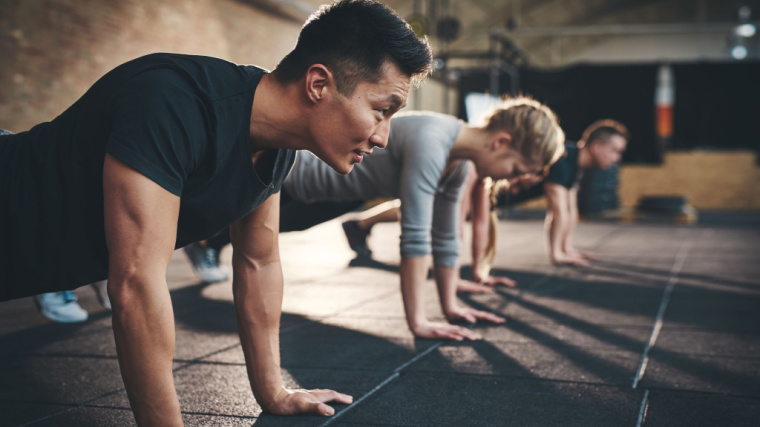
There’s a reason Monday is often called “International bench day.” Training for a strong, muscular chest is awesome and it can be appreciated year-round. But the bench press isn’t the only way to get there. The humble push-up is often pushed aside in the quest for a strong and muscular chest because the latest flashy chest exercise featured on Instagram might look “way cooler.” But is it as effective as the push-up? Probably not.
Credit: Ground Picture / Shutterstock
When performed regularly, the simple push-up and its variations will help you build bigger pecs, triceps, and shoulders, improve your relative strength, and it can even transfer over to boosting your bench and overhead press numbers.
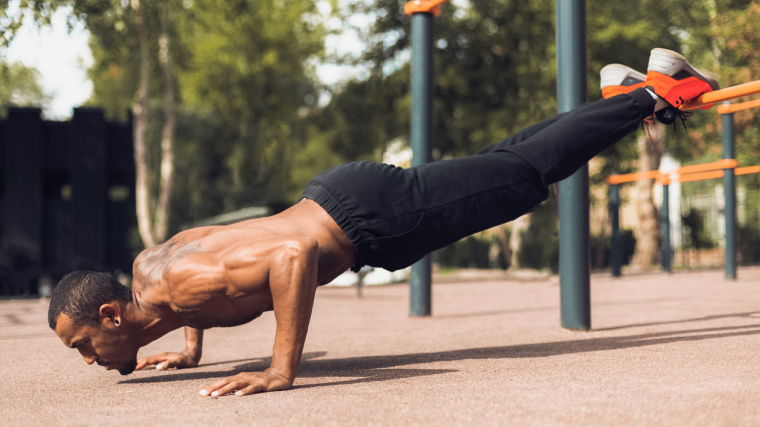
Here are 10 push-up variations to try if you’re ready to give bodyweight training a fair shake. You will never look at push-ups the same way again.
Best Push-Up Variations
Chaos Push-Up
This challenging variation takes the standard bodyweight push-up up a notch by using a resistance band in a quite unusual way. By performing a push-up with your hands on the band instead of the floor, the highly unstable element fires up all of your shoulder and core stabilizer muscles.
The band gives you instant feedback when using anything less than perfect form. You’re forced to move at a slower speed to maintain control, and the increased time under tension does wonders for adding muscle.
When to Use it
When regular push-ups are easy and you’ve advanced to doing push-ups for seemingly endless reps, the chaos push-up will snap you out of this funk. The increased time under tension makes it great for adding muscle and it’s a great alternative exercise for dumbbell bench presses. The instability of the chaos push-up is excellent for additional rotator cuff strength if you’re coming back from a shoulder injury.
How to Do it
Loop a heavy-duty resistance band around safety pins on the squat rack, at roughly waist height. Light to moderate bands may not be able to support your body weight. The higher the band is placed and the higher your body angle, the easier the exercise will be.
Place your hands on the band in a shoulder-width grip and hold tight with stiff arms. Bring your legs behind you and allow the band to support your weight, while engaging your glutes and core. Bend your arms and slowly lower yourself into a push-up. Press yourself up, pause briefly at the top to reset and stabilize before repeating.
Decline Push-Up
The decline push-up is one of the most common variations of the classic push-up. It’s fantastic for adding muscle because it’s relatively low stress on the joints, requires minimal equipment to perform, and can be trained for very high reps which benefits size and strength.
This movement shifts the focus to the upper chest and anterior deltoid, similar to an incline bench press, for better overall muscle development of the chest and shoulders.
When to Use it
Your chest is a relatively large muscle with multiple sections, or heads, so it pays to train with your arms at a variety of angles relative to your torso. (1) Perform the decline push-up in any workout in place of your standard push-up, particularly if your workout lacks angled chest exercises or if your shoulders are bothering you from other pressing exercises.
How to Do it
Place your toes on a box, step, or flat bench and position your hands underneath your shoulders. Engage your core to keep your spine neutral, neither sagging nor excessively arched. Lower yourself into a push-up until your chest is just above the floor and your elbows are angled roughly 45-degrees from your sides. Pause briefly at the bottom and push back to the starting position. Reset your body position at lockout and repeat.
Incline Plyo Push-Up
The incline plyo push-up allows you to generate upper body power with less compressive stress on the joints than similar free weight movements.
The incline plyo push-up is an excellent regression (less challenging variation) from the clapping push-up because you press less of your body weight due to the inclined position. This can allow you to squeak a few more reps and apply more explosive force.
When to Use it
Use sets of six to 10 reps with this powerful variation as a “primer” at the start of a heavy bench press workout to recruit more muscle and ignite your CNS. (2) If you’re having difficulty with plyo push-ups from the floor, this is a good way to introduce explosive movements while building strength, speed, and power.
How to Do it
Place your hands on a stable platform like a secured bench or box, a set of steps, or a Smith machine bar. Keep your arms straight as you lean forward and position your feet back, keeping a straight line through your body. Bend your arms and lower yourself rapidly toward the bench before explosively pushing yourself up and allowing your hands to leave the bench.
As you land, slightly bend your elbows and “catch” yourself on the way down to better absorb the force. Descend smoothly into the next repetition.
Clapping Push-Up
The clapping push-up is performed with maximum force. On each repetition, your hands will leave the ground and you will quickly clap them together to display power, coordination, and control.
Power exercises like the clapping push-up train the fast-twitch muscle fibers of the body, which are capable of more growth than slow-twitch fibers. (3) This exercise is a progression of the incline plyo push-up and should only be performed when you’ve mastered the incline movement.
When to Use It
As the first exercise of the workout, before heavy lifting, perform sets of six to eight reps. This will build explosive strength and help to improve your performance with other pressing exercises following in the workout, such as the overhead press and bench press.
How to Do it
Lie on the floor in a good push-up position with your hands under your shoulders, your legs straight, and your spine neutral. Bend your arms and lower yourself into a push-up position with your elbows at a roughly 45-degree angle. Before your chest touches the floor, press explosively and let your hands leave the floor. Quickly clap your hands together and get them back to the floor to catch yourself. Reset your body before the next repetition or, if you’re advanced, immediately transition into the next rep.
Spiderman Push-Up
The Spiderman push-up is an advanced variation that requires your upper body and lower body to work together with coordination, strength, and stability.
This push-up variation will increase your chest’s time under tension at the peak of your push-up contraction, which will challenge your strength and improve the hypertrophy stimulus. It also tests and challenges your core stability and hip mobility, making it an excellent “bang for the buck” movement.
When to Use It
The Spiderman push-up is excellent to insert into a conditioning workout or fat loss circuit because it trains many muscles with one movement and improves your upper body, core, and hip flexor strength. Make sure to do equal reps on both legs.
How to Do it
Assume your regular push-up position on the ground with your hands slightly wider than shoulder-width apart. Lower your chest toward the ground while simultaneously pulling your right knee toward your right forearm. Don’t allow your torso to rotate excessively to accommodate your rising leg
Pause briefly in the bottom while your chest hovers near the ground before reversing the process and bringing your foot back to the starting position while pushing yourself back up. Repeat the next repetition with the left leg. Alternate legs with each repetition. To cue the overall movement, imagine you’re a web-slinging superhero climbing the outside of a building.
Slider Push-Up
For the slider push-up, you’re using a simple slider device to reach one arm forward as you perform a traditional bent-arm push-up with the opposite arm. This variation recruits more of the serratus anterior (outer chest muscle which controls the shoulder blades), while also increasing muscular tension on your chest and triceps.
If you have shoulder mobility issues, stay within a range of motion you can control by limiting how far you reach forward. The slider push-up challenges your shoulder stabilization and may improve shoulder health over time.
When to Use It
The slider push-up is a great exercise to eventually build up to a one-arm push-up because most of the work is done by one arm while the other is providing support. For maximum focus and strength, perform this exercise near the beginning of any workout, before fatiguing your chest and triceps with other exercises.
How to Do it
Kneel on the ground and put an exercise slider or furniture slider under each hand. Rotate your shoulders to put your wrists, elbows, and shoulders in a stacked position. Straighten your legs and stabilize your entire body in a front plank position. Engage your glutes and keep a tight core.
Lower into a push-up by bending one arm while keeping the opposite arm straight as it extends forward. After reaching the lowest comfortable position, pull the forward hand back while pressing the bent arm to lockout. Alternate sides with each repetition.
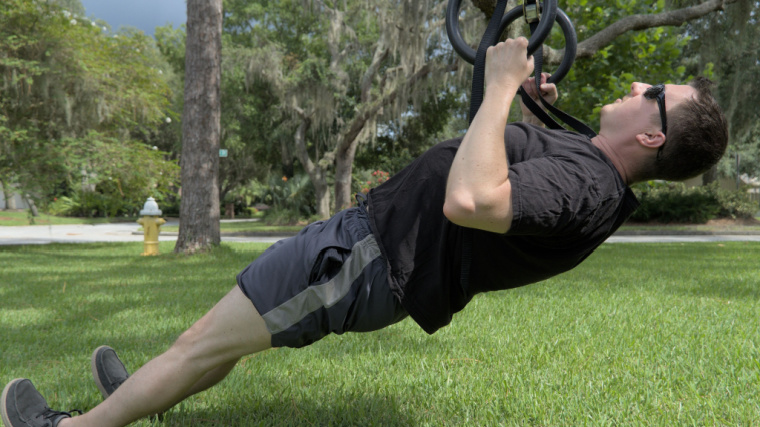
Suspension Strap Single-Arm Push-Up
This variation uses suspension straps, like gymnastic rings or TRX cables, to adjust your body angle which changes the intensity of the push-up. The straps also add an element of instability, which means you’re training core strength as well as upper body and lower body stabilizers.(4)
This exercise will help strengthen imbalances between sides and give you instant feedback if there is anything amiss with your pressing technique since it requires total focus and control.
When to Use It
Unilateral (single-arm) presses are great for strengthening imbalances between sides, since most people naturally have one slightly more developed or slightly stronger arm. If you find one arm lagging behind the other during the bench press or overhead press, this is an effective way to target each side on its own.
How to Do it
Loop the handles together and grip the strap over your shoulder with one hand. Adjust your intensity by moving your feet closer to the anchor point (harder) or further away (easier). Slowly lower yourself while keeping your shoulders square to the floor. Don’t rotate or shift to favor either side. While learning the movement, control the range of motion and don’t let your elbow go too far past your torso. Press back, reset, and repeat. Perform all reps on one side before switching.
Band-Resisted Push-Up
Bodyweight push-ups will never truly go out of style, and sometimes you just want to add resistance to this classic exercise. Putting weight plates on your back is okay, but it can get awkward to keep them in place as you move. This is where a looped resistance band comes in.
The band’s ascending resistance will make the exercise more difficult toward the top of the push-up, which maximizes your muscles’ peak contraction.
When to Use It
The band provides the majority of resistance in the upper end of the range of motion, which will help build triceps lockout strength and muscle gains for your chest and triceps. Do this when you want to add variety to your training, build some chest muscle, and put some pep back into your bench press without joint stress from a barbell.
How to Do it
Loop a resistance band around your upper back and put the ends of the band snugly under your hands. Place your hands underneath your shoulders and rise onto your toes in a front plank position. Keep a straight line through your core and squeeze your glutes. Slowly lower yourself down until your chest is nearly touching the floor. Think about driving your hands through the floor as you press back up and fight resistance to the starting position.
Archer Push-Up
This exercise has you performing a push-up with primarily one arm while the other arm provides support, similar to a slider push-up. The wide grip and long range of motion make this one of the more advanced push-up variations.
By alternating side to side, you allow each arm to do its own share of the work. This unique training angle also works the chest differently from most exercises, which can stimulate more muscle growth.
When to Use It
If your goal is to be able to do one-arm push-ups, archer push-ups can play a big role in getting you there. It can be used as a “gateway” movement to build the pressing strength and total-body stability needed to achieve a clean one-arm push-up.
How to Do it
Get on the ground with your toes planted and your hands set well-beyond shoulder-width. Your wrists and elbows may be more comfortable when your fingers point “out” toward the side walls instead of forward. Maintain a stiff body position through your core.
“Pull” your right chest down toward your right hand by bending your right elbow. Keep your left arm straight as your body approaches the ground. Press through your bent arm to return to the starting position and repeat to the opposite side. Alternate sides with each repetition, and perform an even amount of work on each side.
Yoga Push-Up
This unique exercise is one part push-up and one part “downward dog” yoga pose. It trains strength, mobility, and flexibility in your pressing muscles, core, upper back, lower back, hips, and lower body.
Your pecs and triceps get significant time under tension and a change of pressing angle similar to a decline push-up. The “downward dog”-like position helps to improve strength and mobility in the thoracic spine (upper back), hips, and hamstrings.
When to Use It
The yoga push-up is ideal when you’ve finally decided to perform some of the mobility work that often gets forgotten. It works well as a time-efficient warm-up before any workout, especially sessions that will involve chest pressing or shoulder training because it addresses the upper and lower back.
How to Do it
Start in a regular push-up position, on your toes and hands, with your body straight from head to heel. Descend into a standard push-up with your elbows roughly 45-degrees away from your torso. When your chest is slightly above the floor, press up while pushing your hips back at an upward angle. You should feel a stretch in your hamstrings as your torso and legs form an upside down “V” shape.
Keep your shoulders relaxed and pushed away from your ears. Reverse the entire movement to transition back into the starting push-up position and repeat for reps.
Muscles Worked by the Push-Up
Most push-up movements primarily work the chest, with support from the shoulders and triceps, while the abdominals and lower back work to keep a strong core.
Credit: Prostock-studio / Shutterstock
However, specific variations can emphasize the upper chest, focus more on core strength, or build shoulder and upper back mobility.
Pectorals
Your chest muscles are front and center with the push-up. Your pecs are largely responsible for arm adduction (bringing your arms closer to your centerline) which occurs when you push your body away from the floor.
Triceps
Once your elbows break 90-degrees as you press upwards, your triceps take over significantly to extend your elbows and lockout your arms. Performing any push-up with a relatively close-grip (your hands closer than shoulder-width) will also increase triceps activation. (5)
Anterior Deltoids
The shoulder muscle has three individual heads, each responsible for moving your arm in a different plane relative to your body. The anterior deltoid on the front of the shoulder works to “raise” your upper arm in front of your body. It assists your chest and triceps when pushing your body away from the ground.
Core
If your spine doesn’t stay neutral during the push-up, it all counts for naught because you’ll compromise joint health, safety, and efficiency. The anterior and posterior core — your abs and lower back — keep your torso rigid so your chest and triceps can apply maximum force. Single-arm movements like the slider push-up and single-leg movements like the Spiderman push-up require more core activation to counterbalance a reduced base of support.
Push-Up Form Tips
The most common technique flaw in the push-up is a loss of core stability. This results in an ugly-looking push-up which strains the lower back and increases the risk of injury. Your best bet is to engage your abs and glutes, and stop the movement if you find yourself losing spinal position.
Although there is nothing necessarily wrong with having your hands wider than shoulder-width apart when performing the basic push-up, be sure to keep your elbows angled near 45-degrees from your torso for most push-up movements. When your hands are placed wide, it’s more work on the shoulders (and shoulder joints) and less involvement from the chest and triceps.
Credit: lzf / Shutterstock
The cardinal sin of almost all push-ups is reaching your head down to meet the floor. This is high risk on your cervical spine and neck, and it short-changes the effective range of motion for your target muscles. You can prevent this error by tucking your chin to your chest, pulling your head back to make a “double-chin”, and staring directly at the floor.
Push Yourself with New Exercises
Too many lifters write off the push-up as being “an easy exercise.” They underestimate its value because of the general lack of load and apparent simplicity of the movement. But as any of these variations showcase, a few tweaks here and there will take the bodyweight push-up to the next level by adding extra movement, changing the angle of work, or throwing stability requirements to the mix. Tackle some of these exercises and the push-up will never seem so “easy” again.
References
Rodríguez-Ridao, D., Antequera-Vique, J. A., Martín-Fuentes, I., & Muyor, J. M. (2020). Effect of Five Bench Inclinations on the Electromyographic Activity of the Pectoralis Major, Anterior Deltoid, and Triceps Brachii during the Bench Press Exercise. International journal of environmental research and public health, 17(19), 7339. https://doi.org/10.3390/ijerph17197339
Sale D. G. (1988). Neural adaptation to resistance training. Medicine and science in sports and exercise, 20(5 Suppl), S135–S145. https://doi.org/10.1249/00005768-198810001-00009
D’Antona, G., Lanfranconi, F., Pellegrino, M. A., Brocca, L., Adami, R., Rossi, R., Moro, G., Miotti, D., Canepari, M., & Bottinelli, R. (2006). Skeletal muscle hypertrophy and structure and function of skeletal muscle fibres in male body builders. The Journal of physiology, 570(Pt 3), 611–627. https://doi.org/10.1113/jphysiol.2005.101642
Borreani, S., Calatayud, J., Colado, J. C., Moya-Nájera, D., Triplett, N. T., & Martin, F. (2015). Muscle activation during push-ups performed under stable and unstable conditions. Journal of exercise science and fitness, 13(2), 94–98. https://doi.org/10.1016/j.jesf.2015.07.002
Kim, Y. S., Kim, D. Y., & Ha, M. S. (2016). Effect of the push-up exercise at different palmar width on muscle activities. Journal of physical therapy science, 28(2), 446–449. https://doi.org/10.1589/jpts.28.446
Oct. 7, 2022 — Monkeypox cases in the U.S. disproportionately affect Black Americans, with rates five times higher than among white peers, according to a new report from the Kaiser Family Foundation.
Hispanic Americans, Native Hawaiians and Pacific Islanders also have significantly higher rates of reported monkeypox cases.
“Disparities in cases persist among Black and Hispanic people, a pattern also seen with HIV and COVID-19,” KFF wrote.
The analysis was based on CDC data for 68% of monkeypox cases reported in the U.S. as of Sept. 23. Monkeypox case rates are:
14.4 per 100,000 people among Black Americans
10 per 100,000 people among Native Hawaiians and Pacific Islanders
8.3 per 100,000 people among Hispanic Americans
3 per 100,000 people among Asian Americans
2.8 per 100,000 people among American Indians and Alaska Natives
2.6 per 100,000 people among white Americans
Overall, Black Americans account for the largest share of monkeypox cases, and both Black and Hispanic Americans account for a larger share of cases. About 70% of cases are among people of color, while people of color account for 40% of the U.S. population.
The monkeypox outbreak in the U.S. appears to be slowing down, KFF wrote, reaching a peak in August and declining in September. However, new cases among Black Americans began to exceed those among white Americans in early August. Although those cases are now declining, the numbers continue to remain higher.
In addition, Black and Hispanic Americans have received smaller shares of monkeypox vaccines, the report found. As of Sept. 27, 51% of first doses have gone to white Americans, although they represent 30% of cases. In contrast, Black Americans have received 13% of first doses despite accounting for about 35% of cases. Similarly, Hispanic Americans have received 22% of first doses, while they account for 30% of cases.
“The lower shares of vaccinations among these groups may in part explain why they have had higher numbers of new cases and complicate efforts to address disparities moving forward,” KFF wrote.
The U.S. has reported 26,385 monkeypox cases during the current outbreak, according to the latest CDC data. More than 70,000 cases and 27 deaths have been reported worldwide.
KFF noted the ongoing challenge of tracking the outbreak due to data limitations around testing and vaccination. For instance, race and ethnicity data is missing for 32% of reported cases and 9% of vaccinations. Without data, researchers aren’t able to conduct an analysis of disparities across multiple factors, such as race and ethnicity, sex, gender identity, and risk.
“As has been seen with HIV and COVID-19, underlying structural inequities place people of color at increased risk for public health threats, and focused efforts will be key to minimizing and preventing further disparities going forward,” KFF wrote. “While the federal government has begun piloting efforts to reach communities of color with MPX vaccines in order to address disparities, it is unclear if such efforts will be enough to stave off further disproportionate impact, and much will also depend on what state and local jurisdictions do.”
Bodyweight exercises are often shunned by “hardcore” gym-goers who only deem worthy exercises when you lift heaps of hard-cast iron. Yet they forget that bodyweight movements can be very beneficial, and even humbling. Some would argue that being able to lift a proverbial ton isn’t very worthy if you can’t lift yourself and master your own body weight.
When it comes to training your back, pull-ups aren’t your only option. The inverted row — sometimes jokingly called the Australian pull-up because your body is “down under” the bar — targets your back, shoulders, and biceps.
Credit: MDV Edwards / Shutterstock
The inverted row is highly effective because it provides benefits to beginners and experienced lifters alike, improving pulling strength, back muscle size, and whole-body stability and coordination. Here’s how to perform a perfect inverted row, along with everything you need to know about this powerful and overlooked exercise.
Simple and Effective Inverted Row Demonstration
Call it an inverted row, a bodyweight row, an Australian pull-up, or even the light-hearted but derogatory “fat man pull-up.” Whatever term you use, the movement is the same. Take a look at the straightforward technique and then continue learning.
How to Do the Inverted Row
The inverted row is a relatively less challenging bodyweight back exercise compared to the classic pull-up because you’re lifting a lower percentage of your body weight. This makes it a perfect exercise for newcomers. Nevertheless, improper execution will lead to poor muscle recruitment and minimal benefits, so pay attention to good form.
Step 1 — Get Into Position
Credit: Breaking Muscle / YouTube
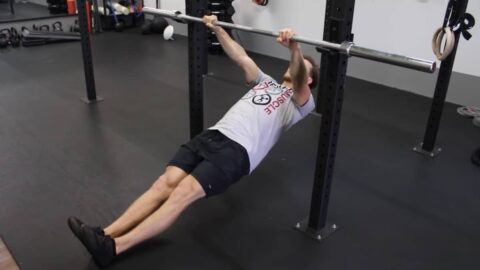
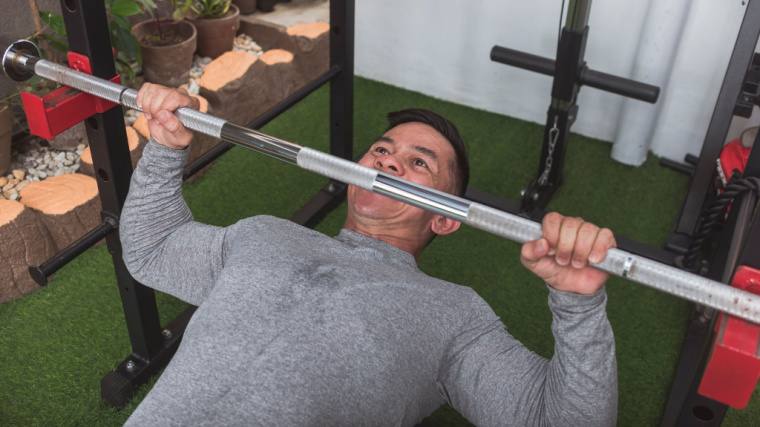
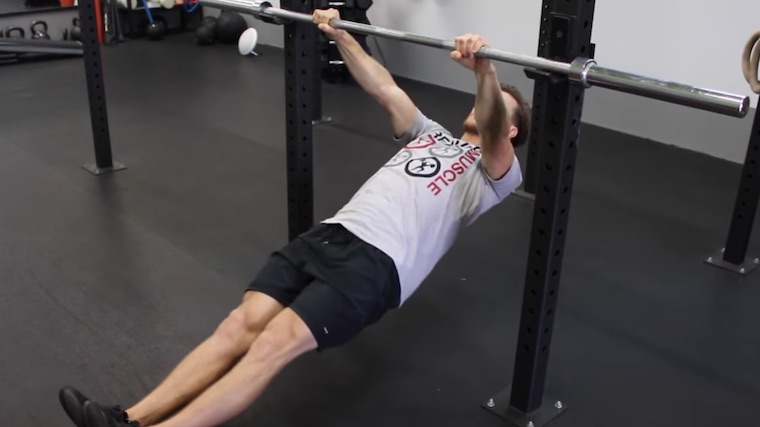
Lie on the ground in a rack or Smith machine and reach your arms toward the ceiling. Note the spot slightly above your fingertips, and set a barbell in the rack at that height. Return to a lying position with your chest under the bar, and take slightly wider than shoulder-width, palms-down grip.
Keep your legs straight and your heels on the ground. Maintain a stiff core and hips to keep your body in a straight line.
Form tip: Because the resistance comes from leveraging your bodyweight, you can easily scale the exercise to suit your strength level. The steeper your body angle, the easier the exercise will be. The more horizontal your body is, the more challenging it will be. However, your back should not be able to rest on the ground in the stretched position. Instead, if necessary, elevate your feet on a bench or step to increase the difficulty.
Step 2 — Pull Your Chest to the Bar
Credit: BarBend / YouTube
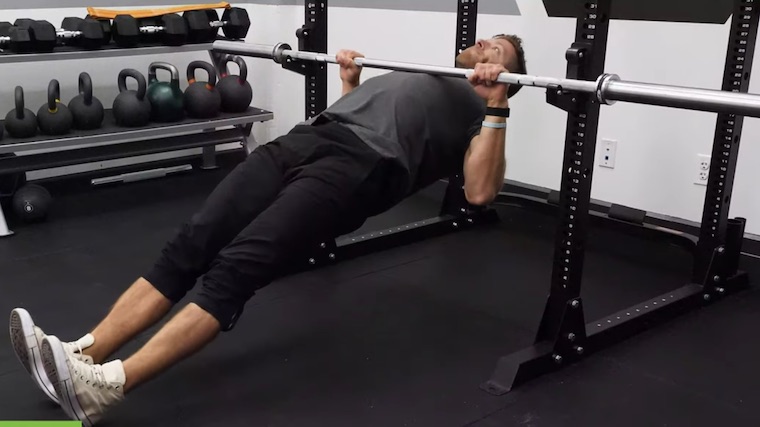
Flex your abs, squeeze your shoulder blades together, and pull yourself up until your torso touches the bar. It should make contact near your lower chest. Think about driving your chest “up” through the bar toward the ceiling.
Do not let your elbows flare out too much on your sides. Keep them relatively close to your body to improve the recruitment of your lats (back muscles). In the top position, don’t bend your legs or let your glutes hang down.
Form tip: If your chest cannot reach the bar, adjust the height and reposition to reduce the difficulty. Achieving a full range of motion is critical for building strength, stimulating muscle growth, and improving shoulder and upper back joint health.
Step 3 — Stay Tight As You Lower
Credit: Breaking Muscle / YouTube
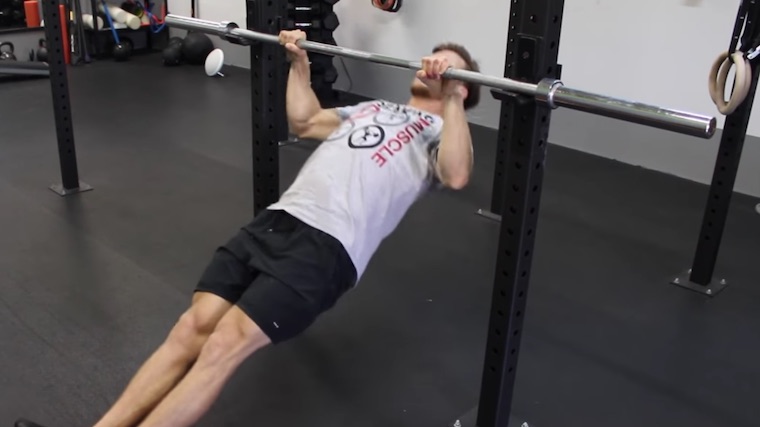
Keep your entire body tense and keep your shoulder blades squeezed together as you slowly straighten your arms. When you’ve reached full lockout, your back and shoulders should still be slightly off the ground.
Pivot your body on your heels, don’t bend your legs during the exercise. Let your back, shoulder, and arm muscles do the work of lifting and lowering.
Form tip: Maintain a stiff posture and an engaged core for maximum benefits. Ensure total-body tension and do not relax during the eccentric (descent or lowering phase).
Inverted Row Mistakes to Avoid
Just because the inverted row is a bodyweight exercise doesn’t mean you get a free pass to butcher basic technique. Good form matters as much with bodyweight exercises as with free weight movements. Review these frequent mistakes to make sure you’re not doing them.
Losing Posture
The main muscles of the inverted row are the back and the arms, but the whole body is involved in the lift. If your glutes start dropping down and you lose tension and posture, the mechanics of the exercise will change and you will reap less benefits. Your body should form a straight line from your ankles to your shoulder joints.
There’s one acceptable exception to the “straight line” rule: To significantly improve your leverage and make the exercise easier, you can bend your legs and plant your feet flat on the floor. However, you should still keep a straight line from your knees to your shoulders while maintaining tension in glutes, core, and shoulder blades.
Avoid it: Push your heels into the ground to tense your legs and contract your glutes. Imagine having a string attaching your hip bones to the ceiling.
Rowing Too High
In the top position of each repetition, the bar should touch the lower part of your chest. If you’re positioned incorrectly and pull too high, with the bar hitting your upper chest or neck, you turn the exercise into a type of face pull variation.
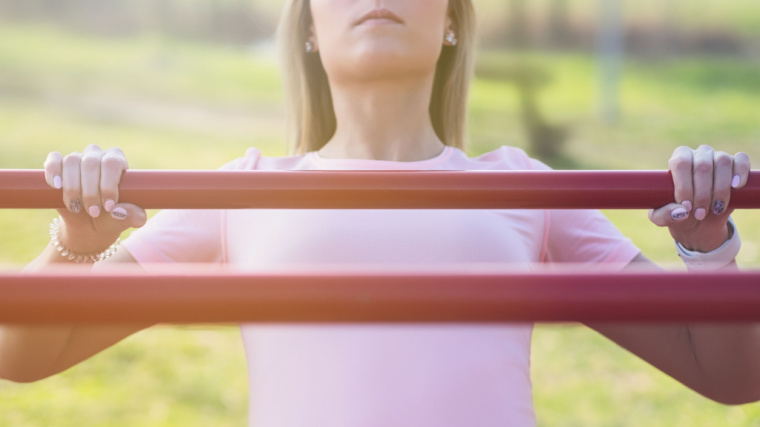
Credit: inimma / Shutterstock
This is a mistake because it decreases activation of your bigger lat muscles and increases recruitment of your rear deltoids (shoulders) and upper back. A higher pulling position also causes your elbows to flare out to the sides, which can increase strain on your shoulder joint, especially if you lack shoulder mobility.
Avoid it: Prior to beginning your set, when setting up the bar position, be sure your lower chest or upper abs are lined up under the bar. This helps to put you in a good pulling position before the movement even begins.
Pulling with “Broken” Wrists
When any exercise becomes difficult, because of fatigue or excessive weight, the body will naturally try to recruit additional muscles to come to the rescue. This can happen with the inverted row if your arms are much stronger than your back, when your wrists bend during the movement.
Credit: Jasminko Ibrakovic / Shutterstock
Pulling with bent or “broken” wrists will shift more stress to your arms and can cause joint pain and discomfort. It also excessively fatigues your gripping strength which will limit the amount of back work you can achieve.
Avoid it: Keep a neutral wrist position at all times, from the stretched position to the top contraction. Think about pulling with your elbows instead of pulling with your hands. If you have wrist pain, use a neutral grip by placing a football bar (sometimes known as a Swiss bar) in the rack instead of a straight barbell or by switching from a barbell to suspension straps (like a TRX).
Benefits of the Inverted Row
The simplest exercises can sometimes be overlooked, but they are often the ones that can provide major benefits. The inverted row can provide several benefits in terms of strength, muscle mass, and core stability.
More Muscle
Just like the pull-up, the inverted row is a fantastic exercise for building muscle mass in the back, arms, and forearms using just your bodyweight. In fact, it can recruit more lat and upper back muscle than a traditional barbell row (1) The inverted row makes it easy to accumulate volume (repetitions and/or sets) to stimulate muscle growth in your target muscles. (2)
Pulling Strength
Bodyweight movements have a reputation of being less effective for building strength because you can’t move extremely heavy weights but, if you’re a beginning lifter, it can prove very efficient. (3) As a multi-joint exercise, the inverted row is indeed an ideal choice for building pulling strength. (4)
Credit: Donny Podrasky / Shutterstock
The inverted row demands whole-body coordination and power. Like many bodyweight movements, you can eventually add resistance, like a weighted vest, to provide basic progressive overload. This will challenge the back, biceps, and grip strength of any experienced lifter.
Less Lower Back Stress
Rowing exercises usually involve the lower back to maintain proper posture and provide stability, but this can often be a limiting factor, especially for lifters with pre-existing lower back problems.
The inverted row creates very little spinal load because your spine isn’t put under any significant strain. As such, if you’re having back pain, it is an ideal option for a rowing movement with nearly zero stress on your lower back. Moreover, it also engages your core, which has been linked to less lower back pain and a better core and spinal health. (5)(6)
Muscles Worked by the Inverted Row
A properly done inverted row can be one of the most efficient back exercises in your arsenal. It recruits multiple muscles in your back without straining the often overused lower back like many alternative movements. As a pulling exercise, the inverted row also recruits several support muscles.
Latissimus Dorsi
The lats are the biggest and strongest back muscles. They go from your hip bone and lower spine to your humerus (arm bone) and are heavily involved in moving your arm through a variety of motions. Because they cover so much of your torso, the lats also contribute to spinal stability and trunk movements. They are the main target of the inverted row.
Upper Back
This includes your trapezius, rhomboids and posterior deltoids — all involved in scapular (shoulder blade) motion and joint health. These muscles work similarly to move the shoulder blades in several ways, assist in pulling motions, and contribute to stabilizing the scapulae during pressing movements.
Biceps
Of course, we all know the biceps. On the front of the upper arm, it is the biggest arm muscle and goes from the radius (forearm bone) to the scapula. The biceps are recruited to perform the inverted row, but other relatively smaller muscles will help the biceps flex (bend) your arm.
The pronated (palm down) grip used during the inverted row actually puts an emphasis on the brachialis, the strongest arm flexor muscle. (7) It is actually located just under the biceps, and can help your biceps appear larger because a well-developed brachialis will “push” it higher.
Forearms
Your forearms will be trained by nearly every back exercise because your grip transfers force from the weight toward the target muscle. Several muscles work throughout your forearms, but the forearm flexors on the palm-side of your lower arm are responsible for your grip and will be taxed the most. The brachioradialis, the biggest muscle on the opposite side of your forearm, will also assist in flexing your upper arm.
Core
In order to maintain proper posture and be more efficient during this exercise, you’ll have to engage your whole core. All of your abs (rectus abdominis, obliques, transverse abdominis), your erector spinae (spinal muscles), and some hip muscles are recruited synergistically. Your abs are the anterior core muscles running on the front of your torso while the erectors are along your back (beginning at the lower back, they run up to your neck).
Your core muscles do not move through a range of motion during the inverted row, but are contracted isometrically to maintain a strong, stable, and safe body position.
Who Should Do the Inverted Row
The inverted row is versatile and demands bare minimum equipment —any bar or beam that can support your weight. Lifters with a variety of goals and abilities can incorporate this exercise into their routine.
Beginners
The inverted row is an ideal pulling exercise for beginners starting to master their own body’s resistance. The exercise can be scaled in an instant to your strength level by either raising the bar or bending your legs to make it easier, or placing your feet on a bench or adding a weighted vest on — or both — to make it harder.
As pull-ups are significantly harder for inexperienced lifters without a base of strength, the bodyweight row is a great first step to increase pulling strength, general fitness, and whole-body tension.
Physique Enthusiasts
Be it a bodybuilder or someone that just wants to pack on some size, many lifters overlook the inverted row as a muscle-building exercise. Despite being a bodyweight exercise, it can be more efficient than some other rowing exercises, especially for targeting your lats and strengthening your upper back. It also has the benefit of being low-stress on your lower back, so you won’t interfere with recovery from low-back intensive exercises like squats or deadlifts.
General Fitness Advocates
Whether you’re a CrossFit enthusiast, sports athlete, or a Regular Joe that wants to improve their functional fitness, the inverted row is a multi-function exercise for developing several physical qualities. You can program it to improve strength, muscle size, muscular endurance, whole-body stability and coordination. You can even build cardiorespiratory capacities by tossing it into a circuit workout to improve your fitness as a whole.
How to Program the Inverted Row
Bodyweight movements are very versatile in programing, and the range of repetitions can vary considerably depending on your goals and strength level. If you’re a newer lifter, focus on only performing high-quality repetitions and treat it exactly like any other resistance exercise — no cheating on your form to squeeze out extra reps. A more experienced lifter can add external load or use a high training volume to make the movement more challenging.
Unweighted, Low Repetition
When you are at the early phase of training and still developing fundamental strength, coordination, and body awareness, your goal is to improve your form and build a general base. You cannot do too many repetitions because you lack the strength to do it without your form breaking down. Three to five sets of four to six repetitions is a good range to stick with.
You can also use a “total reps goal” approach instead of specific sets and reps. Aim for a modest number, roughly 20 repetitions, and complete them in as many sets of quality repetitions as needed. It could take 15 sets or it could be four. Over time, aim to reach the target in fewer total sets.
Unweighted, High Repetition
If you’re a strong lifter, you can use bodyweight training for high repetitions to build muscle while sparing your joints from excessive loading stress. (8) Aim for two to three sets of at least 15 repetitions to failure while keeping a good form. This will provide a great pump and will challenge more your core and postural muscles because of the longer set duration.
Weighted, Medium Repetition
If you can add external resistance to the lift using a weighted vest, a backpack, or a pair of chains draped across your torso, you can treat this exercise like any other resistance training movement and hit it hard and (relatively) heavy. The traditional bodybuilding scheme of three to four sets of eight to 12 repetitions will be your best bet to promote hypertrophy and provide a challenging time under tension.
Inverted Row Variations
Once you’ve mastered the basic movement, you can very easily switch the focus of the exercise to accommodate your goals or individual needs. Here are some simple tweaks to provide variation to your inverted rows.
Supinated Inverted Row
Using a palms-up grip is a simple change if you want to experience more biceps growth, because the arm muscles will be in optimal alignment. As such, most lifters will also be stronger and will be able to bang out more repetitions or use more weight.
This is similar to using chin-ups in place of pull-ups. The adjusted hand position changes muscle recruitment and emphasizes the biceps and forearms over the muscles of the back.
Neutral Grip Inverted Row
The neutral grip, or hammer grip, can be a welcome relief for lifters with achy shoulders, elbows, or wrists. The stress on these joints is drastically reduced because brachialis and brachioradialis recruitment is increased. As an added bonus, building these muscles will help you build a set of classic Popeye arms.
To perform it, use a football bar (or Swiss bar) instead of a straight barbell. If your gym doesn’t have one, you can use a neutral-grip “V-bar” attachment from the pulldown station and set yourself up parallel to the barbell. Suspension straps, like a TRX or gymnastic rings, would also be effective.
Ring Row
Using any suspension straps like a TRX or a pair of gymnastic rings is the most versatile and joint-friendly row option. You can use whatever grip you want: palm-down, neutral, or palm-up. You can even add a natural twisting motion by rotating your hands during each repetition. Begin pulling with a palm-down grip and rotate to neutral or palm-up as you approach the top position.
The main benefit is that the ring’s instability will challenge your core and your shoulders. This variation is the hardest, but the required stabilization will greatly improve your core and shoulder health and stability, which transfers to overall athleticism and power in other upper body exercises.
Inverted Row Alternatives
Variety is the spice of life, and of muscle growth. (9) If you’re ready to switch things up or if you don’t have a spot to perform the inverted row, you’re covered with these effective alternatives.
Seal Row
The seal row is the free weight equivalent of the inverted row. Lie prone (face down) on an elevated flat bench and grab a pair of dumbbells or a barbell — there even are specially designed stations for this exercise with easy to grab weights. Pull the weights from the stretched position beneath the bench toward your chest, as if performing an upside down inverted row.
Because your body is fully supported, cheating with momentum is very difficult. It also nearly eliminates any strain on the lower back, like the inverted row. With this variation, there’s no need for total-body stabilization, so you can solely focus on using your pulling muscles and develop a great mind-muscle connection.
Pull-Up
They say the pull-up is the king of upper-body bodyweight exercises, and for good reason. It’s a tremendous back-builder. When you’re comfortable with inverted rows, get started with this vertical bodyweight exercise.
Like the inverted row, the pull-up will target more of your lats than your upper back. You can use the same grip variations and set/rep programming schemes as the inverted row.
Bent-Over Barbell Row
The standard barbell row might be an upper body pulling exercise in its purest form. Grab a barbell, bend forward and gather tension in your whole body, and start rowing heaps of iron.
This exercise will demand superior whole-body engagement, particularly your glutes and hamstrings to counterbalance the load. If you want to improve your pulling strength, back muscle size, and total body stability, get familiar with this classic movement.
FAQs
Are inverted rows and pull-ups the same thing?
No. Despite both being bodyweight pulling exercises, they are different. One is a vertical movement pattern while the other works horizontally. This means that muscle recruitment will be similar, but not exactly be the same. The inverted row will recruit more of your upper back, for instance.
Pull-ups are also harder, because your body is completely hanging in the air and you’re required to lift proportionally more of your body weight. The inverted row has your feet supported on the ground and angled, which means that you’re lifting a lower percentage of your body weight.
As a bodyweight movement, when should I do the inverted row?
There are no clear rules because it will depend on your specific goals and strength levels. If you want to develop your strength or technique, include them at the start of your workout. If you’re using them to build muscle mass, they can be performed later in session, after your muscles are fatigued from other exercises.
If you really want to speed up your strength and technique gains as a newer lifter, you can also use the grease the groove technique. Perform a single set of a few high-quality repetitions, several times throughout the day (for instance, you can do it at home under a sturdy table), waiting at least 30 minutes between each set. This training method will develop your strength, coordination, and skill so that you quickly become very good at the exercise.
Get Back to Bodyweight Training
The inverted row is a highly effective addition to any training program, whether you’re just getting started in the gym or if you’re well-experienced. While the pull-up has a much more widely known reputation as being “the” bodyweight back-training exercise, the inverted row deserves plenty of attention and can deliver plenty of results. It shouldn’t be treated as an introductory exercise that’s forgotten once you build some strength. It’s definitely time to get on the ground and start pulling.
References
Fenwick CM, Brown SH, McGill SM. Comparison of different rowing exercises: trunk muscle activation and lumbar spine motion, load, and stiffness. J Strength Cond Res. 2009 Mar;23(2):350-8. doi: 10.1519/JSC.0b013e3181942019. PMID: 19197209.
Brigatto FA, Lima LEM, Germano MD, Aoki MS, Braz TV, Lopes CR. High Resistance-Training Volume Enhances Muscle Thickness in Resistance-Trained Men. J Strength Cond Res. 2022 Jan 1;36(1):22-30. doi: 10.1519/JSC.0000000000003413. PMID: 31868813.
Lipecki, Krzysztof & Rutowicz, Bartosz. (2015). The Impact Of Ten Weeks Of Bodyweight Training On The Level Of Physical Fitness And Selected Parameters Of Body Composition In Women Aged 21-23 Years. Polish Journal of Sport and Tourism. 22. 10.1515/pjst-2015-0014.
Brandão, Lucas & Painelli, Vitor & Lasevicius, Thiago & Silva-Batista, Carla & Brendon, Helderson & Schoenfeld, Brad & Aihara, Andre & Cardoso, Fabiano & Peres, Bergson & Teixeira, Emerson. (2020). Varying the Order of Combinations of Single- and Multi-Joint Exercises Differentially Affects Resistance Training Adaptations. Journal of Strength and Conditioning Research. 34. 1. 10.1519/JSC.0000000000003550.
Joan Aguilera-Castells, Bernat Buscà, Azahara Fort-Vanmeerhaeghe, Alicia M. Montalvo & Javier Peña (2020) Muscle activation in suspension training: a systematic review, Sports Biomechanics, 19:1, 55-75, DOI: 10.1080/14763141.2018.1472293
Kumar T, Kumar S, Nezamuddin M, Sharma VP. Efficacy of core muscle strengthening exercise in chronic low back pain patients. J Back Musculoskelet Rehabil. 2015;28(4):699-707. doi: 10.3233/BMR-140572. PMID: 25467999.
Kleiber, T., Kunz, L., & Disselhorst-Klug, C. (2015). Muscular coordination of biceps brachii and brachioradialis in elbow flexion with respect to hand position. Frontiers in physiology, 6, 215. https://doi.org/10.3389/fphys.2015.00215
Schoenfeld BJ, Peterson MD, Ogborn D, Contreras B, Sonmez GT. Effects of Low- vs. High-Load Resistance Training on Muscle Strength and Hypertrophy in Well-Trained Men. J Strength Cond Res. 2015 Oct;29(10):2954-63. doi: 10.1519/JSC.0000000000000958. PMID: 25853914.
Baz-Valle E, Schoenfeld BJ, Torres-Unda J, Santos-Concejero J, Balsalobre-Fernández C. The effects of exercise variation in muscle thickness, maximal strength and motivation in resistance trained men. PLoS One. 2019 Dec 27;14(12):e0226989. doi: 10.1371/journal.pone.0226989. PMID: 31881066; PMCID: PMC6934277.
Oct. 7, 2022 — More than 2.5 million middle school and high school students in the U.S. use e-cigarettes, according to a new study from the CDC and FDA.
The 2022 National Youth Tobacco Survey, conducted between January and May, showed that 14% of high school students and 3.3% of middle school students used nicotine devices at least once during the past 30 days. A year ago, the survey showed that 11.3% of high school students and 2.8% of middle school students reported vaping in the past month.
The numbers remain below 2019 data, which showed that more than 25% of high school students vaped. Even still, anti-tobacco and anti-vaping groups have urged federal regulators to eliminate flavored vaping products that are popular among teens.
In this year’s survey, 85% of teens who vaped said they used flavored e-cigarettes. The most used flavors were fruit (69%); candy, desserts, or sweets (38%); mint (29%); and menthol (27%).
“It is unacceptable that over 2.5 million kids still use e-cigarettes when there is a clear solution to the problem — eliminate all flavored e-cigarettes,” Matthew Myers, president of Campaign for Tobacco-Free Kids, told USA Today.
The FDA has banned flavored vaping products derived from tobacco. However, users have increasingly turned to synthetic nicotine products, which are often disposable and sold in a variety of flavors, the newspaper reported.
In 2022, teens reported several different favorite brands, in contrast to 2019, when JUUL was the most recognized brand. Among those who currently vape, 14.5% said their usual brand was Puff Bar, followed by 12.5% for Vuse, 5.5% for Hyde, and 4% for SMOK. In addition, nearly 22% said their usual brand wasn’t among the 13 listed in the survey.
About 28% of youth reported using e-cigarettes daily, and 42% reported using them on 20 or more days during the past 30 days.
In addition, about 55% of teen vapers said they use disposable e-cigarettes. About 25% use prefilled or refillable pods, and 7% use tanks or mod systems. Another 23% said they didn’t know what type of device they used.
“This study shows that our nation’s youth continue to be enticed and hooked by an expanding variety of e-cigarette brands delivering flavored nicotine,” Deirdre Lawrence Kittner, director of the CDC’s Office on Smoking and Health, said in a statement.
“Our work is far from over,” she said. “It’s critical that we work together to prevent youth from starting to use any tobacco product — including e-cigarettes — and help all youth who do use them, to quit.”
A general perusal of Jaisyn Mike’s social media will say he’s quite confident in his abilities. The two-time International Powerlifting Federation (IPF) World Champion in the +120-kilogram division seems to make it a point to showcase unique feats of strength and power. The 44-year-old competitor’s latest training accomplishment is no different.
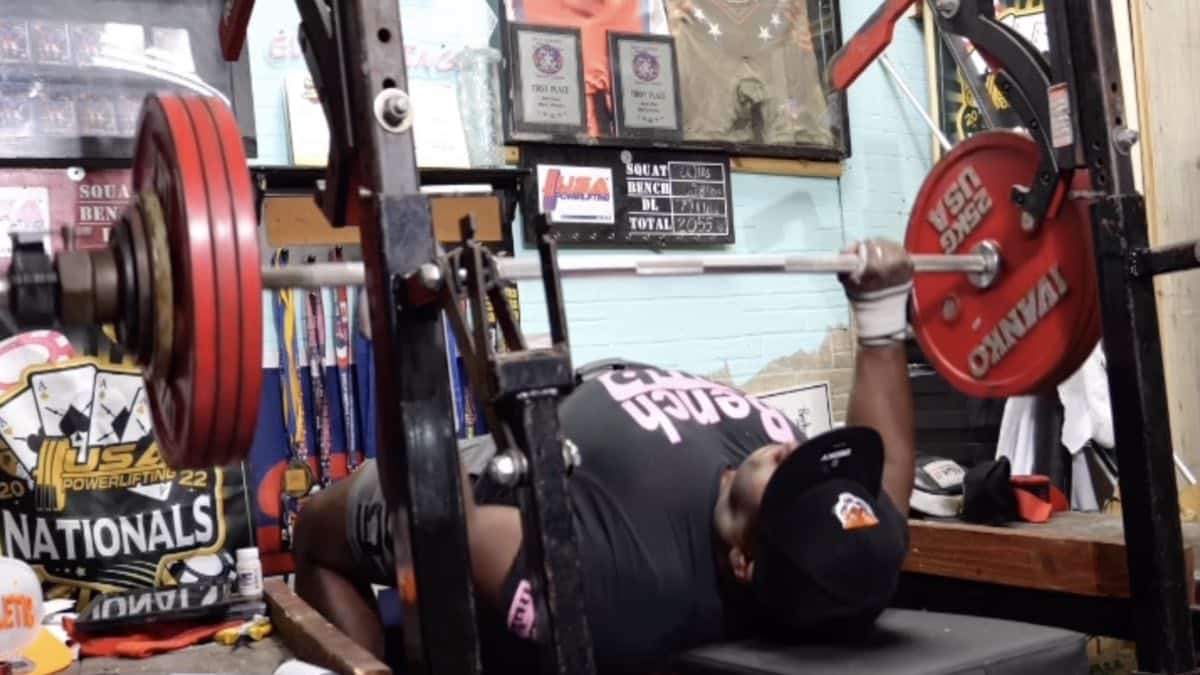
On Oct. 6, 2022, Mike uploaded a video to his Instagram profile where he completed a 192.8-kilogram (425-pound) bench press for 20 reps while wearing wrist wraps and a lifting belt. According to the post’s caption, the show of endurance is a personal record (PR) for Mike.
Per other posts on Mike’s Instagram, his bench press work and general training are related to preparation for the 2023 USA Powerlifting (USAPL) Raw Nationals. While he has competed in the Masters 1 (ages 40-49) category of late, Mike plans to feature in the Open portion and in the 140-kilogram weight class at that specific contest. It would be his first full powerlifting meet since the 2019 USAPL Raw Nationals in October of that year. Mike has participated In bench-only competitions in the time since. Per a press release from USAPL, the 2023 Nationals will take place on Sept. 14-17, 2023, in Memphis, TN.
Competition prep aside, this sort of bench press display is nothing new for Mike, who seems to have centered on that aspect of his strength of late. Recent marks from his routine are right in line with this new PR.
Just several days before he finished this 20-rep set, Mike successfully locked out a 230.4-kilogram (508-pound) bench press for 10 reps. Earlier in the same week, Mike pushed through a 190.5-kilogram (420-pound) bench press for an older 20-rep PR.
When not pushing himself on the bench press, Mike has excelled all the same in the gym. The powerlifter shared an early-October 2022 clip of himself completing a raw 365-kilogram (804.6-pound) deadlift for a one-rep PR. This was a rapid progression from a 354.7-kilogram (782-pound) deadlift that Mike logged in late-September 2022.
According to Open Powerlifting, here’s an overview of Mike’s all-time raw competition bests:
Aside from winning the 2023 Nationals, Mike’s other primary goal appears to be a desire to eclipse a 362.9-kilogram (800-pound) deadlift on a sanctioned lifting platform, especially after some of the recent 900-plus-pound pulls from other powerlifters.
Whether Mike can successfully make a run in the Open at next year’s Nationals remains to be seen. Nonetheless, his recent training progress would indicate he seems to be on the right progressive track.
Featured image: @mr.athletic_over_everything on Instagram
What are you up to this weekend? We are going to see Bros and also enjoy the sunshine after lots of rain! Hope you have a good one, and here are a few fun links from around the web…
A writer interviewed her grandfather-in-law, days before his planned death. “Climbing the hill of life is challenging but marvelous. The way down is slippery. Literally. It’s easier to walk up than down.” (NYMag)
The etymology of the word spinster: “It comes from women who spun wool for a living — spinners. They were financially independent and didn’t need to get married. Then it became a pejorative, this sense of women not needing husbands.”
Says MAK on strategic starters for a dinner party: “Some friends had us over recently and served cold martinis and Lay’s potato chips. Perfect combo.”
Says Amy on the dead dad club: “When my dad died, this is how I felt: ‘We were a religious sect consisting of two people, and now half the congregation was gone.’ – James Marcus”
Says Kay on a podcast that made me laugh: “I have a gigantic crush on Jason Mantzoukas and love listening to him on podcasts, especially the Gilmore Guys. His characters are often loud twits but he comes across as so smart and sensitive in interviews. I also LOVE Scam Goddess, true crimes that aren’t murdery but con-focused; and The Bechdel Cast, where they talk about movies through an intersectional feminist lens; and of COURSE Maintenance Phase because Aubrey Gordon is in fact amazing.”
(Photo by Holly Clark/Stocksy. Hot dads via Phoebe Wahl.)
Note: If you buy something through our links, we may earn an affiliate commission, at no cost to you. We recommend only products we genuinely like. Thank you so much.
Among the 19,958 mother-child pairs studied, 12.4% of children developed obesity or overweight in the full study group, and the children of those mothers who ate the most ultra-processed foods (12.1 servings/day) had a 26% higher risk of obesity/overweight, compared with those with the lowest consumption (3.4 servings/day), reports Andrew T. Chan, MD, a professor of medicine at Harvard Medical School, and colleagues.
The results were published online in the journal BMJ.
The study shows the potential benefits of limiting ultra-processed food during reproductive years to decrease the risk of childhood obesity, the study authors note. Ultra-processed foods, such as packaged baked goods and snacks, fizzy drinks, and sugary cereals, which are linked to an increase in adult weight, are frequently included in modern Western diets.
But the relationship between parents eating highly processed meals and their children’s weight is unclear across generations, the researchers note.
“Overall awareness of the importance of diet in one’s personal health, as well as in the health of their families, is something that we hope will be a source of change, and certainly does start with promoting and educating people about the importance of diet during those critical periods,” Chan said in an interview.
He said it is important not to blame mothers for their kids’ health, as there are other things at play beyond just education. “It requires a concerted effort to ensure that we break down the social and economic barriers to access to healthy foods so that it becomes actually feasible for many women to be able to have access to a diet that will promote health for both themselves and their kids.”
Does Eating Ultra-Processed Food During Pregnancy Make Kids Obese?
In this study, investigators looked at whether eating ultra-processed food throughout pregnancy and while raising kids increased the likelihood of children and teens being overweight or obese.
The study team evaluated 14,553 mothers and their 19,958 children using data collected from two large studies. Males comprised 45% of the children in the cohort. The children spanned from 7 to 17 years of age.
Childhood obesity or overweight has been linked to maternal consumption of highly processed meals during child-rearing.
“We know that lifestyle during pregnancy is important for not only the health of the baby, but also the health of the mother. So, it does represent an opportunity for people to think critically about what they can do to really optimize their health, and it becomes a period of time where people are maybe thinking a little bit more about their health and are more open to new dietary counseling and also more motivated to effect change,” Chan says.
It’s important for women to consider their diet, Chan says. Women need to take into account “what kinds of foods they are eating and, if possible, try to avoid ultra-processed foods that have very refined ingredients and a lot of additives and preservatives, because they tend to really have a higher content of those dietary factors that we think lead to overweight and obesity,” he says.
Physical activity is also important during the reproductive years and pregnancy, and people should aim to sustain physical activity during pregnancy and beyond, Chan notes.
The findings may be limited, as they were based on self-reported questionnaires and some mother-children pairs stopped taking part in the study during follow-up. Most of the mothers were from similar personal and family educational backgrounds, had comparable social and economic backgrounds, and were primarily white, which limits how this study can apply to other groups of people, the researchers noted.
“Staying healthy isn’t something that you should really start doing in middle age or late adulthood, it is really something that should be promoted at a young age, and certainly during young adulthood, because of the influence that it has on your long-term health, but also the potential influence it might have on your family’s,” Chan says.