Though breast cancer treatment can be highly effective, women across the globe face drastically different outcomes depending on where they live.
According to research compiled by the World Health Organization, survival for at least five years after diagnosis ranges from more than 90% in high-income countries to only 66% in India and 40% in South Africa.
Geetha Manjunath, founder and CEO of Bengaluru, India-based Niramai Health Analytix, set out to improve access to screening when a close family member died of breast cancer in her early 40s not long after receiving a diagnosis. The company recently participated in the M2D2 Impact accelerator at the University of Massachusetts Lowell and received FDA 510(k) clearance earlier this year.
Manjunath sat down with MobiHealthNews to discuss how Niramai’s artificial intelligence-enabled screening system works, the importance of explainability when using AI in healthcare and what’s next for the company.
MobiHealthNews: Can you tell me a little bit about how the Thermalytix system works for breast cancer screening?
Geetha Manjunath: I’ll set a little bit of context. If you look at the mortality rates across different countries, there is a huge variation in the number of people who survive breast cancer. In order to stop these deaths, we need regular screening, but that is not feasible today. One, because of the economic constraints. Such a huge initiative is usually restricted to women around 45 years and older, because there is a relationship with age. Also, mammography, which is the standard for breast cancer detection, does not work as well on younger women below 45 years old, because they have what is called dense breasts. In fact, in almost 50% of the ladies above 40 there is a density issue again.
In countries like India, China, the Philippines, the affordability of the machine itself is a big issue for the government as well as small diagnostic centers or private hospitals. So with all this, what Niramai has developed is an affordable, accessible method of detecting breast cancer in women of all age groups and all breast densities. In addition, the machine is actually very portable. You can do the test in the hospital. You can also take it out to do the test in remote areas, rural villages as well as corporate offices. We also have a home screening for breast cancer screening.
The lady enters a small room, like a small booth. She goes in, she closes the door and then she removes her clothes in front of this device. Nobody is inside, it’s like a changing room. Nobody sees her or touches her during the test, which is unlike the experience of doing a mammogram, for example.
It uses an imaging technique called thermal imaging, which can be controversial. Traditionally, thermal imaging has been used for abnormality detection. However, it has never been accurate enough to be used or recommended in hospitals, because we are measuring, let’s say, 400,000 temperature points per person. It’s very hard for the human eye to differentiate between different shades of yellow, different shades of oranges, and so on.
We have developed our artificial intelligence-enabled smart software, which analyzes this temperature distribution on the chest area, and converts that into a cancer report. That is completely done automatically with scoring indicating the level of abnormality. That is our main value proposition, AI algorithms to convert temperature distribution into a cancer report.
MHN: So the cancer report is not saying, you 100% have breast cancer. Is the idea that it highlights potential concerns and you get further tests?
Manjunath:Absolutely. It’s a screening test, which means that out of 100 women screened, we identify those nine or 10 women who need to go for a follow-up diagnostic workup – maybe another mammogram, or 3D mammogram, or more sophisticated breast MRI, or a breast ultrasound.
MHN: AI is becoming a lot more prevalent in healthcare, especially for imaging. How do you balance concerns about introducing bias or not understanding how the AI is making its recommendations?
Manjunath:AI is a machine, and a machine behaves the way you train it. So the training phase is very, very important. What kind of samples you use for training, making sure that the training set is addressing multiple abnormal aspects. For example, in breast cancer, we looked at pregnant women, we looked at people who are menstruating, we looked at people who had fibroadenomas. All of the different categories and subcategories of potential abnormalities have to be included. You definitely need to work with a medical expert to actually ensure that your training is unbiased. It’s really multidisciplinary, because the domain experts and the technology experts have to come together.
And the explainability part is also hugely important. So for example, initially, we just said it would look at a patient and say, cancer or no cancer. But the doctor said, “What do I do with this? I can’t take any action with this. You just say cancer, but which breast and what happened?” So we now have a three page PDF report that is automatically generated, which gives scores for the left breast and the right breast. We do markings on the breast automatically, saying this is where you want to check again.
MHN: You recently received FDA 510(k) clearance here in the U.S. What are the next steps for the company?
Manjunath:We recently received the U.S. FDA clearance, we’re just finishing device registration, though we launched in a beta mode last month. So I’m already looking for partners. To start with, we will be working with thermographers, people who are already using thermal imaging. Our current clearance from FDA is to use this as an adjunct to mammogram, so we would love to work with these imaging centers to provide this facility as well.
In parallel, we are working on the next device, which is a little more sophisticated than our current device, for clearance by the FDA. We need a multisite clinical study in the U.S., so we have identified hospitals in New Jersey and Arizona, and probably Florida as well.
Meanwhile, we have received a huge response from low and middle income countries because of the affordability and accessibility part of it. So, in countries like the Philippines, the UAE, India, Indonesia, we are working with distributors in the local domestic market to take the solution to the developing world. And also we are cleared for use in Europe.
So I’m very excited. I tried to solve a very, very local problem of trying to get Indian women detected with cancer. We’ve now screened 60,000 women in India alone, which is a considerable number, given it’s a new medical device. We have already launched in Kenya. So, I’m very excited to have an opportunity to make a difference in the lives of women, hopefully, around the world.
“You’ve gotta squat” can be heard echoing through gyms worldwide. At face value, it’s undoubtedly useful advice. Squatting strengthens the entire lower body and builds muscle in the legs, while also working the core and upper-body stabilizers.
However, squatting isn’t one specific exercise; it’s a general movement pattern. Telling someone to squat is like telling them to eat. It’s well-intentioned but vague. Many lifters assume that the barbell back squat is the default “squat” and other movements are just variations.
Ivan Kochergin / Shutterstock
While the back squat has plenty of its own advantages, it may not belong on that pedestal. The front squat can easily take the top spot. It offers several benefits the back squat can’t match and just might be a better overall choice for many lifters. Here’s a deep dive into learning which type of squat really belongs in your training program.
Back Squat and Front Squat
Back Squat and Front Squat Differences
Beyond the most visual difference — the barbell’s position — there are several key differences between these two primary squats.
Muscle Recruitment
The bar position during a back squat requires lifters to lean forward, somewhat significantly, during the exercise. This froward lean recruits more of the posterior chain — glute, hamstrings, and lower back — to maintain a stable upper body position. The lower back, in particular, is highly activated during back squats.
While lower back involvement can play a role in building overall strength, it can also be a limiting factor for lifters with pre-existing lower back problems.
In contrast, the front squat significantly recruits the anterior chain muscles — abdominals, hips, and quadriceps. (1) Because the barbell is supported across the front of the shoulders, the load remains closer to the body’s center of gravity without causing any drastic forward leaning.
Credit: Ground Picture / Shutterstock
This upright torso position reduces lower back involvement while increasing abdominal activation. The bar position during the front squat also requires more wrist and elbow mobility to hold the bar in place; the back squat typically requires more shoulder mobility to maintain a stable grip on the bar.
Interestingly, lower body muscle recruitment is more closely related to general squat depth than actual bar position. Achieving a deeper position in the bottom of a squat, whether it’s a back squat or front squat, will recruit more hamstring and glute muscle. (2)
Squatting to a relatively higher position — thighs roughly parallel to the ground or higher — will focus muscular stress on the quadriceps. The front squat has also been shown to increase activation in one of the quadriceps muscle heads, but not the entire muscle. (3)
The upright torso position of a front squat may often allow a lifter to achieve a deeper squat with less overall strain, but many lifters are able to reach comparable depths with a back squat.
Joint Strain
In terms of overall joint stress, the back squat is often considered to be more stressful to joint structures in both the upper and lower body. (4)
Because the load is supported across the upper back and requires an engaged lumbar spine (lower back) with a forward lean, the low back and hips can be placed under a significant strain.
The shoulder joint may also be stressed while supporting the bar across the back, especially for lifters with excessively tight chest or shoulder muscles, or pre-existing shoulder issues.
Credit: Dragon Images / Shutterstock
Joint stress can often be mitigated with certain adjustments to foot placement, stance width, hand position, and squat depth. However, the back squat generally has more potential to be rougher on the involved joints than the front squat.
That said, the front squat can stress the wrist joints because the bar is held in what’s known as the “rack” position, with the palms facing the ceiling and fingers under the bar near your shoulders.
Again, certain adjustments can be made to accommodate poor wrist mobility. Lifters can adjust their grip, use a crossed arm position, or attach long lifting straps to the bar for an easier grip. But the basic front squat movement and rack position can still potentially strain the wrist joint. The back squat places the wrists in a more stable and less stressful position.
Back Squat and Front Squat Similarities
Despite several physical and performance differences, these two primary squat variations share several benefits.
Movement Pattern
If someone confiscated your barbell and asked you to perform a body weight “front squat” and “back squat,” the movements would look pretty much identical. A squat is a foundational movement pattern; “front” and “back” refer strictly to the position of whatever weight you’re using.
It’s what turn of the century lifters used to call the “deep knee bend” — simply bending your legs to achieve a deep squat position. Whether you’re holding a barbell across your back, supporting a barbell on the front of your shoulders, cradling a sandbag in your elbows, or holding a dumbbell at chest-level, you’re still squatting.
Both the front and back squat use the quadriceps, hamstrings, and glutes as active muscles to move the weight. The abdominals and lower back are recruited as stabilizers to maintain a safe and strong upper body position. The upper back, shoulders, even the lat muscles to an extent, provide further torso stability.
Either squat variation can be performed with a relatively wider stance or a more narrow stance, depending on the lifter’s goals and individual limb leverages. Both can also be performed to varying depths and different ranges of motion, which will slightly alter the lower body muscle emphasis.
Technique Differences Explained
While simply shifting the barbell’s position from the front to the back may not sound like a significant change, it initiates a cascade of differences which will affect technical performance of the lift and, ultimately, the overall results.
Bar Position
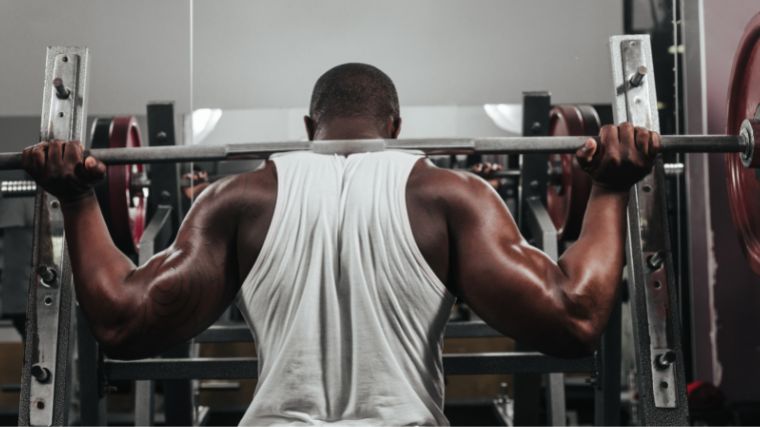
The back squat requires the lifter to support the barbell across their upper back and shoulders. To prevent the bar from sliding directly down the lifter’s back, the torso is angled slightly forward and the hands grip the bar on either side. This creates tension throughout the entire upper body, while activating the large back muscles, abdominals, and lower back for stability.
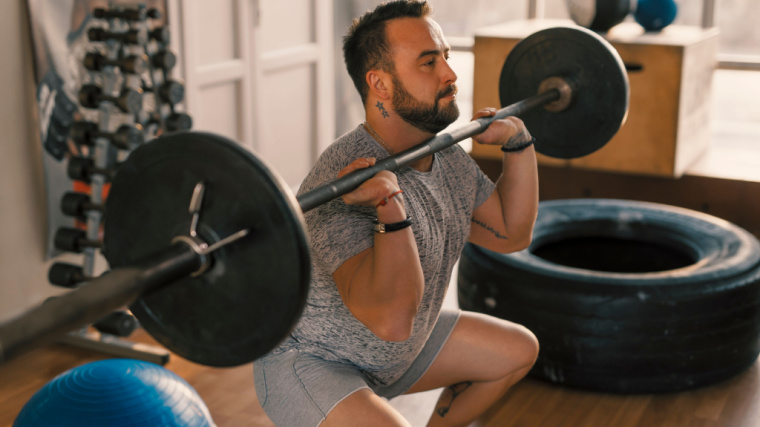
The front squat supports the bar across the front deltoids (front of the shoulder), typically placed close to the collarbones or neck. The rack position requires the lifter to bend their arms and maintain the bar’s position with their hands, or fingers, on the bar.
This front-loaded position requires the shoulders, biceps, and forearms to support the weight. The upper back is also worked isometrically to keep the bar close to the body, and the abdominals are significantly activated to work against the compressive force of the weight.
Body Posture
The angled torso position of the back squat is necessary to counterbalance the load, which puts the lower back into a more active role as a stabilizer. General hip position during the back squat may make it challenging for some lifters to reach a relatively low depth in the bottom position unless they have a high level of hip mobility.
The front squat, due to the more upright torso position, allows lifters to more naturally “sink” into a deeper squat position in the bottom with relatively less strain on their hips, knees, and low back.
Credit: AntGor / Shutterstock
The rack position does require significant upper back strength and the lifter must resist the weight pulling their upper back into a rounded position, while the back squat will typically see lifters falling into a rounded lower back position.
How to Back Squat
Begin with the bar set in a rack at roughly upper-chest level. Dip beneath the bar and place it across your upper back and shoulders. The bar should not rest directly on your neck or spine.
Grab the bar with both hands facing forward. Pinch your shoulder blades together and pull your elbows under the bar to form a stable “shelf” of muscle to support the load. Stand up to unrack the bar, and take one or two small steps backwards.
Step to the side with one foot to set your stance width. Brace your core and push your hips back as you bend your knees. Keep your feet flat throughout the entire repetition. Reach an appropriate depth based on your goals and general mobility. Aiming to have your thighs parallel to the ground is an effective compromise for muscle-building and strength gains. (5)
Form Tip: Squeezing the bar in your hands can contribute to total-body tightness and stability. (6) To ensure a tight upper body and improve power output, grip the barbell hard before unracking and try to crush the bar during each repetition.
Benefits
The back squat is the ideal squat variation for building overall strength. The overall body position maximizes leverage and allows significantly heavy weight to be moved.
This exercise is sport-specific for competitive powerlifters, as it is one of the movements performed in meets.
Because the back squat allows potentially heavier loads to be used, it can be useful for building size and strength together. (7)
Back Squat Variations
The back squat is, itself, one specific squat variation, but there are several similar variations which offer comparable or unique benefits while reducing potential drawbacks like lower back strain.
High-Bar Back Squat
This subtle adjustment to the back squat shifts the bar position higher on the upper back and traps. The slight change in leverage allows the lifter to maintain a more upright torso, which reduces lower back strain and allows a more natural deep squat in the bottom position.
The vertical torso position also encourages a closer stance, which affects squat depth and lower-body muscle recruitment.
Safety Bar Squat
The safety bar is one of the most unique-looking barbells you’ll find in a gym. The extra-thick padding and angled bar sleeves shifts the barbell’s center of gravity, while the forward-facing handles allow a neutral grip which reduces shoulder strain.
The safety bar squat decreases lower back involvement while increasing activation of the upper back muscles.
How to Front Squat
Begin with a barbell in a rack slightly below your collarbones. Grab the bar slightly outside shoulder-width, using a palms-down grip. Approach the bar and allow your arms to bend. Your elbows should point forward as the bar rests on the fronts of your shoulders.
Keep your abs fully engaged and maintain a straight back. Straighten your legs to unrack the bar. Take one or two steps backwards and one step to the side to establish your stance width. Flex your core as you stabilize the weight.
Bend your legs and descend as low as possible. Keep your shoulders pulled back and your upper body vertical as you lower into the bottom position.
Form Tip: Don’t allow your elbows to point down. The barbell, and your torso, will follow your elbows — if they drift down, the weight will fall forward and the lift will fail. Keep your elbows aimed as straight-ahead as possible to ensure a strong and stable body position.
Benefits
This movement allows intense lower body training with limited stress on the lower back.
The front squat is sport-specific for many competitive strength athletes, including Olympic weightlifters and CrossFit athletes.
This exercise is also well-suited for general sports athletes who need a lower body strength-building exercise with limited knee strain. (8)
Front Squat Variations
While the front squat can be performed with several grip variations (basic rack position, cross-arm, or using straps), there are other effective front-loaded squat variations which may be more appropriate for certain lower body workouts, depending on the lifter’s goal.
Goblet Squat
The goblet squat combines the front-loaded, lower back-sparing benefits of a front squat with the simple versatility of a single dumbbell or kettlebell.
The movement is often used to introduce the squat movement pattern to beginners, improve lower body mobility, or as a warm-up for more experienced lifters. However, with sufficient load, intensity, and volume, the goblet squat can be a serious muscle-builder.
Zercher Squat
Named after a popular American weightlifter from the 1930s, the Zercher squat is performed with the barbell supported in the crooks of the elbows rather than in the hands. This removes some of the elbow and shoulder mobility requirements of a front squat, but can sometimes be simply uncomfortable due to the pressure of the weight on the elbows.
Because the barbell is even closer to the hips and the body’s center of gravity, you can maintain an extremely rigid and upright torso. This nearly eliminates lower back strain and heavily recruits the abdominal muscles. The Zercher squat has significant carryover to competitive strongmen/strongwomen, who often compete in events while carrying front-loaded odd objects.
Programming the Back Squat and Front Squat
Choosing the most effective squat variation will depend primarily on your training goal. Individual mobility restrictions, such as pre-existing back pain or hip or ankle issues, may also influence programming.
Sport-Specific Training
While many strength sports require athletes to perform specifically a back squat or specifically a front squat in competition, such as powerlifting Olympic weightlifting, respectively, both movements can be used in a training phase.
Competitive strongmen/strongwomen and CrossFit athletes can benefit from incorporating both movements into their training, since their competitions are more diverse and they may need to perform either (or both) specific movements during a contest.
For Strength
When it comes to squatting for strength, the back squat reigns supreme. The back squat recruits the most total muscle from head-to-toe (or, more specifically, from feet to traps) and coordinates leverage and technique to allow massive weights to be moved.
That’s why it’s one of the big three powerlifts — because it’s an ideal movement for assessing (and building) strength. For context, the highest back squat of all time is in the ballpark of 1,100 pounds while the heaviest-ever front squat, by comparison, is closer to 800 pounds.
For Muscle
Squatting is considered a foundational exercise for beginners looking to build a base of strength, as well as muscle. It’s also a time-tested staple in bodybuilding leg workouts. As a leg-building exercise, the back squat is more than adequate. It puts multiple body parts, including the glutes, hamstrings, and quadriceps, through muscle-building time under tension. (9)
However, relatively few experienced bodybuilders continue training the standard back squat, and instead fit the front squat or a variety of other squat or deadlift variations into their leg routine to more efficiently target specific muscle groups and emphasize individual body parts.
To make a long story short (too late)… what they say is right — you do gotta squat. But despite what the powerlifting-inspired coaches tell you, you don’t “have to” back squat. And despite what the athletic-based coaches tell you, you don’t “have to” front squat. All you do have to to do make a fully informed programming decision based on your specific goals and your individual capabilities.
References
Yavuz, H. U., Erdağ, D., Amca, A. M., & Aritan, S. (2015). Kinematic and EMG activities during front and back squat variations in maximum loads. Journal of sports sciences, 33(10), 1058–1066. https://doi.org/10.1080/02640414.2014.984240
Kubo, K., Ikebukuro, T., & Yata, H. (2019). Effects of squat training with different depths on lower limb muscle volumes. European journal of applied physiology, 119(9), 1933–1942. https://doi.org/10.1007/s00421-019-04181-y
Coratella, G., Tornatore, G., Caccavale, F., Longo, S., Esposito, F., & Cè, E. (2021). The Activation of Gluteal, Thigh, and Lower Back Muscles in Different Squat Variations Performed by Competitive Bodybuilders: Implications for Resistance Training. International journal of environmental research and public health, 18(2), 772. https://doi.org/10.3390/ijerph18020772
Gullett, Jonathan C; Tillman, Mark D; Gutierrez, Gregory M; Chow, John W. A Biomechanical Comparison of Back and Front Squats in Healthy Trained Individuals. Journal of Strength and Conditioning Research: January 2009 – Volume 23 – Issue 1 – p 284-292 doi: 10.1519/JSC.0b013e31818546bb
Clark, D. R., Lambert, M. I., & Hunter, A. M. (2012). Muscle activation in the loaded free barbell squat: a brief review. Journal of strength and conditioning research, 26(4), 1169–1178. https://doi.org/10.1519/JSC.0b013e31822d533d
Abreu, R., Lopes, A. A., Sousa, A. S., Pereira, S., & Castro, M. P. (2015). Force irradiation effects during upper limb diagonal exercises on contralateral muscle activation. Journal of electromyography and kinesiology : official journal of the International Society of Electrophysiological Kinesiology, 25(2), 292–297. https://doi.org/10.1016/j.jelekin.2014.12.004
Schoenfeld, Brad J.; Peterson, Mark D.; Ogborn, Dan; Contreras, Bret; Sonmez, Gul T.. Effects of Low- vs. High-Load Resistance Training on Muscle Strength and Hypertrophy in Well-Trained Men. Journal of Strength and Conditioning Research: October 2015 – Volume 29 – Issue 10 – p 2954-2963 doi: 10.1519/JSC.0000000000000958
Bird, Stephen P. PhD, CSCS1; Casey, Sean BSKin, BSNutr, CSCS2. Exploring the Front Squat. Strength and Conditioning Journal: April 2012 – Volume 34 – Issue 2 – p 27-33 doi: 10.1519/SSC.0b013e3182441b7d
Burd, N. A., Andrews, R. J., West, D. W., Little, J. P., Cochran, A. J., Hector, A. J., Cashaback, J. G., Gibala, M. J., Potvin, J. R., Baker, S. K., & Phillips, S. M. (2012). Muscle time under tension during resistance exercise stimulates differential muscle protein sub-fractional synthetic responses in men. The Journal of physiology, 590(2), 351–362. https://doi.org/10.1113/jphysiol.2011.221200
Plume, a startup focused on virtual care for transgender patients, raised $24 million in Series B funding.
The round was led by Transformation Capital, with participation from General Catalyst and Town Hall Ventures. The investment comes about a year and half after the company announced a $14 million Series A.
WHAT IT DOES
Plume offers digital gender-affirming care, including prescriptions to hormone therapy like estrogen or testosterone, video consultations with providers, lab orders and analysis, support groups and medical letters of support for surgery or name and gender marker changes. In most states, the startup’s membership costs $99 a month.
Plume plans to use the capital from the Series B to expand nationwide, move into virtual primary care and add insurance coverage for the company’s services.
“With today’s announcement, we are on track to reach our goal of increasing access to high-quality, gender-affirming care to patients across the U.S. in both urban areas and coverage deserts,” Dr. Jerrica Kirkley, Plume cofounder and chief medical officer, said in a statement.
“Knowing the hurdles trans Americans face when accessing care, I’m encouraged to reach this benchmark and I look forward to Plume’s growth in the future. I want to thank Transformation Capital, General Catalyst, and Town Hall Ventures for their partnership in transforming health care for every trans life.”
Last year, the recently merged virtual care companies Grand Rounds Health and Doctor On Demand acquired Included Health, a health concierge platform for the LGBTQIA+ community. The company later rebranded under the Included name.
Amazon plans to sunset its Amazon Care employer offering at the end of the year, according to an internal memo first reported by GeekWire and Fierce Healthcare.
The email from Neil Lindsay, senior vice president of Amazon Health Services, said the service will officially shut down on December 31. The decision only affects Amazon Care and its Care Medical group of providers, not the company’s other healthcare projects.
“This decision wasn’t made lightly and only became clear after many months of careful consideration,” Lindsay wrote to Amazon Health Services employees. “Although our enrolled members have loved many aspects of Amazon Care, it is not a complete enough offering for the large enterprise customers we have been targeting, and wasn’t going to work long-term.”
THE LARGER TREND
Amazon Care launched in 2019 as a virtual clinic for its own employees, but the service later expanded to outside employers. Earlier this year, the company announced it was adding in–person care options in more than 20 new cities in 2022, including New York, San Francisco, Chicago and Miami.
But the tech and retail giant has already made big news in healthcare this year. In late July, Amazon announced plans to acquire hybrid primary care provider One Medical in an all-cash deal worth approximately $3.9 billion. The deal hasn’t yet closed.
Amazon is also reportedly one of the bidders for in-home health technology and services provider Signify Health, according to The Wall Street Journal and Bloomberg News. Other interested players include UnitedHealth Group, CVS Health and Option Care Health.
The Amazon Care shutdown isn’t the company’s first failure in the healthcare space either. Its employer-focused joint venture with Berkshire Hathaway and JPMorgan Chase wrapped up operations early last year.
Paddy Padmanabhan, founder and CEO of healthcare and technology advisory Damo Consulting, said success as a stand-alone primary care provider is difficult to achieve, even with Amazon’s consumer focus and analytical abilities.
“Amazon Care was launched on the back of lofty promises of superior customer service and a focus on primary care,” he said. “Primary care is a loss-making business with low reimbursements for most organizations, and healthcare enterprises keep score by whether they lose less money on primary care than the hospital down the street. In addition, the challenges of scaling in a tight labor market must have made it extremely hard for Amazon to continue to remain invested.”
ON THE RECORD
“As we take our learnings from Amazon Care, we will continue to invent, learn from our customers and industry partners, and hold ourselves to the highest standards as we further help reimagine the future of healthcare,” Lindsay wrote.
Alma, which makes software and support tools for mental health professionals building their practices, raised $130 million in Series D funding. The round comes about a year after the company announced its $50 million Series C.
The round was led by Thoma Bravo, with participation from Cigna Ventures, Insight Partners, Optum Ventures, Tusk Venture Partners, Primary Venture Partners and Sound Ventures. Alma said its total raise is now more than $220 million.
The startup offers teletherapy software, billing and scheduling tools and a community of other mental healthcare professionals as well as a directory to help patients find in-network providers.
“By centering therapists at the forefront, Alma is creating a sustainable business model that helps providers accept insurance, grow their private practice, and reach more people seeking care. Over the past year, we scaled our services to offer in-network mental health care in all 50 U.S. states, helping people find much-needed care during their greatest moments of need,” Alma founder and CEO Dr. Harry Ritter said in a statement.
Fair Square Medicare, a tech-enabled insurance navigator, announced Thursday it had raised $15 million in Series A funding.
The round was led by Define Ventures, with participation from Slow Ventures, YCombinator and angel investors, and brought the startup’s total raise to $19 million.
With the investment, Fair Square Medicare plans to launch new services, including helping seniors find and schedule appointments with providers, setting up preventative health and dental care, finding lower-cost prescription options and accessing digital chronic care management programs.
“Seniors deserve a trusted healthcare partner that’s always acting in their best interest,” Chirag Shah, partner at Define Ventures, said in a statement. “Fair Square Medicare’s model builds trust with seniors, because it treats them like family. When you prioritize the long-term relationship with the customer over potential short-term financial gains, they’ll trust you with more of their health. That’s the recipe for sustainable growth, which is why we’re investing in Fair Square Medicare’s future.”
Avenda Health, which is developing an AI platform to better visualize prostate cancer, scored $10 million in a Series B funding round led by VCapital.
Other participants in the raise include Plug & Play Ventures and Wealthing VC Club. The startup plans to use the capital to speed the use of iQuest, its investigational software aims to visualize cancer for better treatment planning.
“Our company’s mission is to provide clinicians and their patients greater access to care while maintaining quality of life that is often missing in prostate cancer treatment. Our technology is solving key issues in men’s health and we look forward to creating real change in prostate cancer care,” Avenda CEO and cofounder Dr. Shyam Natarajan said in a statement. “This funding will play a critical role in expanding the capability and reach of our technology, while adding to our experienced team of urology, medical device and AI leaders.”
Oncology clinical trial startup Trial Library emerged from stealth earlier this week with $5 million in seed funding.
The round was led by Deena Shakir, partner at Lux Capital, with participation from Julian Eison, managing partner at NEXT VENTŪRES, Unseen Capital and other angel investors.
The company offers reimbursement to local providers and oncology practices for pre-screening and referring patients to clinical trials. It also provides navigators for patients looking to enroll, directing them to travel, food and logistics resources.
“The lack of equity in access is a huge barrier that needs to be solved,” CEO and founder Dr. Hala Borno said in a statement. “As a society, we’ve invested so much into exciting new biotech therapies and we’re optimistic that many of these personalized treatments will extend patients’ lives. However, there are still many obstacles that exist, and we aim to combat the barriers experienced by all participants in our research ecosystem – the patients, providers and researchers.”
Aug. 25, 2022 – If you see one, squash it. Stomp on it until it’s dead.
This is the advice agricultural organizations across the Northeast United States are giving when it comes to the spotted lanternfly, an invasive species that has spread rapidly across the country, including into dense urban centers like Philadelphia and New York City. Sightings of the black-and-orange polka-dotted pest have been recorded in at least 11 states.
The insect is native to China, India, and Vietnam. Its first North America appearance was in Pennsylvania in 2014. Since then, it has spread quickly to neighboring states by hitchhiking on plants, cars, and just about anything else it can cling onto. They may reach the West Coast as soon as 2027, warns a recent study from North Carolina State University and the U.S. Department of Agriculture.
Because they are plant-hoppers, they don’t fly. Rather, they launch themselves up and high across alarmingly long distances. While they are no immediate threat to people or pets, they cause harm to over 70 native plants including apple trees, grapevines, and other food crops by sucking on their sap and leaving behind lots of sticky, mold-attracting poop. In Pennsylvania alone, they are responsible for an estimated $554 million in agricultural damage, according to 2019 research from Pennsylvania State University.
Some state departments have imposed quarantine restrictions for infected counties, while others have begun research and health awareness campaigns to educate the public on exactly why this mass launch of brightly colored bugs is so bad for the environment.
“They’re an economic and quality of life issue, as well as a threat to agriculture,” says Pennsylvania Department of Agriculture spokesperson Shannon Powers.
The Public Takes Action
All the havoc these insects cause to food crops and other native plants explains why agricultural experts are asking average citizens to help stop their spread. And the public is stepping up. Self-proclaimed lanternfly hunters are tracking and killing the invaders and sharing their conquests on social media sites like TikTok. Some are even holding lanternfly-smooshing competitions and swapping information on how best to kill as many of them as possible.
“We are thrilled people have gotten on board and are working to control spotted lanternflies,” says Powers. “People pose the greatest risk for spreading the insect. We need their help.”
But experts warn that some do-it-yourself killing methods can cause more harm than good.
“With all of the social media, we often see people taking things into their own hands and using home remedies,” says Julie Urban, an associate research professor in the Department of Entomology at Penn State University’s College of Agricultural Sciences. “Something that might seem pretty innocuous, like a Dawn dish soap, which is benign for humans, can harm trees and beneficial insects like bees. We don’t want people applying unsafe chemicals out there.”
Urban recommends herbicides that are labeled for use on the spotted lanternfly. And of course, she encourages the squashing to continue, especially for the next few weeks. Lanternflies use the late summer to lay their eggs to make sure they will be back in force next year. And since this creature has no known predators outside of its native habitat, experts say it’s up to humans to keep on stomping.
THURSDAY, Aug. 25, 2022 (HealthDay News) — An experimental antibody therapy for multiple sclerosis can cut symptom flare-ups by half, versus a standard treatment, a new clinical trial has found.
The drug, called ublituximab, beat a standard oral medication for MS in reducing patients’ relapses — periods of new or worsening symptoms. It also proved better at preventing areas of inflammatory damage in the brain.
Ublituximab is not yet approved for treating MS; the U.S. Food and Drug Administration is reviewing the trial data and is expected to make a decision by the year’s end, according to drugmaker TG Therapeutics.
If approved, ublituximab would be the latest in a newer group of MS therapies called anti-CD20 monoclonal antibodies: lab-engineered antibodies that target specific immune system cells that drive the MS process.
The new findings offer more proof that the approach benefits patients, according to an expert who was not involved in the trial.
“Is this revolutionary? No. But it’s further confirmation of a clinical benefit from targeting this population of cells in the blood,” said Dr. Lauren Krupp, who directs NYU Langone’s Multiple Sclerosis Comprehensive Care Center in New York City.
MS is a neurological disorder that usually arises between the ages of 20 and 40. It’s caused by a misguided immune system attack on the body’s own myelin — the protective sheath around nerve fibers in the spine and brain. Depending on where the damage occurs, symptoms include vision problems, muscle weakness, numbness, and difficulty with balance and coordination.
Most people with MS have the relapsing-remitting form, where symptoms flare for a period, then ease. Over time, the disease becomes more steadily progressive.
Immune system cells called B cells seem to play an especially key role in driving MS. So recent years have seen the development of monoclonal antibodies that deplete the blood of B cells. One, called ocrelizumab (Ocrevus), was approved in the United States in 2017. A second — ofatumumab (Kesimpta) — followed in 2020.
Both antibodies deplete B cells by targeting a protein on the cells called CD20. Ublituximab has the same target, but it’s engineered to be more potent at killing B cells, said Dr. Lawrence Steinman, lead researcher on the new trial.
The trial did not compare ublituximab against either existing anti-CD20 antibody, stressed Steinman, a professor of neurology at Stanford University. So it’s not known whether it’s any more or less effective.
But a potential advantage of the new antibody, Steinman said, is that it can be administered rapidly.
Both Ocrevus and ublituximab require patients to go to a medical facility for infusions every six months. But an Ocrevus infusion takes about three hours, while ublituximab can be given in one hour.
Kesimpta, meanwhile, avoids infusions altogether. It’s taken at home once a month, using an auto-injector.
“There are different solutions for different people,” Steinman said. “I think it’s always good to have options.”
The findings, published Aug. 25 in the New England Journal of Medicine , are based on more than 1,000 patients with MS, mostly the relapsing-remitting form. A small percentage had secondary progressive MS, a second phase of the disease that follows the relapsing-remitting years.
About half were randomly assigned to ublituximab infusions, while the other half took the oral medication Aubagio (teriflunomide).
Over 96 weeks, ublituximab patients were half as likely to have a relapse — with an average annual rate of just under 0.1, versus almost 0.2 among Aubagio patients. And on MRI scans, they showed fewer areas of inflammation in the brain.
B cells are responsible for churning out infection-fighting antibodies. So a main safety concern with B-cell depletion is that it can leave people more vulnerable to infection. That was the case in this trial: 5% of ublituximab patients developed a serious infection, including pneumonia, versus 3% of Aubagio patients.
There are many drugs approved to treat MS. But Krupp said some recent studies are showing that patients fare better long term when they get “high-efficacy” medications — which include anti-CD20 antibodies — versus older drugs with more-moderate effects.
To Steinman, earlier is better when it comes to starting high-efficacy treatment.
“My philosophy is, if insurance will cover it, knock the disease down hard and fast,” he said.
That brings up the real-world issue of cost: CD20 monoclonal antibodies are expensive; the current list price for Ocrevus is about $68,000 per year, according to drugmaker Genentech.
So often, both Krupp and Steinman said, medication decisions depend on which ones are covered by a patient’s insurance plan.
More information
The National Multiple Sclerosis Society has more on treating MS.
SOURCES: Lawrence Steinman, MD, director and professor, neurology and neurological sciences, and pediatrics, Beckman Center for Molecular Medicine, Stanford University, Stanford, Calif.; Lauren Krupp, MD, director, NYU Langone Multiple Sclerosis Comprehensive Care Center, and professor, pediatric neuropsychiatry, NYU Grossman School of Medicine, New York City; New England Journal of Medicine, Aug. 25, 2022