In just a few months, the next CrossFit season will begin with the 2023 CrossFit Open launching on Feb. 16, 2023. Before the season begins, however, parts of its overall setup will be shifting around. On Oct. 11, 2022, through a press release, CrossFit HQ announced several new changes that will be implemented for the 2023 competitive season.
Here’s an overview of what to expect from the changes to the 2023 CrossFit campaign.
New Competition Map
According to CrossFit HQ’s announcement, athletes will compete in regions based on their country of citizenship, starting with the CrossFit Open and carrying on through the Quarterfinals and Semifinals. Meanwhile, any Individuals or Teams in North America will be divided into regions in the East and West.
Here are the seven competitive regions around the world for 2023 CrossFit:
North America West
North America East
South America
Europe
Asia
Africa
Oceania
The main purpose of these changes is to give the respective competitors an idea of the region and path they must choose to advance to the 2023 CrossFit Games in Madison, WI.
Standardized Programming
Every Semifinals competition will have standardized programming for any athletes who advance to the 2023 CrossFit Semifinals. This is a shift from the 2022 CrossFit Semifinals, which had just two standardized workouts. The same sentiment will apply to the rest of the CrossFit season, which will also be standardized.
The only significant change to the Quarterfinals portion of the 2023 CrossFit season is that 2023 will have just two submission windows. The 2022 campaign had three submission windows. However, eligible athletes can choose which Quarterfinal they want to compete in.
Semifinals
Once in the Semifinals portion, there will be two Semifinals in North America, one in Europe, and other organizers for the regions left on the map. In total, there will be seven Semifinals with a “guaranteed” number of CrossFit Games berths.
Here’s how the qualifying spots will shake out according to CrossFit HQ’s announcement:
The top 60 Individual Women’s athletes, the top 60 Individual Men’s athletes, and the top 40 Teams will compete at the North American East, North American West, and European Semifinals.
The top 30 Individual Women’s athletes, Individual Men’s athletes, and the top 20 Teams will compete at each of the Semifinals in Africa, Asia, Oceania, and South America.
The top 40 Individual Women’s athletes, Individual Men’s athletes, top 38 Teams, and the top 10 athletes in each Age Group will qualify for the 2023 CrossFit Games.
No More Last-Chance Qualifier
The Last-Chance Qualifier that determined any remaining entrants to the CrossFit Games will no longer be around in 2023. Instead, any remaining spots in the 2023 CrossFit Games will be determined by a ranking system from the Semifinals based on the strength of that competition’s field. At the time of this writing, there is no word on how a field’s strength will be calculated.
As for the Teams during the 2023 CrossFit season, any athletes competing in the Teams category still need to participate as Individuals during the Open. When the Open concludes, Teams will choose groups of six people with four regulars and two alternates.
There will also be new eligibility requirements for Adaptive athletes, though those details are unavailable at the time of this article’s publication.
Even with these new changes across the board, the 2023 CrossFit season should be another doozy.
A simple breathing exercise that strengthens respiratory muscles could be beneficial for the 47% of U.S. adults who have high blood pressure.1 The exercise, known as high-resistance inspiratory muscle strength training (IMST), worked so well that it rivaled medication and lifestyle changes for lowering blood pressure.2
High blood pressure is a significant burden to public health, as it’s a major risk factor for coronary, cerebrovascular and peripheral vascular diseases, along with heart attack and stroke.3 More than 1.28 billion people worldwide4 suffer from the condition, with most offered medications as the first line of treatment.
High blood pressure drugs carry “burdensome” side effects that often cause people to stop taking them, researchers noted in The Journal of Alternative and Complementary Medicine.5 Further, about 46% of adults with high blood pressure don’t know that they have it, putting them at increased risk of related heart, brain and kidney diseases.6
Breathing exercises could again provide an answer, as it takes just minutes a day to glean the benefits. Even for those without high blood pressure — or who don’t know they’re at risk — spending five minutes on focused breath training offers myriad benefits with virtually no downside.
For the study, researchers from the University of Colorado Boulder and the University of Arizona split 128 adults aged 18 to 82 years into two groups. One group did high-resistance IMST training consisting of 30 breaths a day for six weeks.
The other group did a low-resistance sham breathing exercise for the same period.7 Conventionally, IMST is used for recovery in people who have been on a ventilator, as well as to support breathing in those with asthma, chronic obstructive pulmonary disease and other breathing disorders.8
While no changes in systolic blood pressure (SBP) or diastolic blood pressure (DBP) occurred in the placebo group, those doing the high-resistance breathing exercise had an average reduction of 9 mmHg in systolic blood pressure.9
According to study author Daniel Craighead, the reduction is similar to what may be achieved with medication and potentially more effective than weight loss or reducing sodium in your diet. He told Insider, “People can expect fairly rapid results. We would expect that if you went longer, blood pressure would go down even more.” He recommended the technique for those with high blood pressure and those hoping to prevent it:10
“What’s really exciting about this is that it’s helpful for a wide range of adults. People with blood pressure at an unhealthy level could stand to benefit from adding this to their routine now. But someone could start in their thirties and stick to it for years to help delay or prevent hypertension.”
The breathing exercise takes just five to 10 minutes a day, with benefits noticeable within two weeks. It involves the use of an inhaler-like device, which provides resistance as you take a breath, causing your respiratory muscles to get a workout. While the trial used a $500 device, less expensive models are commercially available right now.11
According to the study, “These compiled findings from multiple independent trials provide the strongest evidence to date that high-resistance IMST evokes clinically significant reductions in SBP and DBP.”12
Also noteworthy, the participants did the breathing exercises for six weeks, then took a six-week break. When their blood pressure was tested after the break, it was nearly as low as it was immediately after the exercise session ended. The researchers are now looking into whether a “maintenance dose” of the breathing exercise could help extend the blood pressure reductions even longer.13
Controlled Breathing Calms Your Brain, Relieves Stress
One way that IMST appears to be beneficial is by toning and strengthening the muscles used in breathing. Past research also found that high-resistance IMST lowered blood pressure and improved endothelial function in middle-age and older adults with above-normal blood pressure. The breathing technique increased the bioavailability of nitric oxide, helping widen arteries, and reduced oxidative stress.14
Stress is another factor in high blood pressure and relieving it may offer some relief. This is another mechanism by which controlled breathing may help blood pressure. The way you breathe — whether fast or slow, shallow or deep — is intricately tied to your body as a whole, sending messages that affect your mood, your stress levels and even your immune system.
In early 2017, researchers discovered breathing may directly affect your brain activity, including your state of arousal and higher-order brain function.15 As such, controlled breathing exercises may modify stress coping behaviors and initiate appropriate balance in cardiac autonomic tone, which is a term that describes your heart’s ability to respond to and recover from stressors.16
Also intriguing is a 2016 study published in BMC Complementary and Alternative Medicine, which found yogic breathing reduces levels of proinflammatory biomarkers in saliva.17 Controlled breathing triggers your relaxation response, activating your parasympathetic nervous system, which in turn may slow down your heart rate and digestion while helping you feel calm.
By evoking your body’s built-in relaxation response you can change the expression of your genes for the better, including in areas related to energy metabolism, mitochondrial function, insulin secretion, the inflammatory response and stress-related pathways.18
Slow breathing also reduces blood pressure and enhances baroreflex sensitivity, a mechanism to control blood pressure via heart rate, in people with high blood pressure.19 The finding was so strong that researchers suggested slow breathing “appear[s] potentially beneficial in the management of hypertension.”20
Which Breathing Techniques Are Best?
It’s possible to incorporate a variety of beneficial breathing techniques into your day to propel yourself toward optimal health — healthy blood pressure levels included. One of the most basic breathing techniques is to make sure you’re always breathing through your nose. Mouth breathing tends to promote hyperventilation, which decreases tissue oxygenation.
Mouth breathing also results in diminished levels of CO2 in your body and a decreased ability to filter toxic pollutants from the air. Mouth breathing can also elevate your heart rate and blood pressure, sometimes resulting in fatigue and dizziness.21
The Buteyko Breathing Method is one way to reverse health problems associated with improper breathing, the most common of which include over-breathing and mouth breathing. When you stop mouth breathing and learn to bring your breathing volume toward normal, you have better oxygenation of your tissues and organs. The Buteyko Breathing Method allows you to retain and gently accumulate CO2, which calms breathing and reduces anxiety:
Take a small breath into your nose, followed by a small breath out
Hold your nose for five seconds in order to hold your breath, and then release your nose to resume breathing
Breathe normally for 10 seconds
Repeat the sequence
Box breathing is another form of breath control that triggers the parasympathetic nervous system to help manage stress. This technique, also called square breathing or four-square breathing, is used by Navy SEALS to help reduce stress in high-pressure situations.
It involves nose breathing to slow over-breathing and raise CO2 levels to balance oxygenation. To begin practicing box breathing, get in a quiet place where you can concentrate and maintain good posture. Work up to using the technique for five-minute increments:22
Step 1 — Begin by exhaling the air out of your lungs to a slow count of four. Some recommend exhaling through your mouth, others through your nose.
Step 2 — Hold your breath for a slow count of four.
Step 3 — Inhale slowly to a slow count of four through your nose, keeping your back straight and breathing through your abdomen so your shoulders do not rise.
Step 4 — Hold your breath for a slow count of four and return to step 1.
You can also experiment with other forms of controlled breathing to see if it makes a difference for you. Here are several examples of yogic breathing compiled by the Journal of Ayurveda and Integrative Medicine:23
Nadishodhana/Nadishuddhi (Alternate nostril breathing) — With your right thumb, close the right nostril and inhale through left nostril. Closing the left nostril, exhale through right, following which inhalation should be done through right nostril. Closing the right nostril, breath out through left nostril. This is one round. The procedure is repeated for desired number of rounds.
Suryanuloma Viloma (Right uninostril breathing) — Closing the left nostril, both inhalation and exhalation should be done through right nostril, without altering the normal pace of breathing.
Chandranuloma Viloma (Left uninostril breathing) — Procedure similar to Suryanuloma Viloma, breathing is done through left nostril alone, by closing the right nostril.
Suryabhedana (Right nostril initiated breathing) — Closing the left nostril, inhalation should be done through right nostril. At the end of inhalation, close the right nostril and exhale through the left nostril. This is one round. The procedure is repeated for desired number of rounds.
Ujjayi (Psychic breath) — Inhalation and exhalation are done through the nose at normal pace, with partial contraction of glottis, which produce light snoring sound. One should be aware of the passage of breath through the throat during the practice.
Bhramari (Female honeybee humming breath) — After a full inhalation, closing the ears using the index fingers, one should exhale making a soft humming sound similar to that of a female honeybee.
Lowering Blood Pressure With Herbs and Magnesium
Breathing techniques are important but they shouldn’t be considered a panacea. Optimizing your blood pressure requires a comprehensive approach for best results. For instance, imbalanced gut microbes, known as gut dysbiosis, play a role in high blood pressure.24 A strong link between sleep quality and a type of high blood pressure known as resistant hypertension, which does not respond to typical drug-based treatments, has also been found.25
Getting a good night’s sleep, eating right, exercising, addressing stress and avoiding environmental toxins like air pollution are all important for healthy blood pressure. Eating a diet rich in magnesium could also reduce the risk of high blood pressure,26 as can herbs and spices.
In a controlled feeding study of people with known risk factors for heart disease, eating 6.5 grams of 24 herbs and spices — such as basil, thyme, cinnamon and turmeric27 — each day lowered systolic and diastolic blood pressure.28 Study author Penny Kris-Etherton said in a news release:29
“I think it’s really significant that participants consumed an average American diet throughout the study and we still found these results. We didn’t decrease sodium, we didn’t increase fruits and vegetables, we just added herbs and spices. It begs the next question that if we did alter the diet … how much better would the results be?”
As we’ve seen time and again, whether you’re interested in lowering your blood pressure or simply keeping it in a healthy range, small daily habits — like engaging in breathing exercises and eating herbs and spices — add up to big changes for your health.
Working out at home has a ton of benefits: You can save time and gas from not driving, you won’t have to wait to use any equipment, and you’ll have the ability to curl in the squat rack because no one is there to stop you. There are some important considerations to take into account when looking for a home gym machine such as space, budget, and the types of workouts you would like to perform. You can start with just your bodyweight, but there’s only so much you can do without some real equipment.
Thankfully, there are a ton of options nowadays for home gym machines that fit every niche and type of workout you could want to do. Maybe you want to compete in a powerlifting meet, so you’ll need a solid power rack to train. Or you could want to simply stay in shape with some trainer-led workouts, which could lead you to a smart home gym. No matter what you’re looking for, we’ve rounded up the best home gym machines on the market to help you find the right fit for your needs. Let’s dive in and find your match.
Best Home Gym Machines
Best Home Gym Machine Overall
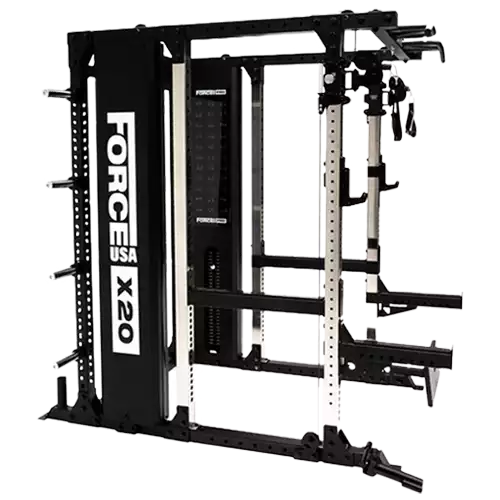
Most people searching for a home gym machine are looking for one piece of equipment that can take care of most (if not all) of their workout needs. We’re here to tell you that you don’t have to look any further than this monster piece of gym equipment, the Force USA X20 Pro.
Force USA X20 Home Gym
No matter if you’re just getting started working out or if you’re an advanced lifter, this power rack that doubles as a functional trainer can accommodate your needs. The power rack portion, made from high-quality 3×3 inch 11-gauge steel, is rated to hold up to 992 pounds, so even the most elite-level lifters can smash their lifts with confidence. As a functional trainer, the X20 Pro features two cable pulley systems with a weight stack for each that ranges from 20 to 289 pounds.
The Force USA X20 Pro comes with a variety of extras to help round out your home gym needs with slots to hang two barbells, a landmine, multiple cable attachments, band pegs for accommodating resistance, two pull-up bars, and upgrade kits available like a lat pulldown for even more versatility. The dimensions for the exterior of the rack are 70 inches wide by 87 inches deep and 92 inches tall, so make sure you measure your space (and measure again) to ensure you have enough room. You can pick the X20 Pro up for around $4,999 before taxes and shipping, and financing is offered depending on credit.
This behemoth of a power rack also doubles as a functional trainer with two 289-pound stacks on a 2:1 cable system. Even the basic package includes 17 different attachments which can be upgraded to include more. The rack can hold up to 992 pounds thanks to heavy-duty 11-gauge steel uprights.
People who want a one-and-done home gym machine that can take care of virtually all their needs with just one piece of equipment.
Those who like to do a variety of different workout types. This home gym can support powerlifting, bodybuilding, suspension training, and general fitness workouts.
Those with a large budget and sufficient space. This rack is expensive, but it takes the place of up to 10 pieces of equipment even without the upgrade kits.
Force USA X20 Home Gym Might Not Be Good For
Anyone trying to ball on a budget would do better to check out some other options on the list before committing to this one.
Those who don’t need all the different pieces of equipment that come with this machine and want a simpler setup may want to look at other options on this list.
People who are limited on space. This rack is not small or lightweight, measuring over seven and a half feet tall and over two tons when assembled.
This isn’t the cheapest or the smallest option, but it’s likely the most robust and versatile one that you’ll find. There are very few types of workouts you can’t do with this machine as it can take the place of up to 10 other machines even without the upgrade kits. Anyone who has the cash and the space will be unlikely to find a better option.
Best Home Gym Machine On a Budget
Sometimes, you have to respect what your pockets are telling you. In cases like that, we’ve got you covered with a home gym machine that still offers a ton of versatility at a lower price point. It may not have as many bells and whistles as some of the other picks, but it’s a solid no-nonsense option that gets the job done.
Sporzon! Home Gym Workout Station
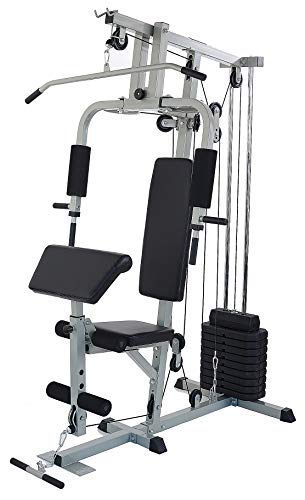
This workout station offers up to 330 pounds of resistance, though it only includes a 125-pound weight stack. Made from steel, this machine is designed to support up to 400 pounds of user weight with a maximum total weight of 1,000 pounds. The cables themselves that are used in the machine are aircraft quality and tested up to 1,000 pounds, as well. A high and low pulley system of 12 total pulleys gives a smooth and consistent resistance throughout the range of motion for each exercise. The best part is the price, which is about $535 before taxes and shipping.
The list of exercises you can do is quite long thanks to the high and low pulley system. You can do flyes, lat pulldowns, triceps extensions, low rows, glute kickbacks, curls with the preacher pad, and even train legs with the leg developer. The included cable attachments are removable, so you can replace them with your preferred type of attachment for even more exercises. This machine measures 80.5 inches tall by 48 inches long and 30 inches wide, and weighs 216 pounds when fully assembled.
Crush a variety of different exercises for a full-body workout with this home gym machine without crushing your bank account. You can train your back, chest, arms, and legs up to 330 pounds of resistance all with this one machine.
Sporzon! Home Gym Workout Station Should Be Good For
Anyone who wants to do full-body workouts with one machine will like that you can accomplish that with the Sporzon! Home Gym Workout Station.
Those who are on a budget but looking for a home gym machine solution. The price is right for the versatility this provides.
People who like to rearrange their home gym. Despite being 216 pounds, 125 pounds of that is the weight stack, so you can maneuver this machine somewhat easily without the weight stack attached.
Sporzon! Home Gym Workout Station Might Not Be Good For
Anyone who competes in a strength sport like powerlifting, strongman, or weightlifting. You’ll need something with a free-weight component.
Athletes who are particularly strong may find the resistance to be insufficient to elicit strength gains.
Those who like variety. It’s true you can train a lot of body parts with this machine, but there are only one or two exercises per body part that this machine can accommodate.
If you’re trying to find the right home gym machine while on a budget, this may be it. You can have a solid full-body workout with a decent amount of resistance while taking up relatively little space compared to other options. Sporzon! made this machine to be versatile and cost-effective, and it hit both of those marks well.
Best Smart Home Gym Machine
Home gym appeal has been on the rise for a while and smart home gym machines have taken over in force by putting all of your workout equipment in one compact package. For a smart home gym machine with almost no setup required that can suit nearly anyone’s fitness needs, look no further than our pick for this category — the Speediance Home Gym.
Speediance Home Gym
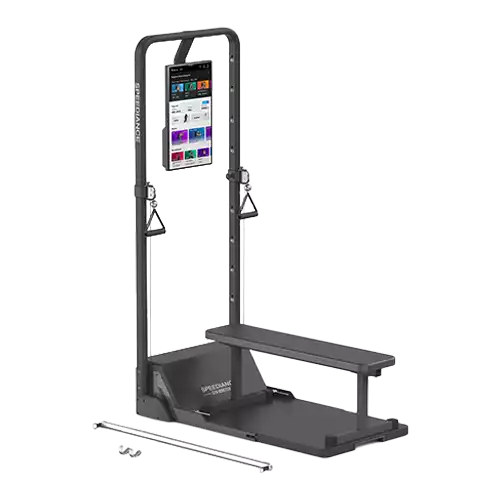
Speediance is an all-in-one smart home gym machine that offers hundreds of workouts that are updated nearly every day. These workouts can be sorted by body part worked or type (such as strength, stretching, or yoga). With almost no setup required unless you opt for the additional weight bench and rower, you can get to working out within minutes of unboxing Speediance. Like many smart home gym machines, Speediance uses electromagnetic weight resistance via two cable pulleys offering a total resistance of 220 pounds. Speediance measures about six feet tall, two and a half feet wide, and four feet long when unfolded, but only sticks out about a foot from the wall.
Thanks to the foldable design, it’s easy to store away when not in use and set back up when you want to work out. If you spring for the optional smart accessories (about $400), Speediance will even count your reps and range of motion with built-in technology in the attachments. The basic package, which will run you about $2,700, includes two regular handle attachments, a barbell, and a weight bench, as well as the Speediance system itself. You will need a subscription membership as sadly you can’t use Speediance without one. The subscription is about $29 per month, and this grants you access to all of the workouts in Speediance’s library.
This next-level smart home gym features a set of cables with resistance up to 110 pounds per side (220 pounds total) and a foldable platform for easy storage. The huge and ever-expanding workout library means you’ll never get bored with the same old workouts.
Those who are new to working out. The workouts feature voiceovers and video guides to help you learn the movements better.
People who are limited on space will appreciate that this folds away neatly for storage and even has wheels to make moving it easier.
Athletes who want to work on stability. The type of resistance used in this machine can potentially help with improving stabilizing muscles over other types of resistance.
Speediance Home Gym Might Not Be Good For
Folks on a budget. This is more of a luxury piece of equipment that can end up costing almost $4,000 with the smart accessories and rowing bench included.
Athletes who are quite strong may find the 220 pounds of resistance to be too light to elicit adaptations for strength or even hypertrophy.
Those who prefer to use free weights to work out will find this lacking in that department as it only uses cables with electromagnetic weights.
As far as smart home gym machines go, Speediance is doing it right with an ever-growing library of workouts and a bunch of workout programs to follow, the average person should make great progress. If you can pony up for the price point, then you’ll have a top-tier smart home gym machine you won’t soon become bored or stagnate with.
Best Home Gym Machine and Rack
For many avid fitness enthusiasts, it’s not enough to just have a home gym machine. They crave more. They want the time-tested ability to use a weight rack in their home gym. If you want it all, then the Force USA X20 Pro Home Gym has you covered.
Force USA X20 Home Gym
The X20 Pro combines a high-end functional trainer with a heavy-duty power rack and throws in barbell storage, a low-row, pull-up bars, a landmine attachment, band pegs, and about a dozen cable attachments to boot. The only thing this machine can’t do for you is cook you dinner, but Force USA may be working on an upgrade kit for that. They’ve already got upgrade kits for jammer arms, a lat pulldown, and dip handles. The cable attachments include a lat pulldown bar, close-grip triangle, plastic D handles, triceps rope and pressdown V bar, ankle cuff, and more — 17 in total for the base model.
The complete home gym solution features a half-rack with safety spotter arms on the outside as well as a full, four-post rack with 3×3 inch uprights made from 11-gauge steel. The weight capacity comes in at 992 pounds, so all but the strongest few people in the world can safely lift in this rack. The two weight stacks that attach to either cable pulley are 289 pounds each with a 2:1 ratio (every two pounds on the stack is one pound in hand) to satisfy those of all strength levels. This machine and rack isn’t small though, so measure before you make your purchase. Its dimensions are 70 inches wide by 87 inches deep and 92 inches tall.
This behemoth of a power rack also doubles as a functional trainer with two 289-pound stacks on a 2:1 cable system. Even the basic package includes 17 different attachments which can be upgraded to include more. The rack can hold up to 992 pounds thanks to heavy-duty 11-gauge steel uprights.
Those who want a centerpiece of their home gym. This machine and rack combo does it all and will make itself the central component of your home gym.
Anyone who wants to only buy one time. With proper care, you can use this rack for a lifetime thanks to the heavy-duty build and stout weight stacks.
Athletes who like variety. There are few exercises you can’t perform with the X20 Pro.
Force USA X20 Home Gym Might Not Be Good For
Anyone on a budget will want to check for other options on this list as this product is quite pricey — around $5,000 before taxes, shipping, and upgrade kits or add-ons.
Those who like to rearrange their gym often. This rack is about two tons when assembled so it’s not being moved easily.
People with low ceilings. The rack itself is over seven and a half feet tall, but you’ll need even more clearance to perform pull-ups safely without bonking your noodle.
It can be difficult to replace so many different pieces of gym equipment, but the Force USA X20 Pro manages to do so in a relatively compact way by wrapping a functional trainer and rack together. The 11-gauge uprights will allow you to use this rack for a lifetime and the 992-pound weight capacity means you can grow into the X20 Pro without worrying about upgrading.
Best Home Gym Cable Machine
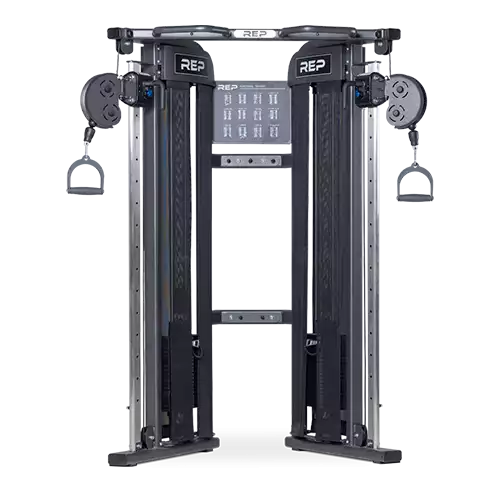
So you’ve already got a power rack and some dumbbells, now it’s time to add a cable machine to complete your home gym. Maybe you just want a cable machine to supplement your current workouts or to get a quick pump in at home. This functional trainer is made for a home gym environment — meet the REP Fitness FT-3000.
REP Fitness FT-3000
Designed to be compact and still provide a commercial gym feel, this functional trainer splits the difference well. A footprint of 78 inches tall by 53 inches wide and 34 inches deep means you’ll likely be able to find space for this machine — we’ve found a corner works nicely. Despite the low profile, REP squeezed two hefty weight stacks in, each weighing 180 pounds for a total resistance of 360 pounds. The price isn’t too bad compared to regular functional trainers either, coming in around $2,150 before taxes with free shipping.
The pulley system is designed to operate smoothly with a constant resistance all the way through the range of motion. If you’ve got some room overhead, you can even do pull-ups with the built-in pull-up bar. For the people with a ton of cable attachments, REP included some hand-dandy storage pegs to hang your attachments on in the center. A consideration to keep in mind for the really strong folks out there is that the pulleys are on a 2:1 ratio which means every two pounds on the weight stack is one pound of resistance in hand.
The REP Fitness FT-3000 is a compact dual cable pulley system that brings commercial gym feel to your home gym space. Though it’s compact, this thing packs a punch with two 180-pound weight stacks and a pull-up bar included.
Those who want the utility of a functional trainer without sacrificing the space these machines normally take up.
People who are more focused on fitness or hypertrophy can achieve quite a bit of work with this relatively small piece of equipment.
Athletes who already have a decent home gym set up but are missing a cable system. This could be the capstone that you need.
REP Fitness FT-3000 Might Not Be Good For
Those who have a bunch of space may want to opt for a larger, non-compact functional trainer that allows more room for cable crossovers and similar exercises.
Anyone who prefers barbell or free weight training will want to check out other options on this list before opting for a functional trainer.
Athletes who are very strong will want to keep in mind that each weight stack maxes out at 90 pounds of real resistance due to the 2:1 ratio.
When selecting home gym machines, space is one of the most important factors, and the FT-3000 takes that to heart. Whether you’ve got a ton of space or you are working with limited real estate, the REP FT-3000 can be your pocket Hercules.
Best Home Gym Machine for Small Places
If you’re working with a really limited space then a smart home gym that mounts on the wall may be a great option. Our pick for this category mounts to the wall and is compact enough to fit in an office, bedroom, living room, or any multi-purpose space in your home.
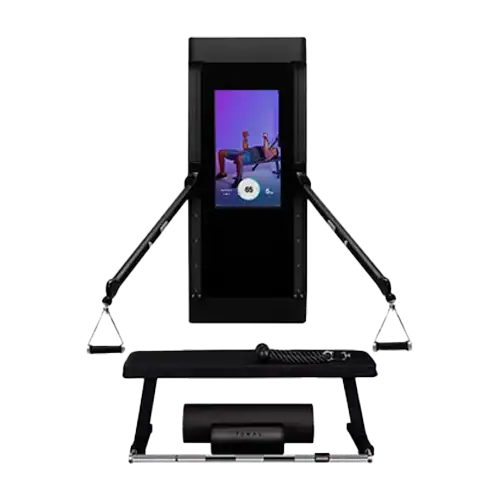
Tonal Home Gym
Tonal wanted to bring the tech and fitness world together to make a superior product. At its core, the Tonal Home Gym is a compact smart device that hangs on your wall, guides you through workouts and adapts to your skills and strengths. With a floor space of a seven-foot by seven-foot box, and a ceiling height of almost eight feet, you have enough room to perform any of the workouts on the device (according to Tonal’s recommendations).
The Tonal Home Gym is pricey at around $3,500 before accessories, delivery, taxes, and the required monthly subscription, but if that doesn’t turn you off then this product can be a great option for those with limited space. You can work with up to 200 pounds of virtual resistance via two easily configurable electromagnetic pulleys. The Tonal software tracks your progress and automatically adjusts the resistance to help you keep making gains. One of the best features is the expert installation which includes installing the system on your wall, pairing the Bluetooth accessories, and setting it up with your WiFi, so you can start working out right away.
Tonal is a blend of tech and fitness that’s interactive and can give up to 200 pounds of electromagnetic resistance through two pulleys. The system adapts as you progress to help keep the workouts challenging and ensure you make progress.
Those with limited space. You can set this up anywhere that there’s a wall and a WiFi connection.
People who want a personal trainer, but don’t have time or can’t make it to the gym. The guided virtual classes here are a happy medium.
Folks who have trouble making progress on their own. Tonal takes the reins here and helps you progress when it senses you can by increasing the resistance.
Tonal Home Gym Might Not Be Good For
Anyone on a tight budget. Tonal does offer financing based on credit approval, but there are cheaper options for home gym machines on this list.
Those who compete in strength sports. The lack of free weights and 200-pound limit may not be enough for you.
People who don’t want to have to pay a monthly subscription on top of the initial cost of the device.
This machine is not only great for those with limited space, it’s a solid option for anyone who wants to work on their general fitness. The guided classes and intuitive nature of the product make it solid for amateurs and moderate lifters alike.
Best Home Gym Treadmill Machine
If you’re training for endurance or simply enjoy running, then you’ll likely want to opt for a treadmill as your home gym machine of choice. Not all treadmill machines are made the same though, and for our pick here, running isn’t even half of it.
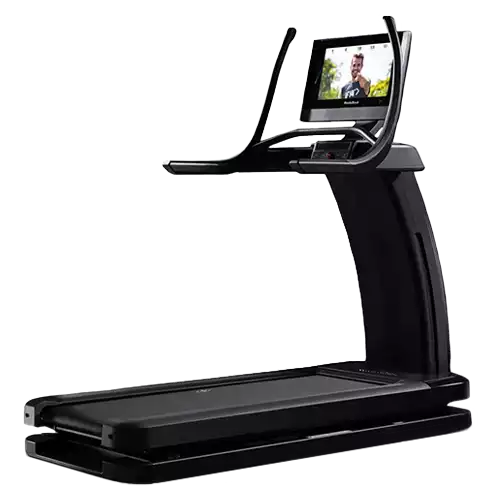
NordicTrack X22i Treadmill
This treadmill has the ability to take you from climbing up a steep mountain to hiking down a decline without ever leaving your house. With the capability of inclining up to 40 percent and declining down to negative five percent speeds of 0.5 through 12 miles per hour, there’s virtually no terrain the X22i can’t simulate. If you want to really feel the burn, you can try the “sled push” mode, which allows you to push the tread belt with just your leg drive. Your legs and lungs will be burning after that for sure.
On top of being a great treadmill, the NordicTrack X22i brings a sophisticated technology to the table with either 22-inch or 32-inch touchscreen display options that tilt and pivot. On these large screens, you can partake in iFit classes which will automatically adjust the incline or decline and speed for you throughout the course of the workout. Thanks to the tilt and pivot screen, you can also perform strengthening or stretching workouts via iFit off the treadmill too. You’ll receive a free 30-day subscription to iFit with your purchase. This premium product does come at a premium price of about $3,500 for the 22inch screen option and $4,500 for the 32-inch screen option (with financing available depending on credit).
The NordicTrack X22i Treadmill is for those who want the feel of running or hiking outdoors while staying in the comfort of their own home. It offers an incline up to 40 percent with a decline down to five percent. Choose from two tilt and pivot touchscreen displays — 22 inches or 32 inches.
People who like to have a large display that they can utilize when running. This treadmill is like having a TV in front of you that doubles as a trainer for other types of workouts like flexibility, strength, and bodyweight, in addition to running.
Athletes who want to prepare for a challenging hike or run will appreciate the wide incline and decline range.
Those who want to just get on and train without having to adjust the settings will like the AutoAdjust™ technology.
NordicTrack X22i Treadmill Might Not Be Good For
Those who are looking for a more traditional functional trainer or cable machine as a treadmill isn’t a typical home gym machine.
People who are on a budget may want to consider a more budget-friendly alternative.
Heavier users and large athletes who may exceed the 300-pound weight capacity.
If you like to hike or run often but don’t always have a way of getting to the great outdoors, then this treadmill and its huge screen can bring the outdoors to you. Not only that, but the X22i can challenge you in ways others can’t — with a wide incline range and “sled push” mode, you’ll be getting your “runner’s high” in no time.
Best Home Gym Squat Rack
A squat rack can be the centerpiece of any home gym, and it’s oftentimes the largest purchase you’ll make for your home gym. High-quality squat racks aren’t cheap, but the versatility they offer is unrivaled. The right squat rack should be sturdy and able to grow with you, which is why we chose the REP Fitness PR-5000 for this pick.
REP Fitness PR-5000
Everything about this rack was designed to be versatile and adaptable. REP bills this as the “power rack you’ll never need to upgrade” because of its robust build. Made from heavy-duty 11-gauge steel, the robotic welded 3×3 inch uprights can handle 1,000 pounds. When ordering the PR-5000 first choose your rack height of either 80 inches or 93 inches depending on your ceiling height. Then pick your depth — either 16, 30, or 41 inches depending on your needs. After that, the add-ons are numerous with weight storage options, pull-up bar options, different safety arms, and J-cups. Match your favorite of eight color options to your home gym color scheme while you’re at it.
If attachments are your thing, then you’ll find no shortage here with 49 in total to choose from, like a belt squat, dip station, lat pulldown, ISO arms, and more. The rack builder is interactive and you can even view the rack in your space using your cell phone. Hole spacing on this rack is industry standard at two-inch spacing with one-inch sized holes, so other companies’ attachments are compatible with this rack too. As icing on the cake, REP backs up this rack with a lifetime warranty. The one drawback is the price, which can exceed $1,000 even with the cheapest configuration and go well into a few thousand dollars when all is said and done.
The REP PR-5000 will be the centerpiece of any home gym with a total of 49 different attachments for unquestionable versatility. Even the strongest lifters can use this rack with a weight capacity of 1,000 pounds due to the 3×3 inch, 11-gauge steel. It even comes with a lifetime warranty.
Those who are looking for a squat rack that they can grow into and adapt based on their training interests and needs.
Heavy lifters who want a squat rack they know can handle the weight they’re lifting with confidence. This rack won’t even blink at 500 or 600 pounds — it can accommodate 1,000 pounds.
Anyone who’s into customizing their gym equipment. Eight colors and dozens of attachments make this one of the most versatile racks on the market.
REP Fitness PR-5000 Might Not Be Good For
Those who want a more cost-effective squat rack may want to look at other options as the price can get quite high once you start adding things on.
Anyone who is working with limited space may want to opt for a more space-friendly design, like a squat stand or a folding rack.
Athletes who just want a basic squat rack without any bells and whistles. This is far from basic and represents the sometimes indulgent side of the home gym community.
True, the REP PR-5000 is going to cost more than many other options for squat racks, but what you pay upfront you receive as returns in the long run. This rack can last a lifetime and has the ability to be upgraded and built out with seemingly endless possibilities. You’d be hard-pressed to find a more versatile squat rack on the market.
Best Home Gym Smith Machine
Contrary to what some lifters may think, smith machines can be useful for way more than something to lean on or a towel rack. They’re legitimate pieces of equipment and even the strongest people in the world (like Brian Shaw) have them in their gyms. Our pick for best home gym smith machine is affordable and doesn’t take up as much space as others.
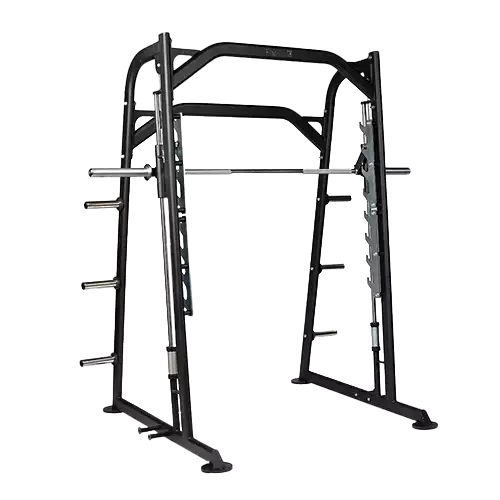
Titan Fitness Smith Machine
This smith machine is about as straightforward as its name. With no frills, this piece of equipment is built to be a sturdy workhorse day in and day out. Each side of the machine has a smooth track for the barbell to glide on and features a safety spotter arm. The spotter arms are adjustable to eight different heights to fit your needs.
Okay, so this smith machine does have some extras, like built-in band pegs for accommodating resistance training. It also has six storage posts to keep your plates on for easy access. There are only a couple of drawbacks here, like a slightly shorter loadable sleeve length than a standard barbell at 13.25 inches compared to the typical 16 inches. The other is a relatively low weight capacity of 600 pounds — well above what most people will need, but still lower than a typical squat rack or other higher-end smith machines. The budget-friendly price of about $1,650 before taxes and possible shipping charges make this a great option though.
Anyone looking to add a smith machine to their gym will like this straightforward option. It offers great value and can take plenty of daily use. This is similar to what you’d find in a commercial gym with a few added features like band pegs and weight storage posts.
Those who are looking for a solid smith machine that won’t break the bank. This machine is priced well and does what you need.
Anyone who needs some extra weight storage will appreciate the built-in storage pegs here.
People who lift alone and want some protection while lifting. Simply flick your wrists forward to lock the bar onto one of the catch hooks.
Titan Fitness Smith Machine Might Not Be Good For
People who are on a very tight budget may want to opt for a few different pieces of more versatile equipment.
Those who prefer a smith machine with a vertical bar path instead of one with a slight pitch like this one has.
Athletes who compete in strength sports. If you’ve got the room and funds for free weights and a smith machine then go for it; otherwise, you’d be better off sticking with free weights.
Titan designed this smith machine to be simple, reliable, and tough. It offers a high quality product at a budget-friendly price point for those in the market for a smith machine. You’re not going to find any high-end extras like cable pulleys, but if you just need a solid smith machine to round out your home gym build, this is the option for you.
What Are the Benefits of Home Gym Machines?
Home gym machines can be a considerable investment up front, but the rewards you can reap are well worth it for many people. They offer convenience, the exact equipment you want, and can even be cost-effective over time.
Convenience
The biggest benefit of owning a home gym machine is the convenience afforded to you. Imagine never having to drive to the gym in the dead of winter or not having to wait for someone doing curls in the squat rack before you can start your max effort lower body day. Heck, you can even curl in your own squat rack — no one can stop you.
Image via Shutterstock / America Captain
Thanks to the convenience, you may even find yourself more dedicated to your program and making better gains than ever before. If you’re the type of person who has an erratic schedule, you won’t have to worry about checking the gym hours or squeezing in a condensed workout with the person at the front desk staring at you because they close in ten minutes.
Tailored to Your Needs
Training for a marathon or big hiking vacation coming up? Get the perfect treadmill with a high incline. Do you prefer to compete in bodybuilding? Then pick up a functional trainer and a wide range of dumbbells. No matter what kind of workouts you prefer to do, your home gym machines can be tailored to your needs since you’re the one selecting the equipment.
Image via Shutterstock / Monkey Business Images
You can set up your space as a minimalist with just the necessary stuff and few distractions, or you can go all out, so you can change up your workouts daily. The only person you’ll have to answer to is you — and perhaps your significant other.
Cost-Effective Over Time
Despite home gym machines being quite a large investment up front, buying one does end up being more cost-effective over time. Not only will you save by not spending money on a gym membership, but you’ll eliminate the commute to the gym, as well as time spent waiting for equipment to be free — and as the saying goes, time is money.
How We Choose Our Picks
Home gym machines are as varied and unique as the people who use them. They come in all different shapes, designs, and prices. We put higher consideration to the utility, value provided, and overall functionality compared to the space the machine takes up.
Utility
Home gym machines are by design different than commercial gym equipment in that they generally have multiple uses. Unless you’re Scrooge McDuck, you likely don’t have a money pit to pull funds from and unlimited space for equipment. The more utility a piece of equipment provides, the higher it’s likely to rank on our list because that makes it better suited for home use.
Value
We acknowledge that home gym machines can be quite an investment, which is why we regard pieces with great value highly. A home gym machine’s value is weighted heavily in our picks, which often is heavily influenced by the quality, functionality, and longevity of the equipment. That said, there are some very pricey items on the list, but rest assured that those pieces will last a lifetime with proper care.
Space Requirement vs. Functionality
If you’re limited on space, then a full dumbbell set might not be the optimal choice for your home gym, and a set of adjustable dumbbells could be more appropriate. A piece of equipment has to be functional, but the functionality has to be worth it for the space it takes up. Power racks are a great example of this — they take up a considerable amount of room, but offer unrivaled functionality. Large pieces of equipment that serve only one purpose are likely to not rank as highly as more compact and versatile machines.
What To Know Before Buying A Home Gym Machine
Okay, so now you know all about home gym machines, but which one is right for you? A quick inventory checklist can help you figure that out. Start by thinking through your fitness goals and how much space you have for the machine(s). After that, gather your all-important budget, and you’ll have a solid idea of what’s right for you.
Fitness Goals
If your goal is to run a marathon, then buying a squat rack instead of a treadmill may not be the best idea. That’s an obvious case with an easy choice. Other times, the decision may not be so easy. If you like to work out for general fitness, then a squat rack may suit your needs, but a functional trainer would as well. It depends on your space and budget at that point. Most of the time though, people have varied goals, so narrow it down to the top few goals and go from there. You can always add on or replace equipment thanks to a thriving pre-owned equipment market.
Space
This consideration is as much about the physical space you have as it is your current lifestyle. If you’re living in an apartment, then a full squat rack and plates may not be the best option, as your neighbors will likely complain about the noise. A smart home gym may be the better choice in that situation.
Image via Shutterstock / MR.SOMKIAT BOONSING
If you’ve got a garage or a roomy basement though, you likely have some space to build out with home gym machines that require more room, like a smith machine or functional trainer.
Budget
This one is pretty straightforward. What can you afford to spend on a home gym machine? The answer will vary from person to person, but keep in mind that you don’t need to get everything all at once, and you can build up your home gym machines over time. A common sentiment in the home gym community is that you’re never done building your home gym.
Wrapping Up
Home gym machines vary greatly in design, function, and type of fitness they focus on developing. One of the most important things you’ll have to do before making an investment in a home gym machine is decide the type of exercise(s) you enjoy doing and will stick to. The last thing anyone wants is an expensive home gym machine to end up as a towel rack, collecting dust. Keep in mind the utility, value provided, and space versus functionality when making your decision, and you’ll be golden.
No matter what type of fitness you’re into — from CrossFit to triathlons, hardcore powerlifting or moderate training — there’s a home gym machine that can accommodate your needs on this list. Regardless of which option you choose, we hope that this article makes your decision easier, so you can catch those gains sooner rather than later.
FAQs
Who should invest in a home gym machine?
Though we’re a big fan of home gym machines, they aren’t ideal for everyone. Some folks really like the social aspect of going to the gym and the comradery that can come along with it. For folks that just want to get their workouts done in the most convenient way possible, home gym machines may be the way to go. You’ll need adequate space and funds up front, as well as the drive to workout at home.
Are home gym machines suitable for those with minimal experience?
In short, it depends. We wouldn’t recommend starting out using a squat rack and heavy weights without any experience. You should invest in a qualified trainer to teach you how to safely lift in that discipline first. There are many options that are ideal for beginners though, such as trainer-led smart home gym machines and non-free weight home gym machines. Take an honest inventory of your experience level and if needed, seek out someone with more time under the bar for some guidance.
How much will it cost for a home gym machine?
Costs range greatly depending on the type of home gym machine you select. For a simpler, budget-friendly option you might spend around $400 to $600. For more advanced and complete options, as well as anything with technology heavily involved, you can spend upwards of $3,000 or more easily. Most options in that price range offer some sort of financing though, depending on credit.
Even as more damning data are coming to light, Pfizer and Moderna are both seeking emergency use authorization (EUA) for their bivalent COVID boosters for children. Moderna is seeking authorization for children ages 6 through 17, while Pfizer’s shot is for children aged 5 through 11.1
According to Reuters,2 “the U.S. Centers for Disease Control and Prevention … expects COVID-19 vaccine boosters targeting circulating variants of the virus to be available for children aged 5-11 years by mid-October.”
Moderna’s new bivalent COVID booster, mRNA-1273.222, sold under the brand name “Spikevax bivalent Original/Omicron,” was authorized for adults over the age of 18 at the end of August 2022.3
In the U.S., the adult dose contains 25 micrograms of mRNA against the original Wuhan strain and 25 mcg of mRNA targeting Omicron variants BA.4 and BA.5.4 In the U.K., Moderna’s bivalent booster (mRNA-1273.2145) contains mRNA against the original Wuhan strain and BA.1,6 an earlier Omicron strain that is no longer in circulation.7,8
Pfizer’s bivalent booster also contain mRNA against the Wuhan strain, BA.4 and BA.5. The two bivalent boosters are only be available to those who have already received the primary two-dose series and/or a monovalent booster at least two months ago.9
It’s probably safe to assume the same rule will apply to children. As of late September 2022,10 38% of American children aged 5 to 11 had received one initial dose and 31% have received two doses. In the 12- to 17-year-old age group, 67% have had one dose and 57% two doses.11 Those with two doses are likely the only ones who will be eligible for the bivalent booster, if authorized.
For decades, the U.S. Food and Drug Administration has had additional safeguards in place for children who participate in medical research.12 With the advent of COVID shots, all of that has been tossed out the window, as children are now being used as medical guinea pigs without any safeguards whatsoever.
It’s really important to realize that these bivalent boosters have been reformulated with new, untested mRNA, yet they’ve only been tested on mice. Despite that, the FDA is now considering giving them to young children.
The effectiveness of Pfizer’s booster is based on antibody levels in eight mice,13 which cannot tell you anything about the level of protection you might receive. Moderna’s booster is also based on antibody levels in mice, although the exact number is unknown.
When it comes to safety, there’s not even mouse data. The safety is assumed based on the original shots, even though the safety data on those is shocking beyond belief. In the short-term, the original COVID shots have between them resulted in 1,417,671 adverse event reports (logged with the U.S. Vaccine Adverse Events Reporting System or VAERS as of September 16, 202214).
That includes 177,973 hospitalizations, 58,024 permanent disabilities, 34,107 life threatening events and 31,071 deaths. For children under the age of 18 alone, there are 55,733 reports of injuries and deaths.
If that’s not cause for alarm, I don’t know what is. It’s certainly not “strong evidence” for safety! What’s more, due to widespread underreporting, you have to multiply those already staggering numbers by underreporting factor of 41 (or more) to get an idea of the true impact.
And, if you still believe the pediatric trials were exhaustive, understand that the monovalent Pfizer booster authorized for children aged 5 to 11, back in May 2022, was based on the antibody levels of just 67 children.15 This is so far outside the norm of what’s historically been required for a drug trial, it’s just ridiculous.
1 in 800 Absolute Risk of Serious Side Effects
While VAERS data paint a clear picture of what’s at stake for parents who opt to inject their children with this genetically engineered bioweapon, we now also have other data showing just how bad of an idea that is.
A recent study16,17 in the journal Vaccine — coauthored by some of the most trusted medical scientists in the world, including Peter Doshi, an associate professor of pharmaceutical services research and a senior editor at The BMJ — looked at data from the FDA, Health Canada and the Pfizer and Moderna trials to assess the risks of Pfizer’s and Moderna’s COVID shots.
They concluded the absolute risk of a serious adverse event from the mRNA shots was 1 in 800, which massively exceeds the risk of COVID-19 hospitalization found in randomized controlled trials.
The risk COVID infection poses to children is even more infinitesimal — especially Omicron infection, which presents as a mild cold in most people — making a 1 in 800 risk of a serious side effect unacceptable beyond description.
Statistics show the rate of COVID-19 associated hospitalization among children aged 5 to 11 is 0.0008%.18 In real-world terms, that’s so close to zero you cannot lower it any further. Additionally, as reported by Clark County Today,19 “Pfizer trial data20 [show] the chance of death in children from the shot is 107 times higher than death from COVID-19.”
Other data are also reviewed in a recent paper21,22 by cardiologist Dr. Aseem Malhotra, who initially recommended the shots but has since changed his mind about their safety. For example, Israeli data show post-jab myocarditis is occurring at a rate of 1 in 6,000. Data from male children and teens in Hong Kong found myocarditis at a rate of 1 in 2,700.
As noted by the Vaccine Safety Research Foundation in the video above, myocarditis — one of the recognized effects of the COVID jab — “has a mortality rate of 25% to 56% within three to 10 years, owing to progressive heart failure and sudden cardiac death.”
Norwegian data show the rate of serious adverse events post-jab is 1 in 1,000 after two doses of Pfizer, and the British Yellow Card system shows 1 in 120 people who have received at least one mRNA injection suffer an adverse event “that is beyond mild.” These are simply extraordinary risk ratios, and there’s no telling what the long-term effects might be, say 10 or 20 years from now.
Trial Showed COVID Jab Increases Infection Risk in Babies
According to CDC director Dr. Rochelle Walensky, “rigorous scientific review” has proven the COVID shots to be safe and effective in infants and young children.23 However, as detailed by diagnostic pathologist Dr. Clare Craig24 (video above), Pfizer twisted its clinical data for young children to achieve a desired result.
Craig points out that of the 4,526 children, aged 6 months to 4 years, who participated in Pfizer’s trial, 3,000 didn’t make it to the end of the trial. Why did two-thirds of the children drop out? Oftentimes, this happens when side effects are too severe for the participant to continue. Here, we don’t know why two-thirds of the participants were eliminated, and “on that basis alone, this trial should be deemed null and void,” Craig says. Moreover:
• Six of the children, aged 2 to 4 years, in the vaccinated group were diagnosed with “severe COVID,” compared to just one in the placebo group. So, what this actually shows is that the likelihood the shot is causing severe COVID is higher than the likelihood that it’s preventing it.
• The only child who required hospitalization for COVID was also in the “vaccinated” group.
• In the three weeks following the first dose, 34 of the children in the vaccinated group and 13 of the unvaccinated children were diagnosed with COVID. That means the children’s risk of developing symptoms of COVID within the first three weeks of the first dose actually increased by 30%! These data were ignored.
Between doses two and three, there was an eight-week gap, and the vaccinated arm again experienced higher rates of COVID. This too was ignored. After the third dose, incidence of COVID was again raised in the vaccine group, and this was ignored as well.
In the end, they only counted three cases of COVID in the vaccine arm and seven cases in the placebo group. They literally ignored 97% of all the COVID cases that occurred during the trial to conclude that the shots were “effective” in preventing COVID.
• While they claim the triple-dose regimen reduced COVID, 12 of the children actually caught COVID twice in the two-month follow-up, and 11 of them were vaccinated.
• The confidence interval for Pfizer’s jab is -370% at the lower end of the 95%, which suggests children who get the jab are nearly four times more likely of getting sick with COVID than their unvaccinated peers.25
Why Are They Targeting Children Who Don’t Need These Shots?
Ever since the COVID shots were first authorized for young children,26 the question of why has been raised. Certainly, it’s not because children are in grave danger of dying from COVID.
The most likely explanation for the FDA’s and CDC’s irrational behavior is that they’re helping the drug makers to get the mRNA shots onto the childhood vaccination schedule, as that is the fastest and easiest route to get permanent liability shielding.
Once the vaccine is on the childhood vaccination schedule, the vaccine makers are permanently shielded from liability for injuries and deaths that occur in any age group, including adults. You can learn more about this indemnification process in “The Real Reason They Want to Give COVID Jabs to Kids.”
So, the end goal is likely to get permanent immunity against liability for injury and death from the COVID shots in all age groups, and to get there, they first need the EUA to cover all children. And, since the FDA is now authorizing reformulated mRNA shots without additional testing, using the flu vaccine model, it seems they want to make sure they have annually updated boosters included in the EUA for children as well.
UK Bans COVID Jab for Under-12
Meanwhile, the U.K. recently rescinded the COVID jab for children under the age of 12, unless they’re in a high-risk medical category. As reported by The Guardian September 6, 2022:27
“The UK Health Security Agency (UKHSA) said children who had not turned 5 by the end of last month would not be offered a vaccination, in line with advice published by the UK’s Joint Committee on Vaccination and Immunisation (JCVI) in February 2022. UKHSA said the offer of COVID jabs to healthy 5- to 11-year-olds was always meant to be temporary.”
Similarly, as of September 1, 2022, Denmark no longer offers the COVID jab to children between the ages of 5 and 17, citing the low risk posed by COVID infection.28 Children with only one dose will not be required to get a second, and no boosters will be offered to this age group.
Sweden opted not to recommend the shot for children between 5 and 11 from the start, as the Swedish Health Agency felt the benefits did not outweigh the risks,29 so boosters for kids are unlikely to be an issue there either.
In the U.S., Florida has gone on record rejecting all COVID shots for children under 5.30 Parents who want to get their toddlers jabbed have the freedom to do so, but it’s not recommended by the state.
Protect Your Children From Medical Experimentation
If you’re still unsure whether the COVID shot is the “right” choice for your child, please read through Dr. Byram Bridle’s “COVID-19 Vaccines and Children: A Scientist’s Guide for Parents,”31 published by the Canadian COVID Care Alliance. It goes through how the shots work, what the known side effects are, results from the clinical trial, the effects of the spike protein and much more.
Side effects from the new bivalent boosters are assumed to be about the same as for the original shots,32 but there’s no guarantee of that. They could be milder, or they could be worse.
In my view, the chances of them being worse is higher, for the simple reason that they’re delivering more than one type of mRNA. Will the BA.4/BA.5 mRNA have different effects? Will they cause cross-reactions? Who knows? There’s no data. At bare minimum, if the adverse effects of the original shots are an indication, there’s every reason to suspect the bivalent boosters will be just as dangerous.
Oct. 12, 2022 — Three-quarters of the largest grocery chains in the U.S. are failing to limit the use of antibiotics in their house-brand fresh meat, thus contributing to the spread of antibiotic resistance.
That’s according to a new report, “Superbugs in Stock,” produced by members of a coalition of public health, animal protection, and consumer groups known as Antibiotics Off the Menu. Of the nation’s top food retailers, Target fared the best — but even it only received a C grade.
About half of the fresh meat sold in this country is purchased in stores.
“That means the grocery industry has a potentially major impact on how antibiotics are used in meat production,” says Matthew Wellington, public health campaigns director at U.S. PIRG, a member of the coalition. “This report shows a dire need for more progress in the grocery sector.”
A Report Card for Supermarkets
For the past 6 years, the coalition focused on restaurants, with an annual report about the practices of major fast-food and fast-casual chains. In the wake of these reports, several chains announced changes to their policies, though not all have followed through.
“We saw there was progress with the restaurant chains, so we wanted to look at the other place people get most of their food,” says Steven Roach of the Food Animal Concerns Trust, lead author of the report. “And coming through the pandemic, where there had been a shift from people eating out to eating at home, we thought it was good time to look at grocery chains.”
Roach and his co-authors gathered information about the supermarket chains’ policies on antibiotic use in private-label chicken, turkey, pork, and beef through a survey as well as company websites and published materials. They assigned points for various scoring criteria — things like having a meaningful and transparent public policy that links to animal welfare, enforcement of that policy, and using third-party verification.
Their findings don’t exactly inspire confidence. Of the dozen major grocery retailers in the U.S., eight received an F grade, with 10 points or fewer out of a possible 100. That group includes Kroger, Walmart, and Albertsons, three of the five top-earning grocers in the U.S. While many of the failing companies do carry some house-brand meat labeled “raised without antibiotics,” none have strong policies to cover the entire range of their private-label fresh meat.
If you’ve become disillusioned with the medical profession over the past three years, you’re not alone. Many have come to distrust doctors, largely thanks to widespread mistreatment of COVID in hospitals, and doctors’ failure to provide sufficient information about the COVID jabs to make informed consent. Doctors’ enforcing the use of masks, even though they ought to know they don’t work against respiratory viruses, hasn’t helped either.
In a recent interview with Steve Kirsch, Dr. Paul Marik, a pulmonary and critical care specialist and founding member of the Front Line COVID-19 Critical Care Alliance (FLCCC), discussed why doctors have been so reluctant to speak out against the clearly dangerous COVID shots. As noted by Kirsch:1
“My blue pilled friends who believe the vaccines are safe have told me they would reconsider their position if just a single one of their own doctors came out against the vaccine. One of them said even if a ‘TV doctor’ (such as Sanjay Gupta) said it was unsafe, they would reconsider their position.
I told them that doctors are afraid to speak out because they will lose their ability to practice medicine if they challenge the mainstream narrative.
My friends find that too hard to believe. They asked me incredulously, ‘Why would the medical community silence doctors who are trying to save lives?’ They didn’t believe my answer. So, I wanted to interview a doctor who is very highly respected and who is not an ‘anti-vaxxer’ to explain it to them.”
Doctors Who Share Their Concerns Are Punished
Like many other doctors, Marik took the COVID shots when they first came out, as was expected of him. It wasn’t until he started reviewing the data for himself, well after the fact, that he realized just how bad they are.
When asked whether he might have misjudged the data, Marik replies, “No, the evidence is very clear.” Yet despite crystal-clear data, when Marik started speaking out against the shots, the medical community retaliated. Marik also suffered retaliation when trying to treat patients with FDA-approved, off-patent, off-label drugs shown to be very effective against COVID.
The hospital pharmacy refused to fill his prescriptions and he was ordered to not prescribe them to anyone. In short, he was ordered to simply watch his patients die, even though he knew he could help them.
The only drug he was allowed to prescribe was remdesivir, which is known to be toxic and often lethal. Remdesivir was developed as an antiviral drug and tested during the Ebola breakout in 2014. The drug was found to have a very high death rate and was not pursued further.
In the early months of 2020, the drug was entered into COVID trials.2 Those trials were also beyond disappointing.3,4,5 Not only was the drug ineffective against the infection but it also had significant and life-threatening side effects, including kidney failure and liver damage.6
But despite its clear dangers and lack of effectiveness, the U.S. Food and Drug Administration still authorized remdesivir for emergency use against COVID in May 2020,7 and then gave it full approval in October 2020.8
How Hospitals Get Rid of ‘Troublesome’ Doctors
When Marik refused to follow the remdesivir protocol, he was subjected to “sham review,” an unofficial but well-known process in which a “troublesome” doctor is accused of wrongdoing and basically railroaded out of practice.
In the end, he was fired, even though he’s never had a single patient complaint in his 30-year career as a critical care specialist. But they didn’t stop there. The hospital administration also reported him to the National Practitioner Databank, and once you’ve been reported as a bad actor to the NPD, it’s virtually impossible to clear your name. Your career is over.
They also reported him to the Board of Medicine, which concocted another set of bogus charges against him. They accused him of prescribing ivermectin to fictional patients whom they falsely claimed were injured by the drug.
“The truth is I was never actually able to prescribe ivermectin,” Marik says. “The patients they claimed I treated were nonexistent patients, so that tells you how far the Virginia Board of Medicine will go … This is the problem if you try to speak out. The [hospital administration] went out of their way to destroy my career because I wanted to treat my patients.”
According to Marik, some of his colleagues who have gone against the narrative have even been physically threatened, and had the lives of their families threatened unless they stop talking. “So, this is serious,” Marik says. The fact of the matter is that doctors who argue against the Big Pharma narrative are a threat to trillion-dollar revenues. Compared to such sums, the value of a doctor’s life is nil.
Enormous Financial Incentives to Kill COVID Patients
Marik points out there were, and still are, enormous financial incentives for hospitals to not provide proper care to COVID patients. Those financial incentives also helped drive up the COVID death count early on in the pandemic. As explained by Marik, every COVID patient has what amounts to a $400,000 to $500,000 bounty on their head, as hospitals receive bonus payments for:9,10
Admission of a “COVID patient,” COVID testing and COVID diagnoses.
Use of remdesivir — According to Marik, the U.S. government pays hospitals a 20% upcharge on the entire hospital bill when remdesivir is used.11,12,13
Use of mechanical ventilation, which Centers for Medicare & Medicaid Services whistleblowers claim kill 84.9% of COVID patients within as few as 96 hours,14 typically due to barotrauma15 (trauma to the lungs from the elevated pressure).
COVID deaths — In August 2020, former director of the U.S. Centers for Disease Control and Prevention, Robert Redfield, agreed hospitals had a financial incentive to overcount COVID deaths.16
According to Marik, whether the patient lives or dies is irrelevant. In fact, if they die, there’s additional monies to be had. The hospitals basically see COVID patients as a cash cow, which is why they don’t tolerate doctors who use early treatment. As shocking as this is to some, it’s not the first time this has happened. Doctors were also paid to prescribe opioids, which contributed to the lethal opioid epidemic.
COVID Jab Injured Patients Desperate for Help
Just as Marik balked at health authorities’ recommendation to not offer early treatment — something completely unheard of until the advent of COVID — he also balked at the idea that patients were faking COVID jab injuries.
After the rollout of the shots, the FLCCC started getting calls from people who were desperate for help, as they suffered serious health problems shortly after their shots. Almost universally, their doctors had told them the shot couldn’t possibly be at fault.
Marik was not so sure, and once he began to really investigate the matter, he realized the data overwhelmingly showed there were serious problems. Marik is now so certain the shots are dangerous, he says he wouldn’t recommend it to a single living soul on the planet, and the FLCCC is now one of the few groups treating COVID jab injuries as well as COVID infection and long-COVID.
‘Unlearning Everything I Learned’
Marik’s professional experiences over the past three years have clearly resulted in a massive awakening to the fact that things have not been as they appeared. He says that in the past six months, he’s come to realize that he was essentially brainwashed by Big Pharma throughout medical school, and that much of what he learned was simply wrong.
He also realized you cannot trust medical journals. They too have been corrupted by Big Pharma. So, now, he’s in the process of unlearning the lies he was taught, and he’s starting anew, looking at health and disease with fresh eyes.
California Bill Seeks to Muzzle Doctors
The harassment and intimidation doctors have suffered under COVID is now cemented into law in California.17 California Assembly Bill 209818 designates “the dissemination or promotion of misinformation or disinformation related to … COVID-19 as unprofessional conduct” warranting “disciplinary action” that could result in the loss of their medical license.19
The bill was approved by the California Legislature September 26, 2022,20 and Gov. Gavin Newsome signed it October 1, 2022.21,22
“Misinformation” is defined as anything that is “contradicted by contemporary scientific consensus contrary to the standard of care.” Misinformation or disinformation related to SARS-CoV-2 includes “false or misleading information regarding the nature and risks of the virus, its prevention and treatment; and the development, safety, and effectiveness of COVID-19 vaccines.”
Basically, what all this means is that the state will dictate what misinformation is and isn’t, because rarely ever is there scientific consensus on anything. Even after decades of investigation, questions frequently linger, and new discoveries that upend old dogmas can come about at any time.
As noted by The Daily Signal,23 “Who decides what is ‘scientific consensus?’ Presumably … it’s precisely those agencies and government actors who, ironically, have been wrong time and again throughout the pandemic.” For examples, see their video below.
Science only moves forward when there is free exchange of ideas. By preventing doctors from sharing information and knowledge as they see fit with their patients, California bureaucrats are not only violating the U.S. Constitution and destroying the medical profession as we know it, they’re also pushing medical science back into the Dark Ages.
The Hunt for Truth-Tellers
I’ve written several articles over the past couple of years detailing the brutal and unethical treatment of medical professionals who have dared speak out against any part of the irrational COVID narrative.
Dr. Meryl Nass, for example, was stripped of her medical license and ordered to undergo psychiatric evaluation — all for the “crime” of successfully saving the lives of COVID patients using hydroxychloroquine and ivermectin.
The three authors included Harvard professor of medicine Martin Kulldorff, Ph.D., Oxford professor Sunetra Gupta, Ph.D., and Dr. Jay Bhattacharya, professor at Stanford University Medical School.
One of the tactics Fauci used against them was to claim scientific consensus — that most all scientists agreed with lockdowns, masking, social distancing and so on — even though there were just as many, if not more, who disagreed. At the time, more than 46,400 medical practitioners and 15,700 scientists had signed the Declaration.
As noted by Bhattacharya in an interview with Jimmy Dore (see hyperlink above), Fauci and Collins had nothing in terms of actual science. They could not defend lockdowns or anything else based on science alone. So, they turned to propaganda, PR and smear tactics.
Dr. Peter McCullough is another FLCCC member with top-notch medical credentials who is being persecuted by the medical establishment for his outspokenness about early treatment and the dangers of the COVID shots. He’s now written a book, “The Courage to Face COVID-19: Preventing Hospitalization and Death While Battling the Bio-Pharmaceutical Complex,” detailing his experiences and the crimes perpetrated against patients, doctors and others in the COVID era.
Dr. Ryan Cole, a clinical pathologist, is yet another example. While he’s been able to be more outspoken than most, thanks to running a private lab, several credentialing organizations have taken action against him in a clear effort to shut him up.
He’s also lost about half of his business, as two insurance companies canceled him for “unprofessional behavior,” i.e., for sharing and discussing the health effects of the COVID jabs, and one of his best friends, with whom he’s worked for 12 years, canceled their business relationship as he didn’t want Cole’s outspokenness to affect his business.
“All because of the defamation by the media, so to tell the truth in this day and age is a dangerous thing,” he told me during an interview earlier this year.
Medicine Has Gone Off the Rails
For the past 25 years, and likely far longer, allopathic medicine has been a leading cause of death in the United States. As detailed in “Are Medical Errors Still the Third Leading Cause of Death?” in 1998, researchers concluded that properly prescribed and correctly taken pharmaceutical drugs were the fourth leading cause of death.24,25
Two years later, in 2000, an article in JAMA written by the late Dr. Barbara Starfield detailed how physicians were the third leading cause of death in the U.S. One of Starfield’s points of contention with the medical system was the lack of systematic recording and studying of adverse events — a shortcoming that has been taken to absurd levels during the COVID era.
A 2003 article titled “Death by Medicine,”26 written by Dr. Carolyn Dean, Gary Null, Ph.D., Dr. Martin Feldman, Dr. Debora Rasio and Dorothy Smith, Ph.D., described how the modern conventional American medical system had by then bumbled its way into becoming the No. 1 leading cause of death and injury in the United States, claiming the lives of nearly 784,000 people annually.
These iatrogenic deaths (meaning deaths resulting from the activity of physicians) include everything from adverse drug reactions and avoidable medical errors, to hospital-acquired infections, surgeries gone bad and deaths from unnecessary medical procedures.
During COVID, all of the shortcomings of medicine have been amplified to the point that many now refer to hospitals as “killing fields” — places where greed rules and patients are mistreated, tortured and killed for profit.
So far, the COVID death toll in the U.S. is well over 1 million,27 and it’s not inconceivable that a vast majority of those were killed by the “standard of care” treatment given (i.e., remdesivir and ventilation, and the withholding of food and fluids).
In December that year, we also showed how the AMA encouraged lawlessness by telling private companies to ignore a court’s permanent injunction against vaccine mandates and implement mandates anyway.
Facing a Painful Reality
If there’s a silver lining to any of this, it’s that people are starting to realize just how far off the rails the medical system has gone, and that we need to make radical changes.
Even doctors like Marik are waking up to realize everything they thought they knew about medicine was actually Big Pharma propaganda, and that profits, not care, is the guiding light of most hospitals.
Many, like Marik, are shocked to realize they are being penalized for trying to improve care and save lives at low cost. I recently interviewed critical care physician Dr. Pierre Kory, another member of the FLCCC, who admitted he was woefully naïve when he first started speaking out about ivermectin back in 2020.
He thought the FLCCC would be hailed as heroes. Instead, they were vilified, maligned, persecuted and fired, and continue to be persecuted to this day, as they’re now also treating COVID jab injuries, which aren’t supposed to exist.
Kory has now written a book, “War on Ivermectin: The Medicine That Saved Millions and Could Have Ended the COVID Pandemic,” which will be available after November 15, 2022,28 detailing the playbook used to suppress ivermectin and other effective COVID treatments. My interview with him, in which we discuss these tactics, will air sometime in mid-November.
In closing, if you or someone you know still cannot believe that a doctor would ever withhold information or straight out lie to you, listen to Kirsch’s interview with Marik. Listen to Nass’s story. Read Kory’s book. Look at the legislation being pushed through in California.
Imagine being a doctor with hundreds of thousands of dollars in educational loans, and being told that if you share information that steers a patient away from “standard of care” — whatever that might be — you could lose your medical license. You could lose your career.
It takes a brave heart to stand up to that kind of pressure, which is why there are so few of them out there talking about early treatment and the dangers of remdesivir, ventilation and the COVID jabs. Those who cherish their health will do well to listen to those who are actually putting everything on the line to share the truth.
Sharing this post for friends who are considering joining Beautycounter as a consultant. It’s one of the best things I’ve done for my business, so I’d love to share more about what it entails and how to get started.
Hi hi! How’s the morning going so far? I’m looking forward to a long weekend with Fall Break, a trip to the pumpkin patch, and a staycation at Great Wolf Lodge.
For today’s post, I wanted to share more about the Beautycounter business. This past week, I’ve had so many people reach out to me about joining as a consultant (<— I think it has a lot to do with the fact that enrollment is $20 right now!!). I don’t talk about the business opportunity too often (usually friends who read the blog will sign up, or just email me to let me know they’re interested in joining), but I know that some of you may be curious about the behind the scenes and with the $20 enrollment promo (ends on 10/17), I had to spread the news.
I also thought it would be a good time to share this post because things are SO expensive right now, and we’re also about to head into an expensive time of year. Between the holiday events/food, family gifts, class parties, teacher gifts, in addition to increased cost of living with inflation… it’s a lot. If you’re looking for an option to make extra money on your own terms (from home!), this is an option that might work for you.
Here’s some more details to decide if it might be for you and how you can get started!
This isn’t just applicable to Beautycounter, but could be used for other network marketing or direct sales opportunities.
How To Build Your Beautycounter Business Plan
Step One
Have a call with your mentor to talk about upcoming events, how they recommend that you get started, or any initial things you need to do. For consultants on my team, I have an onboarding process that they follow, along with a few checkmark steps along the way. I also ask them about their goals! Some friends want to hit the ground running, while others are more low-key about it. Others simply join for the 25% discount, and that’s cool, too. It’s helpful to know their goals so I can coach and support appropriately.
Step Two
Brainstorm your “why” so you can share this with others on your journey. If you’re joining Beautycounter, this might be something about how you wanted to switch to safer products (we all have an “a ha” moment), or if can even be financial. (Like, “I wanted to be able to pay for our kid to take private piano lessons” or daycare costs, etc.) I would be transparent and detailed about your “why,” and write up a post or share in conversation when someone asks you why you joined. There will be many people out there who will relate to your “why” and your story.
Step Three
Create an email list for those who might be interested in learning more about safer skincare and beauty products (with the option to opt out if they’re not interested). Send out an email sharing your “why,” your personal link to shop, and the ability to reach out with questions. I’ve found that our personal networks genuinely want to support our endeavors. If I can buy something from a friend instead of getting it at Target, I will absolutely support that friend!
Step Four
Create a launch event. This is optional, but you can host a pop up to share more about the products, you can do a text pop up, or create samples or drop-off kits for friends to try out the products. A launch event can be a great way to make a splash and let people know about what you’re doing. If you’re shy or not into that, you can order samples to share with friends and check in with them to see how they like them. 🙂
Step Five
Be consistent. Set aside even one hour each week to work on building your business. This can be something like creating an email newsletter, following up with clients, putting together sample kits, or filming a few Instagram stories with your favorite products. A lot of your friends may be watching to see if you continue to use the products before they commit to trying them out for themselves, so stick with it. A friend might think of you when they run out of moisturizer and need to try something new.
Beautycounter Consultant Benefits
Sharing safer products with those you love
Once I first started learning about what was actually in many of our skincare and beauty products in the US, I wanted to spread the word with anyone who would listen. It was SHOCKING for me to learn about all of the chemicals and endocrine disruptors are permitted for use here in the US. It honestly enraged me, and still does, and I feel thankful that I can share products with those I love that were tested for safety and don’t use 1800+ potentially harmful ingredients.
We earn 25-35% commission on our sales, in addition to potentials for bonuses. The minimum sales requirement is $750 for 6 months (including your own purchases), but if you don’t hit that, there’s no penalty. You just become a Band of Beauty member instead of a consultant.
Access to Behind the Counter
This is how we track everything, including client sales, birthdays, follow-up procedures, product credits, recent press, and can watch training videos. I LOVE Behind the Counter because there are specific action plans based on your goals. You can use it as much or as little as you need to, but everything you could ever want to know is in BTC.
Consultant discount
We get 25% off for our personal orders (I feel like this alone is worth it if you love the products!) and steeper discounts for enrollment sets, new product launches, and holiday sets.
Opportunities for bonuses and incentives
Through our Start Counting program, you have the opportunity to earn product credit and bonuses for yourself and your mentor, which increase each month. If you hit the Start Counting milestones each month, the idea is to have your business running and in full momentum when you finish the first 90 days. I hit my Start Counting milestones, and liked that it gave me goals for each month and set me up for long-term success.
The ability to create an extra income stream from home
I can’t say you’ll be a millionaire, but if you think about what an extra $50, $500, or $5,000 per month can do for you, it can be significant. I started off making enough to pay for a nice dinner each month, and now it matches or beats what I make from ad revenue from the blog. There’s lots of potential and opportunity to grow, too. Just like many things in life, you get out of it what you put into it. (The same goes for health and fitness!) Also, you do not have to be super active on social media. We have a lot of rockstars on our team who rarely use social media.
Community
I’ve been able to connect with so many amazing women all over the world, thanks to my partnership with Beautycounter. Our team is filled with inspirational driven women all cheering for each other.
We have a $20 enrollment opportunity (insane!!!) right now, so if you think it might be for you, you can check out more details here. If you’d like to join my team, we’d love to have you and I’d love to help support you along the way.
Please email me if you have any questions or leave them in the comments below!
Have a wonderful morning and I’ll see ya tomorrow with Friday Faves!
Historically, experts believe that food cultivation has been widely established for roughly 7,000 years.1 While many of today’s farmers have embraced the agribusiness evolution that took over U.S. farmland, there are some, like Amos Miller and his 4,000 customers, who believe the old ways are still the best ways. Unfortunately, as reported in this short video from Rebel News,2 the U.S. government does not agree.
In the last 100 years, there have been significant changes in the way farming is carried out. Most significant was the development of genetically modified organisms and chemical pesticides. In 1982 the FDA3 approved the first GMO product, which was developed to treat diabetes: human insulin. The first GMO foods available in the U.S. were alfalfa and sugar beets in 2005.
By 2015 the FDA had approved an application for genetically engineered salmon. Further bioengineered foods and plants include apples, pink pineapples and, in 2020, the GalSafe pig, which is a genetically modified pig that eliminates detectable amounts of alpha-gal,4 which is a sugar on the surface of pig cells that triggers a rare allergy.
As some applauded these scientific advancements, others began asking hard questions about how modifying genetic information and the application of large amounts of pesticides and herbicides will impact animal and human health. Miller5 chose to use farming practices that have successfully provided healthy food for thousands of years.6
Armed Federal Agents Threaten Traditional Farmer
The current story began in 2015 when Amish organic farmer Amos Miller found he had come under the microscope of federal officials from the USDA. The Food Safety Network7 has repeatedly headlined Miller’s plight. In fact, FSN is so enamored with the story that Miller has his own blog tag and pages of content covering the federal government’s issues with a farm that produces organic products, free of pesticides, herbicides and GMO products.
Miller was taken to court by the U.S. Justice Department at the behest of the USDA, according to David Gumpert.8 Miller became aware the USDA had issues with him in November 20159 when he was attending a Weston A. Price Foundation conference and had stored some of his raw milk products in the hotel coolers.
Five months later, in an unrelated incident, the CDC claimed they conclusively linked an “outbreak” of two cases of listeriosis to products from Miller’s Organic Farm. By 2016, the court allowed armed law enforcement officers to accompany the USDA Food Safety and Inspection Service (FSIS) investigators to the home and farm of known Amish pacifist Miller.
Gumpert10 reported that during these inspections, the USDA demanded the member’s food purchase records back to 2012.11 However, Miller refused and cited contractual requirements for keeping this information private.
Gumpert also noted that while Miller had assumed the investigation began from the CDC report of listeriosis, it was the National Organic Program within the USDA that launched an investigation of the Miller North Carolina food club in March 2015, long before the CDC reportedly linked the listeria “outbreak” to Miller’s farm.
Fast forward seven years to 2022, when Miller has found himself consistently under the USDA microscope for nearly seven years. In the most recent foray reported in Rebel News,12 armed federal employees again paid a visit to the farm located in the village of Bird-in-Hand, Pennsylvania.
Why Is the USDA Focused on Miller?
The government is again trying to issue hundreds of thousands of dollars in fines, which would essentially put the farm out of business. Rebel News13 calls this recent court-ordered armed threat “an attack on Amish religious freedom just 150 miles from Washington, D.C.”
Yet, the USDA’s potential motivation for wanting to shut down Miller’s farm doesn’t stop there. Not only does he not use pesticides, herbicides and GMO seeds, he also doesn’t rely on gasoline or fertilizer. In other words, as Rebel News14 points out, his bottom line is not affected by the war between Ukraine and Russia, which has not been the experience of others who don’t farm like Miller.
Federal agencies have resorted to using force and steep fines to make Amos Miller compliant. However, while the USDA calls Miller’s on-farm slaughtered meat a crime, Miller has been unable to comply with the rules since the area slaughterhouses are maxed out and cannot fit his livestock into their schedule.15
Miller has helped organize private food clubs where individuals can purchase dairy, eggs and meat from traditional farmers, and the DOJ seems intent on stamping them out. As Gumpert16 pointed out in 2021, there has not been an official decision about the right to purchase directly from farmers, a principle on which Miller stands.
Today, the farm has roughly 4,000 private food club members who pay a premium to get food from an independent farmer who doesn’t process meat and dairy at USDA facilities.
USDA Defends and Protects Agribusiness
Government agencies and big businesses have a long history of working together. You only have to look at the revolving door between the CDC, FDA and Big Pharma,17,18,19,20 to understand this lucrative intimate relationship has a significant influence on policy development and chemical approval.
Another example is Biden’s choice for the head of the USDA, Tom Vilsack, who served in the position for eight years during the Obama presidency. The Center for Food Safety21 listed seven strong reasons against his nomination for secretary of agriculture, most of which were related to his ties to agribusiness.
Vilsack is known as “Mr. Monsanto,”22 which is likely related to his approval of pesticide-promoting GMO seeds and his approval of the herbicide dicamba developed by Monsanto, despite warnings from nonprofit organizations, farmers and scientists.
In May 2022, Agri Pulse reported that Vilsack confirmed Roundup “is critical for maintaining U.S. crop production and addressing climate change.”23 Agri Pulse reported that Vilsak said “Losing glyphosate ‘would obviously impact and affect production, and I think impact and affect our ability to deal with climate.’”24
He believes Roundup “is critical to no-till farming, which increases soil carbon and protects water quality.”25 In other words, he believes dumping glyphosate on plants is essential for protecting water quality.
‘Experts’ Pushing Fake Junk Food for Billions in Profit
Ultraprocessed junk food peddlers are on the opposite side of the food coin. NOVA (a name, not an acronym) is a food classification system, designed by the Center for Epidemiological Studies in Health and Nutrition, that categorizes foods according to the extent they are processed.26
Studies assessing the impact of ultraprocessed foods on human health regularly use this system. Ultraprocessed foods are defined as industrial formulations with five or more ingredients that can include sugars, fats, salt, stabilizers and preservatives.
They include ingredients that are found only in ultraprocessed foods and are not commonly used in culinary preparations. The purpose is to “imitate sensory qualities”27 that either enhance flavors or disguise undesirable taste in the final product.
Multiple studies have demonstrated that the amount of ultraprocessed food consumed in the U.S. is high. One 2016 study28 found 57.9% of calories study subjects consumed were from ultraprocessed foods. Another 2018 study29 found that 58.5% of calories consumed from 2007 to 2012 came from ultraprocessed foods. An 18-year study30 published in 2021 found the average consumption of ultraprocessed foods rose from 53.5% of the diet in 2002 to 57% in 2018.
Despite mounting scientific evidence against it,31 organizations like the American Heart Association promote a plant-based diet including “convenient meatless foods you like, such as veggie burgers and vegetarian microwavable meals, on hand for a quick, meatless lunch.”32
Unfortunately, many of the options included in this plant-based diet do not come from the whole food produce section of the grocery store, but rather from fake food that carries many patents and is worth billions to the food industry. In 2021,33 experts estimated the market would exceed $162 billion by 2031 and in April 2022, Plant Based News34 announced that plant-based food sales had grown three times faster than total food sales, rising 54% since 2018.
While plant-based foods are touted as sustainable, better for the environment and healthier than organically produced meat and dairy, these foods also fit the classification of ultraprocessed food. The rise of ultraprocessed food as a dietary staple also threatens overall food security since many rely on processed fare from the grocery store.
CAFO Pollution Destroys Communities and Consumer Health
There is a strong argument to be made against concentrated animal feeding operations (CAFOs) that have expanded over the last several decades. Unfortunately, these have become the predominant method of raising livestock. According to Sentient Media,35 these highly industrialized livestock productions “supply an estimated 72% of the world’s poultry and 55% of the world’s pork.”
For example, Jeff Hansen’s hog farm in Iowa produced over 5 million pigs in 2020 through his CAFO operation. Vox36 tells Hansen’s story of how he turned farming into a numbers game and then transformed the American heartland. This is not a rags-to-riches story people in Iowa are championing — unless of course you’re being paid to.
The environmental hazards that result from CAFO farms like Hansen’s are the result of the manure and urine buildup that must go somewhere. An excess amount of nutrients in waste lagoons37 leads to algae overgrowth in waterways, ultimately depleting oxygen in the water, killing fish and other marine life, and making the water unfit for use.
The industry claims manure from CAFOs can be used as fertilizer on the surrounding farmlands,38 often used to grow grain to feed the pigs. But this sends a steady stream of nitrogen and phosphorus into surface and groundwater and potentially spreads disease-causing organisms from the feces of animals that are fed antibiotics to keep them in confined spaces.39
Studies40 have demonstrated that MRSA is aerosolized outside and downwind of a pig CAFO, which bodes danger for those who are living near fields where the waste is being sprayed as fertilizer.
When it’s not in your community, it may be easy to overlook the human and environmental impact. However, people living in the immediate vicinity recognize many of the health effects that were documented in one study41 of North Carolina communities near CAFOs.
The researchers found that people who lived closer to hog CAFOs had a higher all-cause and infant mortality rate, higher hospital admissions, higher number of low-birth-weight infants and a greater number of people who died from kidney disease, septicemia, tuberculosis and anemia.
Regenerative Farming Best Choice for Environment and Consumer
The answer to eliminating CAFOs and protecting the environment is not a plant-based, ultraprocessed diet. Neither are CAFOs the answer to protecting your health against ultraprocessed, plant-based junk food. There is a better solution and Amos Miller is using it. According to the Union of Concerned Scientists:42
“CAFOs are not the inevitable result of market forces. Instead, these unhealthy operations are largely the result of misguided public policy that can and should be changed.”
The Western Journal describes Miller as “an Amish farmer who runs a holistically managed small farm in Bird-In-Hand, Pennsylvania, grows and prepares food in tune with nature, the way he believes God intended.”43
Yet, the federal government does not appear to agree with the 4,000 customers throughout the U.S. who want his meat, eggs and dairy products. As the Western Journal44 reports, the CDC’s finding in 2016 was from a 2014 outbreak of listeria. It isn’t not clear why it took the CDC two years to find the source, but what is clear is there have been no other complaints against the farm.
The Western Journal describes several of the regenerative farming practices Miller uses on his farm, “Miller practices rotational grazing on organic pastures, with the chickens following behind to eat bugs from the droppings. Whey-fed pigs then trample the fertilizer back into the earth.”45
Despite claims of sustainability by Impossible, makers of the Impossible Burger, a careful review of its 2019 Impact Report46 and other data47,48,49 reveal this soy-based “meat” actually causes greater environmental harm than organic grass fed beef production, which has net negative emissions after all relevant factors are taken into account.50
A Carbon Footprint Evaluation report51 for White Oak Pastures — an organic, grass fed livestock operation — shows that when you include enteric emissions, manure emissions, soil carbon capture, vegetation carbon, miscellaneous farm activities, slaughter and transport, the total net carbon emissions, this type of beef production has a negative 3.5 kilos of carbon emissions per kilo of fresh meat.
This means an integrated, holistic system of regenerative farming is six times more carbon efficient than the average CAFO.52 The same cannot be said for GE soy. Data show GE soybean and corn farms are a primary source of water53,54 and air pollution,55 and are primary destroyers of grasslands and forests.56,57
Regenerative grazing is actually a key activity required for the optimal sequestering of carbon dioxide from the atmosphere into our rangelands and pasturelands, while GE soy production is associated with resistant superweeds,58 super pests and uncontrollable cross contamination.
Taken together, these data prove that if sustainability and environmental protection are in fact priorities, then regenerative farming practices such as those used on the Miller farm are the way to go, not fake meat and junk food manufacturing.
A landmark study came out in July 2022, showing that as of 2018, only 6.8% of U.S. adults had optimal cardiometabolic health.1 What this means is that more than 93% of U.S. adults are metabolically unfit, and the actual percentage is probably over 95%, as we don’t have the 2022 data yet — but do know that cardiometabolic health in the U.S. is “poor and worsening.”2
This health crisis in the U.S. formed the foundation of my recent discussion with Polly Tommey, director of programming for Children’s Health Defense (CHD) TV, as part of their “Good Morning CHD” daily news show.3 Before I got into how to radically improve your health if you fall into that metabolically unfit category, I shared two essential compounds that I believe everyone should keep in their medicine cabinet.
Keep These on Hand: Methylene Blue and Melatonin
Methylene blue is the parent molecule for hydroxychloroquine and chloroquine, off-patent drugs commonly used to treat not only malaria but also COVID-19. Methylene blue is actually the oldest drug in the world. It was discovered in 1876 and used as a textile dye for blue jeans, but it has many important medicinal benefits.
It is a highly effective agent against urinary tract infections (UTIs), as it is excreted by your kidneys into your bladder where it reaches very high concentrations and becomes a potent oxidant stress that kills virtually any pathogen in the bladder — without disrupting the microbiome the way antibiotics do.
Methylene blue is also the only known antidote for cyanide poisoning, but the reason why you absolutely should have it in your medicine cabinet has to do with cardiovascular disease, including heart attacks and strokes.
When you have a heart attack or most strokes, it is due to a blood clot that results in loss of blood flow to the heart or brain. If the amount of tissue is significant it will result in death. Reestablishment of blood flow is essential to salvage these tissues. However, reestablishing blood flow, or reperfusion, itself paradoxically causes further damage, threatening function and viability of the heart or brain.
Reperfusion injury is also called ischemia-reperfusion injury or reoxygenation injury. The absence of oxygen and nutrients from blood during the ischemic period creates a condition in which the reestablishment of circulation results in inflammation and oxidative damage through causing oxidative stress rather than restoring normal function.
If you take methylene blue, you can significantly decrease the tissue damage that occurs. However, dosage is important, as you only need a small amount and you don’t want to overdose on it. I recommend using a microspoon for measuring the proper amount, and I discussed dosing suggestions in my interview with Francisco Gonzalez-Lima, Ph.D., who is an expert on methylene blue.
Low doses, 0.5 milligram (mg) to 1 mg per kilo of bodyweight, are recommended for nonacute, longer-term treatments, including the prevention and treatment of dementia, post-stroke and other brain injuries, cognitive enhancement, and the general optimization of health if you’re already healthy.
The second compound that I recommend keeping on hand is melatonin — in a 10 mg sublingual dose. It’s a powerful antioxidant and will limit the reperfusion injury if taken right away after a heart attack or stroke. It’s important that the methylene blue is also administered quickly, ideally within minutes, of the heart attack or stroke.
The longer you wait after the injury the less likely it will provide benefit, which is why it’s essential to keep these items on hand, in your emergency medicine kit.4
Which Type of Methylene Blue Is Best?
There’s industrial grade methylene blue, which you don’t want to get because the manufacturing process typically results in heavy metal contamination. There’s also pharmaceutical grade, but it’s difficult to find or expensive in a powder form. Then there is chemical, or sometimes referred to as lab-grade which, depending on the company, can have very low heavy metals.
You can purchase methylene blue that’s already dissolved in water, but that’s not as good as buying the powder itself and putting it into water. Remember, you’ll need a microspoon for precise measurements.
Time-Restricted Eating Is the Secret
Time-restricted eating (TRE) involves limiting your eating window to a set number of hours during the day. I recommend getting down to at least a six- to eight-hour eating window — and ensuring that you stop eating at least three hours before bed.
Most people reading this can benefit from embracing TRE, with the exceptions being if you’re underweight or pregnant. When you’re metabolically unfit, your body primarily relies on glucose, or sugar, as fuel, instead of using fat as a primary fuel.
Even though the fat is there in abundance, your body doesn’t have the metabolic capacity to access it. For most people, surplus fuel stored in your body is stored in the form of fat. However, no one has more than about two days’ worth of glucose in the form of glycogen, stored in their tissues in their liver and muscles. This is why, when you first start fasting, and you’re unable to access your fat stores, you’ll quickly exhaust your glycogen stores and can experience low blood sugar.
Your body has the ability to make glucose in your liver (gluconeogenesis), but that process takes a while to ramp up and, as a result, most people get relatively hypoglycemic when they first start fasting. You may experience dizziness and fatigue as a result, which are signs that you’re not metabolically flexible. If you were, your body would have more than enough capacity to produce all the fuel you need to keep your brain happy and healthy.5
In the interview, I also pointed out that if you’re obese, you can typically safely go on three-, five- or even seven-day water fasts. Many experts are predicting upcoming food shortages and economic collapse come fall, and I wanted to reassure people that most who fall in this category could probably not eat for months, some people for up to a year, if they’re grossly overweight, and they would be significantly healthier for it.6
Again, fasting isn’t recommended for people who are underweight, pregnant or breastfeeding. You also need to use caution if you’re taking certain medications, such as those for blood pressure or blood sugar.7 Interestingly, when you’re metabolically inflexible and unable to use fat for fuel, your body generates a molecule called acetyl-CoA when it’s breaking down fats — and that happens to be one of the cofactors for your body making melatonin.
So when you’re metabolically inflexible, your body produces far less melatonin — a potent anticancer agent — in the mitochondria where you need it, because that’s where almost all the damage that causes cancer is caused — due to oxidative stress from the process of generating energy within the mitochondria.8
What to Avoid Eating to Protect Your Health
TRE is so powerful that rat studies suggest changing the eating window leads to beneficial effects on health,9 regardless of what’s eaten during that time. That being said, your results are going to be best if you’re eating healthy food. With respect to food, the most important change to make is cutting out industrially processed seed oils, which are misleadingly labeled as vegetable oils.
Examples of seed oils high in omega-6 PUFAs include soybean, cottonseed, sunflower, rapeseed (canola), corn and safflower.10 Omega-6 is considered to be proinflammatory because of the most common variety, linoleic acid (LA), which will radically increase oxidative stress and cause mitochondrial dysfunction.11
In order to avoid LA, you’ll need to avoid eating processed foods and focus on real food instead. If you eat real food and use TRE, your body will become healthier because it’s designed to do this if you provide it with what it needs. If you don’t follow these ancestral guidelines to good health, it predisposes you to disease.
Now, if you eat real food, use TRE and get about one hour of daily sun exposure, that’s going to reduce your risk of 90% to 95% of chronic diseases.12 If you want to get more advanced, you can add in sauna usage, which helps you eliminate toxins and activates beneficial heat shock proteins that refold your proteins to prevent diseases like dementia.
The wavelengths from a near infrared sauna, which heats your body the most effectively, actually penetrate your skin about 3 to 4 inches and get into your mitochondria, causing your mitochondria to make melatonin. About 95% of the melatonin in your body is made in the mitochondria, and near infrared saunas are the only type that have this added benefit of also increasing melatonin.13
Fine-Tuning Your Healthy Lifestyle
As you focus on eating real food and restricting your eating window, it is important to avoid making the mistake of going no-carb or low-carb, as your body needs carbohydrates. While you may initially improve if you cut out carbs, over time it will raise your cortisol levels and can actually lead to insulin resistance and hormonal imbalance.
Foods like watermelon, apples and blueberries can help you add nutrient-rich carbohydrates to your diet. Many people also wonder about coffee, which can be consumed outside of your eating window because it has almost no calories. The coffee should be organic, black and mycotoxin-free.
As for alcohol, it will break your fast if you consume it outside of your eating window. Small amounts may be OK to consume inside of your eating window, but it may impair your sleep if you consume it too close to bedtime, and be aware that wine is a source of the toxic chemical glyphosate. Ideally, I believe alcohol is better off avoided.
Finally, one additional compound that should be added to your emergency medical kit is hydrogen peroxide and a nebulizer. Like methylene blue and melatonin, nebulized hydrogen peroxide is something you’ll want to have on hand for immediate use when you need it. I use nebulized hydrogen peroxide most mornings, but if you start feeling sick, you can use it every few hours, or more, to ward off illness.
If you get these basics down — time-restricted eating, avoiding processed foods and LA, and getting daily sun exposure — you can significantly reduce your risk of becoming chronically ill, and even join the 6.8% of Americans who have been able to maintain good cardiometabolic health.
Talent Acquisition (TA), in its simplest terms, is the name given to the role of attracting and hiring new employees. Yet, it involves a lot more than being an interview partner.
In our TA team, we focus on a people first hiring approach. This means we consider not only the skills that someone has, but also them as a person that has a unique story, characteristics and needs. This plays a part into why our team love their roles – here are some insights:
Being able to meet people from all over the world, from different walks of life and to listen to their stories is very inspiring. I love being able to connect with people and to make the process of getting their dream job enjoyable, stress free and engaging.
Shona
For me, Talent Acquisition is a lot about establishing relationships. It is about getting to know candidates as a person and really making a match that will ultimately benefit both their career and the company’s development. One of my favorite parts in TA is getting to talk with a variety of people on a daily basis, and learning about their background and their interests. I also really enjoy speaking with them one-two-three months into the job, and finding out they are still really enjoying it. It is really rewarding to see that they love their new career path. I think TA made me more understanding of people and their situations.
Dora
“It’s great to get to know people from all over the world, and I end up learning something new from every candidate, which is fascinating. TA is not just about the company, but also about the people – what moves them, how they can contribute and develop themselves. It’s very fulfilling to see that someone you hired is doing well at their role and enjoying working at Runtastic, it shows that it was the right match.
Felipe
Our love for people and helping others is what keeps us going, even on busy days. We see a person behind each application, even when we received around 2500 applications and held over 300 interviews last year!
We strive for great candidate experience
The number of applications may be high, but so is our desire to provide a great candidate experience!
It is defined as the feeling of the candidate when moving through the hiring process of a company. It starts at the moment they come across the job ad and extends to their very last step in the process, be it a rejection message or an offer to join the team.
Between those two points there are a lot of variables that can influence the candidate experience: how the interviews are set up, how the communication is handled and how the touchpoints with the professionals are, just to name a few.
In a way, those are the “business card” of the company and they give a first impression about how the organization runs and what it is like to work there.
At Runtastic, we strive to provide an outstanding candidate experience that reflects our values and we are constantly considering new practices on how to be even better.
Allowing time to get to know candidates on a personal level in the interviews, use of inclusive language, timely communication – we try to get back to candidates within a week – and clear feedback are some of the measures we have in place to achieve that.
We always provide personalized and specific feedback when someone doesn’t make it further in the process, regardless of the stage they are in. We all have looked for a role at some point, and we know how frustrating it is not to get an answer after investing so much time and effort in the application or in an interview.
By reasoning our decision, we give candidates our perspective on which points they could have done better and, therefore, the chance to work on those for the next application – be it at Runtastic or anywhere else!
As mentioned, we meet a lot of different people, who have different gender identities, different (professional) experiences, different sexual orientations, are different ages, the list goes on! Everyone is different and it’s these differences that make us unique and valuable.
This is why DEI (Diversity, Equity and Inclusion) practices are crucial in our day to day work; we want everyone to bring their true self to interviews and feel comfortable in doing so. On top of this, we want to ensure every candidate is treated equally and fairly, with minimized bias in our processes.
At Runtastic, we follow a holistic DEI approach, which entails that TA is a main pillar of our DEI strategy, so this topic is given a lot of importance in our decision-making process.
An example of what we have implemented are structured interview assessments to ensure an objective evaluation of each (internal or external) candidate, creation of a guidebook for our Hiring Managers so all involved in interviews are trained and well prepared for an inclusive interview as well as upping our data game to ensure we are achieving our TA DEI goals, such as an increased diversity of our candidate pool. In all of this, we are also closely collaborating with our Inclusion Agents, team members without a background in TA that bring in a different perspective and help us drive the topic forward.
In hiring, it’s naturally important that the candidate is a fit for the company in terms of values alignment and technical skills. However, it’s also vital that the company is a fit for the candidate. If those expectations are mismatched, it is likely that the person won’t be able to perform to their full potential and that their stint won’t be too long.
We strive to ensure fit for both sides during the process, giving candidates the opportunity to ask questions at any time during the interviews or asynchronously via e-mail. And, during the last round of chats we give candidates the option to come to Austria to meet the team, or have a virtual chat with them. This way, the candidate can know who they would be working with, get authentic insights into what it is like to be a Runtastic, and decide if that fits their expectations.
“The best part of the process was getting to know my new colleagues in a longer call. I enjoyed meeting the whole team and chatting with them”, said Jacqueline, who was hired in 2022 as a Social Media Marketing Strategist.
“What I really appreciated is that you get to talk about your personal side, not only about your professional side. It was nice, because you get a better feeling for the other person”, she added.
“Future steps in the hiring process were very well communicated, and deadlines were clear. There was no waiting for this one email, it was always on time and you always got an answer and feedback.”
Interested in joining? If there’s currently no open role that fits your skills, please consider applying to our Talent Community.
***
if(!isRussia){
//check Cookie Opt out and User consent
if(!run_getCookie(“tp-opt-out”)){
!function(f,b,e,v,n,t,s){if(f.fbq)return;n=f.fbq=function(){n.callMethod?
n.callMethod.apply(n,arguments):n.queue.push(arguments)};if(!f._fbq)f._fbq=n;
n.push=n;n.loaded=!0;n.version=’2.0′;n.queue=[];t=b.createElement(e);t.async=!0;
t.src=v;s=b.getElementsByTagName(e)[0];s.parentNode.insertBefore(t,s)}(window,
document,’script’,’https://connect.facebook.net/en_US/fbevents.js’);
fbq(‘init’, ‘1594940627485550’); // Insert your pixel ID here.
fbq(‘track’, ‘ViewContent’);
}
}