AI-enabled diagnostics company Digital Diagnostics announced Tuesday it had raised $75 million in a Series B funding round led by KKR.
Other participants in the raise include Cedar Pine, Kinderhook, 8VC, Optum Ventures, OSF Ventures, Gundersen Health System, Edward-Elmhurst Health Venture Capital and the University of Iowa.
The company, previously known as IDx, said the Series B brings its total funding pot to more than $130 million. Digital Diagnostics scooped up $33 million in Series A financing in 2018.
WHAT IT DOES
The company got its start in AI-backed eye care with its IDx-DR system used to detect diabetic retinopathy, which can cause vision loss and blindness in people with diabetes. The IDx-DR product received FDA De Novo clearance in 2018.
Two years later, Digital Diagnostics announced it had acquired 3Derm Systems, a company that specialized in providing telemedicine for dermatology. Digital Diagnostics now offers two dermatology-focused tools: DermTriage, which helps providers capture and send skin images to remote dermatologists, and DermSpot, which uses AI to detect some types of skin cancer. The second product is for investigational use only and has not yet been cleared by the FDA.
Digital Diagnostics will use the cash from the Series B to advance its product roadmap, expand distribution and invest in sales and marketing.
“Digital Diagnostics’ AI technology platform is paving the path as a standard of care in the healthcare industry. We’re focused on meeting patients where they want to experience healthcare – from primary care and value-based care groups to retail brick and mortar locations,” the company’s cofounder, president and COO Seth Rainford said in a statement.
“This new investment will help drive the company’s next stage of growth as we double down on our AI product pipeline, allowing for commercial scalability for designing and developing AI the right way.”
MARKET SNAPSHOT
Google has also been exploring using AI for diagnostics. The tech giant is developing its own product for detecting diabetic retinopathy called Automated Retinal Disease Assessment, or ARDA. During a March update on its healthcare tools, Google said it will continue research on ARDA, now focusing on whether photos of the outside of the eye could detect disorders.
Google is also working on an app called DermAssist aimed at helping users identify skin conditions.
Woebot Health, maker of a mental health chatbot, recently appointed Dr. Robbert Zusterzeel as vice president of regulatory science and strategy.
Zusterzeel comes to Woebot from IQVIA, where he served as senior director of U.S. regulatory science and strategy. He’d previously worked at the FDA for nearly 10 years.
“We believe in and have embraced regulation from the start and have expanded our science-based product organization, which makes it the perfect time to add deep expertise to accelerate the process toward clearance. Robbert’s unique mix of clinical, scientific and regulatory skills and passion for this emerging space will be instrumental in bringing our clinically-proven products to market,” Woebot founder and president Alison Darcy said in a statement.
In March, the startup added a $9.5 million investment from Leaps by Bayer, building on a $90 million Series B from July 2021. Woebot also received FDA Breakthrough Device Designation for its investigational postpartum depression digital therapeutic, WB001, last year. Additionally it’s working on a product for adolescent depression, dubbed WB002.
Decentralized clinical trial startup Curebase named Sean Lynch as vice president of clinical operations.
Lynch previously worked as senior director of clinical project management at tech-driven clinical trial company TrialSpark. He’d also served as senior director of global sales and senior project manager at clinical research organization Syntactz.
“Sean is an experienced clinical trial professional with a strong business development background, which makes him ideal to lead our clinical operations,” Curebase founder and CEO Tom Lemberg said in a statement. “His ability to organize and motivate clinical trial teams and his project management training will drive growth for the company while opening up opportunities for more people to participate in medical research.”
Ophelia, which offers virtual treatment for opioid use disorder, appointed Lon Binder as chief technology officer.
Binder most recently was CTO at Cityblock Health, a tech-enabled provider startup aimed at the Medicaid and low-income Medicare populations. He has also served as CTO at vision-care and glasses retailer Warby Parker.
“Lon is an experienced technology leader with a rare combination of vision, creativity, heart and drive,” Zack Gray, cofounder and CEO of Ophelia, said in a statement. “We couldn’t have found a better match for our mission, culture and team. We’re extremely proud to work with him and to build the core technology together that will power the future of addiction treatment.”
Suki, maker of an AI-backed healthcare documentation assistant, announced two new hires for its product team.
Belwadi Srikanth will serve as vice president of product and design. He worked at Google for more than 15 years, where he worked as director of product management.
Anmol Rastogi was named senior director of product management. He’d previously served as vice president of products at Indian online loan company Lendingkart and as India product lead with financial services firm Tala.
“At Suki, we recognize that winning products come from teams comprised of deep talent. We want to attract the best in the business as we aim to bring joy back to medicine by alleviating physician burnout,” Punit Soni, founder and CEO of Suki, said in a statement. “These two new product leads are key appointments who are more than prepared to provide the leadership that will make our product vision a reality in the coming years.”
Home and senior care platform Honor Technology named Andrew Steinberg as chief financial officer.
He previously worked at investment banking firm Evercore, where he was a managing director focused on M&A and capital markets advisory in software, AI and machine learning, medtech and travel tech.
“I am thrilled to welcome Andrew with his deep breadth of knowledge to our executive leadership team,” Honor CEO and cofounder Seth Sternberg said in a statement. “His alignment with Honor’s mission to expand the world’s capacity to care will position us to optimize the massive opportunities we are experiencing in the home care market and enhance our ability to deliver on this vision.”
In October, Honor announced it had raised $70 million in a Series E round and $300 million in debt financing, earning the company unicorn status with a valuation of more than $1.25 billion. The company also recently acquired home care provider Home Instead.
Indian connected health device maker Dozee has partnered with Midmark India, one of the biggest hospital bed manufacturers in South Asia, to launch a connected bed platform for non-ICU settings.
WHAT IT DOES
According to a press statement, their smart bed will enable hospitals to continuously monitor patients’ conditions in step-down ICUs and other non-ICU wards. The connected bed is integrated with Dozee’s AI-powered contactless sensor which is placed under a mattress to track a patient’s vital parameters, including heart and respiratory rates, temperature, oxygen saturation, and ECG, among others. It also has an early warning system that alerts care providers for timely intervention.
Additionally, the smart bed can be connected to a central command centre and a hospital’s HMIS.
Dozee claims its AI-powered RPM sensor has a clinical-grade accuracy of 98.4%.
WHY IT MATTERS
Today, India has around two million hospital beds and 125,000 ICU beds. According to Dozee, about 95% of these beds are being poorly monitored, leading to a reduced ability to detect a patient’s deteriorating conditions early.
As in-hospital patients spend most of their time on a hospital bed, designing a bed that is integrated with an AI-powered sensor is “the most efficient and effective method to automate and digitalise patient monitoring,” the company claimed.
A recent report found that introducing smart connected beds can help hospitals in India save up to $268.7 million each year while addressing shortages in ICU beds and staff.
THE LARGER TREND
At present, Dozee is carrying out its MillionICU programme which aims to convert one million hospital ward beds across India into connected beds.
It is also in the process of acquiring the US Food and Drug Administration’s 510(k) approval for its sensor-based monitor, as well as several patents for detecting and predicting respiratory, cardiac, and neurological patterns, and providing in-depth analysis of vital signals for early warning of health deterioration.
In the aftermath of the Federal Bureau of Investigation’s (FBI’s) unprecedented August 8, 2022, raid1 on former president Donald Trump’s Mar-a-Lago home in Florida, many are starting to question the FBI’s actions, not just in this case, but in a more general sense.
What’s become clear through this raid is that the FBI has been weaponized to hunt down and neutralize political opposition. On the surface, Republicans appear to be the target, but more specifically, the target is really anyone who disagrees with and wants to stop what we now know is a global coup by an unelected technocrat elite.
The raid on the former president shows that no one is safe from government overreach (or more precisely, the overreach of a government captured by the globalist cabal). This is made all the more disturbing by the fact that the FBI has been surveilling millions of American citizens — without warrants or proper cause.
Public assurances aside, the agency has repeatedly been caught acting lawlessly (the FBI-infiltrated kidnapping plot of Gov. Gretchen Whitmer being just one of the more recent examples2), and that lawless behavior is a piece of evidence that suggests it’s been captured by powers that do not have the welfare of American citizens at heart.
FBI Illegally Spies on Millions of Americans
According to the American Civil Liberties Union, the FBI is violating Americans’ privacy “on an enormous scale.” As reported by Bloomberg,3 the 2022 annual transparency report by the Office of the Director of National Intelligence (ODNI) reveals the FBI, between December 2020 and November 2021, scoured private emails, texts and other electronic communications of some 3.4 million U.S. residents, without obtaining a single warrant.
Between December 2019 and November 2020, just under 1.3 million Americans were surveilled in this manner. The report also notes there’s been a sharp uptick in the number of times government officials asked for the identity of individuals surveilled to be revealed, a practice known as “unmasking.”
Supposedly, FBI agents were looking for signs of potential terrorist activity and sought to prevent hacking attacks. But in so doing, they violated the constitutional privacy rights of millions, and considering the hacking attacks that have occurred anyway, this mass surveillance doesn’t seem to be achieving its stated aim.
Privacy Rights Help Prevent Tyrannical Overreaches
While some say you have nothing to worry about if you’re not doing anything wrong, that old adage has long since worn out because, again, we’re dealing with an agency whose job it is to take out political opponents. You don’t need to do anything illegal or criminal to be targeted for neutralization.
“Wrong-think” is now a “crime” in and of itself, so you better believe that privacy matters. You do not want the FBI to rifle through your personal correspondence. They will find something, some sentence, some idea, some opinion, with which to hang you, figuratively speaking.
Just look at Dr. Simone Gold. She’s now serving a prison sentence over what amounts to medical opinion. She didn’t do anything criminal or illegal. She’s a political prisoner.
But by “political prisoner,” I’m not exclusively referring to opponents of the Democrat Party. The true political opposition parties in this day and age are the technocratic Great Reset insiders (who have infiltrated all political parties) on one side, and the rest of us, who see the playbook and don’t want to submit to their planned slave system, on the other.
Congress Must Protect Americans’ Fourth Amendment Rights
In response to the ODNI’s report, Ashley Gorski, a senior attorney with the ACLU’s National Security Project stated:4
“Today’s report sheds light on the extent of these unconstitutional ‘backdoor searches,’ and underscores the urgency of the problem. It’s past time for Congress to step in to protect Americans’ Fourth Amendment rights.”
According to Bloomberg,5 the “authority” used to surveil Americans by the millions was Section 702 of the Foreign Intelligence Surveillance Act (FISA). It’s set to expire at the end of 2023, unless Congress renews it. Clearly, they shouldn’t, as it’s being grossly misused.
“Show me the man and I’ll show you the crime,” Lavrentiy Beria, Joseph Stalin’s secret police chief, once said.6 Beria oversaw the expansion of Stalin’s gulags for political dissidents, and bragged he could prove criminal conduct by anyone, anywhere. Framing innocent people is nothing new. It’s not even all that difficult, especially if you have access to everything a person has ever said, thought or done.
CIA Sued Over Fourth Amendment Rights Violations
The Central Intelligence Agency is also making headlines, and for the same disturbing reason. As reported by Newsweek,7 the CIA illegally surveilled and recorded Julian Assange’s conversations with American attorneys, journalists, doctors, celebrities and at least one U.S. Congressman while holed up in the Ecuadorian Embassy in London to avoid extradition.
The CIA also obtained copies of visitors’ passports, photographs of the IMEI and SIM card numbers in their cell phones (which allows devices to be identified on any network and are essential for surveillance targeting), as well as copies of the private data from their phones and other electronic devices brought into the embassy.
Passports and electronic devices had to be handed over to security guards and could not be brought inside. Unbeknownst to visitors, everything was then meticulously photographed and copied in their absence.
Four Americans who visited Assange are now suing then-CIA director Mike Pompeo in Spanish High Court, seeking damages for violation of their Fourth Amendment rights against unreasonable search and seizure. The agency as a whole is also listed as a defendant, for the purpose of forcing them to expunge all collected records.
Plaintiffs include two New York attorneys on Assange’s legal team, and two American journalists who interviewed him. Lead plaintiff, attorney Margaret Kunstler, told Newsweek:8
“As a criminal attorney, I don’t think that there’s anything worse than your opposition listening in on what your plans are, what you intend to do, on your conversations. It’s a terrible thing. It’s gross misconduct. I don’t understand how the CIA … could think that they could do this. It’s so outrageous that it’s beyond my comprehension.”
Attorneys aren’t the only ones bound by confidentiality. Doctors and journalists also rely on confidential relationships with patients and sources, so the arbitrary copying of everything on their private devices is a gross privacy violation against any number of individuals they may have had interactions with.
CIA Crossed Lines That Shouldn’t Be Crossed
The four plaintiffs are also seeking damages against UnderCover Global, a Spanish security firm that provided embassy protection. The lawsuit was launched after whistleblowers from the firm came forward, admitting they illegally spied on Assange’s visitors, copied their passports and electronic devices, and then passed everything on to the CIA.
UnderCover Global CEO David Morales allegedly was being paid “substantial sums of money to share surveillance data with the CIA.” According to Newsweek:9
“Legal experts, including a former senior intelligence official, told Newsweek that the allegations in the lawsuit, if proven, show the CIA crossed lines drawn to protect American citizens from surveillance by overzealous intelligence agencies.”
According to Tim Edgar, professor at Brown University and former deputy privacy and civil liberties officer for the ODNI, the copying of visitors’ cell phone data is particularly difficult to defend.
“That seems to me like a very excessive amount of collection,” he told Newsweek. “What’s the expected intelligence value from that? It’s a high bar to justify. If it’s just everyone who visited Assange, then it’s not like you have a specific reason to look at a particular phone.”
During one visit, actress Pamela Anderson wrote down her email and Apple ID passwords to get help with technical security from Assange. A photograph of the slip of paper with her passwords and PIN numbers was given to the CIA.
This hardly seems justifiable from a national security standpoint. It smacks of perversion, really, and one wonders how many CIA agents have sifted through Anderson’s private messages for no other reason than pure titillating entertainment.
Seizure of Privileged Material Makes Fair Trial Impossible
But getting back to more serious matters, the CIA’s blanket data collection “may make it impossible for Assange to get a fair trial,” attorney Richard Roth, another plaintiff in the lawsuit, told Newsweek. Making matters even worse, when Assange was arrested by British police in April 2019, the embassy turned over all of Assange’s legal papers and computers to the U.S. Department of Justice. As noted by Roth:10
“When a federal prosecutor comes after a lawyer with a search warrant and seizes their devices, there are multiple layers of review and protection for privileged lawyer-client communications. None of that happened here. They just grabbed everything.”
When done in accordance to law, a court will typically appoint a special master, someone who is independent from the prosecuting government, to make sure privileged communications, such as lawyer-client communication, are segregated from the communication handed over to the prosecution.
Alphabet-Soup Agencies and The Great Reset
Since the beginning of the COVID pandemic, we’ve seen ever more egregious overreaches by government. Intelligence agencies have gone so far as to slap a “domestic terrorist” label on anyone who expresses an opinion that counters the narrative directed by the globalist cabal. This is why privacy rights must be protected at all costs.
Global organizations such as the International Grand Committee on Disinformation (IGCD), which consists of “an international array of legislators, policy advisers, and other experts,” are working together to end free speech worldwide, and every click, comment and online search can and will be used against you.
The digital identity they want to roll out depends on the same kind of intrusive mass surveillance the FBI and CIA have been caught doing, but covering every person on the planet, and without any legal barriers impinging on the kind of information they can gather about you.
In the end, if the technocratic cabal gets their way, you won’t even be able to use a public toilet without a compliance passport giving you the green-light.11 That’s already the case in China, as you can see in the video below.
Tell Congress to Rein in Out-of-Control Surveillance Powers
Surveillance powers have always been sold to us as something that will protect us. It’s high time to realize we’ve been sold a lie. All the surveillance acts are, in fact, being used against us, and for all we know, that’s what they were intended for all along.
After all, The Great Reset didn’t emerge out of nothing, overnight. It’s a plan that’s been in the works for decades, and the digital surveillance network required for it to function as an “open-air prison” has been built up around us for just as long.
We were fooled into thinking it was for our own good, for our protection, but it’s not. It’s to ensure we won’t have the ability to rebel when the final pieces of the Great Reset plan are put into place.
As suggested by Gorski with the ACLU, we need to urge members of Congress to step in and revoke or severely restrict government surveillance powers, and reaffirm the absolute supremacy of the U.S. Bill of Rights. These are rights that cannot be taken from us, come hell or high water — or deep state billionaires with egos the size of Mount Everest.
The way things look, many government agencies — including the FBI and CIA — also need to be dismantled, and only put back together if absolutely necessary, and if so, in new, more limited forms with greater public oversight and more checks and balances.
Make no mistake, this is the highest-stakes game in human history. We’re facing nothing short of the enslavement of all of humankind, and our intelligence agencies are proving — through their questionable, biased and often lawless actions — which side they’re really on.
Whether you’ve been spending more time at the gym lately or browsing fresh routines on fitness blogs, you’ve probably heard rumblings about the Push-Pull training method.
If the rumors are true, it’s a holistic approach to exercise that lets you build muscle, increase strength, and improve your endurance—all while giving your body a healthy dose of rest between sessions.
But what’s the difference between a Pull day and a Push day, and what do those routines look like in practice?
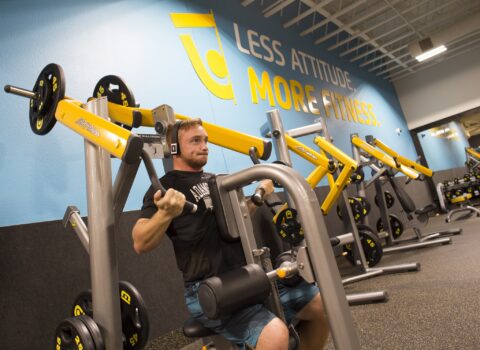
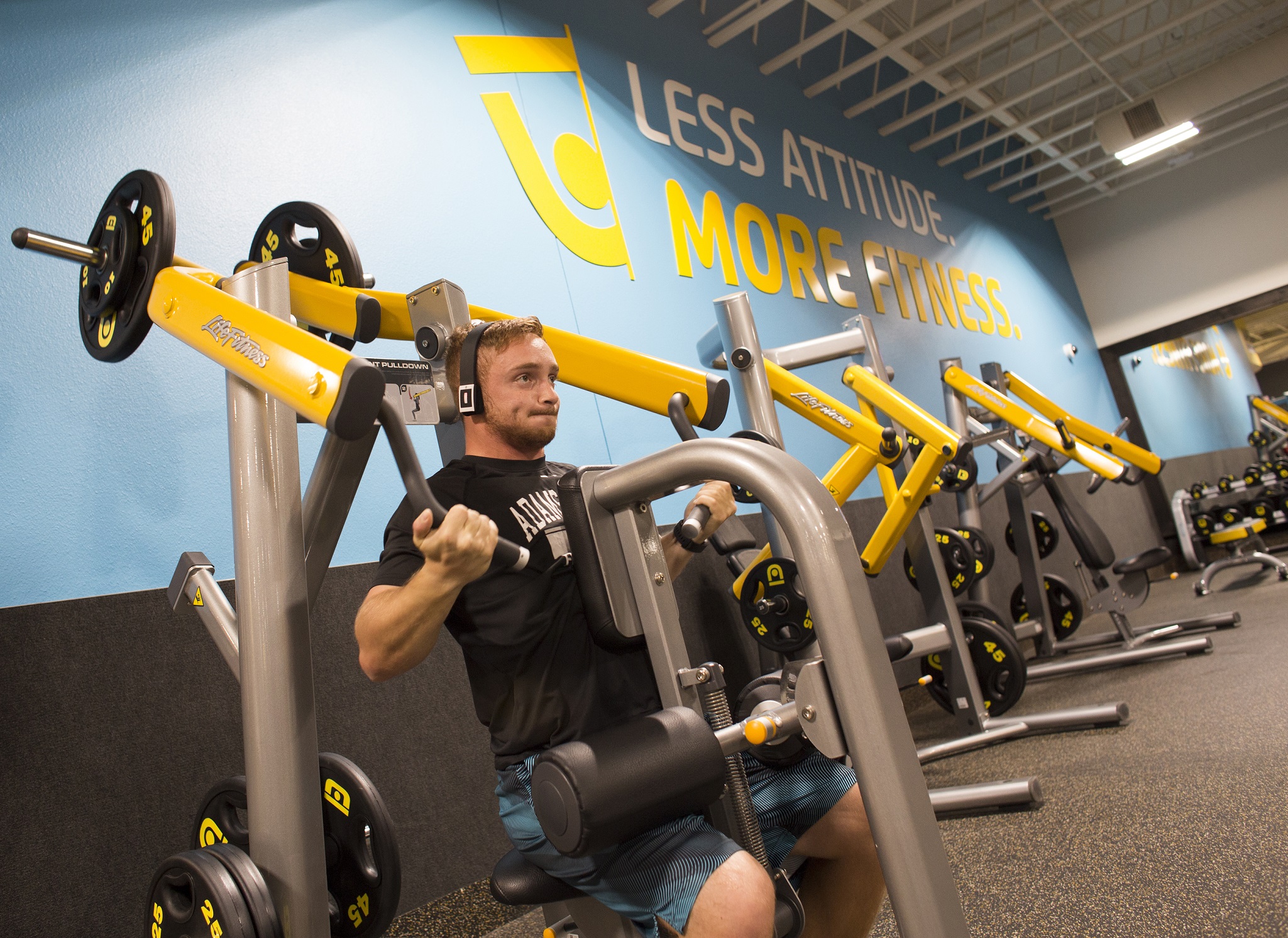
If you’re interested in this exercise method, it’s crucial to know how this three-part regimen (which also includes a Leg and Core Day) works on the gym room floor. For a play-by-play on how to replicate this workout style—plus four tips for getting the most bang for your next workout push with Chuze Fitness—read on.
The Push-Pull Fitness Method: What You Need To Know
When people talk about hitting the gym for Push day or Pull day, they’re referring to an exercise method known as push-pull.
The push-pull method is designed to support a well-rounded workout routine that evenly distributes your efforts across all zones of your body. In its distilled essence, it involves alternating between workouts that focus on different muscle groups.1
Typically, push-pull routines are divided between three categories of targeted exercise:
Push day, where you’ll focus on your arms and shoulders
Pull day, where you’ll focus primarily on your back muscles
Leg and Core day, where you’ll skip your upper body and work out your core and trunk muscles
It’s worth noting that many people choose to include a rest day between the second and third days of training. Push-pull routines can be strenuous to power through day after day, especially if you’re new to working out.
Push vs Pull Exercises: What to Do On Your Next Push or Pull Day
You might not realize it, but you probably do a lot of pushing and pulling in your day-to-day life already. Even the simplest things, from hoisting yourself out of bed in the morning (which uses a pushing motion) to opening the door open for a stranger (which uses pulling), can engage your pulling and pushing muscles.
That said, performing these actions on the gym floor looks a lot different. Let’s take a look at some push day vs pull day workouts to see how they differ.
Push Day Exercises
On Push day, you’ll focus on exercises that use pushing motions to strengthen the muscles in your upper body. These exercises work to target your triceps and the muscles in your chest and shoulders.1
Some of the most well-known and popular Push day exercises include:
Push-ups
Pullover exercise
Shoulder press
Dumbbell bench press
Dumbbell chest fly
Dumbbell overhead triceps extension
Dumbbell lateral raise
Pull Day Exercises
So how would a pull exercise look? In contrast to Push day, a Pull day workout routine tends to incorporate strength-training exercises that force you to pull weights towards your body (rather than press them away).
Some cornerstone Pull day exercises include:
Pull-ups
Bent over rows
Renegade rows
Bicep curls
Upright dumbbell rows
Zottman curls
While Push day focuses on muscles in your chest, shoulders, and arms, Pull day works to target your biceps, forearms, and, most importantly, the complex network of muscles in your back.1
Though the arms, legs, and core often absorb much of fitness enthusiasts’ attention, strengthening your back is a vital component of your overall physical fitness. Your back muscles have tremendous influence over your mobility, and conditioning them can promote better posture to protect your spine and can help prevent pain in your lumbar.
Leg and Core Day Exercises
The first two days of Push-Pull workout routines are devoted to your upper body, but the pushing and pulling don’t come to a halt on day 3.
On Leg and Core day, your workouts will be focused on strengthening the muscles in your legs using the same technique you did on days 1 and 2: pushing and pulling. Primarily, Leg and Core day works to strengthen your:
Hamstrings
Achilles tendon
Femoris
Gluteus maximus
Abdominals
Obliques
Pelvic floor muscles
While Push day and Pull day workout routines revolve around the type of exercise you perform, Leg and Core day is designed to encourage different zones of your body to work cooperatively to build strength. This technique can help you improve your balance, stability, and even your awareness of how different muscle groups work in tandem to help you move.
When Leg and Core day rolls around, some popular exercises to try include:
Deadlifts
Barbell back squats
Quadriceps leg extensions
Seated hamstring leg curls
Dumbbell standing calf raises
Hanging leg raises
Should You Try Push-Pull Training?
Push-Pull training is just one approach fitness enthusiasts take to tending to their overall physique at the gym. This type of exercise regimen might be for you if:
You want to gain muscle mass – According to one study, resistance training like those involved in Push-Pull regimens may be more effective at building muscle than other methods of working out. Furthermore, it’s also excellent for building muscle endurance and overall strength.2
You want evenly distributed results – For many gym-goers, the alternating schedule of push-pull routines means they don’t have to worry about overworking or neglecting any one zone of their bodies.
Your body craves time to recover – While other workout methods force you to work the same muscles many days in a row, push-pull training gives your body time to rest, repair, and build back even stronger between sessions.
You can access the best gym equipment – Because Push-Pull training is a uniquely intensive approach to working out, you’ll see optimal results if you have a range of gym equipment at your disposal for your workouts. Having full access to a range of exercise machines and weights will enable you to tailor your equipment to each individual exercise, as well as level up your weights as you go.
4 Tips For Maximizing Your Push-Pull Routine
The Push-Pull exercise routine can seem relatively straightforward, but getting the most out of this technique may require you to make some changes to your approach to exercise and overall lifestyle.
With that, let’s review four tactics for optimizing your Push-Pull workouts, no matter which day is coming up next:
Mix it up – There is no shortage of exercise options for a Push-Pull workout regimen—which is good news for people who tend to get bored by sticking to the same workout. However, it is possible to run up against muscle fatigue if you put your body through the same exercises day after day.3
To avoid getting bogged down by repetitive workouts, try alternating between different exercises as you rotate through Push, Pull, and Leg and Core day. For example, you could spend a week or two devoting your Pull days to Pull-ups, bicep curls, and renegade rows, then swap one or two out for an alternative.
Weigh your options – It’s difficult to overstate the importance of choosing the right weights for your push-pull workouts, and size can vary between the exercises you’re performing. The right weights for you should spike your heart rate in your first few reps, but they shouldn’t prevent you from feeling so fatigued you can’t proceed with your next exercises after finishing your set.4
Add in “Rest Days” – As we’ve mentioned, many fitness enthusiasts swear by rotating a “Rest Day” into their three-day Push-Pull regimens. This gives your body a day to recover, thereby promoting tissue repair, muscle growth, and avoiding injuries in the long run.5 Plus, even if you take a day off, push-pull will still enable you to exercise all of your major muscle groups twice a week.
Ramp up your sleep hygiene – Getting the proper amount of sleep (at least 7 hours per night) is crucial for staying on top of your physical fitness.6 At the gym, you’re breaking down your muscles—and they’re only able to build back stronger while you’re asleep, when your body packs on new fibers and proteins to your muscles.7 In other words, your workout can only come full circle if you get in your nightly Z’s.
Finally, Push-Pull training is recommended for people who can commit to working out between three to six days each week.8
Like many other styles of working out, Push-Pull takes time and determination to yield results—so if you do choose to make it the cornerstone of your fitness regimen, make that commitment in a community that can motivate and encourage you along your journey. The push pull workout routine also helps encourage muscle growth and target almost every muscle group with a simple routine.
Push Your Workout to the Limit with Chuze Fitness
Every so often, the motivation hits to find a new workout routine, take a fresh approach to your fitness goals, and find a gym buddy who’s as motivated to meet them as you are.
Chuze Fitness is that gym buddy—we just haven’t met yet.
At Chuze Fitness, we believe that achieving fitness individual goals depends on the power of the community behind them. With fitness classes, content from our iChuze wellness app, and dedicated fitness experts on stand-by to answer all your exercise questions, our fitness centers aren’t just gyms. They’re vibrant hubs of activity where everyone is encouraged to push (and pull) towards their own fitness standard. Whether you’re looking to incorporate turf workouts into your routine or try out new exercises, we’re here for you.
To join our community and jump-start your personal wellness goals, use our gyms near me feature to find a location and introduce yourself today.
Reviewed By:
Ani is the Vice President of Fitness at Chuze Fitness and oversees the group fitness and team training departments. She’s had a 25+ year career in club management, personal training, group exercise and instructor training. Ani lives with her husband and son in San Diego, CA and loves hot yoga, snowboarding and all things wellness.
TUESDAY, Aug. 23, 2022 (HealthDay News) — Differences in lifestyles and other factors are linked to big gaps in life expectancy between residents of various U.S. states, 2020 data shows.
That could mean almost a decade more or less of life, a new report from the U.S. Centers for Disease Control and Prevention shows.
“Among the 50 states and D.C., Hawaii had the highest life expectancy at birth, 80.7 years in 2020, and Mississippi had the lowest, 71.9 years,” concluded a team led by Elizabeth Arias, of the CDC’s Division of Vital Statistics.
For the report, the researchers pored over data from each state on mortality rates, as well as 2010 census data and Medicare data, to tally up life expectancy at birth per state.
Much of the differences fell along regional lines, with Americans living in Hawaii, the Northwest, California and the Northeast living the longest. People living in the Southeast typically had the shortest expected lifespans.
The top 10 longest-lived states, by average life expectancy in years, are:
Hawaii — 80.7
Washington — 79.2
Minnesota — 79.1
California — 79
Massachusetts — 79
New Hampshire — 79
Vermont — 78.8
Oregon — 78.8
Utah — 78.6
Connecticut — 78.4
The states ranking in the bottom 10, by average life expectancy in years, are:
Mississippi — 71.9
West Virginia — 72.8
Louisiana — 73.1
Alabama — 73.2
Kentucky — 73.5
Tennessee — 73.8
Arkansas — 73.8
Oklahoma — 74.1
New Mexico — 74.5
South Carolina — 74.8
As seen in other tallies of national life expectancy data, the pandemic played a big role in shrinking American life spans.
“From 2019 to 2020, life expectancy at birth declined for all states and D.C,” the CDC team noted.
Some states were hit harder than others: For example, in New York life spans fell by three years during the pandemic, and in Louisiana life expectancy declined by 2.6 years.
On the other hand, Hawaii seemed relatively spared: In the Aloha State, life expectancy fell by just 0.2 years between 2019 and 2020. In New Hampshire, the decline was just 0.4 years, the report found.
Women still tend to outlive men, living an average of 5.7 years longer than their male peers in 2020, the researchers noted.
The study was published Aug. 23 in National Vital Statistics Reports.
More information
Hopkins Medicine has tips to help you lead a long, healthy life.
SOURCE: National Vital Statistics Reports, Aug 23, 2022
Some people go to the gym just to look good, and that’s a fine goal to have. They spend time and effort working various muscle groups to improve their aesthetics and reach their dream physique. Yet, some body parts aren’t always given the same attention as others.
Credit: Ruslan Shugushev / Shutterstock
Let’s be real. The calves are commonly ignored. That’s a shame, because not only do muscular calves contribute to a well-balanced, eye-pleasing physique, but they also support optimal knee and ankle health and performance. And what more simple exercise than the standing calf raise to develop this muscle group? Let’s take a look at this effective exercise, and learn how and why it should no longer be overlooked.
How to Do the Standing Calf Raise
The standing calf raise is a pretty straightforward movement, but it’s certainly possible to have problems with performance. Let’s cover proper use of this machine to deliver complete calf development.
Step 1 — Get Into the Starting Position
Credit: Ascendancy Fitness / YouTube
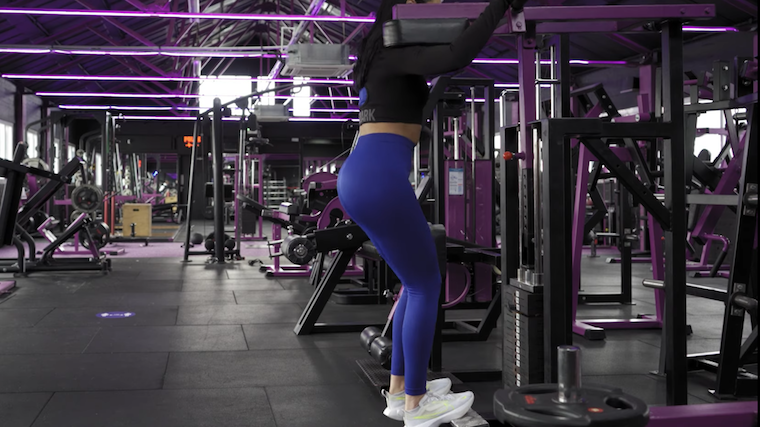
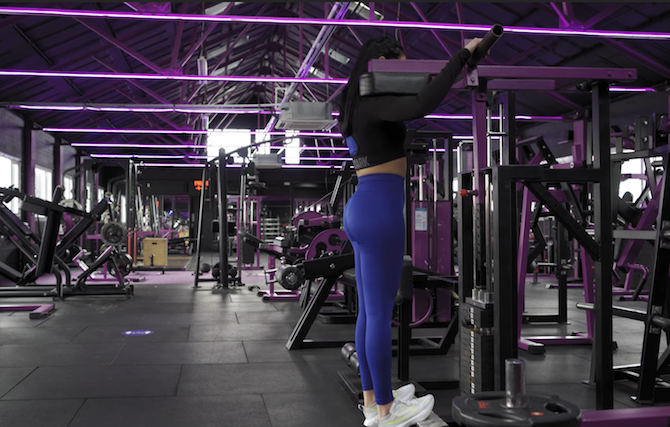
Set your feet roughly shoulder-width apart on the block or step. Only the front halves of your feet should be on the step. Your heels should be hanging in the air. Keep your balance by holding the shoulder pads or support handles. Make sure your hands stay away from the weights and any moving parts.
Keep your knees bent and your back straight as you place your shoulders under the pads. Stand tall by pushing into the balls of your feet and straightening your knees. Keep your core tight to maintain a straight back.
Form tip: Adjust the shoulder pad height so you can stand upright with additional room to perform a full range of motion calf raise. When standing tall, you should be able to rise onto your toes while keeping a straight line from your shoulders to your feet. If you have to hunch over or bend your knees, the exercise won’t be as efficient.
Step 2 — Push Through the Balls of Your Feet
Credit: Jasminko Ibrakovic / Shutterstock
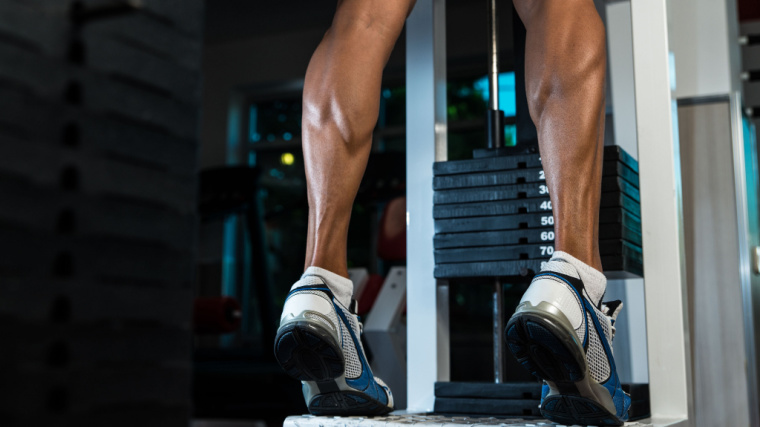
Push through the balls of your feet to raise your heels as high as possible. Keep your legs straight to prevent larger leg muscles from helping. Pause for one second at the top and flex your calves as much as possible. Keep your upper body stable. Resist any urge to shrug your shoulders while your feet move.
Form tip: Completely extend your ankles, pushing all the way to the top. The range of motion is relatively limited on this exercise because the ankle is a relatively small joint. Don’t reduce the range of motion further by stopping before your calves are fully contracted.
Step 3 — Lower Your Heels Slowly
Credit: Ascendancy Fitness / YouTube
Let your heels sink slowly towards the ground, dorsiflexing your foot (letting your heels drop below your toes). Your calves should be in a fully stretched position.
Stay in the stretched position for a second to prevent rebounding or momentum before repeating for additional repetitions.
Form tip: The stretch is an important component of calf growth, so don’t be afraid of feeling a stretch in the bottom position. However, some people lack ankle mobility and have limited range of motion. To minimize the risk of injury, use a slow, controlled speed and avoid dropping quickly into the bottom position.
Standing Calf Raise Mistakes to Avoid
When it comes to building muscular calves, mistakes will stop muscle growth in its tracks. If you want gains, performing each repetition perfectly is of the utmost importance. Here are the most common errors to avoid.
Fast, Rebounded Repetitions
This is the ultimate calf training sin. You might be tempted to use the stretch reflex (rebound) and rush through fast-paced reps in order to lift more weight or make the set easier, but this will just result in eternally puny calves.
Credit: Jasminko Ibrakovic / Shutterstock
The exercise’s range of motion is relatively limited, so if you rush through each rep, the time under tension will be minuscule, resulting in poor growth. This is reinforced by the fact that the calves typically have a lot of type I muscle fibers which respond better to longer sets and more volume. (1)
Avoid it: For optimal muscle growth, slow down the repetitions and don’t shy away from using pauses at the top contraction or in the bottom stretched position.
Cutting the Range of Motion Short
Performing a full range of motion has been proven optimal for muscle growth, especially in the lower body. (2) As such, you have to make sure you go as low as your ankles will allow and flex as high as you can during each repetition.
Credit: Jasminko Ibrakovic / Shutterstock
Short-changing the range of motion can be as bad for muscle growth as blasting through repetitions at warp speed. Calves can be a notoriously hard to grow muscle group. (3) If you want to progress, you will have to accept some muscle-building, muscle-burning discomfort, and ensure you squeeze the muscle through every possible fraction of an inch.
Avoid it: On every single repetition, sink as low as you can in the stretched position. Tension around your ankles will tell you when it’s far enough. Also, push through your toes and imagine your heels reaching the ceiling during the peak contraction.
Using Leg Drive to Move the Weight
Sometimes you can cheat the standing calf raise without even noticing, especially when going heavy. Leg muscles like the glutes and quadriceps are very strong and your body will instinctively “want” to use them to help move the weight, but that reduces the work done by the calves and reduces the muscle-building stimulus.
Credit: Jasminko Ibrakovic / Shutterstock
If your knees begin bending and straightening during the exercise, or if your body bends forward at the hips, you’ll be shifting focus away from the calves and onto other muscle groups.
Avoid it: Focus on a mind-muscle connection with your calves. Instead of just thinking about “lifting the weight up,” think about specifically pushing through your toes. Keep your body straight throughout the set and pay particular attention to your knees and hips.
Benefits of the Standing Calf Raise
Even though calf training is often overlooked, this exercise can find its place in most training regimens. Here are the most important reasons why.
Muscle Growth
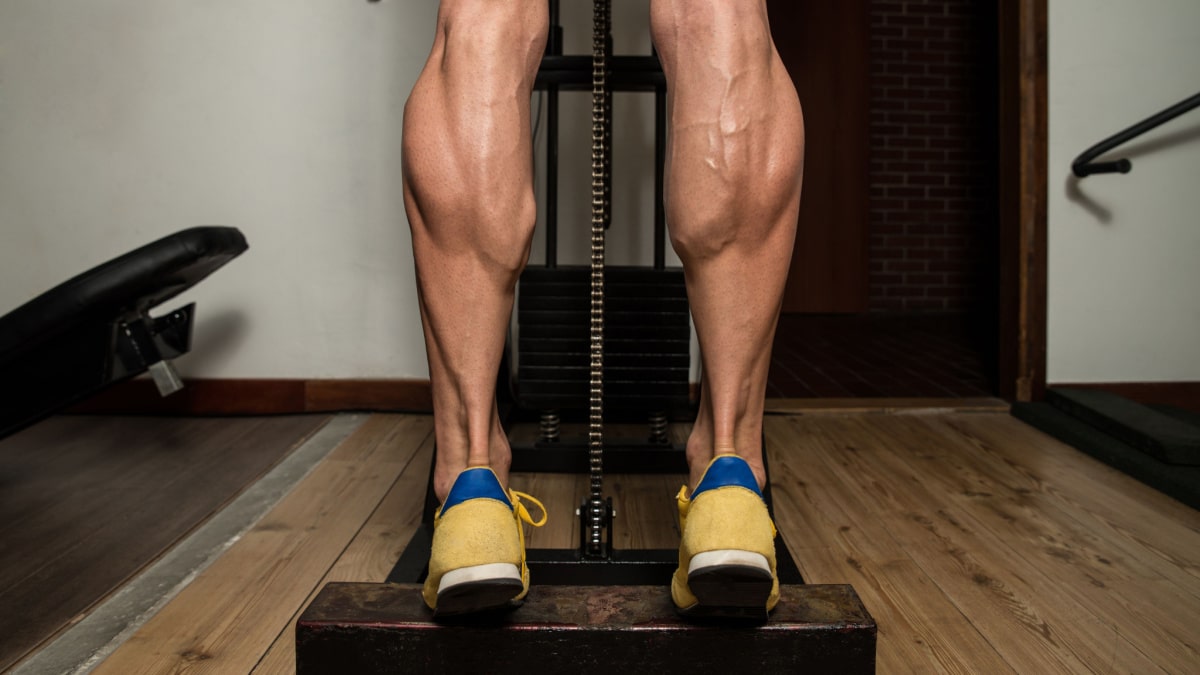
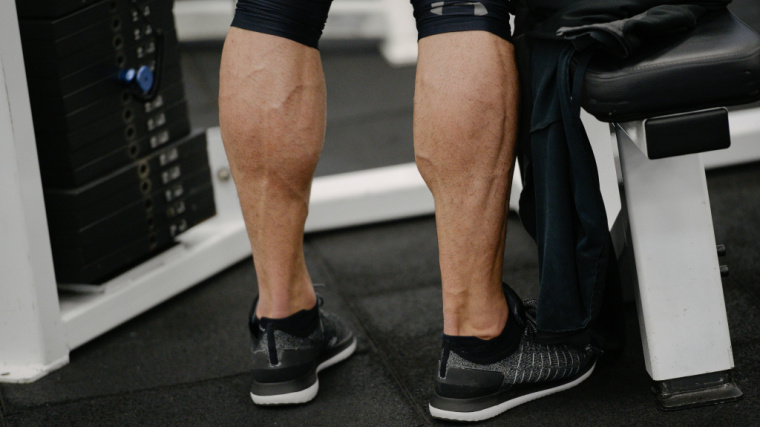
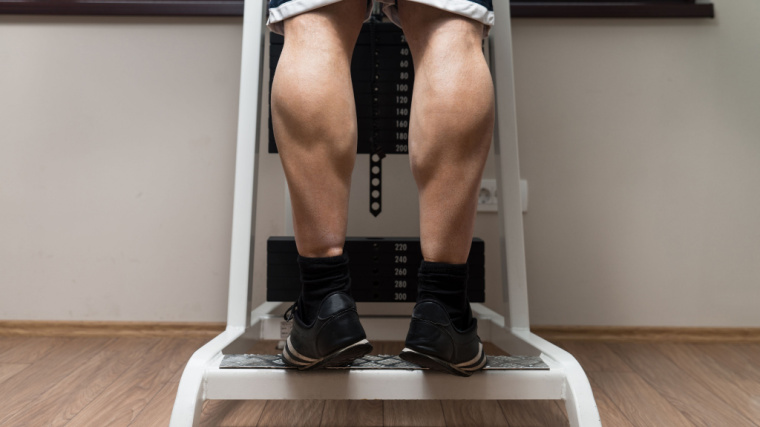
The standing calf raise is one of the best lower leg exercises for hypertrophy. The standing position is an efficient way to target the gastrocnemius — one of the two heads of the calf muscle.
Because of the muscle recruitment and potential time under tension, standing calf raise can bring a significant visual change to your calf development. If there’s only one calf exercise you could do, this would be top of the list.
Explosive Power
If you care about athleticism or sports performance, this standing calf raise actually help. Calf training helps you jump higher and more frequently by allowing your body to produce more force, absorb more force eccentrically (during landing), and reinforce tendon strength and total-body stability so you are more resilient.
The lower leg muscles have an active part in the ankles and knees functions. Every movement that mobilizes these joints — such as running, kicking, tackling, and jumping — will benefit from calf training. Strengthening your calves will help you be a more complete and efficient athlete.
Healthier, Stronger Ankles and Knees
Standing calf raises can eventually improve your ankle mobility by gradually stretching your calves. The calves will also increase in size and strength, resulting in more control and resilience over the ankle and knee joints. (4)
This carries over to everyday life, since many people are on their feet all day long. It’s especially relevant if you walk, run, or play sports that heavily involve your legs.
Muscles Worked By the Standing Calf Raise
The standing calf raise is considered a single-joint isolation exercise, because the only movement should be at the ankle joint. The movement focuses training stress on a single muscle group — the triceps surae, more commonly known as the calves, which are the main muscles in the lower leg.
Gastrocnemius
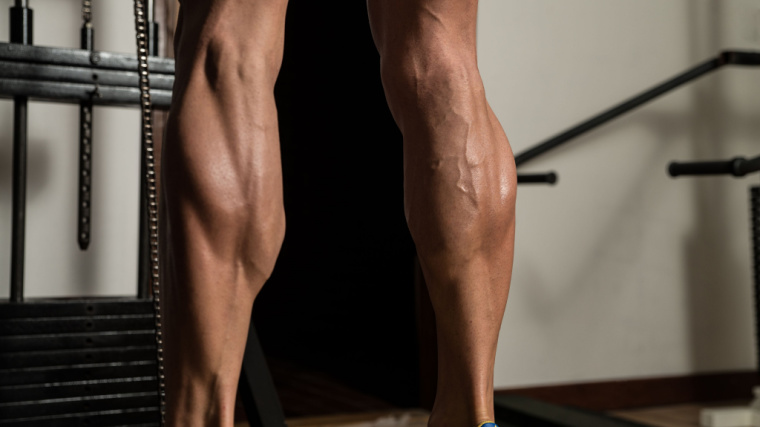
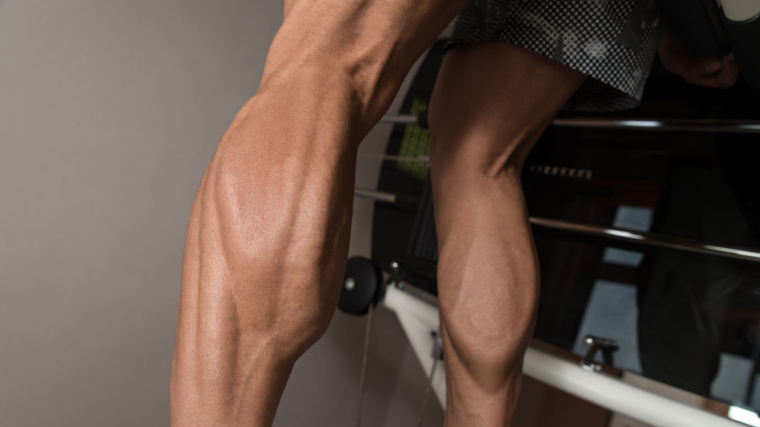
The gastrocnemius is one of two heads of the calf muscle. Sometimes shortened to “the gastroc,” it runs from the back of your knees to your ankles. The gastroc is the larger of the two calf heads and it’s the one you see the most.
Credit: vladee / Shutterstock
Its function is plantar flexion of the foot (extending the ankle and pointing the toes down). It also plays a role to assist your hamstrings when bending your knees. This is a muscle heavily involved in running, jumping, and walking.
Soleus
The soleus is the other head of the calf muscle. This deeper section is located between the gastrocnemius and the lower leg bones. This muscle is significantly involved in plantar flexion (lowering your toes below your heels). The soleus isn’t as big, but it is relatively powerful and it’s crucial for running, walking, and standing tall.
Who Should Do the Standing Calf Raise
Those who completely avoid calf training are sorely mistaken, especially if they want complete physical development. Many lifters should introduce this exercise into their training because it has more to offer than just hypertrophy.
Bodybuilders and Physique Athletes
If you’re interested in an aesthetic, symmetrical physique, you should never skip calves. In fact, in the early days of classic bodybuilding, lifters would aim to have their calves as big as their arms. The legendary Arnold Schwarzenegger supposedly “calf-shamed” himself by frequently wearing shorts, so the constant sight of his relatively small calves would be motivation to train them intensely.
Many people still overlook calf training but, along with your forearms, they are the most visible parts of your body most of the time. In any case, if you’re chasing aesthetics, you cannot avoid working any body part.
Strength Athletes
Calf training won’t directly carry to your big lifts, but it can actually be very valuable to strength athletes. Indeed, the calves help knee and ankle stability, and this is especially true of the soleus because it is more active when your knees are bent — like in the squat.
Moreover, calf training can also improve ankle mobility, which is critical for proper squat mechanics and overall lower body health. If you’re a strength athlete who’s experiencing knee pain, has trouble reaching squat depth, or is experiencing instability when lifting, you should give calf training a go.
Sports Athletes
In athletics, injury prevention is key. Directly training the calves can result in calf muscles that can withstand more shock while improving ankle mobility and resiliency — especially with respect to the Achilles tendon, a vulnerable part of any athlete’s body.
Athletes experience constant stress on the ankle and knee joints when changing direction, sprinting, and performing plyometric movements on or off the field. These activities can be some of the most potentially dangerous movements one can perform if their body’s support structures aren’t durable. As such, if you’re an athlete that cares about knee or ankle injury prevention, you should train your calves.
How to Program the Standing Calf Raise
Being an isolation exercise that targets a single muscle group, it makes no sense trying to go super-heavy with this exercise because it’s less efficient and other muscles will be recruited.
Moreover, calves typically react better to a longer time under tension and higher volume, because they have a high proportion of slow muscle fibers. They are best trained with moderate-to-high rep schemes.
Moderate Weight, Moderate Repetitions
This is a classic, proven hypertrophy scheme. Three to five sets of eight to 12 repetitions will work just fine. The weight should be as heavy as you can handle to the rep range, but not at the expense of form. You should be able to control the weight at all times, achieve a full stretch, and be able to contract maximally without compromising the range of motion.
Light Weight, High Repetitions
Going lighter for higher repetitions is a surefire way to scorch your calves if you have trouble feeling them, and can serve as a great finisher. Two to three sets of 15 to 25 repetitions, reaching muscular failure at the last repetition, is a great way to accumulate volume and grow your calves.
Tempo Work
If you’re a more seasoned lifter, spicing up your calf training can spark new gains and motivation. Calves are particularly responsive to tempo training — manipulating the speed of the lifting and lower phases of each repetition.
For unprecedented soreness and muscle stimulus, try a two-part approach with several sets emphasizing the stretched position followed by several sets emphasizing the contracted position. Two to three sets of 10 to 15 repetitionswith a two-second pause at the bottom, followed by two to three sets of 10 to 15 repetitions with a two-second pause at the top of the contraction.
Going Beyond Failure
If you’re an advanced lifter, you might still need to crank up your calf training to the next level in order to progress. Warning: The muscle burn will be uncomfortable, but tremendously efficient. This approach strategically uses partial range of motion repetitions after exhausting the muscle with a full range of motion, to increase the total time under tension.
Perform one to two sets of 10 repetitions to failure, followed immediately by 10 partial repetitions (doing only the lower half of the range of motion), and then hold the deepest stretch position possible for 10 more seconds.
Standing Calf Raise Variations
Whether you don’t have access to the standing calf raise machine or just want to spice things up, you’re covered. Here are variations that will share the same benefits.
Smith Machine Standing Calf Raise
The Smith machine is a great tool because it takes balance out of the equation and, as such, will be the closest variation to the basic standing calf raise machine. Grab a step or short block and place it directly under the bar, so you increase the range of motion and enjoy a nice stretch.
Set up like you would be doing a standard calf raise, with the front half of your toes on the step, and place the barbell across your traps or upper back, similar to a back squat position.
Leg Press Calf Raise
This is an awesome variation that allows you to focus on your calves with even more total-body stability. Not only is there no stabilization required, but you’re seated in a fixed position and only have to think about using your calves without any upper body involvement.
Sit in the machine and push the platform away. Position the balls of your feet on the bottom of the platform, so that the lower half of your feet are hanging. Keep your legs straight and simply push the weight away through the balls of your feet.
Single-Leg Standing Calf Raise
By working one leg at a time, we’re making the exercise more challenging and more focused on the working muscle. This variation can also help to improve balance, core bracing, and can address muscular imbalances. (5) (6)
Grab a dumbbell and hold it the same side as the leg you will be working. Step onto a platform with only the ball of your foot and let your other leg hang in the air. Use your free hand to hold an stable, stationary object (like a rack) for balance, then brace your core and perform the calf raise.
Standing Calf Raise Alternatives
If the standing calf raise bores you to tears, or if you want to stimulate your calves differently for a complete lower-leg workout, try these alternatives.
Seated Calf Raise
This machine is one of the most popular calf exercises and it complements the standing version. Because your legs are bent, you will focus more on the soleus due to the particular attachment points of the muscle around the knee joint.
An added benefit is that it’s nearly impossible to use your upper body, quads, or hips to cheat the movement. You can strictly focus on your calves. This machine works the exact same way as the standing calf raise, but you’re simply seated with the pad on top of your knees instead of your traps.
Squatting Calf Raise
This movement is ideal if you don’t have access to specialized training equipment. Hold a stationary object with both hands and squat down to parallel, or a bit lower if comfortable. Slowly raise your heels as high as possible before lowering them down to the ground.
Not only will this exercise train your calves, and especially your soleus, it will also challenge your balance, proprioception, and knee and ankle stability in a unique way. As you progress, you can try the exercise while holding a dumbbell or kettlebell like a goblet squat (keeping the weight against your chest).
Tiptoe Farmer’s Walk
If you’re the kind of person that loves functional training, give this exercise a try. Simply grab a pair of dumbbells and start walking on your toes. Keep your core braced, your shoulders pulled back, and chest up.
Rather than total repetitions, go for distance, for time, or until your calves give up on you. This is a fantastic way to end a workout and sneak in some extra work for your core, traps, and forearms at the same time. Bonus: you’ll also burn some calories.
FAQs
Do I need to work my calves specifically?
Yes and no. Calves are stimulated indirectly by many other exercises like running, lunges, and squats. So they’re somewhat activated as assistance muscles. But if you want to focus on increasing the size of your calves, you will have to target them directly.
Calves are a notoriously hard to grow muscle group, and indirect stimulus isn’t often enough to build impressive calves. Skipping direct calf training also means you’re missing out on the ankle and knee health benefits that come from stronger calves.
When should I train calves?
Most people do calf raises at the end of a workout, typically after other leg exercises or other larger body parts. It makes sense because calves are trained with single-joint isolation exercises, and you want to be as fresh as possible when you’re hitting your big compound exercises for other muscle groups.
If you consider your calves to be a high priority, you can hit them first in a session. This way, you’ll have the most energy to devote to these stubborn beasts, and you won’t risk “running out of time” to train them in a workout. It shouldn’t impact other lower body exercises too much. If it does, it’s a short-term issue until your body adapts.
How frequently should I train calves?
Calves are a very resilient muscle group and they can withstand a lot of punishment while also recovering relatively fast. Start with one weekly session. After a few weeks, if you don’t see any progress and feel that your calves can withstand it, increase to two sessions.
Repeat this process as much as needed. Do not be afraid of training them frequently. You can bump this number up to three or four sessions per week if needed, because calf training is relatively low stress on the rest of your body, unlike trying to deadlift four days per week, for example.
Stop. Skipping. Calves.
The standing calf raise machine is found in the corner of most gyms but it’s, sadly, underutilized. It’s a time-tested exercise that packs size onto a body part most lifters would conveniently ignore. Make room for this efficient exercise in your training, or just walk around in shorts until you’ve convinced yourself to fix the problem.
References
Edgerton VR, Smith JL, Simpson DR. Muscle fibre type populations of human leg muscles. Histochem J. 1975 May;7(3):259-66. doi: 10.1007/BF01003594. PMID: 123895.
Schoenfeld BJ, Grgic J. Effects of range of motion on muscle development during resistance training interventions: A systematic review. SAGE Open Med. 2020 Jan 21;8:2050312120901559. doi: 10.1177/2050312120901559. PMID: 32030125; PMCID: PMC6977096.
Lawrence W. Weiss, Frank C. Clark, David G. Howard, Effects of Heavy-Resistance Triceps Surae Muscle Training on Strength and Muscularity of Men and Women, Physical Therapy, Volume 68, Issue 2, 1 February 1988, Pages 208–213,
Elias, John & Faust, Alfred & Chu, Yung-Hua & Chao, Edmund & Cosgarea, Andrew. (2003). The Soleus Muscle Acts as an Agonist for the Anterior Cruciate Ligament: An in Vitro Experimental Study. The American journal of sports medicine. 31. 241-6. 10.1177/03635465030310021401.
Cirer-Sastre R, Beltrán-Garrido JV, Corbi F. Contralateral Effects After Unilateral Strength Training: A Meta-Analysis Comparing Training Loads. J Sports Sci Med. 2017 Jun 1;16(2):180-186. PMID: 28630570; PMCID: PMC5465979.
Bradić, Josipa & Kovačević, Erol & Babajić, Fuad. (2011). Effects of unilateral strength training on balance performance.
Michael Snyder, PhD, director, Stanford Center for Genomics and Personalized Medicine.
PLOS Biology: “Digital Health: Tracking Physiomes and Activity Using Wearable Biosensors Reveals Useful Health-Related Information.”
FastCompany: “These Vibrating Yoga Pants Will Correct Your Downward Dog.”
Business Insider India: “Xiaomi’s first smart glasses can take calls, capture photos, translate text and more.”
Hexoskin.
The New York Times: “Can Technology Help Us Eat Better?”
Veena Misra, PhD, director, Center for Advanced Self-Powered Systems of Integrated Sensors and Technologies (ASSIST), North Carolina State University.
International Data Corporation: “Wearables Market Sees First Decline at Beginning of 2022 as Demand Normalizes, According to IDC.”
Michael Daniele, PhD, associate professor of electrical and computer engineering, North Carolina State University.
JACC: Clinical Electrophysiology: “The WATCH AF Trial: SmartWATCHes for Detection of Atrial Fibrillation.”
Harvard Medical School: “Can a smart watch diagnose a heart attack?”
Alper Bozkurt, PhD, professor of electrical and computer engineering, North Carolina State University.
Stanford Healthcare Innovation Lab: “Infectious Disease and COVID-19 Wearables Study.”
Statista: “The Global Wearables Market Is All About the Wrist.”
Jesse Jur, PhD, director, ecosystem technology, Advanced Functional Fabrics of America; head of nano-extended textiles research, North Carolina State University Wilson College of Textiles.
Athos: “Building Better Athletes.”
Sensoria: “Smart Sock v2.0 & Sensoria Core.”
Biotricity: “Bioheart.”
Nanowear: “Smarter Care. Anywhere.”
National Institute of Diabetes and Digestive and Kidney Diseases: “Continuous Glucose Monitoring.”
Abbott.
John Rogers, PhD, professor of materials science and engineering, biomedical engineering, and neurological surgery, Northwestern University.
Sibel Health: “Better Health Data for All,” “Sibel Health Announces FDA Clearance for ANNE One – A Flexible, Wireless Vital Signs Monitoring Platform.”
William Macharia, MD, pediatrician, Aga Khan University, Nairobi, Kenya.
Zhenan Bao, PhD, professor of chemical engineering, Stanford University.
Jason Heikenfeld, PhD, professor of electrical engineering, University of Cincinnati.